
AIRPORT TIPS
12 Tote Bag Packing Fixes That Keep Your Bag Free and Under the Seat
Sep
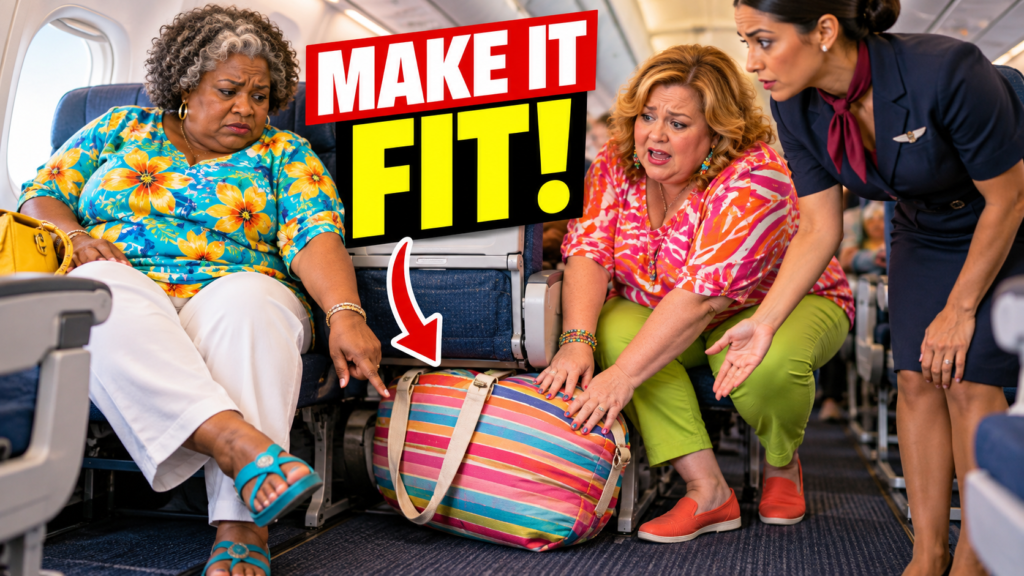
“Excuse me—your bag is taking up MY space!”
The woman by the window looked down. A giant, overstuffed tote had been shoved beneath the seat in front of the passenger beside her—but instead of staying neatly in its own footprint, the soft bag had bulged sideways into her legroom.
“It’s under the seat!” the tote owner protested. “Where else am I supposed to put it?”
A flight attendant stepped over and immediately spotted the problem.
The bag was technically under a seat, but it wasn’t properly packed or neatly stowed. It had been stuffed until it lost its shape, forcing part of it into another passenger’s space.
That is exactly where many travelers get personal-item packing wrong.
A tote can be one of the easiest bags to travel with. It’s lightweight, flexible, easy to access and potentially perfect for the space beneath the seat in front of you.
But “tote bag” is not a magic airline category.
Your airline’s baggage rules still matter.
American Airlines, for example, currently allows one personal item and one carry-on when they meet its requirements. Its personal-item limit is 18 × 14 × 8 inches (45 × 35 × 20 cm), and that item must fit under the seat in front of you. Southwest likewise permits one carry-on and one personal item onboard and states that the personal item goes under the seat in front. Policies can differ by carrier and itinerary.
So if your goal is to use a tote as your personal item and avoid turning it into a baggage problem, the answer isn’t to keep pushing harder.
It’s to pack smarter.
Here are 12 tote bag packing fixes that can help keep your bag compact, organized and ready for the under-seat space.
1. Check Your Airline’s Personal-Item Rules Before You Pack
This is the most important fix because every other packing trick becomes irrelevant if your bag doesn’t meet your airline’s requirements.
Don’t start with:
“How much can I squeeze into this tote?”
Start with:
“What does my airline allow?”
American Airlines currently says a personal item such as a purse or small handbag must fit under the seat in front and should not exceed 18 × 14 × 8 inches.
Southwest’s current policy similarly says passengers may bring one carry-on and one personal item, with the personal item going beneath the seat in front. It also warns travelers that partner-airline rules may differ.
That’s why you should check the official policy for the airline operating your flight—not a random social-media graphic from three years ago.
Don’t Assume Every Airline Uses the Same Limit
There is no single universal personal-item dimension that you should blindly use for every carrier.
And remember: your bag’s dimensions matter after you’ve packed it.
A soft tote might look tiny while empty and become dramatically wider once you fill it with shoes, a hoodie, electronics and toiletries.
Measure the packed bag.
Not the empty one.
2. Start With a Soft-Sided Tote That Can Hold Its Shape
A tote’s flexibility can be an advantage.
It can also be its biggest weakness.
A rigid case has a fixed exterior. A soft tote changes shape depending on what you put inside.
Pack it intelligently and it can stay relatively flat and compact.
Overstuff it and suddenly the sides bulge, the base widens and the top becomes difficult to close.
For under-seat travel, look for a tote that is:
- Soft-sided but reasonably structured
- Easy to close securely
- Not excessively deep
- Comfortable to carry when full
- Simple to organize
- Appropriate for your airline’s applicable personal-item rules
The goal isn’t to buy the biggest tote that might possibly qualify.
The goal is to use one that remains manageable when packed.
Why Shape Matters
Imagine putting a hard toiletry case horizontally at the bottom, shoes on top, a thick sweater beside them and a water bottle against the side.
Your tote may suddenly look like a beach ball.
The dimensions printed on the retailer’s product page won’t matter much if the packed bag is now bulging beyond them.
3. Stop Packing Your Tote to 100% Capacity
If you have to sit on the bag to close it, you’ve already lost one of the biggest advantages of traveling with a soft-sided personal item.
Leave some flexibility.
That doesn’t mean wasting half the bag.
It means avoiding the temptation to fill every last cubic inch until the tote becomes a solid brick.
A little unused space gives you room to:
- Reposition items
- Flatten the bag
- Tuck loose sections inward
- Access essentials
- Add something small during the trip
- Keep the exterior profile under control
It also helps prevent the exact problem from our opening scene: an overstuffed tote being forced sideways because it no longer fits naturally in its intended space.
Use the “No Bulge” Test
Pack the tote and place it upright.
Look at it from the front, side and top.
Are the sides bowing dramatically outward?
Is the zipper under obvious tension?
Is the base much wider than it was empty?
If yes, take something out.
The smartest personal-item packing strategy often involves removing, not compressing.
4. Wear Your Bulkiest Clothing Instead of Stuffing It Inside
A thick hoodie can consume an absurd amount of tote space.
So can a jacket.
If you’re traveling from a cold city to somewhere warm, you may be tempted to take off every outer layer at the airport and stuff everything into your personal item.
Then your carefully packed tote doubles in size.
Instead, consider wearing your bulkiest practical layer while boarding.
Once you’re settled and permitted to do so, you can adjust for comfort.
This isn’t about exploiting a baggage loophole.
It’s simply about avoiding filling limited bag volume with something you’re already capable of wearing.
Prioritize Low-Volume Clothing
Inside the tote, favor items that pack efficiently:
lightweight shirts, underwear, socks and other soft garments that don’t create large rigid shapes.
A pair of bulky shoes can consume the same space as several pieces of lightweight clothing.
Pack accordingly.
5. Roll or Compress Soft Clothes—But Don’t Create a Brick
Rolling clothing can help eliminate awkward gaps and keep small garments organized.
Compression can also be useful.
But there’s a trap.
Travelers sometimes compress everything so aggressively that they create a dense package that technically occupies less space in one direction but pushes the tote outward in another.
That’s not necessarily progress.
The objective is a compact exterior profile, not simply maximum internal density.
Pack Around the Tote’s Shape
Instead of forcing one giant compression cube inside, use smaller groups of clothing.
Place soft items where they can fill irregular gaps around flatter or firmer objects.
Socks can fill small corners.
Underwear can fit around a pouch.
A lightweight shirt can lie flat against the tote’s interior wall.
Think of the tote as a shape you’re trying to preserve—not a container you’re trying to explode.
6. Replace Bulky Organizers With Flat Pouches
Organization is helpful.
Over-organization isn’t.
You don’t need six thick packing cubes, three cosmetic cases, a giant electronics organizer and a hard-shell cable box inside one under-seat tote.
The organizers themselves consume space.
Instead, use a small number of thin pouches.
One might contain charging cables.
Another could hold toiletries.
Another could contain small travel essentials.
Flat pouches also make it easier to remove one category of items without unloading the entire tote.
Give Every Item a Job
Before adding an organizer, ask:
Does this actually make packing easier, or am I packing a bag inside another bag just because it looks organized?
For a personal-item tote, simplicity usually wins.
7. Keep Your Liquids Together and Easy to Reach
Toiletries can turn a compact tote into chaos.
If you’re traveling through a U.S. security checkpoint, check current TSA rules before departure and keep applicable carry-on liquids organized accordingly.
Don’t scatter bottles across five different pockets.
A compact liquids setup has two advantages:
First, you can quickly identify what you’ve packed.
Second, you don’t have to tear apart your carefully organized tote if an item needs attention during screening.
Downsize Your Toiletries
Do you really need a giant shampoo bottle for a weekend trip?
Probably not.
Use appropriately sized travel containers where suitable, leave unnecessary products at home, and remember that hotels or your destination may already provide some basics.
The smallest bottle is the one you don’t pack.
8. Create a Dedicated Electronics Zone
Your phone charger shouldn’t be underneath your shoes.
Your earbuds shouldn’t disappear beneath four shirts.
And your laptop shouldn’t require unloading the entire bag to reach it.
Create one dedicated electronics area.
Depending on the tote design, that might mean:
- A padded laptop sleeve
- One thin cable pouch
- A small accessible pocket for earbuds
- A protected location for a power bank
This isn’t just about convenience.
Certain battery-powered items have specific aviation-safety requirements.
The FAA says devices containing lithium batteries such as laptops, smartphones and tablets should be carried in carry-on baggage. Spare lithium batteries and power banks have stricter rules: they must remain in the cabin rather than checked baggage, subject to applicable battery limits and airline restrictions.
So your electronics zone should be both compact and accessible.
9. Keep Power Banks Accessible—and Know the Current Rules
This deserves its own packing fix.
Power-bank rules have become increasingly important.
Current FAA guidance says spare lithium-ion batteries, including power banks and portable chargers, must be carried in carry-on baggage rather than checked baggage. Most ordinary lithium-ion batteries up to 100 Wh fall within the general passenger allowance; larger 101–160 Wh batteries require airline approval, and airlines may impose stricter limits. Batteries also need protection against damage and short circuits.
The FAA also says that if your carry-on gets checked at the gate or planeside, spare lithium batteries and power banks must be removed and kept with you in the aircraft cabin.
That’s another reason your power bank shouldn’t be buried at the bottom of your tote.
Airline Rules Can Be More Restrictive
Southwest, for example, currently has specific power-bank requirements effective April 20, 2026: one power bank per customer, no more than 100 Wh, carried in the cabin rather than checked luggage, not placed in the overhead bin, and preferably stored in a personal item under the seat. When being used, Southwest requires it to remain visible.
That doesn’t mean Southwest’s exact rule applies to every airline.
It means you should check both general safety guidance and your carrier’s current policy.
10. Keep Medication, Documents and Valuables in the Easy-Access Zone
Your under-seat tote has one major advantage over a roller bag in the overhead bin:
It’s close to you.
Use that advantage.
Important travel essentials should be accessible without digging through your entire bag.
Consider keeping items such as your wallet, travel documents, necessary medication and other important personal essentials in secure, logical locations.
Don’t put everything in one giant open compartment.
Build an “In-Flight Essentials” Layer
Before boarding, imagine that you won’t want to pull the tote completely out again for an hour.
What might you need?
Perhaps:
- Earbuds
- Charging cable
- Medication
- Tissues
- Lip balm
- Glasses
- Phone
- A small snack
- Travel documents when appropriate
Place those items near the top or in accessible pockets.
The items you probably won’t need until arrival can go deeper.
This simple hierarchy prevents the classic in-flight routine of pulling out twelve objects just to find one cable.
11. Keep the Top of the Tote Soft and Flexible
This is one of the most overlooked under-seat packing tricks.
Don’t put your most rigid objects at the very top.
Imagine your tote is almost the right size, but a hard toiletry box is sitting vertically near the opening.
Now the top won’t compress.
Move that rigid object lower and surround it with soft clothing, and the bag may maintain a much cleaner profile.
Think in Layers
A useful approach is:
Bottom: flat, relatively stable items.
Middle: clothing and organized essentials.
Sides: soft items that fill gaps.
Top: light, flexible items plus anything you need to access quickly.
This isn’t a universal formula—you’ll need to adapt it to your tote—but it illustrates the basic principle.
You want the bag to retain some give.
Don’t Leave Loose Straps Everywhere
The FAA advises travelers to tuck in bag straps to avoid creating a tripping hazard. It also recommends stowing heavy items under the seat rather than overhead where appropriate.
Loose handles and dangling straps can also make a tote feel messier and harder to position.
Keep everything controlled.
12. Test the Fully Packed Tote Before You Leave Home
This final fix can prevent the entire airport argument.
Pack your tote exactly as you intend to travel with it.
Close it.
Then measure it.
Don’t measure the manufacturer’s advertised dimensions.
Don’t measure the empty fabric.
Measure the actual packed bag at its widest points.
Compare that result with the current personal-item requirements published by your airline.
Then look at the shape.
Could you reasonably place this bag beneath the seat without forcing it into another passenger’s space?
If your answer is:
“Maybe, if I shove really hard…”
Repack.
Remember What “Under the Seat” Actually Means
American’s current rule says your personal item must fit under the seat in front of you. Southwest likewise directs passengers to place the personal item beneath the seat in front.
That doesn’t mean you should push a badly overpacked tote sideways until it consumes your neighbor’s usable foot area.
And don’t leave part of the bag sticking into the aisle.
Proper stowage matters for more than convenience.
The FAA’s carry-on guidance emphasizes safe baggage stowage and specifically warns travelers to keep straps tucked away to avoid trip hazards.
The Biggest Tote Bag Mistake: Thinking “Tote” Automatically Means “Free”
This misconception is worth correcting because social media makes it sound much simpler than it is.
A tote is a type of bag.
“Personal item” is an airline baggage category.
Those are not automatically the same thing.
A small tote may qualify as your personal item under a particular carrier’s rules.
A gigantic beach tote stuffed with shoes, clothes, electronics and souvenirs may not.
Whether you pay a fee can also depend on the airline, fare, itinerary and what happens if the bag doesn’t comply with the applicable allowance.
So don’t tell yourself:
“It’s a tote, so they can’t charge me.”
Instead ask:
“Does this packed tote comply with my ticket and airline’s current personal-item policy?”
That’s the question that matters.
Don’t Copy Viral “Personal Item Hacks” Without Checking the Rules
Social media loves baggage loopholes.
Some are harmless packing ideas.
Others are essentially instructions for trying to defeat an airline’s baggage policy.
You don’t need them.
Don’t rely on claims like:
“Soft bags never get measured.”
“If you can force it into the sizer, it counts.”
“Airlines can’t charge for tote bags.”
“Personal items have no limits.”
Those are not reliable universal rules.
The FAA explicitly notes that airline rules can be stricter and recommends contacting your airline or checking its website when you have baggage questions.
Pack for compliance—not for an argument at the gate.
A Better Way to Pack Your Tote in Five Minutes
If your tote is currently overflowing on the bed, here’s a quick reset.
Empty everything.
Create four groups: must have, wear, optional and leave home.
Put your absolute essentials back first.
Wear the bulky layer.
Add only the clothing you genuinely need.
Move liquids into a compact compliant setup.
Consolidate electronics into one zone.
Keep necessary battery items accessible and follow current FAA and airline rules.
Then stop.
Look at the remaining pile.
You don’t automatically need to put it all back.
That last step is what separates efficient packing from simply reorganizing too much stuff.
What Should Never Be Buried at the Bottom?
Some items deserve easy access for practical or safety reasons.
A power bank is a prime example because spare lithium batteries and portable chargers must remain in carry-on baggage and may need to be removed if your carry-on is checked at the gate.
Essential medication should also be somewhere you can actually reach it.
The same principle applies to documents or valuables you may need during your journey.
Packing isn’t only about fitting more.
It’s about making the things you packed usable.
What If the Tote Still Doesn’t Fit?
Stop adding hacks.
Take something out.
That’s the answer travelers don’t want to hear, but sometimes it’s the correct one.
No folding method can make unlimited belongings occupy unlimitedly small space.
If the packed tote exceeds your carrier’s applicable limit, reorganize your baggage before reaching the gate.
Maybe you can leave an unnecessary item home.
Maybe a permitted item belongs in your larger carry-on instead.
Maybe you’re trying to travel with more baggage than your fare allows.
Solve that problem before boarding.
Don’t make your neighbor solve it with their legroom.
Under-Seat Courtesy Matters Too
Even a compliant bag can create an unpleasant flight if you handle it badly.
Imagine sitting down and discovering that your neighbor’s belongings have migrated toward your feet.
Nobody wants to begin a three-hour flight negotiating over where someone else’s tote ends.
Keep your belongings controlled.
Don’t spread small items across the floor.
Don’t leave straps where people can catch their feet.
Don’t force a bulging bag sideways simply because that’s the only direction it will move.
Your packing strategy should respect both airline requirements and the people sharing a very small cabin with you.
The 12 Tote Bag Packing Fixes at a Glance
Before your next flight, remember these twelve:
- Check your airline’s current personal-item rules.
- Choose a soft-sided tote that remains manageable when full.
- Leave some flexibility instead of packing to absolute capacity.
- Wear bulky clothing when practical instead of stuffing it inside.
- Roll or lightly compress soft clothing without creating a rigid brick.
- Use a few flat pouches instead of bulky organizers.
- Keep applicable liquids organized and accessible.
- Create one compact electronics zone.
- Keep power banks accessible and follow current FAA/airline rules.
- Keep medication, documents and valuables easy to reach.
- Keep the top flexible and control loose straps.
- Measure and test the tote after it’s fully packed.
Notice what isn’t on the list:
Tricking the gate agent.
Hiding an oversized bag.
Ignoring your airline’s dimensions.
Taking over your neighbor’s legroom.
Those aren’t packing fixes.
They’re problems.
Final Takeaway: Pack the Tote, Don’t Fight the Tote
Back onboard our imaginary flight, the frustrated passenger looks down at her enormous tote.
She pushes.
It bulges sideways.
She pushes again.
Her neighbor pulls her feet away and complains.
Finally, the flight attendant points toward the bag.
The problem isn’t that it’s called a tote.
The problem is how it was packed and whether it can be properly stowed under the applicable rules.
That’s the lesson worth remembering.
A personal-item tote works best when it is intentionally packed to remain compact—not when it’s treated as an expandable container for everything that wouldn’t fit somewhere else.
Check your airline before you travel.
Measure the bag when it’s full.
Prioritize essentials.
Control bulky items.
Keep important electronics and battery items accessible.
And leave enough flexibility for the tote to maintain a practical shape.
Because the best under-seat packing hack isn’t finding a clever way to force an oversized bag into a tiny space.
It’s arriving at the aircraft with a bag that doesn’t need to be forced at all.
FAQ: Tote Bags as Personal Items
Does a tote bag count as a personal item on a plane?
It can, depending on the airline’s rules and the size of the packed tote. American Airlines, for example, lists a purse or small handbag as examples of personal items and requires the item to fit under the seat in front, with current maximum dimensions of 18 × 14 × 8 inches. Always check your specific airline.
Is a tote bag always free to bring on a plane?
No. Calling something a “tote” does not guarantee that it travels free. Your baggage allowance depends on the airline, fare and itinerary, while the packed bag must meet applicable requirements.
Does a personal item have to fit under the seat?
On airlines such as American and Southwest, the personal item is required to fit or be placed under the seat in front of you. Check your own carrier because baggage policies vary.
Can I put a power bank in my tote?
Generally, a personal-item tote carried in the cabin can be an appropriate place for a permitted power bank. FAA guidance requires spare lithium batteries and power banks to remain in carry-on baggage rather than checked baggage, subject to battery-size and airline-specific restrictions.
What happens if my carry-on is gate-checked?
FAA guidance says spare lithium batteries and power banks must be removed from a carry-on that is checked at the gate or planeside and kept with the passenger in the cabin.
What’s the easiest way to make an overstuffed tote fit?
Remove unnecessary items first. Then reorganize bulky clothing, use flatter pouches, keep rigid objects from distorting the bag and measure the tote after packing. Packing techniques cannot make an oversized bag compliant if it still exceeds your airline’s applicable requirements.
SEO PACKAGE
SEO Title: 12 Tote Bag Packing Fixes for Under-Seat Travel
H1: 12 Tote Bag Packing Fixes That Keep Your Bag Free and Under the Seat
Primary Keyword: tote bag packing fixes
Secondary Keywords: tote bag personal item, under seat personal item, personal item packing tips, airline tote bag, under seat bag packing, how to pack a personal item, personal item travel hacks, airline baggage tips
Search Intent: Informational / Air Travel Tips
Meta Description: Discover 12 tote bag packing fixes to keep your personal item compact, organized and ready to fit under the airplane seat without invading legroom.
URL Slug: tote-bag-packing-fixes-under-seat
Featured Snippet: To pack a tote for under-seat travel, check your airline’s personal-item rules first, avoid overstuffing, wear bulky layers, use flat organizers, keep liquids and electronics accessible, follow power-bank rules, and measure the bag after it is fully packed.
Suggested Categories: Air Travel, Airline Tips, Packing Tips
Suggested Tags: Tote Bag, Personal Item, Carry-On Packing, Under-Seat Bag, Airline Tips, Packing Hacks, Air Travel, Carry-On Baggage
Recommended Blog Cover Text: MAKE IT FIT!
High-Curiosity Alternative: TOO BIG? FIX THIS
Shortest CTR Option: PACK IT SMART
