
CRUISE TIP
WHY DOES THIS SHIP HAVE 40 DINING SPOTS?
Sep
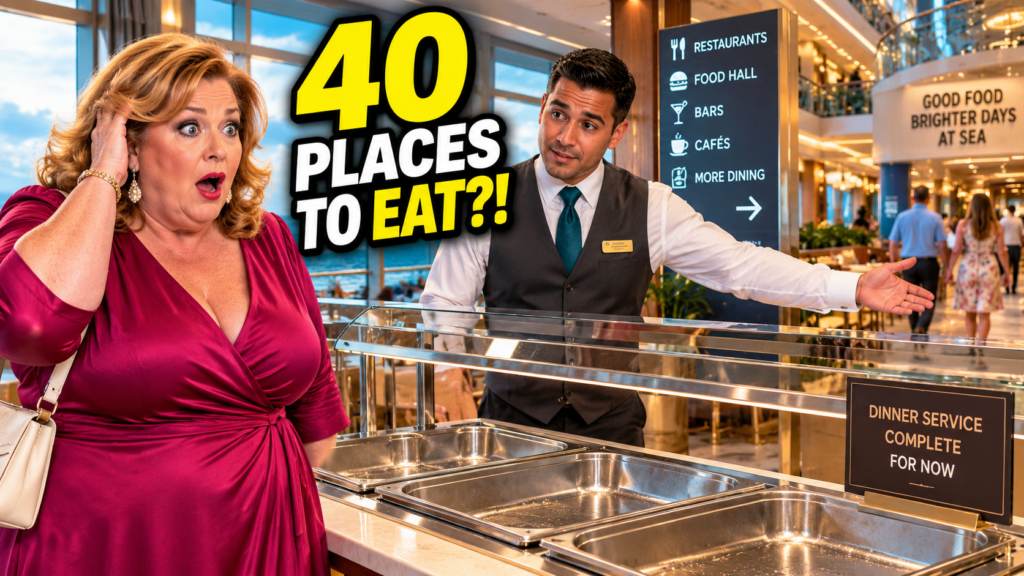
Imagine walking across one of the biggest cruise ships at sea because you have one simple goal: dinner.
You finally reach the dining spot you had in mind, look over the counter—and realize that particular station is finished for now.
“WAIT… you’re telling me there’s NOTHING left to eat here?”
The crew member barely seems concerned. Instead, he points you toward another part of the ship.
“This station is finished for now, ma’am. But you have other dining options.”
You’re already irritated. You walked all the way here because this was where you wanted to eat. Then he tells you there’s another restaurant one deck up. There’s a food hall elsewhere on the ship. There are quick bites, sit-down restaurants and other choices scattered across different neighborhoods.
That raises an obvious question.
How many places to eat can one cruise ship possibly need?
On Royal Caribbean’s Icon Class, the answer is enough to surprise even experienced cruisers: Royal Caribbean currently advertises more than 40 ways to dine and drink across Icon Class ships. Its guide to Icon of the Seas likewise describes more than 40 dining and drinking options.
Forty-plus.
On one ship.
So why does a cruise ship need that many?
The answer has much less to do with excess than you might think—and much more to do with how a modern floating resort handles thousands of people who all want different things at different times.
First, Does the Ship Really Have 40 Restaurants?
This is where the wording matters.
If someone tells you Icon of the Seas has “40 restaurants,” that can create the wrong impression. Royal Caribbean’s own material uses phrases such as “over 40 unique dining and drinking options” and, for Icon Class generally, “over 40 ways to dine and drink.”
That broader number can encompass different kinds of venues and experiences. A massive Main Dining Room is not the same thing as a walk-up snack window. A food hall is different from a premium supper club. A pizza stop is different from a specialty seafood restaurant, and dining and drinking counts can include bars and lounges.
Royal Caribbean’s dedicated Icon of the Seas dining page currently describes over 20 unique dining options specifically.
So the headline question—“Why does this ship have 40 dining spots?”—works as a curiosity hook, but the precise takeaway is this:
Icon Class offers more than 40 ways to dine and drink, not 40 identical full-service restaurants.
That distinction actually makes the ship’s dining strategy more interesting.
Reason #1: Thousands of People Cannot All Eat in the Same Place
Think about a land-based resort with thousands of guests.
Now imagine putting that entire resort on a ship.
Everyone wakes up at roughly similar times. Large numbers of passengers return from shore around similar times. Shows end and release crowds simultaneously. Families suddenly want lunch after spending the morning at a water attraction. Couples want dinner before a performance. Teenagers want food late at night.
If every passenger depended on one enormous restaurant, meal periods could become logistical nightmares.
The solution is not simply to build one dining room bigger and bigger.
It is to distribute demand.
A passenger looking for a full dinner can head in one direction. Someone who wants pizza can go somewhere else. A family wanting something quick can choose a casual venue. Another passenger might prefer a specialty restaurant that requires more time and possibly an additional charge.
Instead of treating every hungry guest as part of one giant line, the ship can spread passengers across multiple venues.
That helps explain why variety and capacity are closely connected.
Reason #2: Not Everyone Wants a Two-Hour Dinner
Cruise dining used to be strongly associated with scheduled sit-down meals.
That experience still exists, but modern cruisers do not all vacation the same way.
Some passengers love dressing for dinner, sitting down and turning the meal into an event.
Others want to eat in 15 minutes because they are heading to a show.
A family might need something convenient between activities. Someone at the pool may not want to change clothes and cross half the ship just to get lunch. Another passenger may want coffee and a snack rather than a full meal.
Icon of the Seas reflects this range.
Royal Caribbean highlights everything from more elaborate dining experiences to grab-and-go food. Its official Icon dining material points passengers toward venues such as the Dining Room, Chops Grille, Giovanni’s Italian Kitchen & Wine Bar and Hooked Seafood while also highlighting casual options such as Pearl Café, Sorrento’s, Park Café, El Loco Fresh and Basecamp.
That is not duplication.
It is segmentation.
Different restaurants solve different passenger problems.
Reason #3: The Ship Is Designed Like Multiple Neighborhoods
One of the most important ideas behind Icon Class is that the ship is not experienced as one enormous room.
It is divided into distinct neighborhoods and activity zones.
That matters for dining because people generally prefer food near whatever they are already doing.
If parents are spending time with young children, walking a long distance to find an appropriate meal can be inconvenient. If passengers are enjoying another area of the ship, they may prefer nearby food instead of returning to one centralized restaurant.
Royal Caribbean Group describes Star of the Seas as having eight neighborhoods and 40-plus ways to dine and drink.
Dining therefore becomes part of the neighborhood concept.
Instead of asking every passenger to travel to the ship’s traditional dining center, food can be integrated into different areas.
That is why the number sounds enormous when you hear “40-plus” but makes more sense when you start moving around a ship of this scale.
Reason #4: Families Need Completely Different Things From Couples
Put two passengers on a romantic anniversary cruise beside a family with young children and ask them to describe the perfect dinner.
You may get completely different answers.
One couple may want quiet lighting, multiple courses and a sophisticated atmosphere.
Parents may want speed, flexibility and food their children will actually eat.
Teenagers may want quantity.
Small children may want something familiar immediately.
Food-focused travelers may want experiences they cannot easily replicate at home.
That diversity is built into modern cruise dining.
For example, Royal Caribbean describes Surfside Eatery as a family-friendly option, while Empire Supper Club represents a much more elaborate premium experience.
Those venues are not competing to provide the same dinner.
They serve different occasions.
That is one of the biggest reasons a ship benefits from having so many options.
Reason #5: A Food Hall Can Solve the “Nobody Wants the Same Thing” Problem
Anyone who has traveled with a group knows this argument.
One person wants Asian food.
Another wants barbecue.
Someone else wants Mediterranean flavors.
Another person is already asking for dessert.
Now multiply that disagreement across families traveling together.
AquaDome Market is an especially useful example of how Royal Caribbean approaches the problem.
Royal Caribbean identifies AquaDome Market as the food hall exclusive to Icon Class and says it has five unique food stands offering different global selections. Its current page lists concepts including Pig Out BBQ, Mai Thai, La Cocinita, Crème de la Crepe and Feta Mediterranean.
Instead of forcing an entire family to agree on one restaurant, several people can choose different foods within the same general venue.
That is not just culinary variety.
It is crowd management and family convenience disguised as choice.
Reason #6: Some Food Needs to Be Fast
There are moments on a cruise when passengers simply do not want a restaurant.
They want food.
Now.
Perhaps a show starts soon. Maybe the kids are hungry after swimming. Perhaps passengers returned from an excursion and missed their preferred lunch period.
That is why quick-service dining matters.
Royal Caribbean describes Surfside Bites as a quick stop for snacks and casual foods. Sorrento’s handles pizza by the slice, while other concepts provide grab-and-go or casual alternatives.
This also explains why the fictional passenger at our opening food station does not necessarily have a ruined evening simply because one station has finished service.
On a ship designed around numerous dining choices, the answer may simply be:
Try another venue.
The important caveat is that individual restaurants and stations have their own operating hours. Having dozens of options does not mean all of them are serving every item 24 hours a day.
Reason #7: Some Meals Are Included—and Others Are Premium Experiences
Here is another point that can confuse first-time cruisers.
Forty-plus dining and drinking options does not mean every option is included in the cruise fare.
Royal Caribbean distinguishes between included and additional-cost dining. For example, current itinerary material identifies AquaDome Market and Surfside Bites as included, while venues such as Pier 7 and Empire Supper Club are shown as additional-cost experiences.
This allows the ship to serve two very different markets at once.
A passenger can take a cruise and eat at included venues without turning every meal into an extra purchase.
Another traveler may deliberately budget for specialty restaurants because food is a major part of the vacation.
The large number of venues therefore represents not only different cuisines but different price points and experience levels.
Before booking specialty dining, always check the current listing for your sailing because inclusions, menus, packages and prices can change.
Reason #8: Food Has Become Part of the Entertainment
On modern mega-ships, eating is not always just a practical necessity.
Sometimes dinner itself is the event.
Royal Caribbean describes Empire Supper Club as an upscale experience combining a multi-course meal with cocktails and live jazz.
That is fundamentally different from grabbing a slice of pizza.
Once dining becomes entertainment, it makes sense for a cruise line to offer more venues. The ship is not merely feeding passengers; it is filling parts of their vacation schedule.
One evening might be casual.
Another could revolve around specialty dining.
Another might involve a quick meal before a show.
A seven-night cruise gives passengers multiple opportunities to try different experiences, and the ship benefits when guests feel there is still something new to discover late in the vacation.
Reason #9: Variety Helps Prevent “Cruise Food Fatigue”
Imagine eating breakfast, lunch and dinner in exactly the same room for seven days.
Even if the food were good, the experience could start to feel repetitive.
Large ships combat that problem by changing more than the menu.
They change the environment.
One meal can happen beside huge ocean views. Another might be in a traditional dining room. Another may be in a food hall. Another can be pizza on the go. Another can become an upscale evening experience.
Royal Caribbean’s Icon dining lineup ranges from casual venues to specialty restaurants and food-hall concepts, which allows passengers to change both cuisine and atmosphere during the voyage.
For repeat cruisers especially, that sense of discovery can be valuable.
You are not simply asking, “What is for dinner?”
You are asking, “Where should we eat tonight?”
Reason #10: Location Matters on a Ship This Large
People who have never sailed on a modern mega-ship sometimes underestimate how much location matters.
If you are already in one neighborhood, the closest convenient dining option can be much more appealing than crossing the ship.
This is why scattering dining choices around the vessel is practical.
Royal Caribbean’s Icon material places different food experiences within distinct areas, including family-oriented Surfside concepts, Central Park venues and AquaDome Market.
Dining becomes part of the ship’s geography.
The restaurant is not merely somewhere to eat.
It helps give a neighborhood its identity.
But What Happens If the Place You Want Is Closed?
Now we return to the frustrated passenger standing in front of the empty station.
This situation is entirely plausible in principle, but it needs to be understood correctly.
A venue finishing service does not mean “the cruise ship ran out of food.”
It means that particular venue, station, or meal period may no longer be serving what the passenger wanted.
That distinction matters.
With a ship offering a large network of dining choices, the next step is to check what is currently open.
Royal Caribbean encourages passengers to use its app for cruise planning and onboard information, and the exact operating schedule can vary. A smart cruiser checks venue hours rather than assuming every restaurant operates continuously.
So when a crew member says, “Try somewhere else,” that is not necessarily a brush-off.
On a mega-ship, another dining option may genuinely be nearby.
More Choices Do Not Automatically Mean Shorter Lines
Here is the catch.
Forty-plus ways to dine and drink sound like a guarantee that you will never wait.
They are not.
Passengers still tend to want the same things at the same times.
Popular venues can become busy. Specialty restaurants may require reservations. Families may converge on convenient options during peak periods. The restaurant closest to a major attraction may naturally attract more people.
More venues give the ship more ways to distribute demand, but they cannot eliminate human behavior.
If everyone wants dinner at 7:00 p.m., 7:00 p.m. is still going to feel different from an off-peak period.
That is why experienced cruisers pay attention not only to where they eat but when they eat.
The “40” Number Is Really About Choice
This is the biggest takeaway.
When people hear “40 dining spots,” they imagine forty traditional restaurants lined up beside one another.
That is not the best way to understand Icon Class.
The more useful picture is a giant floating resort containing many different ways to satisfy different dining moments.
Sit-down meals.
Food-hall choices.
Fast casual.
Snacks.
Pizza.
Included dining.
Specialty experiences.
Family-friendly venues.
Premium evenings.
Bars and drinking venues also contribute to the broader “40-plus ways to dine and drink” figure Royal Caribbean advertises for Icon Class.
Once you understand that, the number stops sounding ridiculous.
It starts sounding like infrastructure.
Icon of the Seas vs. Star of the Seas: The Number Keeps Making Sense
This dining strategy is not limited to one marketing headline for one ship.
Royal Caribbean’s current guide to Star of the Seas says that ship offers more than 40 venues to dine and drink, serving 23 cuisines, and says 17 restaurants are included in the cruise fare.
Royal Caribbean Group likewise promoted Star of the Seas with “40-plus ways to dine and drink” across its eight neighborhoods.
That makes the broader strategy clearer.
As Icon Class evolves, dining variety is being treated as one of the defining features of the class rather than as an accidental collection of restaurants.
The ship itself is a destination.
Food is one of the systems that makes that destination work.
How to Avoid Getting Stuck at the Wrong Dining Spot
If you are sailing on a ship with this many options, having a strategy helps.
First, learn which restaurants are included and which cost extra. Do not wait until you sit down to discover that the experience you chose carries an additional charge.
Second, check operating hours. A venue existing onboard does not mean it is open whenever you happen to arrive.
Third, identify two or three backup options near the areas where you expect to spend your day.
Fourth, make reservations when they are recommended or required for the experience you want.
And finally, don’t assume the most famous restaurant is automatically the best choice for every meal. Sometimes the biggest advantage of a ship with enormous dining variety is discovering the smaller, faster option that perfectly fits what you need at that moment.
Is Having This Many Dining Options Actually Better?
For many passengers, yes—but only if they use the variety.
If you eat in the same dining room every night, the fact that the ship has dozens of other dining and drinking choices may not matter much to you.
For families, groups with different tastes and travelers who enjoy exploring food, however, the variety can be a major advantage.
It gives people flexibility.
And flexibility becomes increasingly important as ships grow into floating resorts with neighborhoods, entertainment districts, family areas, pools, shows and activities competing for passengers’ time.
Dining has to fit around the vacation rather than forcing the entire vacation to fit around dinner.
So Why Does This Ship Have 40 Dining Spots?
Because one enormous restaurant cannot efficiently satisfy every passenger, every appetite, every schedule and every type of vacation.
Because a family wants something different from a couple celebrating an anniversary.
Because some passengers want a multi-course dinner while others need food before the next show.
Because one person wants pizza while another wants something entirely different.
Because food helps define the ship’s different neighborhoods.
Because premium dining can function as entertainment.
And because on a floating resort carrying thousands of vacationers, choice itself becomes part of the product.
Royal Caribbean’s official language remains the key factual distinction: Icon Class offers more than 40 ways to dine and drink, while Icon of the Seas’ dedicated dining material describes more than 20 unique dining options.
So imagine our frustrated passenger one last time.
She has walked across the ship expecting dinner.
The station she wanted is finished for now.
She looks at the empty trays and thinks her evening has just been ruined.
Then the crew member points toward another deck.
Another restaurant.
Another food hall.
Another option.
“How many places to eat does this ship HAVE?”
“More than forty dining options.”
She stares at him.
“FORTY?! Why does one ship need that many?”
Now she has her answer.
On a ship this large, those venues are not there simply to impress you with a giant number.
They are there because thousands of people are trying to have thousands of different vacations—all on the same ship.
