
CRUISE TIP
Over 60? Can You Save a Seat at the Cruise Buffet? 9 Things You Should Know Before You Sit Down
Sep
You walk into the cruise buffet at noon and immediately realize you have a problem.
The food isn’t the problem.
There are carving stations, salads, desserts, hot dishes, fruit, and more choices than you could possibly fit on one plate.
The problem is finding somewhere to sit.
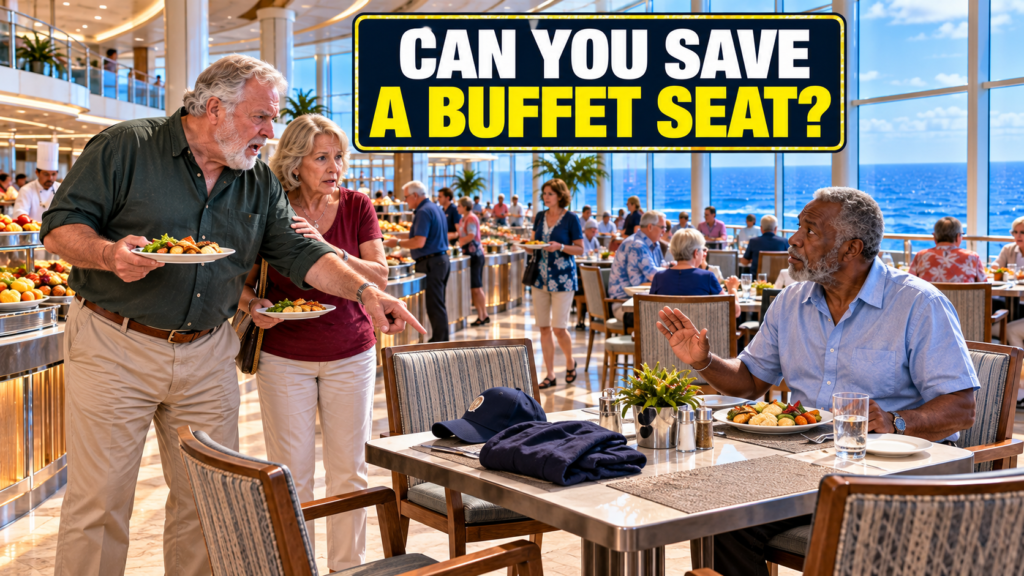
You finally spot an empty table near a window. Your spouse puts a hat on one chair. You leave a jacket on the table.
“Perfect. We’ve got a table.”
Then both of you walk away to get lunch.
Ten minutes later, you return carrying two full plates — and another passenger is sitting there.
Your hat has been moved to the edge of the table.
Now what?
Was that table really yours?
Can you actually save a table at a cruise buffet?
Or does leaving your belongings behind mean almost nothing once you walk away?
This seemingly simple question can cause surprisingly awkward moments on a cruise, especially during busy breakfast and lunch periods.
The first thing to understand is that a cruise buffet generally shouldn’t be treated like an assigned table in the Main Dining Room.
For example, Royal Caribbean describes its Windjammer as a self-service buffet that does not require reservations. Its traditional Main Dining Room, by contrast, can involve assigned seating, while My Time Dining can involve reservations.
Those are very different dining arrangements.
That doesn’t mean someone will immediately take your seat every time you stand up for another piece of pie. It also doesn’t mean every cruise line has exactly the same policies or procedures.
But if you’re traveling as a couple — especially if walking long distances, carrying plates, or navigating a crowded dining room takes more effort than it used to — a little planning can prevent a surprisingly frustrating lunch.
Here are nine things cruisers over 60 should know.
1. A Buffet Table Usually Isn’t the Same as Your Assigned Dining Table
This is the distinction that causes much of the confusion.
At dinner in a traditional Main Dining Room, you might have an assigned dining time and table. Depending on the cruise line and dining program, another arrangement might allow or encourage you to make a reservation.
A buffet operates differently.
You generally enter during operating hours, choose your food, and find available seating.
That casual flexibility is one reason passengers love buffets. You can eat when the venue is open without turning every meal into a formal dining event.
But flexibility also means you shouldn’t automatically assume that an empty buffet table works like a reserved restaurant table.
Putting your hat down may communicate, “Someone is using this spot.”
It does not necessarily mean, “This table has now been officially reserved for me.”
That distinction becomes particularly important when the buffet is packed.
If you’re unsure about the setup on your particular ship, ask a crew member rather than relying on what happened on your last cruise. Dining operations and layouts can vary by cruise line and ship.
2. A Hat or Jacket Is Not a Reservation System
Picture this.
You find a four-person table.
You put your jacket over one chair, leave your hat on another, and then you and your spouse walk to opposite sides of a huge buffet.
By the time you return, several minutes have passed.
From your perspective, the situation seems obvious:
“Our belongings were there. We were coming back.”
But imagine being another passenger carrying a hot plate through a crowded dining room.
They see several apparently unused chairs and no passengers.
How long are they supposed to wait?
Thirty seconds?
Five minutes?
Fifteen?
Are the owners getting food?
Did they leave the restaurant?
Nobody knows.
That’s why relying entirely on personal belongings can create misunderstandings.
There is also an important distinction between briefly getting up from a table you’re actively using and trying to claim seating well before your party is ready to sit down.
Cruise etiquette guidance generally favors consideration for other passengers in crowded shared spaces. The same basic principle applies here: don’t occupy more space than you reasonably need.
For couples, there is a much easier solution.
3. Try the “One Stays, One Goes” Strategy
This may be the simplest cruise buffet trick for two people.
Once you’ve found a table, one person sits while the other gets food.
Then switch.
That’s it.
It isn’t glamorous, but it solves several problems at once.
There is no ambiguity about whether the table is occupied because an actual passenger is sitting there.
You also avoid having both people carrying plates around the dining room while simultaneously searching for somewhere to sit.
For some older travelers, this can make lunch significantly less stressful.
Cruise buffets can be large. You may be navigating passengers moving in different directions, chairs being pulled out, children, trays, serving stations and people suddenly stopping to decide what they want.
If balance or mobility is a concern, there is little advantage in making both travelers navigate all of that at exactly the same time.
One person can remain comfortably seated while the other makes a first trip.
When that person returns, switch.
Yes, it may take a few extra minutes.
But those few minutes can be far more pleasant than standing in the middle of a crowded buffet holding a plate and wondering where your table went.
4. Peak Hours Can Completely Change the Experience
The same buffet can feel like two different restaurants depending on when you arrive.
At a quieter time, you might walk in and immediately find several empty tables.
During a busy period, finding the seat may take longer than finding the food.
Cruise Critic notes that passengers should expect searches for tables during peak buffet periods.
So don’t focus exclusively on what you want to eat.
Look at the dining room first.
If you’re traveling with a partner, consider finding your seating before both of you begin filling plates.
And if your schedule is flexible, changing when you eat can sometimes be easier than fighting the biggest crowd.
This is particularly useful for travelers who don’t enjoy standing for long periods.
You don’t earn a prize for eating lunch at exactly the same time as everyone else.
Sometimes the smartest buffet strategy is simply recognizing when the room is overwhelmed and adjusting.
5. Two People Don’t Always Need a Giant Table
Here’s another situation that creates unnecessary tension.
A couple walks into a packed buffet and finds a table designed for six people.
They spread out.
One chair holds a handbag.
Another holds a jacket.
A third has a shopping bag.
Suddenly two passengers are effectively occupying six seats while other couples are circling the dining room carrying plates.
If the restaurant is mostly empty, this probably isn’t a major issue.
When every table is filling up, it becomes a different story.
Use the amount of space you reasonably need.
If a smaller table becomes available and changing tables is easy for you, consider taking it.
This doesn’t mean you should make yourself uncomfortable. Travelers with mobility equipment, accessibility needs or other practical requirements may genuinely need additional space.
The point isn’t to create a rigid rule.
It’s simply to notice what’s happening around you.
Cruise ships are shared environments. A small amount of awareness can make the experience much easier for everyone.
6. Be Careful About Saving Seats for People Who Haven’t Arrived Yet
Holding one seat for your spouse who is actively getting food is one thing.
Trying to hold eight seats for friends who haven’t even left their cabins is something else.
The larger the group, the more complicated buffet seating becomes.
Suppose four of you arrive first and find a large table.
Another four friends say they’ll meet you “in a few minutes.”
Ten minutes pass.
Then fifteen.
Meanwhile, passengers carrying food are walking past several empty chairs that nobody is actually using.
That’s when frustration starts.
The more crowded the venue, the less practical it becomes to claim a large number of unused seats for people who may arrive much later.
If you’re cruising with a group, coordinate before entering the buffet.
Decide approximately when you’re meeting.
Don’t send one person ahead simply to build a fortress of jackets, hats, bags and water bottles around a huge table.
And if your group is large enough that seating together is important, consider whether another dining venue might suit that meal better.
7. Before Taking a Seat, Ask One Simple Question
The problem works both ways.
Imagine you see a table with four chairs.
One woman is sitting there.
Three chairs are empty.
Don’t immediately pull one out and sit down.
Ask.
“Excuse me, is anyone sitting here?”
That five-second question can prevent an argument.
Maybe her husband is getting coffee.
Maybe another couple is returning with food.
Or maybe she’ll smile and say, “No, please sit.”
Sharing tables isn’t necessarily a bad thing, either.
You might even meet interesting people.
Cruises naturally bring together travelers from different states, countries and backgrounds. A casual buffet conversation can turn into one of those small vacation memories you weren’t expecting.
But asking first matters.
Likewise, if someone politely asks whether your unused chairs are available, you don’t have to treat the question as an attack.
A buffet is a shared dining environment.
Clear communication works much better than silently making assumptions about chairs, hats and jackets.
8. Don’t Assume the First Seating Area Is Your Only Option
This is an especially useful habit on large ships.
Passengers sometimes enter a buffet, see a packed cluster of tables and conclude:
“There isn’t anywhere to sit.”
Not necessarily.
Before becoming frustrated, look around.
Some buffet venues are larger than they initially appear. Depending on the ship, there may be additional seating farther around the dining area, near windows, or in another usable adjacent location.
Cruise layouts vary considerably, so don’t assume your previous ship’s arrangement applies to the next one.
Royal Caribbean, for example, describes Windjammer as offering substantial seating, including window seating, and notes that food can also be taken elsewhere in certain circumstances.
If you’re unsure where you’re permitted to eat, ask a crew member.
This is particularly worthwhile for older travelers.
Walking in circles with a full plate isn’t an efficient way to discover the ship.
On your first buffet visit, take a moment to learn the layout before loading your plate.
Where are the quieter sections?
Where are the beverage stations?
Where are the exits?
Where is seating easiest to access?
If you use a cane, walker, wheelchair or other mobility aid, which route gives you the most room?
Learning those details once can make every buffet visit afterward easier.
9. Never Let a Buffet Seat Ruin Your Vacation
Let’s return to our opening scene.
You left your hat on a table.
You came back.
Someone else is sitting there.
You’re convinced you saved it.
They’re convinced you abandoned it.
Now you have two choices.
You can turn a lunch-table misunderstanding into a confrontation.
Or you can solve the actual problem.
The actual problem is:
You need somewhere to eat.
If there’s genuine confusion or you need assistance finding appropriate seating, calmly ask a crew member for help.
Don’t move another passenger’s food.
Don’t get into a shouting match.
Don’t treat a chair like property worth ruining an afternoon over.
And don’t assume that because something happened one way on another ship, every cruise line has the same rule.
There is no universal “hat on chair” system governing cruise buffets.
Policies, layouts and operating practices can differ.
A calm solution will almost always get you back to enjoying your lunch faster than winning an argument.
So, Can You Save a Seat at a Cruise Buffet?
The best answer is:
Don’t treat a cruise buffet table as if it were an officially reserved dining table.
There may be perfectly ordinary moments when one member of your party briefly remains at or returns to a table while another gets food. That’s different from assuming unattended belongings give you an unquestionable claim to seating for an indefinite period.
For couples, especially travelers over 60, the easiest strategy is often the simplest:
Find a suitable table. Let one person stay. Let the other get food. Then switch.
During busy periods, use only the seating you reasonably need.
If you’re joining another table, ask first.
If you’re traveling with a large group, coordinate instead of trying to hold a collection of empty chairs for an uncertain amount of time.
And if you’re confused about the practice on your particular ship, ask the crew.
Cruise vacations are full of decisions that actually matter: choosing the right cabin, making it back from port on time, managing medications, planning excursions, understanding what’s included in your fare and keeping important travel documents secure.
A buffet chair shouldn’t become one of your biggest problems.
The next time you walk into a packed buffet and finally spot an empty table, remember one simple rule of thumb:
A person sitting at the table communicates a lot more clearly than a hat does.
