
AIRPORT TIPS
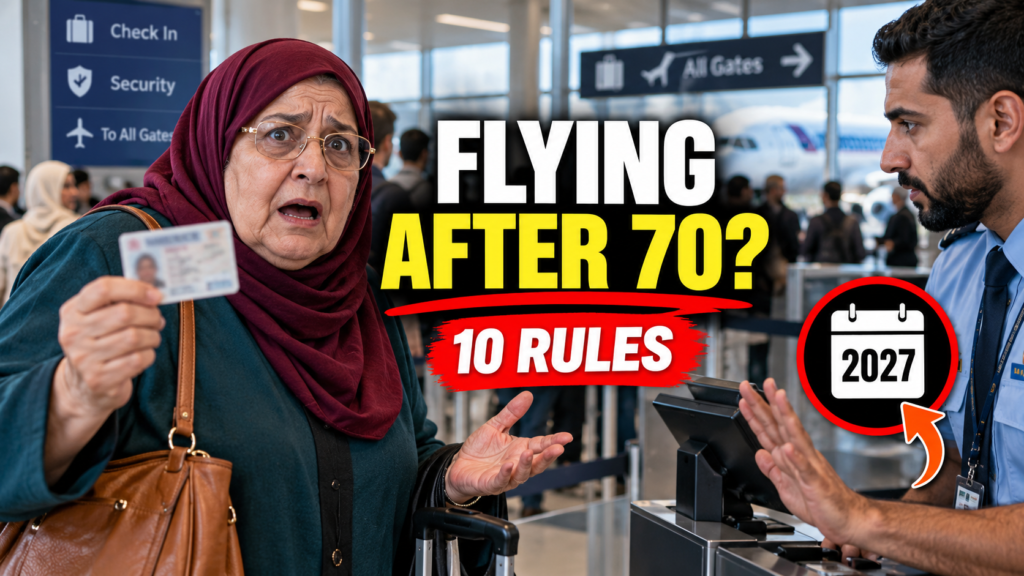
Flying After 70? 10 Airport Rules That Actually Changed in 2027
Sep
Flying after 70 can feel very different from the airport experience you remember from even a few years ago.
Identification requirements have tightened. Digital identity technology is appearing at more checkpoints. Battery rules can affect what goes in your checked suitcase. Travelers carrying medication need to understand exceptions to the normal liquids rule. And passengers with disabilities or mobility limitations have important federal protections that many travelers still don’t fully understand.
But there is one important fact to clear up immediately:
There is no single federal package of “10 new airport rules for everyone over 70” that suddenly begins on January 1, 2027.
Some of the rules travelers will encounter in 2027 took effect earlier. Others have been updated recently, and certain federal wheelchair-related provisions have an enforcement timeline extending into April 2027.
So if you’re over 70—or helping a parent, spouse or older relative prepare for a flight—these are the changes and current rules worth understanding before heading to the airport.
1. Your Age Does Not Exempt You From Current Airport ID Requirements
One of the easiest mistakes for an older traveler to make is assuming that an old driver’s license will still work because it has worked for decades.
That can create a stressful surprise at the security checkpoint.
TSA’s REAL ID enforcement began on May 7, 2025. Adult travelers need an acceptable form of identification for airport security screening, such as a REAL ID-compliant state credential or another form of identification accepted by TSA.
Being 70, 75 or 80 does not create a blanket exemption from the identification requirement.
That makes this a particularly important rule for seniors who may have renewed the same style of driver’s license for many years without thinking about airport identification requirements.
What older travelers should do
Check your identification before the day of your flight.
Don’t simply look at the expiration date and assume everything is fine.
Determine whether the credential you intend to present is currently accepted by TSA. If you plan to use an alternative form of identification, such as a passport, verify that it is acceptable and ready before leaving home.
A five-minute ID check at home can prevent a very stressful conversation at the airport.
2. No Acceptable ID Does Not Always Mean You Should Immediately Leave the Airport
Imagine this situation.
A 74-year-old passenger reaches the checkpoint and presents an identification document that cannot be accepted.
She panics.
“My flight is boarding! Are you telling me I have to go all the way home?”
Not necessarily.
TSA’s published travel guidance says travelers who do not have identification may still be allowed to travel after providing additional information so TSA can attempt to verify their identity.
Passengers cleared through that process may be subject to additional screening.
However, this is not a secret loophole and it is definitely not a guarantee that anyone without acceptable ID will be permitted to fly.
If TSA cannot verify a traveler’s identity, the traveler may not be allowed through the security checkpoint.
What older travelers should do
If there is an ID problem, don’t immediately abandon the trip without speaking to the appropriate TSA personnel.
Explain the situation calmly and follow their instructions.
Most importantly, don’t intentionally arrive without acceptable identification because you’ve heard online that “TSA can just look you up.”
The additional identity-verification process should be viewed as a possible procedure for an unexpected problem—not as a replacement for traveling with proper identification.
3. REAL ID Is Not a Special Rule for People Over 70
This distinction matters because social-media travel advice often turns ordinary federal requirements into “new senior rules.”
REAL ID does not suddenly apply because someone celebrates their 70th birthday.
TSA’s identification requirement applies broadly to adult travelers, not specifically to seniors.
So a headline saying:
“Everyone over 70 needs a new special airport ID in 2027”
would be misleading.
The useful lesson for older passengers is different.
Many seniors may have held the same type of identification for a long time, making it especially important to verify their documents before traveling.
The simple rule
Before flying in 2027, ask:
Is the identification I plan to present currently accepted by TSA?
Don’t ask:
Was this license accepted the last time I flew?
Those are not necessarily the same question.
4. Medically Necessary Liquids Can Exceed the Normal 3.4-Ounce Limit
This is one of the most important airport-security rules for older passengers carrying medication.
The standard TSA liquids rule generally restricts liquids, aerosols, gels, creams and pastes in carry-on baggage.
But medically necessary liquids are treated differently.
TSA states that passengers may bring medically necessary liquids, medications and creams in quantities exceeding 3.4 ounces or 100 milliliters in carry-on baggage, subject to security screening procedures.
That means a traveler should not automatically throw away medically necessary liquid medication simply because the container is larger than the standard carry-on limit.
What you should do
Keep medically necessary items organized and accessible.
Allow additional time for screening.
Be prepared to identify medically necessary items to security personnel and follow TSA instructions for separate or additional screening when required.
And don’t confuse an exception for medically necessary liquids with the idea that all ordinary liquids are exempt from the 3-1-1 rule once you turn 70.
They aren’t.
Age does not erase the standard liquids rule. Medical necessity is the relevant distinction.
5. Medication Is Allowed—but It Still Goes Through Security Screening
Older travelers often carry several medications, which can make airport security feel intimidating.
The important thing to understand is that medication itself is not automatically prohibited.
TSA states that medications in pill, liquid and other permitted forms can travel through security, but they remain subject to screening.
The biggest mistake is waiting until you are standing at the checkpoint to organize everything.
A better approach
Before leaving home, separate the items you may need to identify or access during screening.
Keep important medication somewhere you can reach easily rather than burying it underneath a week’s worth of clothing.
For liquid medication exceeding the normal limit, be prepared for the applicable screening procedures.
If you’re traveling with specialized medical equipment or supplies, check the current TSA guidance for that specific item before your trip.
The goal isn’t to hide medical items from security.
The goal is to arrive knowing how they are supposed to be screened.
6. Wheelchair Assistance Is a Disability Accommodation, Not a Luxury Upgrade
This is where many older passengers misunderstand their rights.
If walking long distances through a major airport is difficult because of a disability, don’t automatically assume wheelchair or guided assistance is merely an expensive VIP service.
Under DOT disability rules, airlines have obligations to provide assistance to passengers with disabilities.
DOT says this can include assistance moving from the terminal entrance or vehicle drop-off point to the departure gate, through the security checkpoint and onto the aircraft. Assistance can also cover connections and movement from an arriving aircraft toward baggage claim or the pickup area.
DOT also says required accommodations under its disability rules generally cannot simply be charged as optional luxury services.
But there is an equally important distinction:
Being over 70 by itself does not automatically make a traveler a passenger with a disability.
These protections are disability-related, not an automatic senior-citizen benefit.
What to do
If you need disability-related mobility assistance, communicate that need to your airline.
If you arranged assistance before traveling, identify yourself to airline personnel when you arrive so the requested service can be provided.
If a problem occurs, DOT says airlines must make a Complaint Resolution Official (CRO) available to address disability-accommodation issues.
7. Wheelchair Protections Have Changed—and Part of the Timeline Really Does Reach 2027
This is the strongest genuine 2027 element in this article.
DOT issued a final rule in December 2024 strengthening protections for airline passengers with disabilities who use wheelchairs.
The rule addressed areas including safe and dignified assistance, wheelchair handling and employee training.
But the regulatory timeline has continued changing.
On August 4, 2026, DOT announced that it was extending enforcement discretion for four provisions of the wheelchair rule from December 31, 2026 until April 30, 2027.
Those four areas concern:
- Airline liability for mishandled wheelchairs
- Frequency of refresher training
- Pre-departure notifications
- Fare-difference reimbursements
DOT also extended related enforcement discretion concerning a hands-on training mandate connected with onboard wheelchair assistance and lavatory accessibility.
That does not mean all wheelchair protections disappear until April 2027.
DOT specifically says the enforcement action concerns identified provisions while other disability protections continue to apply.
Why this matters
If you use a wheelchair or mobility device, don’t rely on an old travel article describing the regulatory timeline.
This area has been changing.
Check current DOT guidance close to your travel date, particularly if your trip is in 2027.
8. Passengers With Disabilities Have Specific Boarding and Airport-Assistance Rights
The federal protections go beyond simply providing a wheelchair.
DOT’s Airline Passengers with Disabilities Bill of Rights describes a series of protections under the Air Carrier Access Act and its implementing regulations.
For example, passengers with disabilities can have rights relating to airport assistance, boarding and deplaning, assistive devices, accessible information and certain seating accommodations.
DOT says passengers with disabilities must receive prompt and timely boarding and deplaning assistance upon request from properly trained personnel.
It also says a passenger with a disability who self-identifies at the gate as needing additional time or assistance to board, stow accessibility equipment or be seated must be given an opportunity to preboard, subject to the applicable rules and limited exceptions.
Don’t confuse age with disability
This distinction should appear in every senior-travel guide.
Turning 70 does not automatically give you every disability accommodation listed under federal law.
But if you are a passenger with a disability who qualifies for those protections, your age does not take those rights away either.
If you need assistance, ask for the accommodation you actually need.
9. Your Power Bank Belongs in Your Carry-On, Not Your Checked Suitcase
This rule catches travelers of every age.
It is especially easy to forget when packing at the last minute.
According to current FAA guidance, spare lithium batteries—including power banks and portable chargers—must be carried in carry-on baggage and cannot be packed in checked baggage.
FAA’s current guidance states that rechargeable batteries from 0–100 watt-hours (Wh) are generally allowed on passenger aircraft, while batteries from 101–160 Wh require airline approval. Batteries exceeding 160 Wh are generally forbidden on passenger aircraft, subject to rules for particular categories such as mobility devices.
Airlines and international regulations can impose additional restrictions.
There’s another important detail.
If your carry-on bag is unexpectedly gate-checked, FAA guidance says spare lithium batteries and power banks need to be removed and kept with you in the aircraft cabin.
Before leaving home
Check your:
- Power bank
- Portable phone charger
- Spare camera batteries
- Laptop batteries
- Battery-equipped smart luggage
- Mobility-device battery, if applicable
Don’t assume that because something is allowed on an airplane, it is allowed in both carry-on and checked baggage.
Those are two different questions.
10. Digital ID and Facial Identity Technology Are Expanding—but They Are Not a Mandatory “Over-70 Rule”
Airports are becoming increasingly digital.
That can be confusing for an older traveler who is accustomed to handing an officer a physical driver’s license and boarding pass.
TSA has been developing and deploying digital identity technology, including systems that can use facial comparison at participating checkpoints.
But don’t turn that technological shift into a fictional 2027 mandate.
TSA says it receives a passenger’s digital identification information at checkpoints with the passenger’s consent, and passengers control access to the digital ID stored on their mobile device.
So claims such as:
“Everyone over 70 will have to use facial recognition in 2027”
should not be treated as established federal policy.
What older passengers should remember
New technology does not mean you should blindly follow instructions you saw in an online video months earlier.
Check the current procedure for the airport and identification method you’re actually using.
Digital ID availability can depend on location, program participation and supported credentials.
And if you’re uncomfortable or confused about a checkpoint procedure, ask the personnel working there rather than guessing.
The Biggest Myth About Flying After 70 in 2027
The biggest misconception may be the idea that there is one completely separate set of airport rules for senior citizens.
There isn’t.
Many of the most important rules apply to travelers of all ages.
REAL ID enforcement isn’t an “over-70 law.”
Lithium-battery restrictions aren’t an “over-70 law.”
The standard liquids rule isn’t eliminated when you turn 70.
Digital ID isn’t automatically mandatory because you’re a senior.
And disability accommodations are based on qualifying disability-related needs—not simply the number on your birth certificate.
What changes after 70 is often what matters most to you as a traveler.
Medication may become more important.
Walking long airport distances may become more difficult.
Medical devices may require additional planning.
You may be carrying identification you’ve used for many years.
And unfamiliar checkpoint technology can make an already stressful travel day more confusing.
That’s why understanding the rules before arriving matters.
What If TSA Rejects Your ID?
Don’t immediately panic.
And don’t immediately assume you’re guaranteed to miss the flight.
TSA’s published guidance recognizes an identity-verification process for travelers who arrive without acceptable identification.
You may be asked to provide additional information so TSA can attempt to confirm your identity.
If your identity is successfully verified, additional screening may be required.
If TSA cannot verify your identity, you may not be permitted to proceed through the checkpoint.
That distinction is essential.
The process is not guaranteed admission.
It is a potential way TSA may attempt to resolve an identification problem.
That’s why the safest strategy remains extremely simple:
Bring acceptable identification in the first place.
Do Travelers Over 70 Automatically Get TSA PreCheck?
No.
Being over 70 should not be confused with automatic enrollment in TSA PreCheck.
TSA PreCheck is a specific expedited-screening program with its own eligibility and enrollment process.
Age-related screening procedures and accommodations also should not be described as automatic TSA PreCheck membership.
If someone tells you:
“Once you turn 70, you automatically get TSA PreCheck.”
don’t build your airport plans around that claim.
Verify your actual status before traveling.
Can Seniors Bring More Liquid Through Airport Security?
Not simply because they’re seniors.
This is another important distinction.
A 74-year-old passenger does not automatically receive a larger ordinary liquids allowance merely because of age.
However, medically necessary liquids, medications and creams can qualify for exceptions from the normal 3.4-ounce limitation, subject to TSA procedures.
So the correct question isn’t:
“I’m over 70. Can I bring this?”
It’s:
“Is this medically necessary, and what TSA screening procedure applies to it?”
Can Seniors Request Wheelchair Assistance at the Airport?
Passengers with disabilities who require wheelchair or guided assistance have substantial federal protections.
DOT says airlines must provide prompt assistance to passengers with disabilities who request it, including assistance through various portions of the airport journey.
If you know you’ll need disability-related assistance, arranging it ahead of time can make the airport experience easier, even though advance notice generally isn’t required for many accommodations. Some specialized accommodations can have advance-notice requirements.
The important point is to communicate your actual needs.
Don’t struggle silently through a huge terminal because you assume assistance is only for someone “more disabled” than you.
At the same time, don’t present disability accommodations as a universal age-based perk.
What Should Travelers Over 70 Do Before Flying in 2027?
A few days before departure, perform a simple airport check.
Confirm that the identification you plan to present is acceptable.
Review your medication and medically necessary liquids.
Check any CPAP, mobility equipment or other medical device against current TSA and airline guidance.
