
CRUISE NEW
Your Cabin Crew Will LOVE You If You Ask This One Question on Day One
Sep
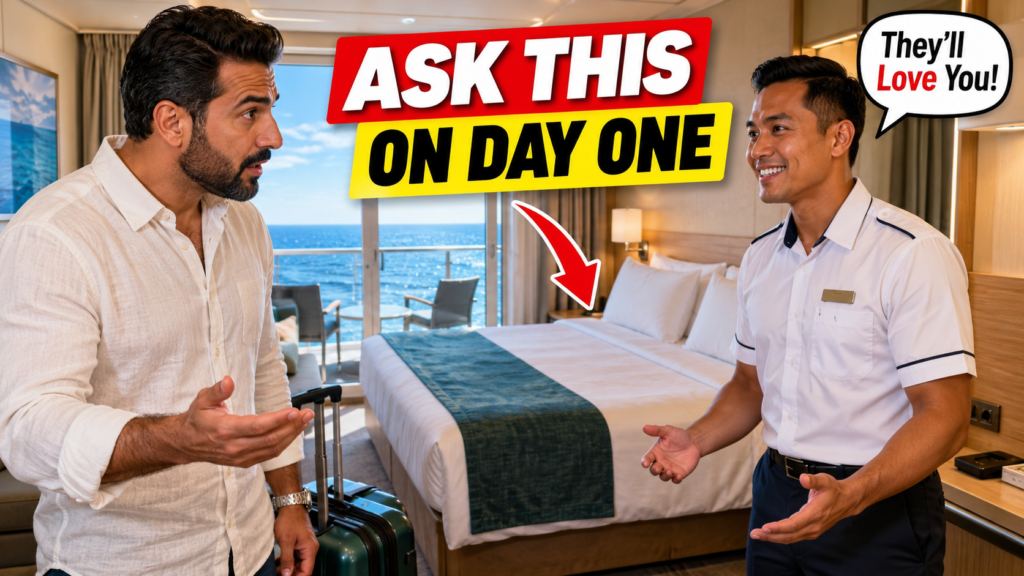
You finally open the door to your cruise cabin on embarkation day.
Your luggage is behind you. The ocean is shining through the balcony doors. After months of planning, you’re ready to unpack and start your vacation.
Then you look at the bed.
Something is wrong.
You expected two separate beds.
Instead, there is one large bed in the middle of the room.
Your first instinct might be to march into the hallway and complain.
But before you do, there is one question worth asking your stateroom attendant on Day One—and it can change the tone of your entire cruise.
Not because it guarantees special treatment.
Not because it gets you a free upgrade.
And not because cruise lines have some secret policy rewarding passengers who know the right words.
The reason is much simpler.
Your stateroom attendant is one of the crew members most directly involved in your everyday cabin experience.
Starting that relationship with a conversation instead of a confrontation can make it much easier to identify the little things that matter to you before they become big frustrations.
And the question is:
“What should I tell you on Day One instead of complaining about it later?”
It sounds almost too simple.
But here’s why it matters.
The Day One Cabin Problem Most Cruisers Handle the Wrong Way
Imagine a passenger from Dubai boarding a cruise ship for the first time.
He opens his balcony cabin and immediately sees something he wasn’t expecting.
One bed.
He had requested two separate beds.
His suitcase isn’t even unpacked yet, and he’s already irritated.
He finds the stateroom attendant.
“Hold on. I specifically requested two separate beds. Why am I looking at one?”
The attendant remains calm.
“Sir, the bed configuration can usually be changed.”
That answer doesn’t satisfy him.
“Then why wasn’t it changed before I boarded? I paid for this cabin months ago!”
It’s easy to understand the frustration.
You booked something.
You expected it to be ready.
Now your vacation has barely begun and you’re already dealing with a problem.
But this is where the conversation changes.
Instead of escalating the argument, the attendant says:
“Before you unpack, ask me one question.”
The passenger looks at him.
“One question? I need the bed fixed.”
And the attendant replies:
“Ask me: ‘What should I tell you on Day One instead of complaining about it later?’”
That’s the real cruise tip.
Why This Question Works
The phrase itself isn’t magic.
Your attendant isn’t going to secretly upgrade your cabin because you said it.
You don’t move to the front of some invisible service line.
The real value is that the question forces you to think about your cabin needs before small annoyances accumulate.
Maybe you want separate beds.
Maybe you need additional pillows.
Maybe you prefer extra hangers.
Maybe you need ice.
Maybe there is something in the room that genuinely isn’t working properly.
Instead of discovering each issue separately over the next three days, you can communicate reasonable cabin needs early.
That gives the crew an opportunity to address what can actually be addressed.
The difference is subtle but important:
“Here’s everything wrong with this room.”
versus:
“Here’s what would make this cabin work better for us. What should I tell you now?”
Same cabin.
Same passenger.
Very different conversation.
Your Stateroom Attendant Can Actually Help With Cabin Requests
This isn’t based purely on cruise etiquette.
Major cruise lines themselves describe stateroom attendants or stewards as people who help guests with cabin-related needs.
Royal Caribbean advises travelers that stateroom attendants can help with requests for things such as extra pillows or blankets, hangers and ice.
Princess Cruises similarly describes its stateroom stewards as crew members who keep the room tidy, refresh towels and assist with special requests.
Carnival also describes its accommodations as including a dedicated stateroom attendant.
So talking to the person responsible for servicing your cabin isn’t an internet “hack.”
It’s normal cruise communication.
The trick is simply to have that conversation early and respectfully.
What About the Wrong Bed Configuration?
This is an especially useful example because some cruise cabins really do use convertible bed configurations.
On multiple Carnival ships, official deck plans identify accommodations with two twin beds that convert to a king.
That does not mean every bed on every ship can be separated or reconfigured.
Some cabins have fixed configurations, and layouts vary by ship and stateroom category.
But if you enter your cabin and the beds are configured differently from what you expected, don’t immediately assume you’re stuck with that arrangement for the entire cruise.
Ask.
Your attendant or Guest Services can tell you whether the configuration in your particular cabin can be changed.
And do it before you’ve unpacked half your suitcase across the bed.
The One Question to Ask on Day One
Here it is again:
“What should I tell you on Day One instead of complaining about it later?”
You can also make it sound softer:
“Is there anything about our cabin needs that would be helpful for me to tell you now?”
Or:
“Before we unpack, can I tell you the few things that matter most to us in the cabin?”
The exact wording isn’t important.
The attitude behind it is.
You’re not demanding that the attendant predict everything you’ll want.
You’re opening a conversation.
What Should You Mention?
Don’t hand your attendant a ridiculous twenty-item wish list.
Focus on genuine cabin needs.
For example:
Bed configuration.
If your cabin has a convertible setup and you need two separate beds rather than one combined bed—or vice versa—ask whether it can be changed.
Extra pillows or blankets.
If you know you’ll need them, asking early is more practical than discovering the problem when you’re ready to sleep.
Hangers.
Cruise cabins can have limited closet space, particularly when two people are sharing a room. If additional hangers are available and you need them, ask.
Ice.
If this is something you expect to use in your cabin, ask your attendant how ice requests are handled on that ship.
Towels or other ordinary cabin needs.
If something is genuinely missing or you have a reasonable housekeeping request, communicate it clearly.
And if something is broken?
Report it.
A malfunctioning fixture is not a “preference.” It’s something the ship should have the opportunity to investigate.
Why Day One Matters
Embarkation day looks relaxing from the passenger side.
You board.
You eat lunch.
You explore the ship.
You take pictures.
You walk onto the balcony and watch the port disappear.
Behind the scenes, however, turnaround day can be extraordinarily busy.
Royal Caribbean has described turnaround day as a race against the clock, with crew having only hours to prepare a ship for an entirely new group of passengers.
That includes cleaning guest rooms and preparing the vessel for the next sailing.
So when you meet your stateroom attendant on embarkation day, you may be meeting that person after an extremely busy turnaround.
That doesn’t mean you shouldn’t report a legitimate problem.
You absolutely should.
It simply means that a little clarity and courtesy can go a long way.
What NOT to Say to Your Cabin Attendant
There is a huge difference between reporting a problem and treating a crew member like a personal servant.
If you enter your cabin and something isn’t right, explain the issue.
Don’t begin with:
“I paid thousands of dollars, so you work for me.”
Don’t threaten someone’s tip before they’ve had a chance to address the problem.
Don’t demand something the crew member has no authority to provide.
And don’t assume every request can be fulfilled.
Instead, explain the issue and ask what can be done.
That keeps the conversation focused on solving the problem.
Don’t Use the Question as a Trick to Get Better Treatment
This is important.
The title says:
Your Cabin Crew Will LOVE You If You Ask This One Question on Day One
That’s a catchy way to describe good cruise etiquette.
It should not be interpreted literally as a guaranteed service strategy.
There is no official cruise-line rule stating that passengers who ask this question receive better treatment.
You aren’t buying preferential service with a clever sentence.
And you shouldn’t expect:
Free upgrades.
Secret perks.
Priority housekeeping.
Free specialty dining.
Extra loyalty benefits.
Or exceptions to ship policies.
The question works because it encourages clear communication, not because it unlocks hidden benefits.
Should You Tip Your Stateroom Attendant on Day One?
This question often appears whenever cruisers talk about building a good relationship with cabin staff.
But don’t confuse the two issues.
Cruise lines have their own gratuity, service-charge or crew-appreciation systems, and policies differ.
Princess, for example, publishes information about Crew Appreciation and explains that its onboard team is available to address concerns.
Your decision about additional tipping should not turn into an attempt to purchase special treatment.
You shouldn’t need to wave cash at someone just to communicate ordinary cabin requirements.
Respectful communication costs nothing.
What If Your Request Can’t Be Fixed?
This is where expectations matter.
Your stateroom attendant isn’t all-powerful.
Some requests may depend on:
The design of the cabin.
Availability of an item.
Safety requirements.
Ship policy.
Maintenance.
The specific room category.
Or another onboard department.
If your bed cannot physically be configured the way you want, your attendant cannot redesign the cabin.
If you’re unhappy with your cabin location, the attendant cannot simply move you into an empty suite.
In fact, some cruise lines warn that onboard or same-day cabin upgrades may not be available when ships are sailing at capacity.
So if the answer is:
“I’m sorry, but I can’t do that.”
The next question shouldn’t automatically be:
“Why not?”
A better question may be:
“What options do I have?”
The Bigger Day One Lesson
There is a reason experienced cruisers often want to get cabin issues sorted early.
Your stateroom becomes your home for the voyage.
You sleep there.
You shower there.
You get dressed there.
You store your luggage there.
You return there after long port days.
A small annoyance on embarkation afternoon can feel enormous by Day Four if you’ve been silently tolerating it.
So inspect your room after you arrive.
Not obsessively.
Just practically.
Is the bed configuration appropriate?
Does everything appear to be functioning?
Do you have the basic items you need?
Is there something reasonable you already know you’ll want?
If so, communicate it.
7 Things to Do When You First Enter Your Cruise Cabin
Once you have access to your stateroom, a simple routine can prevent unnecessary frustration.
1. Check the bed configuration.
Make sure it works for the people sharing the cabin. If the beds appear convertible but aren’t arranged as expected, ask whether they can be changed.
2. Look around before completely unpacking.
If something is obviously wrong, it’s easier to address before the room is covered in luggage and clothing.
3. Identify your genuine cabin needs.
Don’t create problems that don’t exist. Think about what you’ll actually use.
4. Meet your stateroom attendant when practical.
A simple introduction can establish who to speak with about ordinary housekeeping needs.
5. Make reasonable requests clearly.
Specific requests are easier to understand than vague complaints.
6. Report actual problems promptly.
If something isn’t functioning properly, give the ship an opportunity to address it.
7. Remember your mandatory Day One responsibilities.
Your cabin isn’t the only thing that matters on embarkation day. Follow your cruise line’s instructions for required safety procedures and muster requirements.
Don’t Forget the Muster Drill
While you’re dealing with your cabin, don’t become so distracted that you forget one of the most important parts of embarkation day:
The safety briefing or muster process.
Cruise lines provide instructions for completing required safety procedures.
Royal Caribbean, for example, tells passengers to head to their Assembly Station on the first day to confirm completion of mandatory safety training through its app or complete the required demonstration.
So yes—sort out the beds.
Ask for the pillow.
Meet your attendant.
But don’t let a cabin issue distract you from required safety procedures.
Cabin Attendant vs. “Cabin Crew”: What’s the Correct Term?
There’s another useful distinction.
Passengers sometimes call the person servicing their cruise cabin “cabin crew.”
That’s understandable in casual conversation.
But on cruise ships, terms such as stateroom attendant and stateroom steward are more precise.
Royal Caribbean commonly uses “stateroom attendant.”
Princess uses “stateroom steward.”
Carnival refers to a “dedicated stateroom attendant.”
“Cabin crew,” meanwhile, is strongly associated with airline flight attendants.
We’re keeping the phrase in this article’s title because it’s immediately understandable to a broad travel audience.
But when you’re actually onboard, “stateroom attendant” is usually the clearer term.
The Conversation That Could Save Your First Night
Let’s return to our passenger.
He enters the cabin angry because the beds are wrong.
At first, he sees only the mistake.
Then his attendant asks him to think beyond it.
“What should I tell you on Day One instead of complaining about it later?”
The passenger finally thinks.
“Separate beds, extra pillows, and more hangers.”
Now the attendant has useful information.
Instead of dealing with three separate complaints over the next two days, they have one conversation.
The passenger asks:
“So the question isn’t really about the bed?”
And the attendant answers:
“No, sir. It’s about giving me a chance to fix the little things before they ruin your cruise.”
That’s the entire lesson.
Frequently Asked Questions
Can a cruise ship separate one large bed into two twin beds?
Sometimes.
Many cruise staterooms use twin beds that can be converted into a larger configuration, but this varies by ship, room and occupancy arrangement. Carnival’s official deck plans, for example, identify many cabins with two twin beds that convert to a king, while other accommodations have different or non-convertible configurations.
Always check your specific stateroom.
Can I ask my stateroom attendant for extra pillows?
On Royal Caribbean, official guidance specifically says stateroom attendants can help with extra pillows or blankets.
Availability and procedures can vary by cruise line and sailing.
Can I ask for more hangers?
Royal Caribbean also specifically identifies hangers among requests stateroom attendants can assist with.
Again, availability isn’t unlimited.
Can I ask for ice?
Royal Caribbean lists ice requests among the things stateroom attendants can help with.
Ask how your particular ship handles the request.
Should I make all my requests immediately after boarding?
Communicate genuine needs early, but use common sense.
Embarkation and turnaround are busy periods.
You don’t need to hunt down a crew member the second your foot crosses the gangway.
Once your cabin is available and you’ve identified a genuine issue or need, communicate it politely.
Will asking this question get me better service?
There is no guarantee.
That’s not the point.
The benefit is creating a respectful conversation and giving the appropriate crew member an opportunity to understand reasonable cabin needs early.
What if my cabin attendant can’t solve my problem?
Ask what the appropriate next step is.
Depending on the issue, another department such as Guest Services or maintenance may need to become involved.
The Question Is Really About Respect
Cruising puts thousands of passengers and crew members together in a floating resort.
Most guests are thinking about vacation.
Crew members are working.
That doesn’t mean passengers shouldn’t expect the services they’ve paid for.
It means there is a productive way to communicate when something isn’t right.
You can storm into the hallway shouting:
“Why isn’t this fixed?!”
Or you can explain the problem and give the crew an opportunity to address it.
That’s why the best Day One question isn’t:
“What can you give me?”
It’s:
“What should I tell you on Day One instead of complaining about it later?”
Tell them what genuinely matters.
Listen to what can and cannot be done.
Then let them do their job.
Because sometimes the difference between spending your first night annoyed and spending it comfortably isn’t a secret cruise hack.
It’s simply having the right conversation before the problem gets bigger.
Final Takeaway
When you enter your cruise cabin on Day One, don’t assume every small issue has to become a fight.
If the beds aren’t configured as expected, ask whether they can be changed.
If you need extra pillows, blankets, hangers or ice, ask whether those items are available.
If something isn’t working, report it.
And when you meet your stateroom attendant, consider asking:
“What should I tell you on Day One instead of complaining about it later?”
It’s not a magic phrase.
It won’t guarantee better treatment.
It won’t unlock secret perks.
What it can do is start your cruise with something far more useful:
Clear expectations, respectful communication, and a chance to solve the little problems before they become big ones.
