
CRUISE NEW
They Missed Their Cruise While Shopping—Then Demanded the Captain Turn the Ship Around
Sep
PART 1 — “The Ship Won’t Leave Without Us”
By the time Robert and Diane stepped ashore that morning, Diane had already decided the port was going to be the highlight of their day.
Robert, seventy-one, had other priorities.
“Lunch, a walk, maybe one store,” he told her as they left the port area. “Then we head back early.”
Diane smiled as if she agreed.
Less than two hours later, she was carrying three shopping bags.
The trouble was that the shopping district sat close enough to the harbor that Robert could still see their cruise ship between buildings. Every few minutes, its huge white upper decks appeared beyond a window or at the end of a street.
That gave him confidence he probably shouldn’t have had.
Whenever Diane asked about the time, Robert glanced toward the harbor instead of checking carefully.
“The ship’s right there.”
They had already passed several stores when Diane spotted another upscale shop.
“Five minutes.”
Robert gave her a look.
“You said that twenty minutes ago.”
“This time I mean it.”
Inside, five minutes became fifteen.
Diane examined scarves, jewelry and travel accessories while Robert wandered toward another display. Neither seemed particularly concerned. Other cruise passengers had been moving steadily back toward the port, but Robert barely noticed.
Then Diane held up another item.
“Robert, look at this one too!”
Robert finally checked his watch.
For a moment, he hesitated.
Diane noticed.
“What?”
Robert looked toward the enormous storefront windows. He could still see part of the harbor beyond them.
“Relax. The ship’s not leaving without us.”
That sentence was all Diane needed.
She returned to shopping.
A few minutes later, however, something changed outside.
The stream of passengers heading toward the port had disappeared.
Diane pulled out her phone.
Her smile vanished.
She checked the screen again, as though staring at it harder might change what it said.
Then she looked through the windows.
“Robert?”
He continued examining the item in his hand.
“Robert!”
Something in her voice finally got his attention.
She was no longer looking at the merchandise.
She was staring toward the harbor.
“Robert! It already left!”
He laughed once.
Not because it was funny.
Because he thought she had to be mistaken.
Then he walked quickly toward the window.
The section of harbor where he expected to see a stationary wall of white steel looked very different.
Robert dropped the item back onto the display.
“Come on.”
Diane didn’t put down her shopping bags.
That detail would become painfully noticeable later.
They hurried out of the store, through the shopping district and toward the terminal. Diane struggled to keep pace while three bags bounced against her legs.
Robert was several steps ahead.
“Maybe they moved berths,” he said.
Diane didn’t answer.
They turned the final corner.
The pier came into view.
So did the water beside it.
Empty water.
Farther out in the harbor, unmistakable in the bright afternoon light, was their cruise ship.
And it was moving away.
PART 2 — “Call the Captain!”
Robert stopped so suddenly that Diane nearly walked into him.
For several seconds, neither spoke.
The ship wasn’t sitting a few yards from the terminal waiting for two missing passengers.
It was underway.
Diane stared at it, then at Robert.
“You said—”
“I know what I said.”
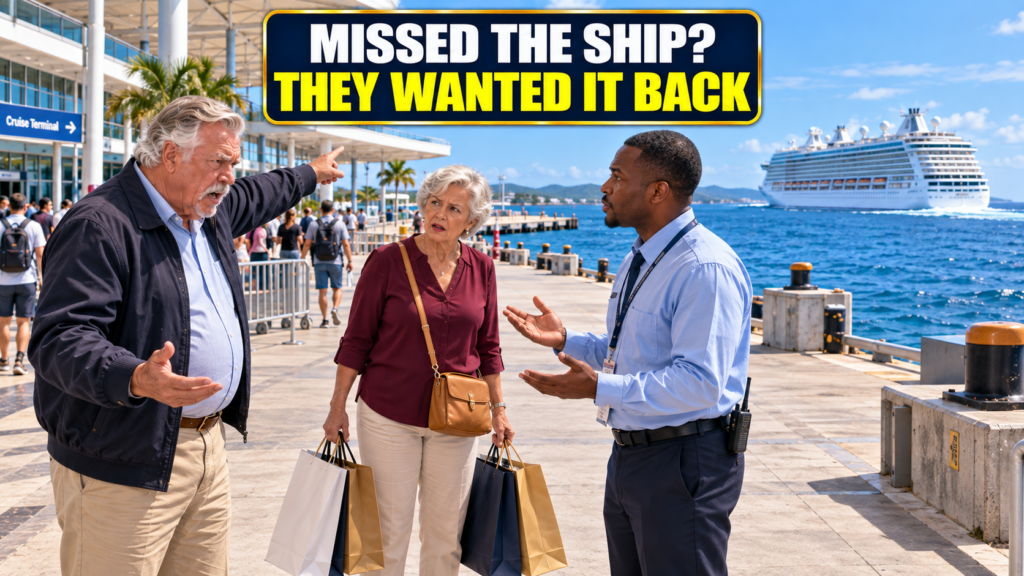
Robert spotted a port employee farther along the pier and immediately marched toward him.
Diane followed, still carrying all three bags.
The employee could probably tell what was coming before Robert even reached him.
Robert pointed toward the harbor.
“Call the captain! Tell him to come back!”
The employee remained calm.
“Sir, the ship has already departed.”
“I can see that.”
Robert pointed again.
“So call them.”
The employee explained that he could help the couple work out what options might be available, but bringing the ship back was not something he could simply arrange.
Robert stared at him.
“We paid for that cruise.”
Diane stepped closer.
“And our cabin is on there.”
Neither fact changed the position of the ship.
It continued moving across the harbor.
The employee tried again.
“Let’s figure out what you have with you.”
That wasn’t the answer Robert wanted.
He wanted a phone call.
A captain.
A ship turning around.
Something that transformed their mistake into somebody else’s responsibility.
Diane’s embarrassment was rapidly becoming irritation.
“Then tell him to turn around! We’re passengers!”
The employee looked at Diane.
Then his eyes dropped briefly toward her hands.
Three shopping bags.
Diane noticed.
Her expression tightened.
“We weren’t just wandering around,” she said defensively. “We were right near the port.”
Robert jumped back in.
“And we’re only a little late.”
But “a little late” looked very different when the ship was already separated from the pier by open water.
The employee didn’t argue about whose fault it was.
Instead, he focused on the problem in front of him.
Did they have identification?
Phones?
Payment cards?
Necessary medication?
Travel documents?
Information about the ship’s itinerary?
Each question seemed to make Robert a little quieter.
Their large suitcases were aboard.
Most of their belongings were aboard.
The cabin they had paid for was aboard.
And the ship was continuing its voyage without them.
Robert finally lowered his arm.
“So what are we supposed to do?”
It was the first useful question he had asked.
The employee explained that they needed to establish exactly what documents they had and then determine what legitimate travel options existed. Rejoining a cruise later isn’t necessarily as simple as racing to the next stop; the itinerary, local entry requirements and what the cruise operator permits can all matter.
For the first time, Diane stopped watching the ship.
She began searching her purse.
Robert patted his jacket pockets.
Then the employee asked the question that changed both their expressions.
“Do you have your passports with you?”
Robert looked at Diane.
Diane looked at Robert.
For the first time since reaching the pier, neither of them had anything to say.
PART 3 — THE MOST EXPENSIVE SHOPPING STOP
Diane opened her purse on a nearby bench.
The shopping bags were placed on the ground beside her.
Twenty minutes earlier, those bags had felt like trophies.
Now they looked ridiculous.
Robert stood over her while she checked one pocket after another.
“Please tell me you have them.”
“I’m looking.”
“You always carry the documents.”
“And you always tell me when we need to leave.”
That ended the conversation for several seconds.
Fortunately, they had enough of their important documents and essentials with them to begin working through the situation rather than simply standing on the pier arguing.
But there was no magical solution.
No private pickup.
No captain reversing course because Robert was angry.
The port employee helped direct them toward the people and information they needed to contact. From there, the couple had to determine what options were actually possible for their itinerary.
Robert’s attitude slowly changed.
He stopped asking when the captain was coming back.
Instead, he started asking practical questions.
Where could they go?
Who should they contact?
What information would they need?
Could they potentially rejoin later, if permitted and logistically possible?
And how much would fixing their mistake cost?
There was no single reassuring answer.
Every possibility involved something Robert had spent the entire afternoon pretending didn’t matter:
time.
Transportation had schedules.
Travel arrangements required planning.
Documents mattered.
The ship had an itinerary.
And buying passage to another location wouldn’t automatically guarantee that they could simply walk aboard at a later port.
Diane sat silently while Robert worked through the situation.
Eventually, she picked up one of her shopping bags and looked inside.
A few hours earlier, she had spent nearly ten minutes deciding whether she wanted one of the things in that bag.
Now she couldn’t remember why it had seemed important.
Robert sat beside her.
The harbor looked much larger without the ship at the pier.
Diane finally turned toward him.
“You said they wouldn’t leave without us.”
Robert rubbed a hand across his face.
“I thought they’d know we weren’t back.”
“They probably did.”
Robert looked at her.
That was the uncomfortable part.
Knowing two passengers were missing and being able to hold or reverse an operating ship indefinitely were not the same thing.
Robert had treated the return time like a suggestion because the ship was physically visible.
As long as he could see it, he had felt in control.
But a cruise ship doesn’t operate according to whether one passenger is still choosing between souvenirs.
Diane looked down at the bags again.
“We should’ve left after the first store.”
Robert gave a tired laugh.
“I said one store.”
“You came into the last one too.”
“I know.”
There was no point arguing anymore.
Whatever arrangements came next, they would now have to deal with them together.
Robert glanced toward the water one final time.
The ship that had seemed enormous from the shopping district was becoming smaller in the distance.
Nobody had turned it around.
Nobody had sent a private boat to collect them.
And the captain had not appeared at the pier to negotiate.
The port employee had done something far less dramatic and far more useful: he had helped them stop demanding the impossible and start dealing with the consequences of being late.
Diane gathered her shopping bags.
This time, she didn’t look particularly excited about carrying them.
Robert stood and checked his watch.
Diane noticed.
“Plenty of time?”
Robert looked at her.
She raised one eyebrow.
He decided not to answer.
They walked back toward the terminal together, three shopping bags swinging between them, while the ship continued toward its next destination.
Robert had been right about one thing that afternoon.
They had plenty of time.
They just chose to spend it shopping.
