
AIRPORT TIPS
Flight Attendants Wish Seniors Knew This Luggage Trick (I Do It Every Time!)
Sep
For many older travelers, the hardest part of flying does not happen at security, at the gate, or even during a long walk through the terminal. It happens during a few awkward seconds after stepping onto the airplane.
You reach your row, turn toward the overhead bin, grab your carry-on with both hands—and suddenly realize that the suitcase that seemed perfectly manageable while rolling through the airport feels dramatically heavier when you have to lift it above shoulder level.
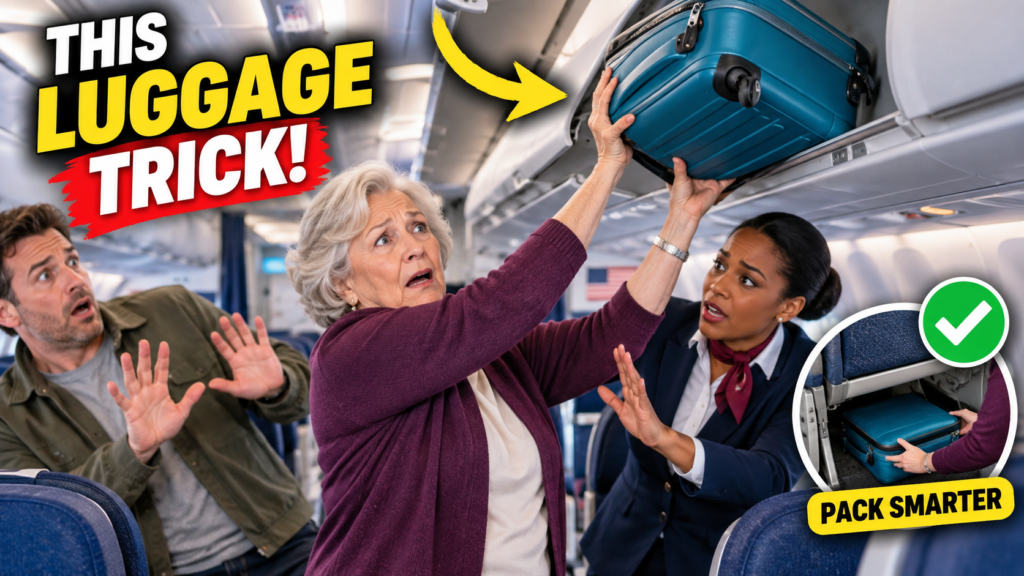
That is exactly why one simple packing strategy can make such a difference: do not make your overhead carry-on the heaviest bag you have to handle.
Instead, when the items and available space allow it, put heavier essentials in a properly sized personal item that can be safely stowed under the seat in front of you, while keeping the suitcase you expect to lift into the overhead bin lighter and easier to control.
This is more than a convenience trick.
The Federal Aviation Administration (FAA) specifically advises passengers to stow heavy items under the seat in front of them rather than overhead. The FAA also warns that carry-on items falling from overhead bins can injure passengers.
For senior travelers in particular, thinking about where the weight goes can make boarding less stressful and reduce unnecessary lifting.
But there are several important details travelers need to understand before simply moving everything heavy into a smaller bag.
The Real Problem With a Heavy Overhead Carry-On
A wheeled suitcase can be deceptive.
When you are moving through a terminal, most of its weight is supported by the floor. You extend the handle and roll it behind you. Even a fairly heavy bag may feel manageable.
Boarding changes the equation.
Now you may need to stop in a narrow aisle, rotate the suitcase, raise it above your shoulders and maneuver it into a compartment while other passengers are waiting behind you.
The movement requires much more than simply pulling a suitcase across a smooth airport floor.
A bag that was comfortable to roll can suddenly become difficult to control.
That matters because overhead-bin loading is not happening in an empty room. Other passengers may be standing nearby, people may be trying to reach their seats, and bags may already occupy part of the compartment.
If your suitcase begins slipping backward, there may be someone directly behind you.
The FAA addresses this risk directly in its carry-on baggage guidance. It warns that objects falling from overhead bins can cause injuries and advises passengers to stow heavy items under the seat in front of them instead of overhead.
That official guidance leads to a useful packing principle:
Think about lifting weight, not just total luggage weight.
The Luggage Trick: Make the Bag You Lift the Lighter One
Many travelers instinctively pack according to size.
Large items go into the suitcase.
Small items go into the personal item.
There is another way to think about it.
Before leaving home, divide your belongings according to weight, access and baggage rules.
Your overhead carry-on does not necessarily need to contain every dense item simply because it is the larger bag.
When appropriate, heavier essentials that you are permitted to carry and that fit comfortably in your personal item can remain closer to floor level.
Your personal item must still comply with your airline’s requirements and fit completely in the permitted under-seat space.
Meanwhile, the suitcase destined for the overhead compartment can contain more of the lighter items.
Think clothing rather than unnecessarily dense objects.
The goal is not to create an extremely heavy personal item.
The goal is to avoid concentrating unnecessary weight in a suitcase that you know you will need to lift overhead.
That distinction matters.
Why This Can Be Especially Helpful for Senior Travelers
Aging does not automatically mean someone needs assistance.
Many people in their 60s, 70s, 80s and beyond travel independently and handle their own baggage without difficulty.
The mistake is assuming that because you can comfortably roll a suitcase, you will necessarily be comfortable lifting that same suitcase overhead.
Those are different movements.
Even travelers who are perfectly comfortable walking through the terminal may prefer to avoid an awkward overhead lift.
This is where packing strategically before reaching the airport can help.
Instead of discovering the problem while standing in the aircraft aisle, test the bag at home.
Can you safely control it when lifting it?
If it feels uncomfortably heavy before your trip has even started, adding another sweater, book, toiletry bag or pair of shoes is unlikely to improve the situation.
Repack before leaving home.
That small decision can eliminate a surprisingly stressful moment during boarding.
Do Not Assume a Flight Attendant Must Lift Every Senior Passenger’s Bag
There is an important distinction here.
Being an older passenger by itself should not be confused with the disability-related assistance protections established by the U.S. Department of Transportation.
Travelers should therefore avoid boarding with an intentionally unmanageable suitcase based on the assumption that a flight attendant will automatically lift it for them.
If you know that lifting your carry-on will be difficult, deal with that problem before you are standing underneath the overhead compartment.
Pack lighter.
Redistribute appropriate items.
Check a bag when that makes more sense.
And check your airline’s baggage rules before traveling.
The situation is different for passengers with disabilities who need assistance.
Under DOT protections, passengers with disabilities have specific rights to assistance. DOT states that once a passenger with a disability has boarded, airlines must provide requested assistance that includes stowing and retrieving carry-on items, including assistive devices.
DOT also says airlines are required to help carry gate-checked or carry-on luggage when a passenger receiving airport assistance is unable to carry that luggage because of a disability.
If this applies to you, communicate what assistance you need.
Do not assume airline personnel automatically know.
Your Personal Item Still Has to Fit
The luggage trick has an obvious limit: the personal item cannot simply become an enormous second suitcase.
The FAA notes that a personal item needs to fit under the seat in front of you, and travelers should check their individual airline’s baggage rules.
Airline policies differ.
Carry-on dimensions can differ.
Personal-item dimensions can differ.
Aircraft can differ.
Available storage can differ.
That is why the best version of this strategy is not:
“Put everything heavy under your seat.”
It is:
“When appropriate, avoid putting unnecessary heavy items overhead; distribute your packing so the bag you must lift is easier to control.”
Your under-seat bag must fit where it is supposed to fit and must not interfere with required cabin safety arrangements.
Always check your airline’s current requirements rather than assuming that a bag accepted on one carrier will automatically be accepted on another.
Pack by Access as Well as Weight
Weight is only half of the trick.
Think about what you are likely to need during the flight.
Imagine putting your glasses, charging cable, headphones and reading material into your overhead suitcase.
You sit down.
You fasten your seat belt.
Then you remember that your glasses are above you.
Later you need your charger.
Then you want your sweater.
Each time, you may need to stand, open the overhead compartment, find the suitcase and retrieve something.
For travelers who find repeated standing or reaching uncomfortable, this is inefficient.
A well-organized personal item can serve as your in-flight access bag.
Appropriate items you expect to use can stay within easier reach.
The exact contents will vary by traveler, but the principle remains the same:
Pack according to what you will need and where you will need it.
Do not automatically place an item in the overhead suitcase just because there is room.
Medication Deserves Special Planning
Medication is one category where convenience and travel resilience overlap.
For passengers with disabilities, DOT specifically notes that assistive devices can include prescription medications and medical devices needed to administer those medications. DOT also advises travelers with disabilities to carry medicine or assistive devices such as syringes as carry-on items because passengers can unexpectedly become separated from checked baggage.
Even outside disability-specific situations, the underlying travel-planning lesson is useful: think carefully before placing something important in baggage that may become inaccessible.
Do not casually pack essential items based only on which suitcase has the most empty space.
Consider when you will need them and what would happen if a checked bag were delayed.
For questions about medications, screening, medical equipment or unusual items, verify the current requirements with the appropriate authority and your airline before traveling.
Assistive Devices Are Not Ordinary Carry-On Baggage
This is particularly important for some older passengers.
A cane, walker, wheelchair, CPAP machine or other qualifying assistive device should not automatically be treated like an ordinary personal item.
DOT states that assistive devices may include canes, crutches, walkers, wheelchairs, hearing aids, CPAP machines, portable oxygen concentrators, prescription medication and certain other equipment used by passengers with disabilities.
Qualifying assistive devices do not count toward the passenger’s baggage limit.
Depending on the device and available safe storage, an assistive device may be stowed in an overhead compartment, under the seat or in a designated stowage area.
If an assistive device cannot safely be accommodated in the passenger cabin, DOT provides requirements concerning its transportation in the baggage compartment.
That is why a traveler should not sacrifice necessary accessibility equipment simply to make room for ordinary vacation belongings.
Treat accessibility equipment as its own planning category.
Preboarding May Help Some Passengers With Disabilities
If you have a disability and need additional time or assistance to board or stow accessibility equipment, DOT protections may also be relevant.
DOT’s Airline Passengers with Disabilities Bill of Rights says airlines must allow a passenger with a disability who self-identifies at the gate as needing additional time or assistance to board, stow accessibility equipment or be seated an opportunity to preboard, subject to the applicable requirements and exceptions.
This can be valuable because the worst time to discover that you need assistance is after the aisle has become crowded.
If you qualify and need assistance, communicate that need to airline personnel.
Planning ahead can turn boarding from a rushed physical challenge into a much more orderly process.
What If Your Carry-On Gets Gate-Checked?
This is where another critical baggage rule enters the picture.
You may pack perfectly and still arrive at the gate to discover that your carry-on needs to be checked.
Overhead space is limited, particularly on some aircraft and busy flights.
FAA guidance tells travelers to be prepared for the possibility that an airline may require bags to be checked.
And if your carry-on is gate-checked or checked planeside, do not simply hand it over without thinking about the batteries inside.
The FAA says spare lithium batteries and power banks must be removed from a carry-on that is being gate-checked or planeside-checked and kept with the passenger in the cabin.
This is one reason I like keeping a small, organized personal item.
If my overhead suitcase unexpectedly has to leave the cabin, I want to be able to quickly identify anything that must stay with me.
I do not want to stand at the aircraft door digging through an overpacked suitcase while everyone waits.
Power Banks Belong in the Cabin
This deserves its own reminder because power banks have become such a normal part of travel.
A portable charger may feel like just another electronic accessory.
From an aviation-safety perspective, however, it contains a lithium battery.
FAA PackSafe guidance states that spare lithium batteries—including power banks—must be carried in carry-on baggage rather than checked baggage.
If the bag containing them is checked at the gate or planeside, they must be removed and kept in the aircraft cabin.
So when organizing your bags, do not bury a power bank somewhere you cannot easily locate.
Make it accessible.
That way, if your suitcase is unexpectedly tagged at the gate, you can comply without unpacking half your luggage.
The Three-Zone Packing Method
One simple way to organize your luggage is to think in three zones.
Zone 1: Under-Seat Personal Item
This is for permitted items that make sense to keep accessible and that fit within your airline’s personal-item requirements.
The FAA’s safety guidance supports putting heavy items under the seat rather than overhead, but the bag still needs to fit safely.
Think strategically rather than trying to cram everything possible into this space.
Zone 2: Overhead Carry-On
This is the bag you may physically have to lift.
That fact should influence how you pack it.
If you can shift appropriate dense items elsewhere while staying within all baggage and safety requirements, doing so can make the suitcase easier to control.
Clothing and other comparatively light belongings may make more sense here than concentrating every heavy object in the suitcase.
Zone 3: Checked Baggage
For some travelers, checking a suitcase is the better option.
There is no prize for carrying everything onto the aircraft.
However, checked baggage introduces another set of considerations.
Certain items must remain in the cabin, and FAA dangerous-goods rules apply to batteries and other materials.
Before moving something from carry-on to checked baggage, verify that it is permitted there.
Five Mistakes That Defeat the Trick
The first mistake is overloading the personal item.
Moving weight from one bag to another does not help if you create a personal item that is difficult to carry or does not fit under the seat.
The second is ignoring airline-specific dimensions.
A bag being called a “personal item” by its manufacturer does not guarantee that every airline will accept it as one.
The third is burying important items.
Anything you may need quickly should not be trapped beneath layers of clothing.
The fourth is forgetting battery rules.
If your carry-on is unexpectedly checked, you need to know which items must come out.
The fifth is waiting until you are aboard to solve a problem you already knew existed.
If you cannot comfortably control your suitcase at home, the narrow aircraft aisle will not magically make it easier.
A Better Five-Minute Packing Test
Before leaving for the airport, place your packed bags on the floor.
First, check your airline’s current size, number and weight requirements.
Then look at your overhead suitcase.
Ask yourself:
Can I safely control this bag during the kind of movement required to stow it?
Do not test yourself by attempting a dangerous overhead lift at home.
The point is simply to recognize when you have created a bag that is clearly too cumbersome for you to handle comfortably.
Next, inspect your personal item.
Does it comply with your airline’s requirements?
Can it fit under the seat as required?
Are the things you expect to use during the flight accessible?
Do you know where your batteries and power bank are?
Have you kept essential items appropriately available?
If your carry-on suddenly needs to be checked at the gate, do you know what needs to come out?
Five minutes spent answering those questions can prevent confusion later.
What Seniors Should Ask the Airline Before Flying
If you are uncertain about baggage, contact the airline rather than relying on something you remember from a previous trip.
Ask about the current carry-on allowance.
Ask about personal-item dimensions.
Ask about checked baggage if you are considering checking your larger suitcase.
If you have a disability and need assistance, explain the assistance you need rather than simply saying, “I’m a senior.”
That distinction helps airline personnel understand what service you are requesting.
DOT advises passengers with disabilities that they can arrange assistance such as wheelchair or guided assistance, seating accommodations related to disability needs and assistance involving the loading or stowing of assistive devices.
Many accommodations do not generally require advance notice, although DOT notes that advance notice can be required for certain services or equipment.
When your needs are more complex, contacting the airline ahead of time can make the airport experience easier.
This Is a Packing Strategy, Not a Secret Airline Rule
That distinction is important.
There is no universal federal rule saying:
“Senior citizens must pack their luggage this way.”
And this article should not be read as saying that every older traveler needs special baggage treatment.
The useful part is the combination of an official FAA safety recommendation and practical packing.
FAA guidance says heavy items should be under the seat rather than overhead.
From that guidance comes a sensible strategy:
When your baggage allowance, item type and available storage permit it, avoid creating an unnecessarily heavy overhead suitcase.
That is the “trick.”
It is simple enough that many travelers overlook it.
Why I Use This Approach Every Time
The biggest benefit is not saving thirty seconds during boarding.
It is predictability.
I know which bag is supposed to stay near me.
I know which suitcase may need to go overhead.
I know where important small items are.
I know where my power bank is if the larger bag suddenly has to be checked.
And I am not relying on another passenger or crew member to rescue me from a suitcase I knowingly packed too heavily.
For an older traveler—or anyone who simply wants an easier boarding experience—that organization can be worth far more than squeezing one more item into a carry-on.
The Bottom Line
The best luggage tricks are usually not secret loopholes.
They are small decisions made before you reach the airport.
For this one, remember a simple principle:
Do not unnecessarily concentrate heavy items in the suitcase you expect to lift overhead.
The FAA specifically recommends stowing heavy items under the seat in front of you rather than overhead. Your personal item must still fit properly, and your airline’s individual baggage restrictions still apply.
Keep the overhead suitcase manageable.
Keep important permitted essentials organized and accessible.
Know where your lithium batteries and power bank are in case your carry-on is gate-checked.
And if you have a disability and need assistance with baggage, boarding or an assistive device, communicate that need to the airline rather than struggling silently.
The smartest packing decision may be the one you barely notice once the flight begins—because boarding simply became easier.
