
CRUISE TIP
Don’t Cruise After 60 Without Knowing These 5 Secrets
Sep
Cruising after 60 can be one of the easiest and most enjoyable ways to travel.
You unpack once, wake up somewhere new, enjoy meals and entertainment without constantly changing hotels, and let the ship carry you from destination to destination.
But there is a side of cruising that many travelers don’t discover until something goes wrong.
And sometimes the mistake happens before you even step onto the ship.
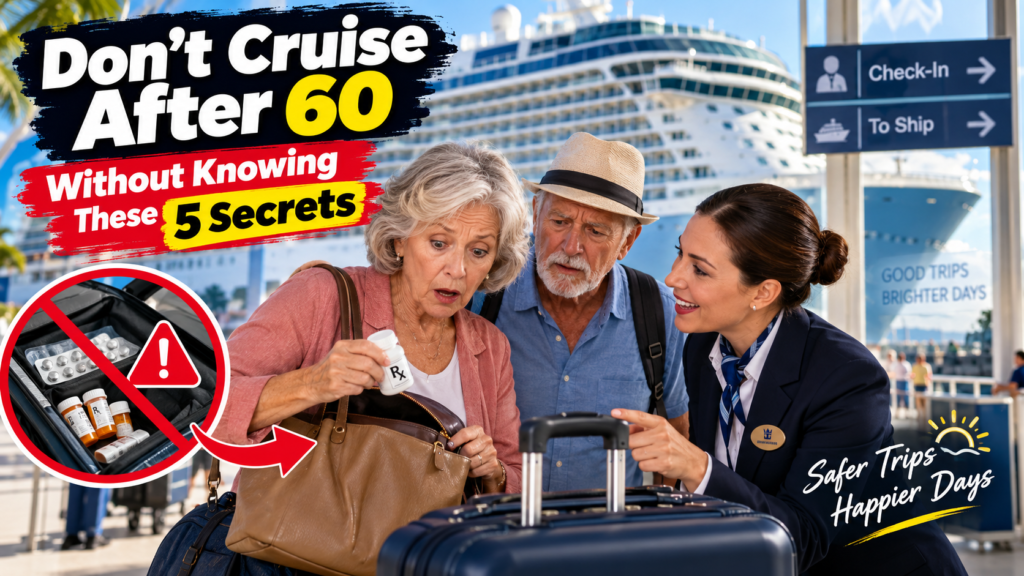
Imagine a 68-year-old woman standing inside a busy cruise terminal with her husband.
They have checked their large suitcase, finished the first stages of embarkation, and are preparing to continue toward the ship.
Then she suddenly reaches into her carry-on bag.
Her expression changes.
“Wait! All my medication is inside the suitcase I just checked!”
Her 70-year-old husband turns toward her.
“You packed ALL of it in there? You need some of that tonight!”
She looks toward the luggage area.
“I thought the suitcase would be in our cabin right after we boarded!”
A cruise employee notices their concern and approaches.
Instead of telling them to continue boarding and hope for the best, he asks for their luggage information and explains that he will contact the luggage team to see whether the bag can be located before they continue.
Then he gives them a piece of advice they will never forget:
Keep essential medication in your hand luggage—not in checked luggage.
That is Secret #1.
And for travelers over 60, especially those for whom medication, mobility or accessibility has become more important, there are four more things worth understanding before the next cruise.
These aren’t “senior perks” automatically awarded when you turn 60.
They are practical cruise-planning lessons that can make a major difference when you actually need them.
Secret #1: Never Put Essential Medication in Your Checked Luggage
This sounds obvious.
Until you’re standing in the terminal and realize you just did it.
Cruise embarkation is different from checking into a hotel.
You may hand over your larger luggage before boarding the ship, and you should not assume that you’ll immediately have access to that bag again.
Your suitcase may take time to reach your stateroom.
That is inconvenient if your swimsuit is inside.
It can become much more important if the bag contains medication you need.
Royal Caribbean’s current health and conduct policy specifically advises guests not to pack medication in checked luggage. Instead, medication should be carried onboard in hand luggage so it remains accessible.
The cruise line also advises passengers to bring enough required medication for the entire voyage and recommends carrying extra in case unexpected delays extend the trip.
There is another detail many travelers overlook.
Do not assume the ship’s medical center will necessarily stock the exact medication you use at home.
Cruise ships have medical facilities, but that doesn’t mean every prescription drug will be available onboard or in every port.
That makes your medication part of your essential travel kit.
Treat it the same way you treat your passport.
Build a “Never Check This Bag”
For travelers over 60, a small personal bag can be one of the most important pieces of luggage on the entire vacation.
Consider keeping essential medication, travel documents, identification, wallet, phone, valuables and other necessities in the bag that stays physically with you.
If you rely on glasses, hearing-related equipment or another small essential device, think carefully before separating yourself from it too.
The rule is simple:
If losing access to an item for several hours would create a serious problem, don’t casually put it in the checked suitcase.
Bring More Medication Than the Exact Number of Cruise Days
If your cruise lasts seven days, packing exactly seven days of essential medication leaves no margin for disruption.
Weather changes.
Transportation can be delayed.
Flights can be canceled.
Itineraries can change.
A problem after disembarkation can extend the journey home.
Your cruise line’s current medical guidance should always be checked before departure, and travelers with specific medical questions should also follow the advice of their own healthcare professionals.
But from a basic travel-planning standpoint, the lesson is clear:
Don’t plan your medication supply as though every part of your journey is guaranteed to happen exactly on schedule.
The Mistake Our Couple Almost Made
Back in the terminal, the employee does not promise the couple that their burgundy suitcase will magically reappear in thirty seconds.
Instead, he does the responsible thing.
He asks for identifying luggage information.
He contacts the appropriate luggage team.
And he tells them not to continue blindly without addressing the problem.
The husband asks:
“What if something like this happens on our next cruise?”
The employee answers:
“Keep essential medication in your hand luggage, not your checked suitcase.”
The wife looks surprised.
“Even if they’re delivering our luggage to the cabin?”
Yes.
Because luggage delivery is not the same thing as keeping an essential item immediately accessible.
That distinction can change your entire embarkation day.
Secret #2: Mobility Assistance May Be Available—But Being Over 60 Isn’t What Qualifies You
This is one of the biggest areas of confusion in senior cruise advice.
You may see claims online like:
“Over 60? Ask for priority boarding.”
Or:
“Seniors get free wheelchair service.”
Those statements are too broad.
Being 60, 65 or 70 does not automatically create a universal cruise-industry entitlement to priority treatment.
But passengers who have genuine mobility or disability-related needs may have important assistance available to them.
Royal Caribbean, for example, currently states that it provides complimentary wheelchair assistance for embarkation and disembarkation for guests with mobility disabilities.
It also lists boarding and departure assistance among its accessibility services.
That is very different from saying:
“Everyone over 60 gets a wheelchair.”
Think About Function, Not Birthday
A healthy 72-year-old who walks several miles every day may need no mobility assistance whatsoever.
A 62-year-old with a significant mobility limitation may need considerable assistance.
Age alone doesn’t tell the story.
Before your cruise, think realistically about what you can comfortably manage.
Cruise terminals can involve significant walking.
Ships can be enormous.
A cabin located far from an elevator may require repeated long walks every day.
Gangways can vary in steepness.
Port days can involve buses, uneven pavement, stairs and long distances.
Don’t wait until you’re exhausted to start thinking about mobility.
Request Assistance Before the Cruise When Appropriate
Royal Caribbean currently encourages guests to communicate accessibility needs when booking and requests advance notice for certain equipment and services.
For pier assistance, its published guidance advises contacting the company in advance so assistance can be prioritized.
Even when wheelchair assistance is available, peak embarkation periods can involve waiting.
This is why planning ahead matters.
If you know you’ll need assistance, contact the cruise line’s accessibility department rather than simply arriving at the terminal and assuming everything will happen instantly.
Wheelchair Assistance at Embarkation Isn’t Necessarily a Wheelchair for the Entire Vacation
This distinction is extremely important.
A cruise line providing wheelchair assistance for boarding does not necessarily mean it is providing you with a personal wheelchair for seven days.
Royal Caribbean’s published guidance says its complimentary wheelchair assistance is for embarkation and disembarkation.
Guests who need a wheelchair or scooter during the cruise may need to bring their own or arrange an appropriate rental.
If you’re traveling with mobility equipment, also verify dimensions and storage requirements before sailing.
Royal Caribbean, for example, requires assistive devices such as scooters to be stored and charged in the guest’s stateroom rather than left blocking corridors or elevator areas.
This is exactly the kind of detail that is much easier to solve before vacation than at the terminal.
Secret #3: Tell the Cruise Line What You Need Before You Sail
Some travelers hate asking for help.
They worry that they are being difficult.
So they say nothing during booking.
Nothing before departure.
Nothing during online check-in.
Then they arrive at the pier expecting crew members to instantly understand their needs.
That can create unnecessary problems.
If you have an accessibility need, contact the cruise line early.
Royal Caribbean currently encourages passengers to notify the company of their needs at booking. Its accessibility information specifies advance-notice periods for certain services and equipment.
Why?
Because some accommodations require preparation.
Equipment may need to be arranged.
Transportation may need to be coordinated.
A suitable stateroom may need to be reserved.
Shore excursion options may need to be identified.
The earlier the cruise line understands what you actually need, the better the opportunity to determine what can be provided.
Don’t Just Say “I’m a Senior”
That doesn’t tell the accessibility team very much.
Instead, explain the practical need.
For example:
You use a wheelchair full-time.
You travel with a mobility scooter.
You need assistance during embarkation.
You require accessible bathroom features.
You cannot comfortably navigate stairs.
You use specific accessibility equipment.
The objective is not to disclose unnecessary personal information.
The objective is to give the cruise line enough relevant information to understand what accommodation or service you’re requesting.
Not Every Service Can Be Arranged at the Last Minute
Cruise ships are large, but resources are not infinite.
Ports are different.
Vehicles are different.
Accessible shore transportation may be limited.
Specialized equipment may require advance arrangements.
Waiting until embarkation morning can reduce your options.
A five-minute conversation weeks before the cruise may prevent a much more frustrating conversation at the pier.
Secret #4: An Accessible Cabin Is Not a “Free Bigger Room Hack”
This may be the most important myth to kill.
Accessible staterooms can be larger or configured differently from standard cabins because they are designed to accommodate specific accessibility needs.
That does not make them a secret cabin-upgrade trick for older passengers.
Royal Caribbean states that its accessible staterooms are intended for guests with mobility disabilities or other disabilities requiring the accessible features provided.
Those features can include wider doorways, increased turning space, roll-in showers, grab bars, lowered fixtures and other accessibility-oriented design elements.
Those rooms exist for a reason.
Don’t Book One Just Because You’re Over 60
Age alone is not the point.
Need is.
Royal Caribbean’s current accessible-stateroom policy says guests reserving these cabins must acknowledge their need for the accessible features through its Guest Special Needs process.
It also states that someone occupying an accessible cabin without a disability requiring those features may be moved to a non-accessible stateroom so the accessible room can accommodate a guest who needs it.
So if someone online tells you:
“Here’s a secret: book the wheelchair cabin because it’s bigger.”
Ignore that advice.
Accessible inventory can be limited, and those features may be essential to another passenger.
But If You Genuinely Need the Features, Ask About Them
The opposite mistake is also common.
A traveler genuinely needs an accessible cabin but hesitates to book one because they don’t understand what it provides.
If mobility has become difficult, research the cabin design before booking.
Look at doorway width.
Bathroom access.
Shower configuration.
Turning space.
Bed access.
Storage.
Distance from elevators.
And whether your mobility device can actually fit through the relevant doorway.
The “secret” is not getting extra square footage.
The secret is booking the right cabin for your actual needs.
Cabin Location Can Matter Even Without an Accessible Cabin
Even travelers who don’t require an accessible stateroom should think about location.
A giant cruise ship can involve substantial walking.
If you know repeated long walks are uncomfortable, study the deck plan before selecting your room.
A cabin that looks like a bargain may feel less attractive after you’ve walked the length of the ship multiple times per day.
Think about which places you’ll use most.
Dining.
Elevators.
Theater.
Pool deck.
Guest Relations.
Gangway access.
You don’t need to eliminate walking.
You simply need to avoid accidentally making every activity harder than necessary.
Secret #5: A Ship Can Be Accessible While a Port or Excursion Isn’t
This is the secret that can completely change a port day.
You researched the ship.
You booked an accessible stateroom.
You arranged mobility equipment.
Everything onboard works beautifully.
Then the ship reaches a destination.
And suddenly the situation changes.
Why?
Because accessibility doesn’t stop at the ship’s door.
Ports Are Different
Royal Caribbean’s current accessibility guidance explains that factors such as gangway steepness, tender operations, weather, tides, sea conditions and shore-side facilities can affect whether passengers using assistive devices can get on or off the ship.
That means:
“The ship is accessible”
does not automatically mean:
“Every destination on the itinerary will be equally accessible.”
This is especially important when tendering is involved.
What Is a Tender Port?
Sometimes a cruise ship doesn’t dock directly at a pier.
Instead, it anchors offshore and passengers travel between the ship and land using smaller vessels generally called tenders.
For many passengers, this is simply another part of the port experience.
For someone with significant mobility limitations, it can become a major planning issue.
Royal Caribbean’s published guidance says that at many tender operations, guests may need to be able to take some steps and use a collapsible manual wheelchair.
Motorized wheelchairs and mobility scooters may not be able to use tenders unless roll-on capability is available.
And even a port originally expected to use a pier can sometimes change to tendering.
So if getting ashore at a particular destination is important to you, research the situation before booking—and verify the latest information again closer to sailing.
Accessible Excursions Are Not Available Everywhere
Another common assumption is that every cruise excursion can simply accommodate a wheelchair.
That isn’t true.
Royal Caribbean notes that historical locations, uneven terrain, steps, inclines and narrow sidewalks can make some tours unsuitable for wheelchairs or scooters.
Accessible excursions may be available at certain ports depending on appropriate transportation and local infrastructure.
The company also requests information about mobility devices for accessible excursion planning, including dimensions and weight.
This is not paperwork for the sake of paperwork.
A vehicle lift has physical limits.
A ramp has physical limits.
A mobility scooter has dimensions.
Those details determine what is actually possible.
Don’t Wait Until the Morning of the Excursion
If an accessible port experience is important to you, research it before the cruise.
Ask:
Does this port dock or tender?
Could tendering affect my ability to go ashore?
Is accessible transportation available?
Does the excursion involve stairs?
Is the terrain uneven?
Can my mobility device be accommodated?
Is an able-bodied companion required for a particular accessible excursion?
What information does the cruise line need from me?
Those questions are far more useful than simply asking:
“Is this excursion senior-friendly?”
“Senior-friendly” can mean almost anything.
Accessibility requirements are specific.
Bonus Secret: Cruise Crew Members Are Not Personal Caregivers
This point is uncomfortable but extremely important.
Cruise crew members can provide many forms of reasonable assistance.
But there are limits.
Royal Caribbean’s current health and conduct policy states that crew members are not required to assist passengers with personal tasks such as eating, dressing or toileting.
It also advises travelers who require such personal assistance to consider those needs when planning their cruise.
That means a passenger who needs significant daily personal care should not assume a cabin attendant or another crew member will function as a personal caregiver.
If you need that level of assistance, plan for an appropriate companion or discuss your circumstances with the cruise line’s accessibility department before booking.
This isn’t about discouraging anyone from cruising.
It is about planning for the support you actually need rather than discovering the limitation after the ship has sailed.
Why These Secrets Matter More After 60
Again, turning 60 doesn’t suddenly change the cruise rules.
There is no universal switch that activates five hidden senior benefits on your birthday.
But travel priorities can change over time.
Maybe you now take daily medication that you didn’t need ten years ago.
Maybe walking long distances has become more tiring.
Maybe stairs are harder.
Maybe your spouse uses a cane.
Maybe you need a mobility scooter for longer excursions.
Maybe you simply want a less stressful vacation.
That is why these five secrets matter.
They aren’t about age discrimination or special treatment.
They’re about planning intelligently for how you travel today.
A Smart Pre-Cruise Checklist for Travelers Over 60
Several weeks before departure, review your cruise with fresh eyes.
Start with medication.
Do you have enough for the voyage plus a reasonable buffer?
Will all essential medication remain in your hand luggage?
Do you have the information you may need regarding your prescriptions?
Next, think about mobility.
How much walking can you comfortably manage?
Do you need embarkation or disembarkation assistance?
Are you bringing a wheelchair, walker or scooter?
Does it meet the cruise line’s requirements?
Then check the cabin.
Is its location practical?
If you genuinely need accessibility features, have you reserved the appropriate type of stateroom and completed the required accessibility process?
Now look at every port.
Dock or tender?
Accessible transportation?
Uneven terrain?
Long walks?
Steps?
Mobility-device restrictions?
Finally, consider your support needs.
Can you independently manage your personal daily needs?
If not, have you planned appropriate assistance?
That checklist may not be exciting.
But it can prevent some of the most frustrating cruise surprises.
What to Keep in Your Embarkation-Day Carry-On
Your embarkation bag deserves more thought than many travelers give it.
At minimum, consider the items you absolutely cannot afford to lose access to for several hours.
Essential medication belongs near the top of that list.
Then consider:
Passports and travel documents.
Government-issued identification.
Wallet and payment methods.
Phone.
Important medical or accessibility information.
Small valuable items.
Essential personal aids.
Anything you may need before your checked luggage arrives.
The exact list will differ from traveler to traveler.
The principle remains the same:
Your checked suitcase is for things you can temporarily live without.
Your carry-on is for the things you cannot.
What Not to Assume Just Because You’re Over 60
Do not assume you automatically receive priority boarding.
Do not assume a wheelchair will be provided for your entire vacation.
Do not assume an accessible cabin is simply a larger room available as a senior hack.
Do not assume every excursion can accommodate every mobility device.
Do not assume ship employees can provide personal caregiving.
And definitely do not assume essential medication is safe to pack away simply because your suitcase is supposed to arrive at the cabin later.
Instead, ask what applies to your actual need.
That distinction matters.
Five Questions to Ask Before Booking Your Next Cruise
Before paying the final balance, ask yourself:
1. What medication and essential medical items must remain with me at all times?
2. Will I need mobility assistance at embarkation, onboard, in ports or during disembarkation?
3. Does my cabin location and configuration match my actual mobility needs?
4. Can I comfortably participate in the ports and excursions I’m booking?
5. Have I told the cruise line about accessibility needs that require advance planning?
If you can answer those five questions confidently, you’re already approaching the trip differently from many passengers.
The Biggest Mistake Is Waiting Until Something Goes Wrong
Remember the woman standing in the cruise terminal?
Her problem didn’t begin when she needed her medication.
It began earlier.
It began when an essential item went into a bag she would no longer control.
Fortunately, a cruise employee noticed the problem and helped her determine what to do next.
But the better outcome would have been avoiding the situation entirely.
The same applies to accessibility.
Don’t wait until embarkation to mention that you need specialized assistance if it could have been arranged in advance.
Don’t wait until you’re standing beside a tender boat to discover your scooter cannot necessarily go with you.
Don’t wait until you open your cabin door to start wondering whether your mobility device fits.
And don’t wait until you’re exhausted from walking to realize your cabin is much farther from the places you use than expected.
The best senior cruise “secret” isn’t really a secret at all.
It’s preparation.
Final Thoughts: Don’t Cruise After 60 Without Knowing These 5 Secrets
Cruising after 60 doesn’t need to become more complicated.
In many ways, good planning can make it easier.
Just remember these five things.
First: Keep essential medication in your hand luggage and bring an adequate supply.
Second: If you have genuine mobility or disability-related needs, investigate embarkation and disembarkation assistance before sailing.
Third: Tell the cruise line about accessibility needs early enough for appropriate arrangements to be considered.
Fourth: Use accessible staterooms when you genuinely need their features—not as a trick to obtain a larger cabin.
Fifth: Research ports, tenders and shore excursions instead of assuming accessibility onboard guarantees accessibility ashore.
None of those lessons means every traveler over 60 needs special assistance.
Many don’t.
The point is knowing what exists before you need it.
Because the worst time to learn an important cruise rule is when your suitcase has already disappeared into the luggage system, your ship is about to leave, or the excursion you’ve been dreaming about is waiting on the other side of a tender you didn’t know you might have trouble boarding.
Our 68-year-old traveler learned her first lesson at the terminal.
Her husband looked at her after the employee explained the medication rule.
“We’re over sixty and nobody ever explained that to us.”
She looked back at the employee.
“If THAT is one of the secrets… what are the other four?”
Now you know.
