
CRUISE NEW
HE MOVED ONE PIECE OF FURNITURE IN HIS CRUISE CABIN — THEN SAW A $5,000 DAMAGE CLAIM

Sep
PART 1 — “I Only Moved It a Few Feet”
By the third afternoon of their cruise, Darnell Carter had found exactly one thing he disliked about their balcony cabin.
It wasn’t the bed. It wasn’t the bathroom. It wasn’t even the limited storage space that his wife, Susan, had warned him about before they packed.
It was the heavy lounge chair positioned between the sitting area and the balcony door.
Darnell was seventy, broad-shouldered, heavyset, and still convinced that anything with four legs could be moved if you put enough muscle behind it.
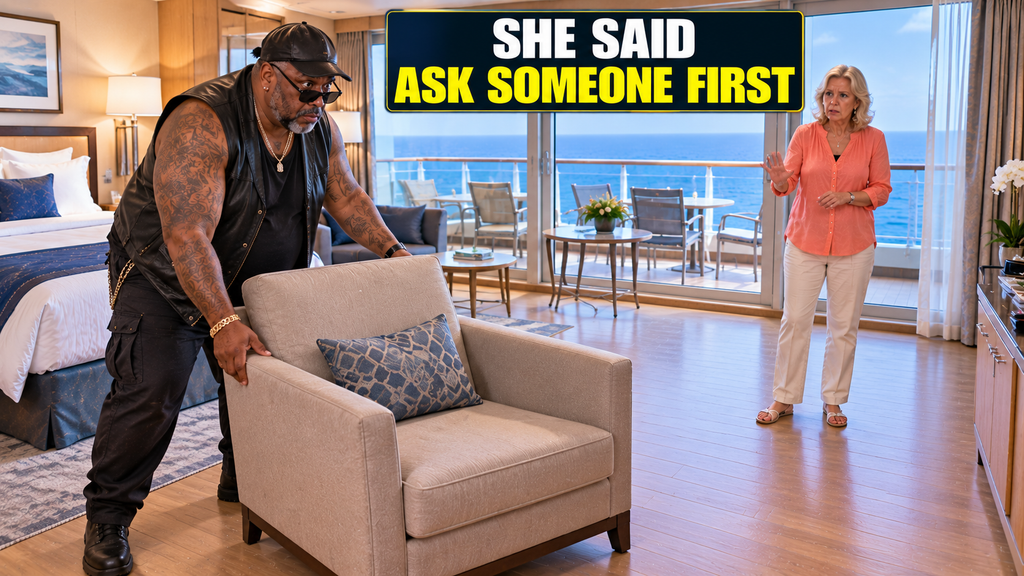
He stood in front of the chair with his hands on his hips.
“This thing takes up half the room.”
Susan looked up from the small table where she had been organizing their belongings.
“It was there when we arrived.”
“That doesn’t make it a good place for it.”
Susan knew that tone.
She had been married to Darnell long enough to recognize the difference between him making an observation and him announcing a decision.
“Maybe we should ask someone before moving it.”
Darnell stared at her over the top of his sunglasses.
“Susan, it’s our cabin for the week. I’m moving a chair, not rebuilding the ship.”
He gripped the furniture and started dragging it sideways.
Susan immediately heard the sound.
Scrrrraape.
“Darnell.”
He kept pulling.
Another harsh scraping sound traveled across the cabin floor.
“Darnell, stop.”
He finally released the chair several feet away.
“There.”
He stepped backward and admired the extra space he had created.
“Tell me that isn’t better.”
Susan wasn’t looking at the chair.
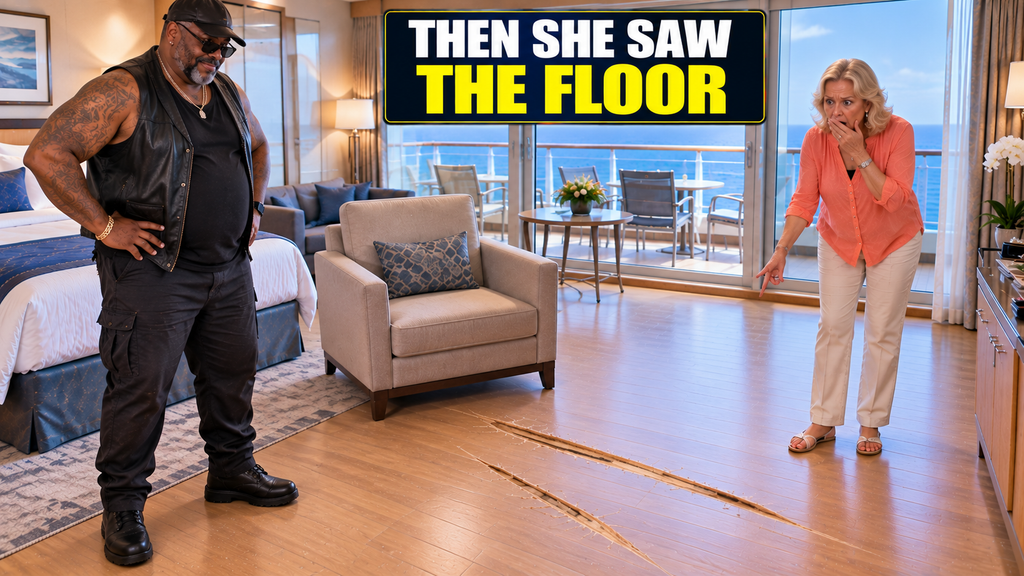
She was looking at the floor.
Two long marks stretched across it.
One looked superficial.
The other didn’t.
She crouched slightly without touching it.
“You scratched the floor.”
Darnell glanced down.
His expression barely changed.
“They can polish that out.”
“You don’t know that.”
“It’s a floor, Susan.”
She wanted to argue, but Darnell was already enjoying his newly arranged cabin.
For nearly an hour, nothing happened.
Then came a knock.
A crew member stood outside. His name was Malcolm, and his calm demeanor immediately contrasted with Darnell’s suspicious expression.
Malcolm stepped only far enough inside to inspect the cabin after speaking with them.
His attention went first to the displaced furniture.
Then to the floor.
He followed the marks with his eyes from one position to the other.
Darnell folded his arms.
“Something wrong?”
Malcolm remained professional.
“Was this furniture moved, sir?”
“Yeah. I moved it.”
Susan said nothing.
Malcolm looked more closely at the damaged area.
“I’ll need to document this.”
Darnell unfolded his arms.
“Document what?”
“The floor appears to have been damaged when the furniture was moved.”
Darnell gave a short laugh.
“Damage?”
He pointed toward the chair.
“I moved one piece of furniture.”
Malcolm didn’t argue.
He simply looked down at the gouges again.
And for the first time, Susan noticed that one of them was much deeper than it had appeared from across the room.
PART 2 — THE ARGUMENT
Darnell’s irritation grew the moment Malcolm began documenting the condition of the floor.
“This is ridiculous.”
Susan stood several feet behind her husband.
“Darnell, just let him explain.”
“I am letting him explain.”
He wasn’t.
Every time Malcolm started a sentence, Darnell interrupted.
“I paid for this cabin.”
“I understand, sir.”
“I didn’t throw anything.”
“I understand.”
“I didn’t break the chair.”
Malcolm nodded.
“The furniture itself isn’t the issue.”
“Then what is?”
Malcolm gestured toward the floor.
“That is.”
Darnell looked down.
To him, they were still scratches.
To Susan, they were starting to look considerably worse.
Malcolm explained that the damage needed to be assessed before anyone could tell them what would happen next.
That should have ended the conversation.
Instead, Darnell interpreted it as proof that the problem wasn’t serious.
“So nobody even knows what it costs.”
“I didn’t say that, sir.”
“But you don’t have a number.”
“Not yet.”
Darnell turned toward Susan with a look that practically said I told you so.
Malcolm eventually left.
For the next hour, Darnell complained about the encounter.
“They’re going to buff it.”
Susan was less certain.
“You dragged something heavy across the floor.”
“I moved it three feet.”
“It sounded like you were dragging a refrigerator.”
That finally made Darnell laugh.
The tension eased.
Briefly.
Later, another knock came at the cabin door.
Malcolm had returned with documentation concerning the fictional damage assessment.
Darnell immediately stood.
“All right. How much to polish the scratches?”
Malcolm didn’t react to the phrasing.
“Sir, the assessment is not treating these as superficial marks.”
Darnell’s smile disappeared.
“What does that mean?”
“The affected flooring has been assessed as requiring repair.”
Darnell looked toward the marks, then back at Malcolm.
“So what are you telling me?”
Malcolm held the paperwork securely in his own hand.
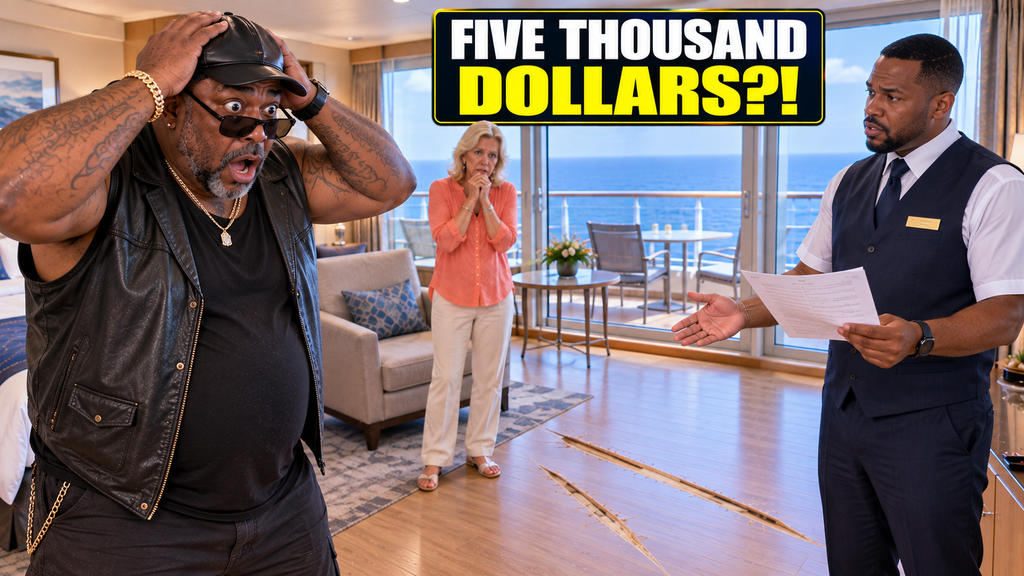
“Based on the damage assessment for this incident, the compensation claim is five thousand dollars.”
Silence.
Darnell didn’t move.
Susan’s eyes went straight to her husband.
He slowly lowered his sunglasses.
“What?”
“Five thousand dollars.”
Darnell’s eyes widened.
His mouth opened.
Then the volume arrived.
“FIVE THOUSAND DOLLARS?!”
Malcolm remained still.
“For moving one piece of furniture?!”
“Darnell—”
“No. Five thousand dollars for scratches?”
Susan’s voice became quieter.
“Honey… please. Don’t make this worse.”
But Darnell was staring at the paperwork as though it had personally insulted him.
He pointed toward the floor.
“That is not five thousand dollars.”
Malcolm answered calmly.
“I can explain what was documented.”
“I want more than an explanation.”
Darnell’s anger was changing now.
Underneath it was something Susan recognized immediately.
Concern.
Five thousand dollars was no longer an argument about a chair.
It was real money.
Darnell took another look at the damaged floor.
Then at the paperwork.
His voice dropped slightly.
“Show me.”
Malcolm waited.
“Show you what, sir?”
Darnell pointed at the document.
“Show me exactly what you say I did that costs five thousand dollars.”
For the first time since the argument began, Darnell stopped talking.
And started listening.
PART 3 — WHAT THE PAPERWORK SHOWED
Malcolm did not ask Darnell to simply accept the number.
Instead, he walked him through what had been documented in this fictional incident.
The first mark was long but comparatively shallow.
The second was the problem.
The heavy furniture had not glided evenly across the floor. One part of its base had dug into the surface while Darnell pulled it.
That explained the sound Susan had heard.
The scrape hadn’t merely traveled across the top.
It had gouged into the flooring along part of the route.
Darnell crouched enough to inspect it more carefully.
For the first time, he could see the depth.
He stood again.
“That came from the chair?”
Malcolm answered carefully.
“The documented damage follows the path between the furniture’s original position and where it was moved.”
Susan looked at her husband.
“I told you it sounded bad.”
Darnell didn’t respond.
Malcolm continued explaining the assessment and the documentation associated with the claimed repair.
Darnell listened for perhaps thirty seconds.
Then he interrupted—but this time his voice was controlled.
“Wait.”
Malcolm stopped.
“You’re telling me five thousand dollars. I want to know exactly what I’m being charged for.”
“That’s a reasonable question.”
Those six words changed the atmosphere.
Darnell had expected another confrontation.
Instead, Malcolm showed him where the relevant information appeared in the fictional assessment and explained how he could raise questions about it through the review process available within the story.
No threats.
No security officers suddenly appeared.
No additional penalty was invented because Darnell had argued.
The issue remained exactly what it had been from the beginning:
the damaged floor and the $5,000 compensation claim associated with this fictional incident.
Susan moved closer to Darnell, though she still gave him space.
“Can we just read everything before you yell again?”
Darnell looked at her.
“I wasn’t yelling.”
Susan raised an eyebrow.
Malcolm wisely said nothing.
Darnell looked back at the paperwork.
“All right. Maybe I was yelling.”
It was the first sign that the confrontation was cooling.
He asked several more questions.
What portion of the flooring was considered affected?
What exactly had been documented?
Could he challenge or request review of the assessment?
Malcolm answered what he could and directed him to the process described in the fictional paperwork for anything requiring further review.
Darnell was still unhappy.
Very unhappy.
But he was no longer arguing that nothing had happened.
That distinction mattered.
He walked back toward the displaced furniture and stared at the route he had dragged it across.
From that angle, the damage seemed obvious.
Susan stood behind him.
“I asked you to call somebody.”
Darnell remained silent.
She waited.
He finally turned.
“You did.”
“And what did you say?”
Darnell frowned.
“Susan.”
She almost smiled.
“What did you say?”
He knew exactly what she wanted.
He sighed.
“I said I was moving a chair, not rebuilding the ship.”
Susan looked down at the gouged floor.
“That line didn’t age particularly well.”
Even Malcolm struggled to hide a brief smile.
Darnell noticed.
For a second, Susan thought her husband might become angry again.
Instead, he shook his head.
“Okay. That one was good.”
The argument was over.
The dispute about the amount wasn’t necessarily over, and Darnell still intended to review every part of the claim before agreeing with it.
But something had changed.
He no longer treated the damage itself as imaginary.
Later, after Malcolm had left, Darnell sat quietly with the paperwork.
The heavy chair remained exactly where he had dragged it.
Susan began getting ready for dinner.
After several minutes, she looked over.
“You still mad?”
“Yes.”
“At me?”
“No.”
“At them?”
Darnell considered it.
“At everybody.”
Susan laughed softly.
Then Darnell looked once more at the long marks across the cabin floor.
His expression changed.
“All that because I wanted three more feet of space.”
Susan picked up her bag.
“Next time, we call somebody.”
Darnell stared at the furniture.
Then at the paperwork.
Then at the floor.
“Next time,” he said, “I’m not touching anything.”
Susan opened the cabin door.
“That works too.”
Darnell followed her out, leaving behind the chair he had been so determined to move.
A decision that had taken only seconds had turned into the biggest argument of their cruise—and, in this fictional story, a $5,000 damage claim he certainly hadn’t expected when he first put his hands on that chair.
