
CRUISE TIP
TIMES OF YEAR YOU SHOULD AVOID CRUISING — DID YOU KNOW?
Sep
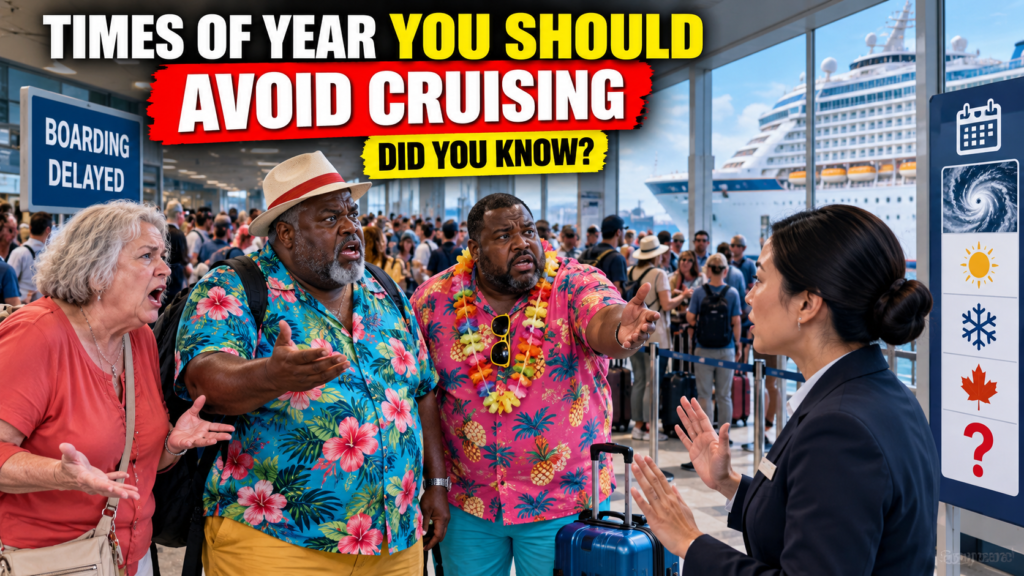
Imagine arriving at the cruise terminal ready for vacation.
Your luggage is packed. Your documents are ready. The ship is sitting outside. You can practically picture yourself on deck with the ocean in front of you.
Then you join the line.
One hour passes.
Then two.
Then three.
People start sitting on their suitcases. Others keep checking their phones. Tempers rise. A passenger finally walks up to an employee and demands:
“THREE HOURS! We’ve been standing here for THREE HOURS and we still can’t board?!”
Someone else points at the enormous line:
“Some people have been waiting almost FOUR HOURS!”
In our dramatized example, the cause of that delay is deliberately unspecified. A long embarkation delay can happen for different reasons, and a three- or four-hour wait should not be presented as normal cruise boarding.
But the scene raises a bigger question:
Are there certain times of year when cruising becomes less predictable?
Yes.
And if you’re choosing a cruise based on sunshine, smooth logistics, specific ports or avoiding crowds, the date on your booking can matter almost as much as the ship.
That doesn’t mean there is one universal “worst month to cruise.”
There isn’t.
The Caribbean, Alaska, Mediterranean, Mexican Riviera, Hawaii and South Pacific all have different weather patterns and operating seasons.
But there are definitely periods when certain cruisers should think twice before booking.
Here are the times of year you should avoid cruising—or at least approach more carefully—depending on what matters most to you.
1. Mid-August Through Mid-October: Think Carefully About Caribbean Cruises
If itinerary predictability is your priority, this is probably the most important period on the list.
The Atlantic hurricane season officially runs from June 1 through November 30, according to the U.S. National Hurricane Center. But tropical activity is not evenly distributed throughout those six months.
The climatological peak of Atlantic hurricane season occurs around September 10, and the period from roughly mid-August through mid-October contains a large concentration of Atlantic tropical activity.
That makes late summer and early fall a period worth considering carefully when booking cruises involving the Caribbean, Bahamas and other Atlantic-influenced destinations.
But here’s the crucial distinction:
Hurricane season does NOT mean your cruise will encounter a hurricane.
Ships continue sailing throughout hurricane season.
Many passengers take cruises during these months without a hurricane disrupting their vacation at all.
The real issue is increased uncertainty.
If a tropical system threatens an itinerary, a cruise line may need to alter its plans.
That can mean changing ports, changing the order of port calls, adjusting arrival or departure times, or taking a different route.
Royal Caribbean, for example, states that it monitors weather conditions and can modify itineraries when necessary to avoid tropical systems and protect guests, crew and ships.
So the smarter question isn’t:
“Is it safe to cruise during hurricane season?”
It’s:
“How disappointed would I be if my itinerary changed?”
If you’re booking primarily because you absolutely must visit one specific island on one specific day, peak tropical-weather season may not be your ideal choice.
If you’re flexible and mainly want to enjoy the ship, the calculation may be very different.
2. September Deserves Special Attention in the Atlantic and Caribbean
If there is one month that deserves a prominent warning in a discussion about times of year you should avoid cruising, it’s September—specifically for Atlantic and Caribbean weather risk.
The reason is climatology, not clickbait.
The National Hurricane Center identifies approximately September 10 as the climatological peak of Atlantic hurricane season.
That doesn’t mean a hurricane appears on September 10 every year.
It doesn’t mean September cruises are unsafe.
And it certainly doesn’t mean every September itinerary gets changed.
It means that, historically, this period sits near the peak of Atlantic tropical-cyclone activity.
That’s an important distinction.
Who Should Think Twice About a September Caribbean Cruise?
September may be less attractive if you:
- become very anxious about tropical-weather forecasts,
- have little flexibility if embarkation or transportation plans change,
- are emotionally committed to visiting every advertised port,
- dislike the possibility of itinerary changes,
- or are planning a major once-in-a-lifetime event around a particular destination.
On the other hand, a traveler who understands the risk and is flexible may make a completely different decision.
That’s why calling September simply “the worst month to cruise” is too broad.
September is a higher-consideration period for some regions and some travelers—not a universal no-cruise month.
3. Don’t Treat the Entire June–November Hurricane Season as Equally Risky
One of the biggest mistakes in cruise advice is turning:
“Atlantic hurricane season runs June 1–November 30”
into:
“Never cruise June through November.”
Those statements are not equivalent.
The official Atlantic season covers six months, but activity varies considerably within that window. NOAA and the National Hurricane Center’s climatology show the strongest concentration of Atlantic activity in late summer and early fall.
So a June Caribbean cruise and a September Caribbean cruise do not have identical climatological profiles simply because both occur during the official hurricane season.
Likewise, November 1 doesn’t automatically mean a hurricane will appear just because the official season hasn’t ended.
Use the season as a risk window, not a guarantee of bad weather.
4. Don’t Assume Hurricane Season Is the Same Everywhere
Here’s something many first-time cruisers don’t realize:
“Hurricane season” isn’t one universal worldwide calendar.
The familiar June 1–November 30 dates apply to the Atlantic season.
The Eastern North Pacific season officially begins earlier, on May 15, and continues through November 30.
That matters for itineraries involving Mexico’s Pacific coast and other destinations influenced by Eastern Pacific tropical systems.
The Central Pacific, relevant to Hawaii, also has its own tropical-cyclone considerations.
Other parts of the world have completely different cyclone seasons.
The Northwest Pacific can experience tropical cyclones throughout the year, while Southern Hemisphere cyclone seasons follow different seasonal patterns from the Caribbean.
So don’t watch a generic video that says:
“Avoid cruises from June through November.”
and assume it applies to every cruise destination on Earth.
Always ask:
“June through November WHERE?”
That one word changes everything.
5. Mexican Riviera Cruises Have Their Own Tropical-Weather Considerations
The Caribbean gets most of the attention in U.S. cruise discussions, but Pacific Mexico isn’t immune to tropical weather.
The Eastern Pacific hurricane season officially runs from May 15 through November 30.
That means passengers considering destinations along Mexico’s Pacific coast should evaluate tropical-weather risk based on the Eastern Pacific, not simply copy Caribbean advice.
Again, the existence of a hurricane season does not mean you shouldn’t cruise.
It means you should understand what you’re buying.
If a specific port is the entire reason for your vacation, weather-related itinerary flexibility matters more.
If the ship itself is your destination, a port change may be disappointing but not vacation-destroying.
6. Hawaii Cruisers Shouldn’t Ignore Tropical Weather Either
Hawaii often gets imagined as a completely separate category from hurricane-season cruising.
But the Central Pacific also has a tropical-cyclone season.
The Central Pacific Hurricane Center recognizes the hurricane season as running June 1 through November 30.
That doesn’t mean you should avoid Hawaii for half the year.
Far from it.
It simply reinforces the central lesson of this guide:
Weather risk must be matched to the region.
Don’t apply Caribbean assumptions to Hawaii.
Don’t apply Hawaii assumptions to Alaska.
Don’t apply Atlantic climatology to the South Pacific.
The phrase “worst time to go on a cruise” only becomes useful when you add a destination.
7. Peak School-Holiday Periods May Be the Wrong Time If You Hate Crowds
Weather isn’t the only reason you might avoid a particular cruise date.
Sometimes the problem is demand.
School breaks, major holidays and popular vacation periods can dramatically change the feel of a sailing.
Families naturally travel when children are out of school.
That can make certain sailings especially attractive to parents—and potentially less attractive to travelers looking for a quieter atmosphere.
Examples can include periods around:
- spring break,
- summer school holidays,
- Thanksgiving,
- Christmas,
- New Year’s,
- and other major holiday windows.
This doesn’t mean every holiday sailing is unbearably crowded.
Cruise ships operate with defined passenger capacities, and passenger demographics vary significantly by ship, itinerary and cruise line.
But if your dream cruise involves quiet pools and a low-key atmosphere, booking during a major family vacation period deserves extra thought.
The Same Period Can Be “Best” and “Worst”
For a family with children:
School break may be the perfect time.
For a couple looking for a quieter vacation:
The exact same sailing may be less appealing.
That’s why there is no universal cruise calendar.
The “worst” time depends partly on you.
8. Major Holiday Cruises Can Be Wonderful—but Know What You’re Buying
Christmas and New Year’s cruises can be spectacular.
Ships may have festive decorations, special meals, celebrations and holiday programming.
But those advantages can also make holiday departures highly desirable.
If your main priorities are low prices, low demand and avoiding holiday crowds, choosing one of the year’s most popular vacation periods may work against your goal.
This is an important SEO myth to correct:
“Avoid holiday cruises because they’re bad.”
No.
Holiday cruises aren’t bad.
They’re simply a different product experience.
For some passengers, celebrating New Year’s Eve at sea is worth every dollar.
For others, paying for a quieter trip during another period makes more sense.
So when evaluating when not to cruise, don’t ask only whether a date is popular.
Ask whether the reason it’s popular aligns with the vacation you actually want.
9. Avoid Booking Around Weather Risk If One Port Is Non-Negotiable
This is one of the most practical tips in the entire article.
Suppose you’ve dreamed for ten years about visiting one particular Caribbean island.
You choose a cruise specifically because it stops there.
Everything else is secondary.
In that situation, you should think especially carefully about booking during a period of elevated tropical-weather risk.
Why?
Because cruise itineraries can change.
Royal Caribbean explicitly notes that weather conditions can result in itinerary modifications, and cruise operators may adjust routes to avoid unsafe conditions.
A cruise ticket is not a weather guarantee.
The ship’s master and cruise line must respond to real operating conditions.
That creates a simple rule:
The more important a specific port is to you, the more important itinerary predictability becomes.
If you’d be devastated by a port substitution, factor seasonal weather risk heavily into your booking decision.
If you’d happily spend another day onboard instead, you have much more flexibility.
10. Avoid High-Risk Weather Periods If Schedule Certainty Is Critical
Here’s another traveler who should be more cautious:
Someone who absolutely cannot tolerate disruption.
Maybe you need to be home for work immediately after the cruise.
Maybe you have a major event.
Maybe your transportation arrangements are extremely tight.
Maybe you’re combining the cruise with several independently booked components.
Weather doesn’t automatically cancel cruises.
But when conditions become disruptive, transportation systems beyond the ship can also be affected.
Your flight to the embarkation city matters.
Local roads matter.
Airports matter.
Hotels matter.
Ports matter.
So even if the cruise ship successfully avoids the storm, your journey to or from the ship can still become complicated.
This is why experienced travelers often build buffer time into important cruise trips.
What Happens When a Hurricane Threatens a Cruise?
Hollywood gives people the wrong picture.
A cruise captain doesn’t see a hurricane on the horizon and say:
“Let’s sail straight through it.”
Cruise operators monitor weather and can adjust itineraries when necessary.
Royal Caribbean explains that it monitors storms and may alter itineraries to avoid tropical systems that could affect the safety of guests, crew or ships.
Possible operational responses can vary with circumstances.
A ship might change course.
A port call might change.
Arrival or departure timing could be adjusted.
The itinerary could be modified.
But none of those outcomes should be described as guaranteed.
Never say:
“Your cruise WILL be rerouted during hurricane season.”
Say:
“Your itinerary MAY change if weather conditions require it.”
That’s the accurate version.
Could Bad Weather Cause a 3–4 Hour Boarding Delay?
Possibly—but don’t automatically connect those two facts.
Remember the dramatic terminal scene at the beginning?
Passengers waited three or four hours.
They were angry.
Boarding was delayed.
But we intentionally did not identify the cause.
That’s important.
A cruise boarding delay could involve many operational circumstances, and without verified information about a specific incident, you should not blame it on weather.
The lesson from that fictional scene is broader:
Travel does not always happen exactly on schedule.
If the cruise line tells you boarding is temporarily delayed, rely on official sailing updates rather than rumors spreading through the terminal.
A frustrated passenger saying:
“I heard the ship has a mechanical problem!”
isn’t an official source.
Neither is:
“Someone on Facebook says we’re canceled!”
Get the actual update.
Is September Really the Worst Month to Cruise?
This is one of the most searched questions around cruise timing.
The answer is:
It depends where you’re cruising.
For the Atlantic and Caribbean, September deserves additional consideration because it overlaps the climatological peak of Atlantic hurricane activity.
For an entirely different cruise region, September may have a completely different weather profile.
And even in the Caribbean, September isn’t automatically a terrible choice.
A traveler might accept the weather uncertainty because the sailing fits their schedule or budget.
Another traveler might decide itinerary certainty matters more.
Both decisions can be rational.
Is Hurricane Season a Good Time to Get a Cruise Deal?
Potentially attractive pricing can be one reason travelers consider shoulder-season or weather-risk periods, but don’t turn that into a universal rule.
Cruise pricing is dynamic.
It can vary with:
- demand,
- ship,
- itinerary,
- cabin category,
- departure port,
- holiday calendar,
- booking timing,
- promotions,
- remaining inventory.
So don’t assume:
“September cruises are always cheap.”
And don’t assume:
“Christmas cruises always cost exactly twice as much.”
There is no reliable universal multiplier.
Compare the actual sailings you’re considering.
The Best Cruise Date Depends on Your Priorities
Instead of asking:
“What is the worst time to cruise?”
try asking:
“What is the worst time to cruise for ME?”
That produces a much better decision.
If weather predictability matters most:
Consider avoiding periods close to peak tropical-cyclone activity for the region you’re visiting.
If visiting every scheduled port matters most:
Seasonal weather risk deserves extra weight.
If avoiding children and family crowds matters most:
Think carefully about major school breaks and family vacation periods.
If celebrating holidays at sea matters most:
Christmas or New Year’s could be exactly what you want.
If price matters most:
Compare actual fares across several departure dates instead of relying on generic “cheapest month” claims.
If schedule certainty matters most:
Build more flexibility around periods with elevated weather disruption potential.
How to Check Weather Risk Before Booking a Cruise
Don’t rely entirely on weather apps showing a ten-day forecast when you’re booking six months ahead.
For long-range planning, climatology is more useful.
For Atlantic and Eastern Pacific tropical weather, the National Hurricane Center is an authoritative source.
As your departure gets closer, monitor your cruise line’s official sailing information and notifications.
For example, Royal Caribbean publishes information explaining how weather can affect cruise operations and itinerary changes.
The closer you get to departure, the more important current information becomes.
Historical risk helps you choose a date.
Current forecasts help you prepare for the actual trip.
Those are different tools.
What You Should Do During Hurricane Season
You don’t necessarily need to cancel the idea of cruising.
Instead, cruise differently.
Keep your expectations flexible.
Watch official communications.
Understand that ports can change.
Consider arriving at your embarkation city with enough time to absorb transportation problems.
Review the terms of your booking and any travel insurance you’re considering carefully.
Know what your airline will do if weather affects your flight.
And don’t build a complicated trip with zero margin for error if disruption would create serious consequences.
Most importantly:
Don’t fall in love with the itinerary more than the vacation.
If you’re willing to adapt, cruising during a higher-risk weather period can still be enjoyable.
If every port must happen exactly as advertised, choose your timing more conservatively.
Five Cruise-Timing Mistakes to Avoid
1. Treating all hurricane-season months as identical. Atlantic hurricane season spans June through November, but activity isn’t evenly distributed.
2. Assuming hurricane season is worldwide. Different ocean basins have different tropical-cyclone seasons.
3. Believing a cruise ship will simply sail through a hurricane. Cruise lines monitor weather and can modify routes and itineraries when conditions require it.
4. Assuming a cheap fare automatically means a bad cruise. Lower-demand periods can involve trade-offs, but price alone doesn’t predict your experience.
5. Booking one specific port during a higher-risk period and assuming the itinerary can never change. Weather can force itinerary modifications.
FAQ: Times of Year You Should Avoid Cruising
What is the worst time of year to take a Caribbean cruise?
There is no universal “worst” period, but travelers concerned about tropical weather and itinerary changes should pay particular attention to mid-August through mid-October, which surrounds the climatological peak of Atlantic hurricane activity.
When is Atlantic hurricane season?
The official Atlantic hurricane season runs from June 1 through November 30.
When does Atlantic hurricane season peak?
The National Hurricane Center identifies approximately September 10 as the climatological peak.
Should I avoid cruising in September?
Not automatically.
For Caribbean and Atlantic itineraries, September overlaps a climatologically active tropical-weather period, so travelers who need maximum itinerary certainty may prefer another time.
But many September cruises still operate.
Do cruise ships sail during hurricane season?
Yes.
Cruise ships continue operating during hurricane season. When tropical systems threaten an itinerary, cruise lines can alter routes or port schedules when necessary.
Will my cruise be canceled if there’s a hurricane?
Not necessarily.
The outcome depends on the storm, route, ports and operational conditions. Itinerary modifications may be possible instead.
Never assume cancellation—or normal operation—before receiving an official update.
Is hurricane season June through November everywhere?
No.
Those dates are associated with the Atlantic season. Other ocean basins have different tropical-cyclone seasons. The Eastern Pacific season, for example, officially begins May 15.
Should I avoid Christmas and New Year’s cruises?
Only if their characteristics don’t fit what you want.
Holiday sailings may be attractive to many vacationers and families. If you prioritize avoiding peak holiday demand or want a quieter atmosphere, another period may suit you better.
Are cruises always cheaper during hurricane season?
No.
Cruise prices vary dynamically based on itinerary, ship, cabin, demand, departure date, promotions and inventory. Compare actual fares instead of assuming every hurricane-season sailing is cheap.
So, When Should You Actually Avoid Cruising?
Here’s the simplest answer.
You should consider avoiding a particular period when the seasonal trade-offs directly conflict with the reason you’re taking the cruise.
If you absolutely need every Caribbean port to happen as planned, think carefully about peak Atlantic tropical-weather periods.
If crowds ruin your vacation, reconsider major school-holiday sailings.
If you have no schedule flexibility whatsoever, be conservative about weather-risk periods and tight transportation connections.
If you’re flexible, however, a time someone else calls the “worst time to cruise” could still work perfectly well for you.
That’s the real secret.
There isn’t one cruise calendar for everyone.
Final Verdict: Are There Really Times of Year You Should Avoid Cruising?
Yes—but not in the absolute way viral travel videos often suggest.
For Atlantic and Caribbean cruises, mid-August through mid-October deserves additional consideration, especially around September, because it overlaps the climatologically most active portion of Atlantic hurricane season. The official Atlantic season itself runs from June 1 through November 30, with a climatological peak around September 10.
Cruise lines can adjust itineraries when tropical systems threaten operations, but that does not mean every hurricane-season cruise gets delayed, rerouted or canceled.
Other regions have different cyclone calendars.
Holiday and school-break periods present a different trade-off: they can attract travelers who specifically want those dates, while people seeking a quieter experience may prefer another time.
So before you click BOOK, ask yourself three questions:
Where am I cruising?
What seasonal risks exist there?
How flexible am I if the itinerary changes?
Because sometimes the difference between a frustrating cruise and an incredible one isn’t the ship.
It’s when you decided to sail.
