
AIRPORT TIPS
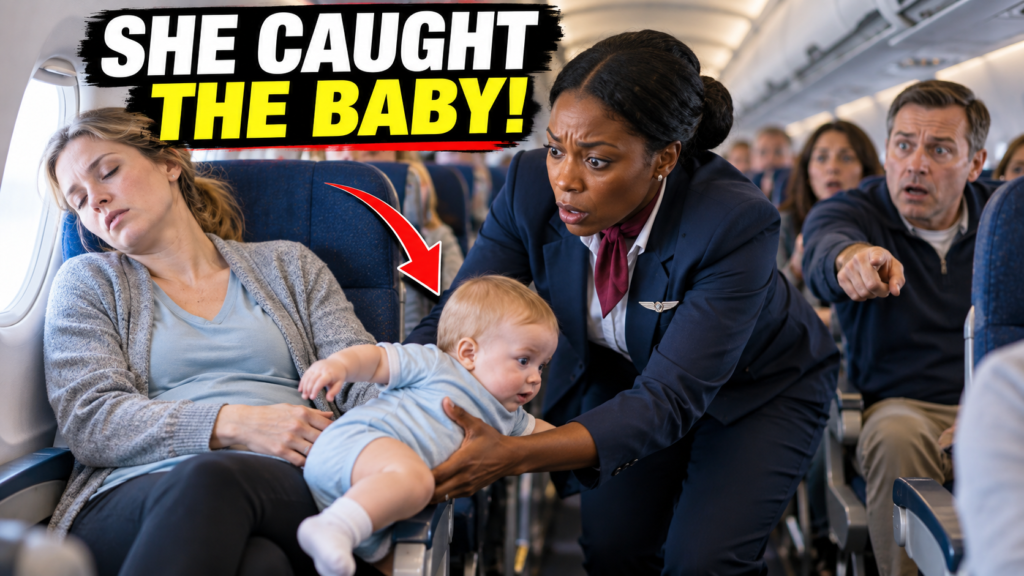
FLIGHT ATTENDANT CATCHES BABY SLIPPING FROM SLEEPING MOTHER’S ARMS
Sep
For most passengers, it looked like an ordinary flight.
The cabin was quiet. The steady hum of the engines filled the background. Some travelers stared at their phones, others looked out the windows, and a few had already fallen asleep.
But one flight attendant noticed something that suddenly turned an uneventful trip into a frightening few seconds.
A young mother sitting near the window was exhausted.
She had been struggling to keep her eyes open while holding her 9-month-old baby on her lap.
“I’m sorry,” the mother quietly admitted. “I haven’t slept all night.”
The flight attendant understood.
“That’s okay, ma’am. Just make sure you keep a secure hold on your baby.”
Then she continued through the cabin.
Moments later, the mother’s head rested against the seat.
Her eyes closed.
Her arms relaxed.
And the baby began to slip.
A passenger across the aisle saw it happening.
“Ma’am! Your baby!”
The flight attendant turned.
There was no time for a long warning.
She moved toward the seat and reached for the child.
“I’ve got the baby!”
The mother jolted awake.
“Oh my God! My baby!”
The flight attendant had the child securely supported.
“Your baby’s okay. I’ve got them.”
Still trying to understand what had happened, the mother stared at her.
“You caught my baby?”
“Yes. Everything’s okay.”
The mother’s panic turned into relief.
“Thank you… thank you so much.”
It’s the kind of dramatic cabin moment that can unfold in seconds.
But behind this dramatized scenario is a much larger aviation-safety issue that every parent traveling with an infant should understand.
The Danger Can Develop Faster Than You Think
Traveling with a baby is exhausting.
Parents may arrive at the airport after waking before sunrise, packing late into the night, driving for hours, dealing with security, waiting at the gate and then trying to manage feeding, diapers and luggage aboard the aircraft.
By the time the plane is cruising, sleep can become almost impossible to fight.
That’s what makes the scenario so relatable.
The mother isn’t portrayed as deliberately placing her child in danger.
She’s exhausted.
Her mistake happens when exhaustion wins.
As her muscles relax during sleep, her grip on the baby changes.
And on an airplane, a child slipping from someone’s arms isn’t the only concern.
Unexpected aircraft movement can happen too.
Why Holding a Baby on Your Lap Deserves Serious Attention
In the United States, the Federal Aviation Administration permits children under age 2 to be held on an adult’s lap during flight.
But “permitted” doesn’t mean “safest.”
The FAA strongly recommends that parents secure young children in an approved child restraint system or device appropriate for the child’s size rather than relying solely on an adult’s arms.
Why?
Because an adult may not be able to securely restrain a child during severe turbulence or another sudden event.
Even a strong parent can be caught off guard by unexpected movement.
That’s why the larger safety lesson from this story isn’t simply:
Stay awake.
It’s:
Think about how your child will remain secured throughout the flight.
A Separate Seat Can Provide an Important Safety Advantage
Parents sometimes choose lap-infant travel because it can reduce the cost of flying.
Under U.S. rules, a child who hasn’t reached their second birthday can generally travel without occupying a separate seat on applicable flights.
But the FAA recommends something safer: purchasing a seat for the child and using an approved child restraint system.
That can include an appropriate car seat approved for aircraft use.
This gives the child a secure place during critical phases of flight and periods when the seat-belt sign is illuminated.
It can also give an exhausted parent another advantage that is easy to overlook:
The child doesn’t have to depend entirely on the parent’s grip while that parent fights fatigue.
Turbulence Makes the Issue Even More Important
The baby in our dramatized story begins slipping because the mother falls asleep.
But imagine the same situation combined with unexpected turbulence.
The cabin can appear completely normal one second and move abruptly the next.
That is one reason flight crews repeatedly encourage passengers to keep their seat belts fastened while seated.
For an infant being held in someone’s arms, sudden movement presents an obvious problem.
The adult’s arms become the restraint system.
And human arms don’t provide the same protection as a properly installed, approved restraint.
The FAA specifically emphasizes that during unexpected turbulence, adults may not be capable of safely holding a child.
That makes planning ahead particularly important.
Flight Attendants Are Watching More Than Beverage Carts
Passengers often associate flight attendants with boarding assistance, drinks, snacks and customer service.
Those duties are highly visible.
But safety is central to the job.
Flight attendants are trained crewmembers responsible for cabin safety and emergency procedures.
During an ordinary flight, they’re constantly observing the cabin.
They’re checking whether passengers comply with safety instructions.
They’re watching the aisles.
They’re responding to medical situations.
They’re dealing with unexpected passenger behavior.
And they’re prepared to react when something suddenly goes wrong.
In our story, the flight attendant’s defining moment isn’t delivering a service.
It’s noticing danger and reacting quickly.
The beverage cart can wait.
A child cannot.
The Passenger Across the Aisle Matters Too
There’s another person in this story who deserves attention.
The passenger who shouts:
“Ma’am! Your baby!”
He doesn’t sit silently and assume somebody else will notice.
He alerts the cabin immediately.
That response illustrates a useful principle aboard an aircraft.
If you see an immediate safety problem, alert a crewmember.
Passengers shouldn’t interfere unnecessarily with flight operations or attempt to turn every minor situation into an emergency.
But a baby visibly slipping from a sleeping adult is different.
That’s an immediate problem.
A clear warning can make a difference.
Why Parents Become So Exhausted During Air Travel
Anyone who has traveled with an infant knows the flight itself may be only one part of a very long day.
Consider everything that can happen before the aircraft even leaves the gate.
A parent may have:
woken up hours earlier than usual,
packed baby supplies,
prepared bottles or food,
loaded luggage,
driven to the airport,
returned a rental car,
carried bags through the terminal,
passed through security,
changed diapers,
managed feeding,
handled a crying child,
waited through boarding,
and finally squeezed into an airplane seat.
Then the engines start.
The cabin becomes warm and quiet.
The baby settles down.
And suddenly the parent’s body realizes just how tired it is.
Falling asleep can happen surprisingly quickly.
That’s why parents should plan for exhaustion rather than assume they will simply overpower it.
“I’ll Just Hold the Baby” Can Become Harder After Hours of Travel
At the beginning of a trip, holding an infant may sound easy.
After several hours, it can feel completely different.
Arms become tired.
Posture changes.
The parent shifts position.
The baby moves.
And if the adult falls asleep, muscle control naturally changes.
That doesn’t mean every sleeping parent holding a baby will experience a dangerous incident.
But it does mean the plan depends heavily on the adult remaining capable of maintaining a secure hold.
A proper child restraint reduces that dependency.
What the FAA Recommends for Young Children
The FAA’s guidance is straightforward: the safest place for a child under age 2 aboard a U.S. aircraft is in an approved child restraint system or device, not simply on an adult’s lap.
Parents considering bringing a car seat aboard should check whether it is approved for use in both motor vehicles and aircraft.
They should also confirm airline-specific requirements before travel.
Not every restraint product marketed to parents is approved for aircraft use.
Booster seats, for example, aren’t appropriate for use during taxi, takeoff and landing in the way an approved aircraft child restraint can be.
Planning before reaching the gate matters.
Not Every Car Seat Works the Same Way on an Airplane
Parents should inspect their child restraint before traveling.
An approved seat should have the required labeling showing that it meets applicable safety standards and is certified for aircraft use.
The restraint also needs to be appropriate for the child’s size.
Installation matters too.
Aircraft seats and cabin configurations differ from cars.
Parents should follow the restraint manufacturer’s instructions and applicable airline/FAA guidance.
If you’re unsure whether your child’s seat can be used aboard the aircraft, don’t wait until everyone is boarding to find out.
Check beforehand.
What About CARES?
For some young children, another option may be the FAA-approved CARES device.
CARES stands for Child Aviation Restraint System.
It is designed specifically for aviation use for children who meet its applicable size requirements.
Unlike a conventional car seat, it is a harness-type restraint designed to work with an aircraft passenger seat.
But again, parents need to verify that the device is appropriate for their child and approved for use.
The important takeaway is that parents have options beyond simply holding a young child for an entire flight.
Can a Parent Sleep While Traveling With a Lap Infant?
This is where practical reality meets safety.
Parents get tired.
Telling someone who has been awake all night to “just don’t fall asleep” isn’t much of a safety plan.
If you’re traveling with another capable adult, consider taking turns caring for the baby.
If the child has a purchased seat and an approved restraint, use it according to applicable instructions.
If you’re traveling alone and becoming overwhelmingly exhausted, don’t ignore that fact.
Think ahead about how you’ll manage the child safely.
And if you’re uncertain about something happening in the cabin, ask the flight crew rather than improvising.
The goal isn’t to shame exhausted parents.
It’s to avoid creating a situation in which a baby’s safety depends on someone successfully fighting sleep for hours.
Flight Attendants Can’t Watch One Passenger Continuously
The flight attendant in our scenario happens to be nearby when things go wrong.
That’s fortunate.
But passengers should never assume a crewmember will always be standing close enough to catch a child.
Flight attendants are responsible for an entire cabin.
They may be assisting another passenger.
They may be preparing for service.
They may be seated during turbulence.
They may be at the opposite end of the aircraft.
They may simply be looking in another direction at the critical second.
That’s why prevention is far more reliable than hoping someone has extraordinary reflexes.
What Parents Should Do Before Flying With a Baby
A smoother and safer flight often begins days before departure.
Start by checking the airline’s infant-travel policy.
If you’re considering purchasing a separate seat, confirm the requirements for using your child restraint.
Check the labeling on the restraint itself.
Make sure you understand how it installs.
Pack essential baby items where they’re easy to reach.
Don’t bury everything you may need beneath several layers of luggage.
Think about feeding times.
Think about diaper changes.
And think seriously about sleep.
If you’re beginning the trip already exhausted, recognize that as a practical issue rather than something you’ll automatically overcome once aboard.
Don’t Ignore the Seat-Belt Sign
Unexpected turbulence is one reason passengers are encouraged to remain restrained while seated.
Parents should take cabin safety instructions seriously, especially when traveling with a young child.
If the flight crew asks passengers to sit down, sit down.
If they tell passengers to remain seated with seat belts fastened, follow the instruction.
Don’t walk around unnecessarily during turbulence because a baby is restless.
A crying baby may be stressful.
An unsecured passenger during unexpected aircraft movement can be much more dangerous.
When conditions become uncertain, safety takes priority over comfort.
A Quiet Cabin Can Create False Confidence
Some of the most surprising safety moments happen when nothing appears wrong.
There doesn’t have to be a storm outside.
There doesn’t have to be an announcement from the cockpit.
There doesn’t have to be panic in the cabin.
Our story begins in a completely ordinary environment.
That’s what makes the moment effective.
A mother is tired.
A baby moves.
Her arms loosen.
Another passenger notices.
And suddenly everyone nearby is alert.
Safety problems aren’t always dramatic before they happen.
Sometimes they begin quietly.
The Flight Attendant’s Calm Response Is Just as Important as the Catch
Imagine being the mother.
You wake suddenly.
Your baby isn’t where you remember holding them.
A flight attendant is standing beside you with your child.
Your heart would probably race before you even understood what happened.
That’s why the next words matter:
“Your baby’s okay. I’ve got them.”
After an immediate hazard has been controlled, calm communication can help prevent confusion and panic.
The flight attendant doesn’t need to humiliate the mother.
She doesn’t need to start shouting.
The immediate priority is the child’s safety.
Then the situation can be assessed.
This Shouldn’t Become a Story About Shaming an Exhausted Mother
It’s easy to watch a scenario like this and immediately ask:
“How could she fall asleep?”
But that reaction misses the more useful lesson.
Parents are human.
Sleep deprivation is real.
Travel is exhausting.
A good safety system anticipates predictable human limitations rather than pretending they don’t exist.
If a parent’s plan for keeping a baby safe depends entirely on staying awake despite severe exhaustion, that plan has a weakness.
The better question is:
How can the child remain protected even if the parent becomes exhausted?
That’s where advance planning and appropriate restraints become important.
The Real Hero Move Happens Before the Emergency
The dramatic version of this story has an obvious hero.
The flight attendant sees the baby slipping.
She reacts.
She catches the child.
Everyone exhales.
But in real-world travel, the best outcome is the one where nobody needs a heroic catch.
The baby is properly secured.
The parent can manage fatigue.
The flight crew doesn’t have to sprint down the aisle.
The passenger across the aisle never has to shout.
Nothing goes viral.
Nothing dramatic happens at all.
In aviation safety, boring can be an excellent outcome.
What Travelers Can Learn From Those Few Seconds
This scenario offers several useful lessons.
Parents should understand the difference between what is legally permitted and what safety authorities recommend.
Travelers with young children should investigate approved restraint options before departure.
Exhaustion should be planned for.
Flight-crew instructions should be followed promptly.
And passengers who notice an immediate safety problem should alert the crew.
Most importantly, parents shouldn’t assume their arms will always be enough during unexpected movement or deep fatigue.
The Moment the Mother Realized What Happened
After the panic came relief.
“You caught my baby?”
“Yes. Everything’s okay.”
For the flight attendant, it may have been only seconds of action.
For the mother, those seconds could feel much longer.
One moment she was exhausted and holding her child.
The next she was waking to a stranger protecting the person who mattered most to her.
“Thank you… thank you so much.”
It’s an emotional ending.
But the strongest lesson isn’t that travelers should hope to have a fast-reacting flight attendant nearby.
It’s that parents should make safety decisions that reduce the need for anyone to make a split-second rescue.
The Bottom Line
In the United States, children under age 2 may be permitted to travel on an adult’s lap, but the FAA strongly recommends securing young children in an approved child restraint system or device appropriate for the child.
That distinction matters.
A parent’s arms may feel secure during a calm flight.
Fatigue, unexpected turbulence or sudden aircraft movement can change the situation quickly.
So if you’re flying with a baby, don’t think only about tickets, bags, bottles and boarding.
Think about what happens when you’re exhausted.
Think about how the child will remain secured.
Check your airline’s policies.
Check the FAA guidance.
And make the safety plan before you get on the plane.
Because a flight attendant with incredible reflexes can make a powerful story.
A baby who never starts falling in the first place is an even better ending.
