
CRUISE NEW
CRUISE SHIP PRANKS: FUNNY… UNTIL ONE WENT TOO FAR!
Sep
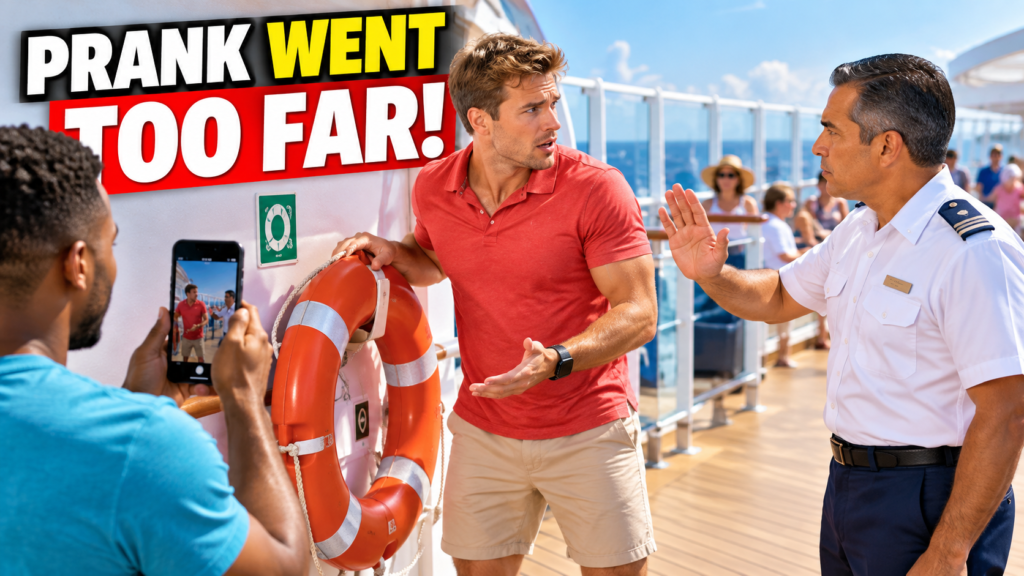
The phone was already recording.
On a sunny cruise ship deck, one passenger laughed as his friend pointed a camera at him. The ocean stretched behind them, other vacationers were enjoying the afternoon, and what started as another silly vacation video seemed completely harmless.
Then the prankster walked toward a life-saving equipment station.
His friend hesitated.
“Keep filming! It’s just a prank!”
The man reached toward the mounted life ring.
That was when a crew member noticed.
He immediately approached.
“Sir, step away from the safety equipment.”
The passenger laughed it off.
“Relax! I’m putting it right back!”
The crew member didn’t laugh.
“Not when you interfere with emergency equipment.”
Suddenly, the prank wasn’t funny anymore.
The passenger’s expression changed.
“Wait… am I actually in trouble?”
The crew member looked directly at him.
“You need to come with me.”
And that fictionalized scene illustrates an important lesson for anyone planning a cruise:
A joke can stop being harmless very quickly when it involves safety equipment, dangerous behavior, harassment, restricted areas, or instructions from the crew.
So where exactly is the line?
Cruise Ship Pranks Aren’t Automatically a Problem
Cruises are vacations.
People celebrate birthdays, anniversaries, graduations, honeymoons and family reunions onboard. Friends joke with each other. Couples surprise one another. Passengers record funny vacation videos.
There is nothing inherently wrong with having fun.
A harmless prank between willing friends might be as simple as pretending someone’s dessert disappeared and then immediately returning it.
Nobody is endangered.
Nothing is damaged.
No stranger is humiliated.
Ship operations aren’t disrupted.
Safety equipment isn’t touched.
Crew members aren’t forced to intervene.
That’s very different from doing something risky and defending it with:
“It was just a prank.”
Calling an action a prank doesn’t automatically exempt it from ship rules.
What matters is what you actually did.
When Does a Cruise Prank Go Too Far?
There isn’t one universal definition covering every imaginable joke on every cruise ship.
Cruise lines publish their own guest conduct, safety and security policies, and passengers should always check the rules applying to their specific sailing.
But several boundaries appear repeatedly in major cruise-line policies.
A prank can become a serious issue when it involves behavior such as:
- interfering with safety or emergency equipment;
- entering restricted or crew-only areas;
- damaging ship property;
- threatening, intimidating or harassing other people;
- unwanted physical contact;
- creating dangerous conditions;
- ignoring crew instructions;
- disrupting ship operations;
- or recording people in circumstances where filming violates applicable onboard policies.
That means the difference between funny and unacceptable isn’t determined by how many people laugh at the video.
It’s determined by the behavior itself.
Why Safety Equipment Is a Terrible Prank Prop
This is the clearest lesson from our opening scenario.
A life ring may look simple.
It’s still safety equipment.
Life-saving equipment exists for emergencies—not as a prop for social-media content.
Carnival Cruise Line’s current ticket-contract language specifically addresses tampering with life-saving devices such as life rings and life jackets outside emergencies or authorized situations. Its terms allow consequences that can include fines and/or disembarkation without refund depending on the violation and circumstances.
Royal Caribbean’s Guest Health, Safety and Conduct Policy similarly prohibits guests from tampering with ship equipment, facilities or systems.
Norwegian Cruise Line also restricts interference with equipment, facilities or systems designed for guest safety.
So if a crew member tells you to stop touching safety equipment, the smart response isn’t:
“But I’m filming a prank.”
It’s to stop.
Immediately.
“I Was Going to Put It Back” Isn’t the Point
This is another common misunderstanding.
Suppose someone touches or starts interfering with emergency equipment and then says:
“I wasn’t stealing it.”
Or:
“I wasn’t going to damage anything.”
Or:
“I was putting it right back.”
Those statements don’t necessarily address the actual problem.
The concern may be the interference itself.
Safety equipment needs to remain where it belongs, properly secured and available for its intended purpose.
A passenger doesn’t need to intentionally destroy something before crew members have a reason to intervene.
That’s why the fictional crew member in our opening scene doesn’t wait to see how the prank ends.
He stops it while it’s happening.
The Crew’s Instructions Matter
Imagine the same scene continues.
The crew member says:
“Step away from the safety equipment.”
The passenger responds:
“Why? I’m not hurting anybody.”
That is exactly the wrong direction to take the interaction.
Major cruise lines require guests to comply with appropriate safety and security instructions.
A disagreement with a crew member isn’t the time to test how far you can push the situation for the camera.
If you’re confused, you can ask for clarification after complying.
But turning a simple instruction into a confrontation can escalate a minor incident unnecessarily.
A prank that might have ended with a warning can become a much bigger problem when the passenger refuses to cooperate.
Could a Passenger Actually Be Removed From a Cruise?
Potentially, depending on the cruise line, conduct and circumstances.
Major cruise lines reserve substantial authority to respond to serious or prohibited guest behavior. Consequences can include actions such as warnings, restrictions, confiscation of prohibited items where applicable, reporting an incident, denial of boarding or future sailing, and removal from the ship.
The exact response isn’t universal.
That’s important.
You should not assume:
“Touch this object and you automatically get kicked off the ship.”
That’s too simplistic.
Likewise, you shouldn’t assume:
“Nothing happened on my friend’s cruise, so it’s always allowed.”
Individual situations can be handled differently.
The captain, security personnel and authorized shipboard staff may need to consider what happened, whether anyone was endangered, whether equipment was affected, whether the passenger complied with instructions, and the cruise line’s applicable policies.
Not Every Prank Needs to Involve Safety Equipment to Cause Trouble
Safety equipment is an obvious boundary.
But it isn’t the only one.
Imagine someone decides to prank another passenger they don’t know.
They follow the person through a hallway.
They deliberately block the person’s path.
They repeatedly film the stranger’s reaction.
The stranger asks them to stop.
They continue because they want a bigger reaction for the video.
At that point, the issue may no longer be whether the original joke was funny.
The behavior could raise concerns about harassment, intimidation, privacy or disruptive conduct depending on what actually occurs and the cruise line’s policies.
Royal Caribbean, for example, addresses harassment, threatening behavior and uninvited physical contact in its guest conduct policy.
The principle is straightforward:
Your vacation entertainment shouldn’t require making another passenger feel unsafe.
Filming the Prank Can Create Another Problem
Smartphones have changed vacation pranks.
Years ago, a joke might have been shared among five friends.
Today, someone may be performing for thousands—or millions—of potential viewers.
That can encourage people to escalate.
The first prank gets 500 views.
The second gets 5,000.
Suddenly someone thinks:
“We need something crazier.”
That’s where judgment can disappear.
But being on a cruise ship doesn’t mean every person or every situation is automatically available for your content.
Some cruise lines have policies governing photography and recording, particularly when filming becomes intrusive, interferes with operations, involves sensitive situations or affects the privacy and enjoyment of other guests.
Norwegian Cruise Line, for example, addresses guest photography and video recording in its policies and places limitations on conduct that affects safety, security, privacy or other passengers’ enjoyment.
Carnival also maintains restrictions concerning recording in certain safety, security and medical contexts.
The safest approach is simple:
Record your own group.
Respect other passengers.
Respect crew instructions.
And don’t create an incident just because the camera is rolling.
The Camera Doesn’t Give You Special Permission
This deserves emphasis.
Sometimes people behave differently when they’re creating content.
They may believe filming changes the rules.
It doesn’t.
Saying:
“We’re making a video.”
doesn’t turn a restricted area into an accessible one.
Saying:
“It’s for TikTok.”
doesn’t transform safety equipment into a prop.
And saying:
“My friend is recording everything.”
doesn’t make a crew instruction optional.
If anything, recording your own actions may create a clear record of what occurred.
So before doing something dramatic for a reaction video, ask yourself whether you’d still do it if nobody were filming.
If the answer is no, that’s worth thinking about.
Restricted Areas Are Another Obvious Boundary
Cruise ships are enormous, complicated working vessels.
Passengers see restaurants, theaters, pools, bars, cabins and lounges.
But many areas exist for ship operations and crew use.
Doors, signs and barriers indicating restricted or crew-only access aren’t invitations to create an exploration prank.
Entering somewhere you’re not authorized to enter can create security and operational concerns.
Norwegian and other major cruise lines address unauthorized access to restricted areas in their conduct policies.
So a prank such as:
“Let’s sneak through this crew-only door and see how long it takes them to catch us!”
isn’t a clever upgrade from a harmless joke.
It’s exactly the type of escalation to avoid.
Never Create a Fake Emergency for Entertainment
This is another line passengers shouldn’t experiment with.
Cruise ships take emergencies seriously because they have to.
Crew members train for fire, medical events, security situations, evacuations and other emergencies.
Passengers also participate in required safety procedures.
Creating panic or deliberately making people believe a dangerous event is happening isn’t comparable to swapping your friend’s dessert.
Even without discussing any specific hypothetical penalty, the principle should be obvious:
Don’t make ship personnel or passengers react to a fake dangerous situation just so you can record their response.
A prank should never consume real emergency attention.
Don’t Mess With Doors, Barriers or Safety Systems
The same logic applies beyond life rings.
If something appears to be part of the ship’s safety infrastructure, leave it alone.
Don’t manipulate equipment.
Don’t interfere with barriers.
Don’t tamper with systems.
Don’t move emergency gear for a photo.
Don’t climb onto something because the ocean view will look better from there.
Royal Caribbean’s conduct policy includes restrictions involving unsafe behavior and ship equipment and also addresses dangerous conduct around railings and barriers.
Those restrictions exist because a cruise ship isn’t a movie set.
You’re on a working vessel at sea.
What About Pranks Between Friends?
This is where cruise fun can remain exactly that—fun.
Suppose you’re traveling with three close friends.
Everyone enjoys practical jokes.
You temporarily hide your friend’s hat in your cabin.
You swap an empty dessert cover.
You put a silly decoration on a friend’s cabin door where permitted and without damaging anything.
You stage a harmless surprise.
Nobody outside the group is targeted.
Nobody’s belongings are damaged.
Nothing affects ship operations.
Nobody touches safety equipment.
Nobody enters restricted spaces.
When your friend says stop, you stop.
That is a completely different category from risky stunts performed for public reactions.
Consent and context matter.
Five Questions to Ask Before Doing a Cruise Prank
Before pressing record, use a quick reality check.
1. Could Anyone Get Hurt?
If yes, don’t do it.
That includes both obvious physical danger and situations likely to cause panic.
2. Does It Involve Ship Safety Equipment?
If yes, leave the equipment alone.
A life ring, life jacket or other emergency device is not there for entertainment.
3. Does It Require Breaking, Moving or Tampering With Ship Property?
If yes, find another joke.
4. Does It Target Someone Who Doesn’t Want to Participate?
If a stranger is uncomfortable, stop.
A person’s angry reaction isn’t permission to keep escalating for better footage.
5. Would You Stop Immediately If a Crew Member Told You To?
The answer should be yes.
If your prank depends on ignoring crew instructions, it’s already a bad plan.
“But Everyone Was Laughing” Isn’t a Defense
This is one of the most important distinctions in prank culture.
Something can be funny to the people filming it and still create a legitimate safety or conduct problem.
Your friends laughing doesn’t determine whether ship equipment can be touched.
Views don’t determine whether a restricted area becomes accessible.
Comments don’t determine whether another passenger consented to being harassed.
And viral potential doesn’t override crew instructions.
The audience watching the finished 20-second video may never see the operational context surrounding it.
Ship personnel do.
What Should You Do If Your Friend Takes a Prank Too Far?
Suppose you’re the person holding the phone.
Your friend starts doing something you weren’t expecting.
Don’t encourage the escalation simply because you’re already recording.
Tell them to stop.
If a crew member intervenes, don’t argue on your friend’s behalf or try to turn the confrontation into additional content.
Follow instructions.
If necessary, stop recording.
The goal should be to de-escalate the situation.
Remember the friend in our opening scene.
At first, he’s filming.
Then he realizes the joke isn’t going the way they expected.
That’s the moment to choose common sense over content.
What Happens After Crew Intervenes?
There is no universal script.
A crew member might simply instruct the passenger to stop.
Depending on the circumstances and applicable policy, the incident could be referred to supervisors or security personnel.
More serious conduct may produce more serious consequences.
The important factual distinction is that cruise lines generally reserve discretion to enforce their guest conduct and safety rules.
That is why we should avoid claims such as:
“Every passenger who touches a life ring gets fined $500.”
Unless a cruise line has published a specific applicable penalty, statements like that shouldn’t be invented for dramatic effect.
The truth is already strong enough:
Interfering with safety equipment can violate cruise-line policy, and serious violations can have serious consequences.
Why Cruise Pranks Keep Getting More Extreme
Social media rewards attention.
A harmless prank may not produce a dramatic reaction.
So creators escalate.
A fake dessert disappears.
Then someone scares a friend.
Then strangers become targets.
Then someone enters somewhere they shouldn’t.
Eventually the creator starts thinking about shock value instead of consequences.
That’s exactly when a simple question helps:
“Would this still be funny if ship security had to get involved?”
If the answer is no, stop before you get there.
The Best Cruise Pranks Don’t Need Victims
If you want funny vacation content, keep it within your own group and make everyone part of the joke.
Create fake awards for your friends.
Stage an absurd cabin-door reveal where permitted.
Challenge each other to harmless vacation games.
Set up a ridiculous outfit surprise.
Film reactions to funny food combinations.
Create inside jokes that don’t interfere with anyone else.
The funniest cruise memory shouldn’t require another passenger to have a terrible afternoon.
And it definitely shouldn’t require a crew member to interrupt their actual job.
Remember: The Crew Is Working
Passengers are on vacation.
Crew members aren’t.
They’re operating a hotel, restaurant complex, entertainment venue and oceangoing vessel at the same time.
When a crew member interrupts a prank involving a safety issue, they’re not “ruining the fun.”
They’re doing their job.
Treat them accordingly.
Don’t insult them.
Don’t deliberately provoke them for a reaction.
Don’t shove a camera in their face because you think confrontation will improve the video.
And don’t assume paying for the cruise means every part of the ship is yours to use however you want.
Harmless Fun vs. A Prank That Went Too Far
The difference can be surprisingly simple.
Harmless:
Your friend opens a covered plate and discovers you temporarily moved their slice of cake.
They laugh.
You return it.
Lunch continues.
Questionable:
You repeatedly target a stranger with a prank after they tell you to stop.
Now their comfort and consent are part of the situation.
Too Far:
You interfere with emergency equipment, enter a restricted area, create an unsafe situation, damage property, or refuse a crew instruction.
At that point, calling it a prank doesn’t change what happened.
The Biggest Mistake: Escalating After You’re Told to Stop
Return to our fictionalized opening.
The crew member says:
“Sir, step away from the safety equipment.”
Imagine the passenger immediately responds:
“Sorry.”
He steps back.
That’s de-escalation.
Now imagine instead that he laughs, continues touching the equipment and says:
“What are you going to do about it?”
The situation has changed.
The original prank may have attracted attention.
The refusal to cooperate creates a second problem.
When crew members give a legitimate safety instruction, don’t turn compliance into a challenge.
Your pride isn’t worth turning a stupid joke into a serious incident.
Before You Press Record on Your Next Cruise…
Have fun.
Film the ocean.
Record the sailaway.
Capture your friends laughing.
Make ridiculous vacation memories.
Play harmless jokes on people who enjoy them.
But know where the boundaries are.
Leave emergency and safety equipment alone.
Stay out of restricted areas.
Respect other passengers.
Don’t damage ship property.
Don’t create dangerous situations.
Follow crew instructions.
And remember that “it’s just a prank” isn’t a magic phrase that erases what you actually did.
THE BOTTOM LINE
Cruise ship pranks can be funny.
They can become some of the best memories of a vacation.
But there’s a huge difference between making your friend laugh and interfering with the safe operation of a ship.
The fictional prankster at the beginning of this story thought touching a life ring would make his video more entertaining.
Then the crew member appeared.
“Sir, step away from the safety equipment.”
He laughed.
“Relax! I’m putting it right back!”
But the crew member’s response changed everything:
“Not when you interfere with emergency equipment.”
That’s the line every passenger should understand.
The moment a prank involves safety equipment, dangerous behavior, harassment, restricted spaces, property damage or refusal to follow crew instructions, the joke may be over.
So enjoy your cruise.
Have fun.
Record the memories.
Just don’t become the passenger whose viral vacation video ends with:
“Wait… am I actually in trouble?”
