
AIRPORT TIPS
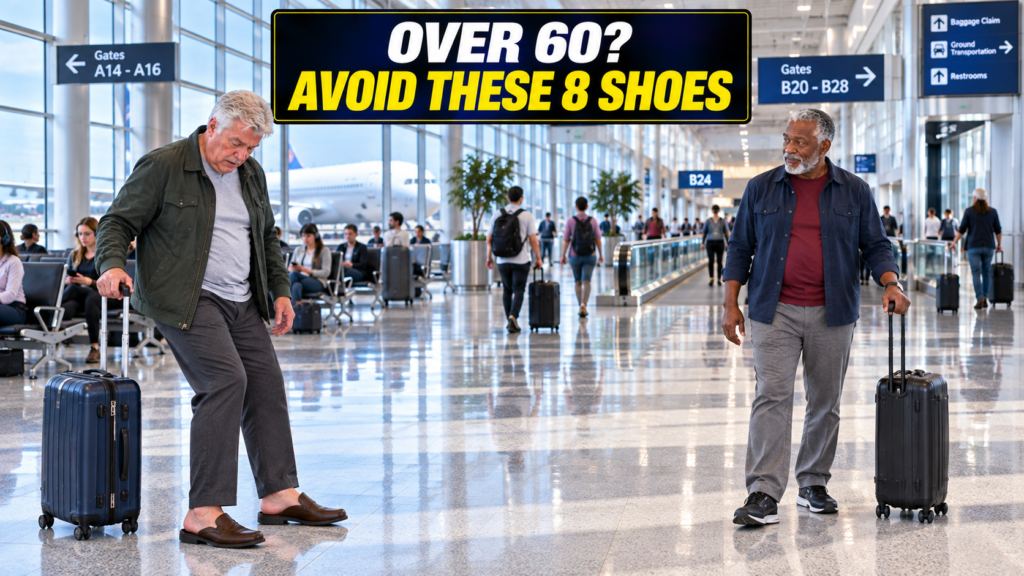
Over 60? 8 Shoes You May Regret Wearing on Your Next Flight
Sep
Most travelers spend more time thinking about what goes inside their suitcase than what goes on their feet.
But on a flying day, your shoes may have to handle far more than you expect. You might walk from a parking garage to the terminal, stand in a security line, cross a huge concourse, navigate escalators and moving walkways, board through a jet bridge, sit for hours, and then do it all again after landing.
For travelers over 60, there is another reason to choose carefully: comfort, stability, and ease of movement can matter more than looking perfectly dressed for the airport.
That does not mean the TSA or FAA has a list of eight “bad shoes” that older passengers are prohibited from wearing. It doesn’t. Most of the footwear choices below are practical recommendations, not federal restrictions.
There are, however, some useful official guidelines worth knowing. TSA’s travel checklist recommends wearing easily removable shoes and says travelers in standard screening should remove their shoes for screening. FAA evacuation guidance also specifically tells passengers to remove high-heeled shoes before using an evacuation slide if possible.
So before you automatically reach for the pair you always wear, take another look.
Here are eight types of shoes you may regret wearing on your next flight—and what to consider instead.
1. Loose Backless Slides and Flip-Flops
Imagine walking quickly toward your gate when the backless shoe on one foot starts sliding away from your heel.
Now you have to shorten your stride, stop to reposition it, or shuffle along to keep it from coming off.
That’s not necessarily a serious problem. But it is exactly the kind of small inconvenience that can become increasingly annoying during a long airport day.
Backless slides and flip-flops can be comfortable when you’re relaxing at home, around a pool, or at a hotel. An airport is different. You may be walking significant distances while pulling luggage and paying attention to signs, other passengers, and gate information.
The issue isn’t that open-back shoes are prohibited. They aren’t.
The practical question is whether the footwear stays securely attached to your feet when you walk at your normal airport pace.
If you already notice your heel moving around or your toes working to keep the shoe in place, think about how that will feel after a long walk through a large terminal.
A more practical choice for many travelers is a lightweight shoe that fits securely around the foot while still being easy to put on and take off.
Your airport footwear shouldn’t demand your attention every twenty steps.
2. Very High Heels
High heels may work perfectly well for a dinner, meeting, or special event at your destination. They are much less practical for many airport travel days.
Consider everything that can happen before you reach your airplane seat.
You may encounter long corridors, escalators, ramps, uneven transitions between surfaces, a sloped jet bridge, and a last-minute gate change that suddenly adds a significant walk.
This is also the one category on this list with a particularly relevant piece of FAA emergency guidance.
The FAA tells passengers using an evacuation slide to remove high-heeled shoes before exiting if possible. Its broader flying-safety guidance similarly tells passengers to remove high heels during an evacuation involving a slide.
That does not mean high heels are banned aboard U.S. flights.
The distinction matters.
You can wear heels to the airport. But when deciding whether they’re the smartest shoes for the entire travel day, consider both everyday mobility and the fact that FAA evacuation instructions specifically address them.
For many travelers, the simpler solution is to travel in a stable pair of comfortable shoes and pack the dressier pair for the destination.
3. Shoes That Already Feel Too Tight
If a pair of shoes feels tight before you leave home, a long flight is probably not the time to hope it gets better.
Foot and leg swelling during air travel is common and usually harmless, according to Mayo Clinic. Sitting for a long period can contribute to blood pooling in the leg veins and fluid moving into surrounding tissue.
That means a shoe that feels merely snug early in the morning could become noticeably less comfortable later in the trip.
This is especially worth considering on an itinerary that combines a long airport day with several hours in the air.
You don’t need shoes that are excessively loose. In fact, a shoe that moves around too much creates a different problem.
Instead, look for an appropriate secure fit with enough room that your feet are comfortable before the trip even begins.
And remember that persistent or one-sided swelling accompanied by pain is a different matter from ordinary temporary travel swelling. Mayo Clinic advises seeking medical attention for concerning symptoms rather than assuming they’re simply part of flying.
Footwear can improve comfort, but it isn’t a treatment for a medical problem.
For an ordinary travel day, the takeaway is simple: don’t start a long flight in shoes that already feel painfully tight.
4. Brand-New Shoes You Haven’t Broken In
The night before a trip can feel like the perfect time to open that box containing the new walking shoes you bought specifically for vacation.
There’s one problem: you don’t actually know how they feel after an hour of walking.
A shoe can feel wonderful during a few minutes around the house and very different after a long airport trek.
A stiff edge may begin rubbing your heel. A seam you barely noticed may become irritating. The toe box may feel different once you’ve been walking for a while.
None of this is an aviation regulation. It’s basic travel planning.
The airport is simply a poor place to discover that your new shoes and your feet don’t get along.
Before traveling, wear your intended airport shoes enough to know how they fit during normal walking. You don’t need to deliberately wear them out. You simply want to eliminate unpleasant surprises.
This matters even more when the trip begins with a connection.
A sore spot that develops at your departure airport doesn’t disappear when you land for your layover. You may still have another terminal to cross, another boarding process, and another flight ahead.
Save the experimental footwear for a day when returning home is easy.
5. Heavy, Bulky Boots
Sometimes boots are exactly what your destination requires.
If you’re heading somewhere cold, wet, or rugged, wearing the bulkiest footwear during the flight can even make sense because it saves suitcase space.
But there is a tradeoff.
Heavy boots can become tiring during a long terminal walk, and elaborate footwear can be more cumbersome when you need to remove and put it back on.
TSA’s travel checklist specifically recommends wearing easily removable shoes. The same checklist says passengers using a standard screening lane should remove their shoes and place them directly on the X-ray belt. TSA PreCheck screening can be different; TSA documentation describes keeping shoes on as one of the program’s expedited-screening benefits.
So don’t interpret “avoid bulky boots” as a TSA rule.
It isn’t.
Instead, ask yourself whether wearing them is worth the extra bulk for your particular itinerary.
If your destination genuinely requires heavy boots and your luggage space is limited, wearing them may still be the best option. If they’re simply a fashion choice for a warm-weather trip, a lighter alternative could make the airport portion considerably easier.
Travel advice should make your trip work better—not force everyone into the same footwear.
6. Complicated Lace-Up Shoes
Some shoes seem easy until you’re sitting near a security checkpoint trying to remember which lace, hook, strap, or buckle comes next.
Again, the shoe itself isn’t the problem.
The complexity is.
TSA recommends easily removable footwear, so a shoe that takes considerable effort to take off and put back on may simply be less convenient for travelers who need to remove their shoes during screening.
Think about what happens after your shoes come through the X-ray.
Other passengers may be collecting bins. You need to retrieve your belongings. Your carry-on needs to be reorganized. You may also have a jacket, electronics, or other items to manage.
That is not an ideal moment to spend several minutes dealing with complicated footwear.
This doesn’t mean everyone should wear slip-ons. A shoe should still fit securely.
The better goal is finding the balance between secure while walking and manageable when you intentionally need to remove it.
A simple fastening system can be especially useful if bending down for an extended period is uncomfortable.
Choose something you can operate confidently and independently rather than whatever happens to look easiest in an advertisement.
7. Shoes With Smooth, Slippery Soles
Airport travel involves many different surfaces.
You may move from outdoor pavement to polished terminal flooring, onto carpet, across a jet bridge, and eventually into the aircraft.
A stable sole with reasonable traction can therefore be a sensible choice.
This is an area where wording matters.
There is no need to claim that TSA or FAA has issued a special prohibition against “slippery shoes.” The reason to reconsider them is much simpler: if a pair already feels unstable on smooth flooring, an airport isn’t the ideal environment to test your luck.
Look at the shoes you already own.
Do the soles provide a stable platform? Do you feel confident turning, stopping, and changing direction? Can you walk naturally without feeling as though the shoe is sliding beneath you?
Those questions are more useful than chasing a particular brand or style.
Also remember that “comfortable” and “stable” aren’t always the same thing.
An extremely soft shoe may feel wonderful while sitting but provide less of the secure feeling you want while walking. Conversely, an extremely rigid shoe may feel stable but become uncomfortable over distance.
The best travel footwear generally strikes a balance appropriate for your own mobility and comfort needs.
8. Loose or Poorly Secured Shoes
This final category sounds similar to flip-flops, but it’s broader.
A closed shoe can still fit poorly.
Perhaps the laces are left so loose that your heel lifts dramatically with every step. Maybe the shoe is simply too large. Perhaps a fastening system no longer holds correctly.
If your foot moves excessively inside the shoe, you’re compensating for the footwear instead of simply walking.
That’s worth addressing before a travel day.
Airport passengers frequently multitask while moving. You might be pulling a suitcase with one hand while checking gate signage, looking for your travel companion, or navigating around other people.
Your shoes should be one of the things you don’t have to think about.
Before leaving home, walk around in your travel footwear with the socks you intend to wear. Pay attention to heel movement and overall fit.
You don’t want footwear that’s painfully tight.
You also don’t want footwear that’s barely staying attached.
The useful middle ground is a secure, comfortable fit that allows you to move naturally.
What Should Travelers Over 60 Wear Instead?
There isn’t one perfect “airport shoe for seniors,” and age alone doesn’t determine what someone should wear.
A healthy, active 70-year-old may have completely different footwear needs from another traveler of the same age who uses a mobility aid or has a foot condition.
Rather than searching for one supposedly perfect model, consider five characteristics.
Secure fit: The shoe should remain attached naturally while you’re walking. You shouldn’t have to grip it with your toes or repeatedly reposition your foot.
Comfortable room: Avoid beginning the trip in footwear that already feels painfully tight, particularly when you’ll be sitting for a long period.
Stable sole: Choose a shoe that makes you feel confident on typical walking surfaces and doesn’t noticeably slide around.
Familiar fit: Travel in shoes you’ve worn enough to know they’re comfortable. Airport day isn’t shoe-testing day.
Manageable fastening: If you expect to remove your footwear at security, a system you can handle easily can reduce unnecessary hassle.
For some people, that combination may describe a walking shoe. For others, it could be a comfortable sneaker or another supportive travel shoe.
The label matters less than how it performs for you.
And if you have a medical condition affecting your feet, circulation, balance, or mobility, individualized guidance from a qualified healthcare professional is more useful than a generic internet footwear list.
What TSA and FAA Actually Say About Your Shoes
This is where a lot of travel advice becomes unnecessarily confusing.
There are three different things being discussed in this article: security procedures, official safety guidance, and practical travel recommendations.
They aren’t interchangeable.
TSA’s travel checklist recommends wearing easily removable shoes. It also instructs travelers in standard screening lanes to remove their shoes and place them on the X-ray belt. TSA documentation describes keeping shoes on as a TSA PreCheck benefit.
Those are security-screening considerations.
The FAA, meanwhile, provides emergency-evacuation guidance. Its current passenger evacuation page tells travelers to follow crew instructions, leave carry-on bags behind, move to the nearest safe exit, and remove high-heeled shoes before using an evacuation slide if possible.
That’s safety guidance for an emergency.
The rest of the footwear considerations in this article—such as avoiding an untested new pair or reconsidering a loose-fitting shoe—are practical travel recommendations.
Calling all eight “TSA rules” or “FAA rules” would be inaccurate.
They’re not.
And turning them into “eight shoes you’re not allowed to wear on a plane” would be even more misleading.
You have far more freedom than that.
The purpose is simply to choose footwear that makes the airport and flight easier rather than harder.
One Final Check Before You Leave Home
When you’re dressed for your next flight, don’t judge your shoes based only on the first five minutes.
Imagine the entire journey.
Could you comfortably walk through a large terminal in them?
Will they stay securely on your feet?
Are they already tight before you’ve even boarded?
If standard security screening requires you to remove them, can you take them off and put them back on without turning the process into a project?
Have you actually worn them enough to know they’re comfortable?
And would you still be happy with your choice after a gate change sends you much farther down the concourse?
If the answers are reassuring, you’ve probably made a reasonable choice.
The best airport shoe isn’t necessarily the most expensive, the most fashionable, or the one marketed specifically to older travelers.
It’s the pair that fits your needs, stays securely on your feet, and lets you get through the travel day without constantly thinking about your shoes.
Sometimes the smartest travel upgrade is already sitting in your closet.
