
CRUISE NEW
She Demanded a Cruise Refund Because the Waves Were Too Loud Then Guest Services Asked One Simple Question
Sep
PART 1 — “I PAID TO SLEEP”
At a little after seven in the morning, the ship’s Guest Services desk was unusually peaceful.
Most passengers were still having breakfast or sleeping in after a long evening onboard. Only a handful of people crossed the lobby while the ocean rolled past the enormous windows.
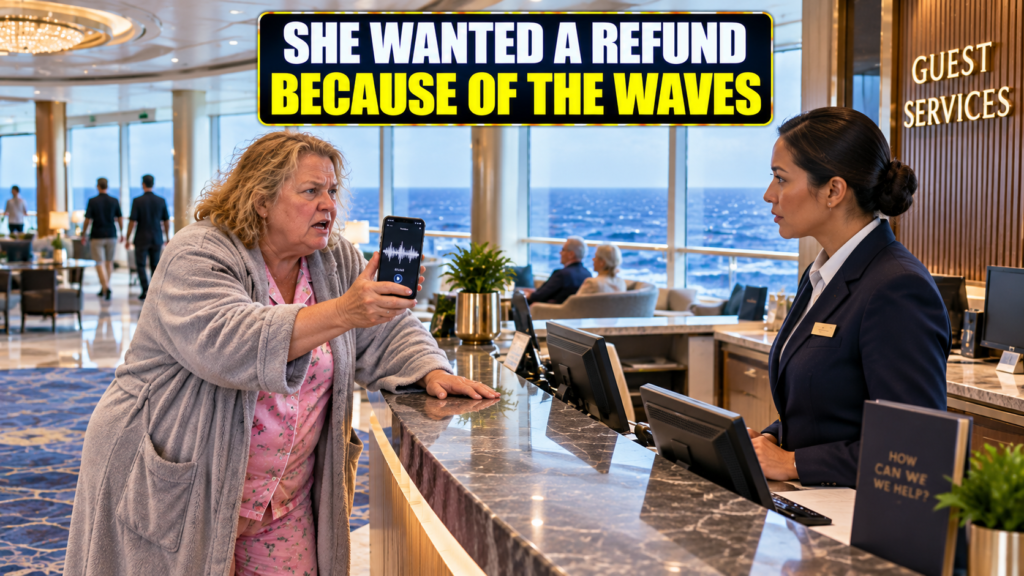
Then a woman appeared wearing pajamas.
Her name was Margaret Collins, a 69-year-old passenger traveling on what she had repeatedly described as her “relaxation cruise.”
There was nothing relaxed about her now.
Margaret still wore pink floral pajamas beneath a soft gray bathrobe. Her strawberry-blonde hair was messy, her eyes were puffy, and her expression suggested that somebody was about to be held responsible for a very bad night.
She walked directly to the counter.
“I need someone to hear this.”
Before the Guest Services employee could ask what was wrong, Margaret placed her smartphone on the counter.
She tapped PLAY.
WHOOSH.
A few seconds passed.
CRASH.
Then came another long rush of water.
The employee listened carefully.
Margaret folded her arms.
“That went on all night.”
The employee glanced at the phone.
“I’m sorry you weren’t able to sleep, ma’am. Was there a noise coming from inside the cabin?”
“No. Outside.”
“Was something striking your balcony door?”
“The waves!”
The employee paused.
Margaret picked up the phone and held it closer.
“Listen to that! Those waves kept me awake all night!”
The employee looked toward the windows, then back at Margaret.
“Ma’am… that’s the ocean outside your balcony.”
Margaret’s tired eyes narrowed.
“Exactly!”
She planted one hand on the counter.
“Your soundproofing failed. I want last night refunded.”
The employee initially seemed unsure whether she had understood correctly.
Margaret explained that she had specifically chosen a balcony cabin because she wanted comfort. In her view, paying more for a cabin meant she should not have to spend the night listening to water crashing outside.
“I paid for a balcony cabin,” she said. “I also paid to sleep.”
The employee did not argue.
Instead, she began asking questions.
Had Margaret heard rattling from the balcony door?
“No.”
Metal banging?
“No.”
Unusual vibration?
“No.”
Engine noise?
“No.”
A loose door or window?
“No!”
Margaret was becoming impatient.
“It was the waves. I have already told you that.”
The employee entered the complaint into the system.
Margaret leaned over the counter.
“So you’ll refund the night?”
“I can’t make that decision based only on what we’ve discussed.”
Margaret’s expression hardened.
“Then get somebody who can.”
The employee remained calm.
“If you’re reporting a possible problem with the cabin, we can have it reviewed.”
“Good.”
Margaret pushed her phone forward again.
“And I have proof.”
Another wave rolled through the recording.
WHOOSH—CRASH.
Margaret looked almost triumphant.
To her, the recording settled everything.
She had lost sleep. She had recorded the reason. And somebody onboard was going to compensate her for it.
The employee picked up the phone at the desk.
“I’ll ask my supervisor to speak with you.”
Margaret straightened her robe.
“Finally.”
She looked like a woman who believed the argument was already over.
She didn’t realize the next person would ask one question that completely changed the complaint.
PART 2 — THE COMPLAINT GETS TESTED
A few minutes later, a Guest Services supervisor approached the counter.
He had already received a brief explanation from the employee, but he did not laugh, roll his eyes, or dismiss Margaret.
Instead, he listened.
Margaret started from the beginning.
She described going to bed around eleven, waking repeatedly, checking the balcony door, trying another pillow and eventually using her phone to record what she considered unacceptable noise.
Then she played the recording again.
The supervisor listened.
WHOOSH. CRASH. WHOOSH.
“That,” Margaret said, “is what I paid thousands of dollars not to listen to all night.”
The supervisor looked at her calmly.
“What exactly would you like us to inspect?”
Margaret hesitated.
“The soundproofing.”
“All right.”
That answer seemed to surprise her.
The supervisor explained that if she believed there was an actual problem with the cabin, they could look for something specific: an issue with the balcony door, its seal, unusual vibration, rattling or another abnormal source of noise.
Margaret’s confidence returned immediately.
“Excellent. Once you see it, we can discuss my refund.”
The supervisor made no such promise.
But Margaret was already walking toward the elevators.
A short time later, the three of them stood inside her balcony cabin.
The bed was unmade.
The curtains were partly open.
Beyond the glass door was a wide expanse of moving blue-gray water.
Margaret pointed dramatically toward the balcony.
“There.”
The supervisor inspected the door area.
He opened it.
He closed it.
He checked the latch.
Nothing obvious appeared loose.
Margaret stood behind him with her arms crossed.
“Well?”
“So far, I’m not seeing the kind of issue you described.”
She stared at him.
“Wait.”
Everyone became quiet.
For several seconds, nothing happened.
Then the ship moved through another swell.
Water rushed along the hull.
WHOOSH—CRASH.
Margaret’s eyes widened.
She pointed toward the balcony.
“THAT!”
The supervisor looked outside.
“That’s exactly what I’m talking about!” she continued. “Imagine hearing that when you’re trying to sleep.”
The employee remained silent.
The supervisor finally understood exactly what Margaret meant.
There was no mysterious banging.
No rattling fixture.
No malfunctioning door obvious in their inspection.
The sound Margaret had spent the night recording was the ocean moving against the ship.
But Margaret interpreted the supervisor’s silence very differently.
She smiled for the first time that morning.
“Now you heard it yourself.”
“Yes, ma’am.”
“So now you understand why I deserve my money back?”
The supervisor carefully explained that hearing the sound did not, by itself, establish that the cabin had a defect.
Margaret’s smile disappeared.
“You just heard it!”
“I did.”
“And you expect people to sleep through that?”
The supervisor explained that conditions at sea could vary and that sounds from the ocean could be noticeable depending on conditions and cabin location.
Margaret shook her head.
“That isn’t my problem. I purchased a cabin, not an ocean soundtrack.”
She held up her phone again.
“I have twenty-eight minutes of this.”
The supervisor glanced at the screen.
Margaret clearly believed the length of the recording strengthened her case.
But there was still one problem.
Twenty-eight minutes of recorded waves could demonstrate that Margaret heard waves.
It did not automatically demonstrate that anything in the cabin was broken.
The supervisor offered to continue discussing practical options.
Margaret interrupted.
“I don’t want options. I want last night refunded.”
The supervisor remained composed.
Before discussing compensation, he said, they needed to separate two very different things: an actual cabin problem and the normal environment surrounding a ship at sea.
Margaret stared at him.
Then another wave hit.
CRASH.
She pointed toward the balcony again.
“There! It did it again!”
The supervisor looked at the ocean.
Then at Margaret.
She crossed her arms.
“So,” she demanded, “what are you going to do about it?”
PART 3 — THE ANSWER SHE DIDN’T EXPECT
Back at Guest Services, Margaret was still carrying her phone like evidence in a courtroom.
She placed it on the counter again.
“I lost an entire night of sleep.”
The supervisor acknowledged her frustration.
But he explained that there was an important distinction.
If there were a verified problem with the cabin—a faulty balcony door, abnormal mechanical noise, a loose fixture or another actual defect—that could be documented and addressed.
What they had observed so far was different.
The sound Margaret kept identifying was the sea itself.
Margaret stared at him.
“So you’re saying I should just accept it?”
“I’m saying the recording alone doesn’t show that the cabin is defective.”
That was not the answer she wanted.
Her voice rose.
“Then move me somewhere I can’t hear it.”
The supervisor asked whether she wanted them to explore another cabin option if an appropriate alternative was available.
Margaret stopped.
For the first time that morning, she did not have an immediate response.
She looked at the employee.
Then at the supervisor.
Then at her phone.
“Would I still get my refund?”
The question revealed the real argument.
She wasn’t simply asking for help sleeping.
She wanted the previous night reimbursed.
The supervisor did not promise that.
He explained that her complaint could be documented and reviewed, but he was not going to declare the cabin defective simply because her recording contained the sound of waves.
Margaret became indignant again.
“What’s the point of paying extra for a balcony if I can’t sleep?”
Neither employee answered sarcastically.
That only seemed to frustrate her more.
She picked up the phone and played the recording one final time.
The lobby filled with the muffled sound of rushing water.
WHOOSH.
Margaret looked at the supervisor as if she had just produced undeniable evidence.
He listened.
CRASH.
Then he asked:
“Did you record any other noise besides this?”
Margaret frowned.
“What do you mean?”
“Anything mechanical? Rattling? Banging? Something from the door?”
“No. I’ve already told you. This is the noise.”
The supervisor nodded.
And suddenly Margaret seemed to hear her own argument from the other side of the counter.
She had arrived furious about “poor soundproofing.”
She had demanded an inspection.
The inspection had not revealed the defect she expected.
Her strongest piece of evidence was twenty-eight minutes of ocean sounds recorded from a cabin floating on the ocean.
But she still wasn’t ready to surrender.
“So that’s it?”
The supervisor explained that the complaint would remain documented and that Guest Services could discuss reasonable practical options with her. But he would not promise the refund she was demanding merely on the basis presented.
Margaret snatched up her phone.
“I’ve stayed in hotels quieter than this.”
The employee nodded politely.
Margaret tightened the belt on her gray robe and turned away from the desk.
She made it several steps across the lobby before another swell rolled against the ship.
A low rush of water could be heard beyond the windows.
Margaret stopped.
She slowly turned her head toward the ocean.
CRASH.
For a moment, she simply stared through the glass.
Her expression made it look as though the Atlantic itself had waited for the perfect opportunity to annoy her again.
She shook her head.
“Unbelievable.”
Then she marched toward the elevators, still in her floral pajamas.
The Guest Services employee watched her leave.
Only after the elevator doors closed did she glance at the supervisor.
Neither of them needed to say anything.
Margaret had walked into Guest Services that morning convinced she had recorded proof that her balcony cabin was defective.
She had played the recording repeatedly.
She had demanded an inspection.
She had even taken the supervisor upstairs so he could hear the problem for himself.
But by the end, her recording had proved only one thing beyond dispute.
There was an ocean outside her cruise-ship cabin.
And unfortunately for Margaret, that was the one thing Guest Services couldn’t switch off.
