
CRUISE TIP
OVER 60? DON’T BOOK A CRUISE CABIN UNTIL YOU CHECK THESE 10 THINGS

Sep
Booking a cruise cabin looks simple until you start comparing the choices.
Inside or Oceanview? Balcony or no balcony? Midship or farther forward? Close to an elevator or farther down the hallway? Pick your own cabin or save money with a guarantee-style booking?
For travelers over 60, there isn’t one cabin category that’s automatically the smartest choice.
The better question is this:
What gives you the best combination of price, location, comfort, and convenience for the way YOU plan to use the ship?
A cheaper cabin can be a fantastic value. An expensive balcony can be worth every dollar. But either choice can disappoint if you ignore where the cabin is located and what you’ll actually do onboard.
Before you book, check these 10 things.
1. Don’t Choose the Cabin Type Before Checking the Location
One of the easiest mistakes is starting with only three words:
“Inside or balcony?”
Cabin category matters, but location deserves attention too.
Imagine finding a cheaper cabin and immediately booking it. Then you look carefully at the deck plan and realize many of the places you expect to visit repeatedly are located much farther away than you anticipated.
That doesn’t make the cabin bad.
It simply means the lower price came with a convenience trade-off you didn’t consider.
Before booking, pull up the ship’s deck plan and identify the areas you expect to use frequently.
Depending on your vacation style, those could include the buffet, main dining room, theater, pool deck, observation areas, lounges, or other public spaces.
Then look at the cabin again.
The best location isn’t automatically midship, forward, or aft.
It’s the location that makes sense for your routine.
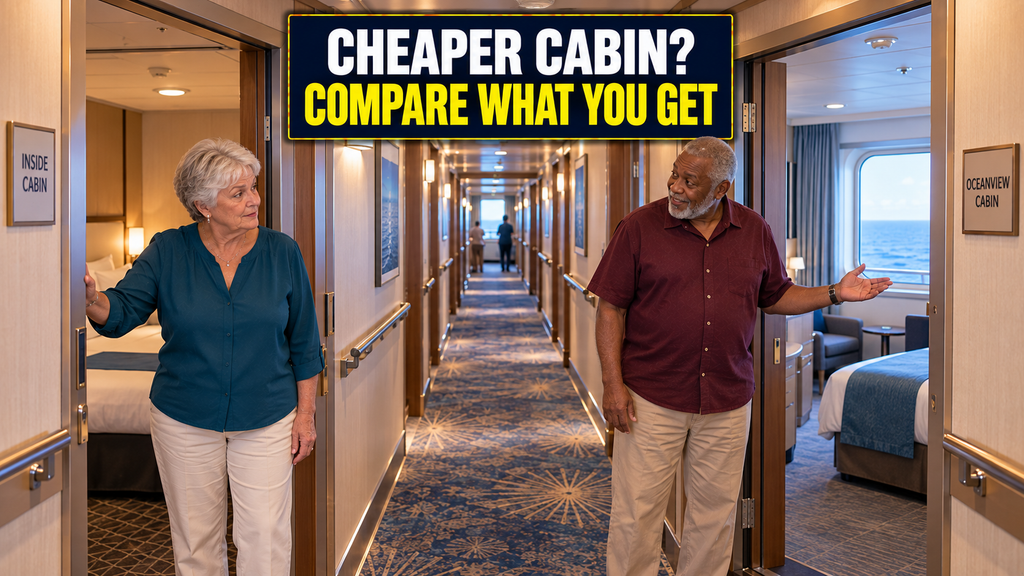
2. Inside Cabins Can Save Money — But Ask What You’re Giving Up
Don’t dismiss an Inside cabin simply because it doesn’t have an ocean view.
For the right passenger, it can be an excellent way to control the cost of a cruise.
Think about how you actually travel.
Are you someone who wakes up, gets dressed, and immediately leaves the cabin?
Do you spend most of the day exploring ports and most evenings enjoying restaurants, entertainment, and public areas?
If the cabin is primarily somewhere to sleep, shower, and change clothes, paying significantly more for a view you rarely enjoy may not provide much extra value to you.
But there’s another side.
An Inside cabin doesn’t provide the traditional exterior window or private balcony experience. If natural light, watching the ocean from your room, or spending quiet time in your cabin is important, paying more for another category may be worthwhile.
The key is to compare the actual price difference on your sailing.
Don’t assume:
Inside = cheap and bad.
And don’t assume:
Balcony = expensive and better.
Ask what you’re getting for the additional money and whether you’ll use it.
3. Oceanview May Be the Middle Ground You’re Looking For
Passengers sometimes jump directly from Inside to Balcony when comparing cabins.
Don’t forget to check Oceanview options.
Depending on the ship and sailing, an Oceanview cabin may offer something important to travelers who want natural light and an exterior view without necessarily choosing a balcony.
But don’t automatically assume Oceanview will always sit neatly between Inside and Balcony in price.
Cruise pricing is dynamic.
Availability, demand, ship, itinerary, cabin category, promotions, and timing can all affect what you see when booking.
Instead, compare the actual numbers in front of you.
Suppose the difference between Inside and Oceanview feels reasonable to you, while moving from Oceanview to Balcony requires a much larger jump.
Oceanview suddenly becomes worth a closer look.
On another sailing, the price gaps could be completely different.
That’s why cabin value should be evaluated on the cruise you’re actually considering — not based on what someone paid last year.
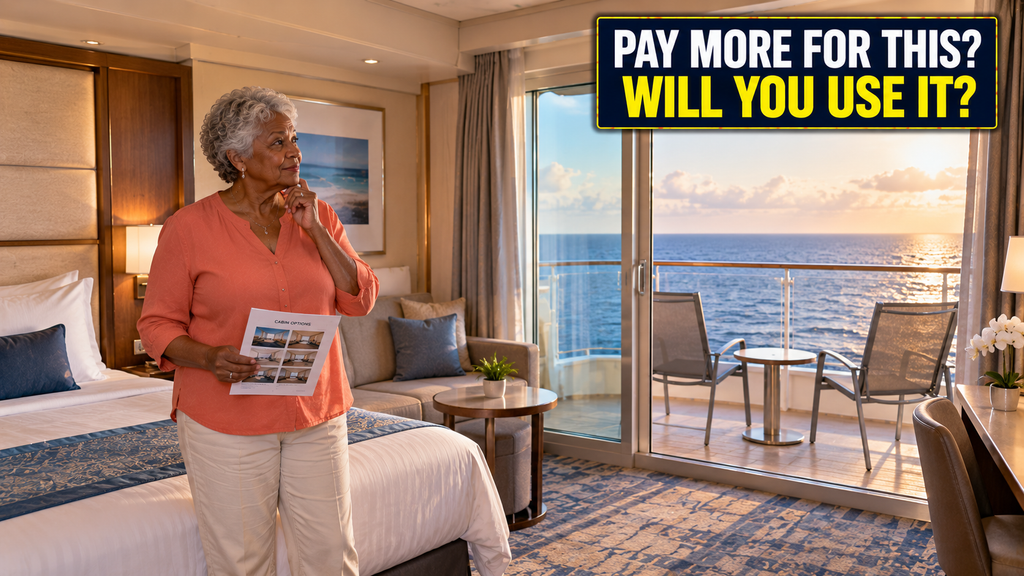
4. Don’t Pay for a Balcony Just Because Everyone Says You “Need” One
Ask experienced cruisers about cabins and eventually someone will tell you:
“Once you get a balcony, you’ll never go back.”
Maybe that’s true for them.
It doesn’t have to be true for you.
A private balcony can be one of the most enjoyable features of a cruise cabin. You might drink coffee outside in the morning, read while watching the ocean, enjoy some private outdoor time, or simply appreciate being able to step outside without going to a public deck.
If those moments are important to you, the additional cost may be money well spent.
But ask yourself one question before upgrading:
How much will I actually use it?
If you’re off the ship during port days and spend sea days at the pool, restaurants, lounges, activities, and shows, you may spend surprisingly little waking time in your cabin.
In that situation, compare the balcony premium with other things that money could buy during your vacation.
The lesson isn’t “skip the balcony.”
It’s:
Pay for a balcony because you want the balcony experience — not because someone else told you it’s mandatory.
5. Count Your Daily Trips, Not Just Your Cabin Number
This is where cabin convenience becomes very personal.
Open the deck plan and imagine an ordinary sea day.
You leave your cabin for breakfast.
Later, you return to change.
Then you head somewhere else for an activity.
Back to the cabin.
Dinner.
Cabin again.
Evening entertainment.
Then finally back to bed.
A location that looked perfectly reasonable during booking can feel very different after you’ve traveled the same route repeatedly.
That’s why “always book midship” is too simplistic.
Instead, think about your likely daily routine.
If you expect to spend a lot of time in one particular part of the ship, proximity to that area may matter more to you than being perfectly centered.
Another passenger may have an entirely different routine.
This isn’t about assuming everyone over 60 wants to walk less.
Many older travelers enjoy walking extensively.
It’s about avoiding unnecessary trips that add nothing to your vacation.
If two similarly priced cabins appeal to you, their locations relative to your favorite areas can become a useful tiebreaker.
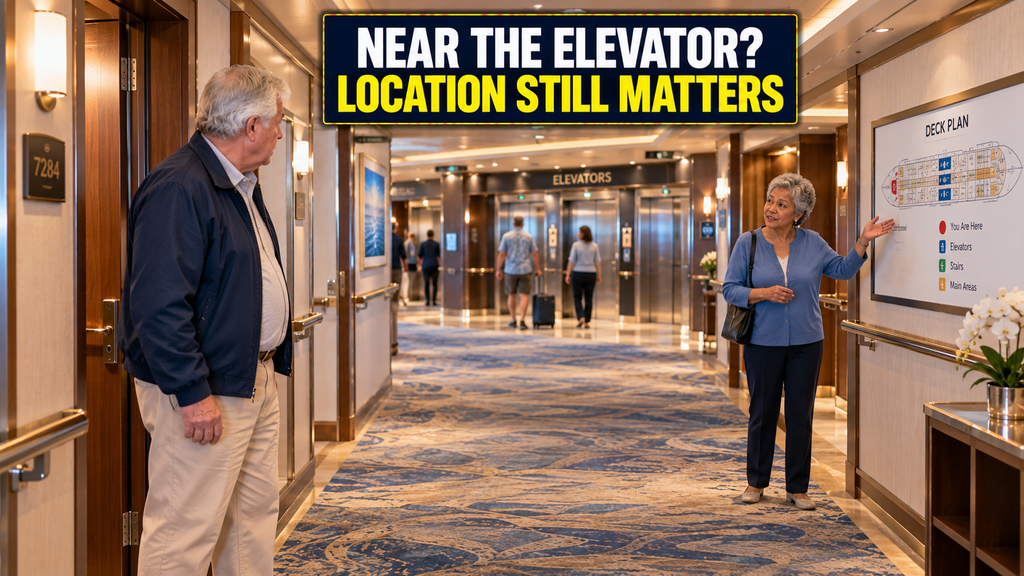
6. Near an Elevator Can Be Convenient — But Check Exactly How Near
“Never book near the elevators.”
You’ve probably heard some version of that advice.
It’s too broad.
Being reasonably close to elevators or stairwells can be extremely convenient, especially on a large ship where you may travel between many decks several times per day.
But location still matters.
There’s a difference between a cabin conveniently positioned near a vertical transportation area and one located where you’re concerned about passenger traffic from a nearby public space.
Instead of automatically rejecting everything near an elevator, inspect the exact deck plan.
Look at the hallway configuration.
Look at the nearby public areas.
Look at how passengers are likely to move through that section of the ship.
Then decide how you personally balance convenience and your preference for a quieter location.
A blanket rule can’t make that decision for you.
7. Look Above AND Below Your Cabin Before Booking
This may be the most overlooked deck-plan check on this list.
You’ve found a cabin you like.
The location on your deck looks great.
Before booking it, change the deck-plan view.
What’s directly above you?
Now check below.
Depending on the ship, nearby decks may contain cabins or various public and operational spaces.
If having a quiet cabin is particularly important to you, understanding the surrounding layout is useful before you pay.
This doesn’t mean a cabin near a public area will automatically be noisy.
Ships are designed differently, sound conditions vary, and a deck plan alone cannot tell you exactly what you’ll hear inside a particular cabin.
But the deck plan can show you what is nearby.
That gives you another piece of information to consider before choosing between two otherwise similar rooms.
When possible, check at least three levels:
Your deck.
The deck above.
The deck below.
It takes only a few minutes.
8. A Guarantee Cabin Can Save Money — But Understand the Trade-Off
A guarantee-style cabin can look tempting when the price is attractive.
The basic trade-off is important to understand.
Depending on the cruise line, fare, and category, you may choose or be guaranteed a certain category while allowing the cruise line greater control over the exact stateroom assignment.
That can work well for flexible travelers.
If you’re primarily concerned about getting aboard at a price you like and aren’t particularly worried about your exact cabin location, giving up some control may be perfectly reasonable.
But location-sensitive passengers should think carefully.
If you strongly prefer a certain part of the ship, want to be close to a particular area, or care about avoiding certain locations or view conditions, compare those preferences against the savings.
A guarantee cabin isn’t automatically a “bad cabin.”
It’s a trade:
Potential savings or fare value in exchange for less control over the exact assignment.
Read the terms for the specific booking before deciding.
9. Accessible Cabins Are Accommodations — Not a Bigger-Room Trick
You may come across online discussions suggesting accessible cabins as a clever way to get extra space.
That’s the wrong way to approach them.
Accessible staterooms are designed with features intended to accommodate passengers with relevant accessibility needs. Depending on the ship and cabin, those features can include changes to entrances, bathrooms, fixtures, and usable space.
If you have accessibility requirements, don’t rely solely on a generic cabin description.
Contact the cruise line during the booking process and explain what accommodations you actually need.
Ask whether the specific stateroom and ship can meet those requirements.
And do it early enough to give yourself more options.
Being over 60 by itself does not mean you need an accessible cabin.
This is about individual needs, not age.
For passengers who do need those accommodations, choosing the correct cabin can be far more important than getting a particular view.
10. Compare TOTAL Value Before Paying for an Upgrade
Now you’ve reached the dangerous button:
UPGRADE.
A better cabin category appears.
The photograph looks beautiful.
The additional price doesn’t seem outrageous.
Should you take it?
Before saying yes, run through six questions.
1. How much more will I actually pay?
Look at the real difference for your booking, not a generic advertised starting price.
2. What am I receiving for that additional money?
More space? A window? A balcony? A different category? A different location?
3. Will I actually use that feature?
A feature you rarely use has less personal value, regardless of how impressive it sounds.
4. Where is the upgraded cabin located?
An upgrade in category isn’t necessarily an upgrade in location for your particular routine.
5. What’s around the cabin?
Check the same deck, plus what’s above and below.
6. How important is choosing the exact location to me?
If convenience matters greatly, control over location may be more valuable than moving up a cabin category.
That’s why the most expensive room you can afford isn’t automatically the best-value cabin.
Neither is the cheapest room available.
So Which Cruise Cabin Should You Actually Choose After 60?
There is no universal answer.
A traveler who spends every possible minute around the ship may be perfectly happy saving money with an Inside cabin.
Someone who loves quiet mornings overlooking the ocean may consider a Balcony worth every dollar.
Another passenger may prioritize an Oceanview.
Someone else may care far more about location than view.
And a flexible traveler may happily accept less control over exact location in exchange for an attractive guarantee-style fare.
Your age doesn’t make that decision.
Your budget, priorities, daily routine, and individual needs do.
Before booking, put the cabin photograph aside for a moment and open the deck plan.
Check the cabin.
Check its location.
Check what’s nearby.
Check above and below.
Think about where you’ll actually spend your time.
Then compare what you’re getting with what you’re paying.
The Bottom Line
When you’re over 60, the smartest cruise cabin isn’t automatically the cheapest cabin, the biggest cabin, the balcony cabin, or the cabin closest to the middle of the ship.
It’s the one that fits the way you want to cruise.
For some travelers, that means spending less on the room and more on the vacation.
For others, paying extra for a balcony creates exactly the experience they want.
And for many passengers, simply choosing a more convenient location can matter as much as moving up to a more expensive cabin category.
So before you press that final BOOK button, remember three things:
PRICE.
LOCATION.
HOW YOU’LL ACTUALLY USE THE SHIP.
When those three work together, you’re much closer to finding a cabin that’s good for both your money and your convenience.
