
AIRPORT TIPS
Flying After 60? 7 Pilot Facts That Will Change How You See Autopilot
Sep
If you’ve ever looked into the cockpit of a modern airliner, you may have had the same thought:
With all those computers, doesn’t the airplane practically fly itself?
It’s an understandable assumption.
Modern commercial aircraft can have sophisticated autopilot, navigation, flight-management and automatic-thrust systems. From the passenger cabin, a long cruise at 35,000 feet can look almost effortless.
The airplane seems steady. The pilots aren’t constantly wrestling with the controls. Hours can pass without passengers noticing anything dramatic happening.
So what are the pilots actually doing?
Quite a lot.
Autopilot can reduce workload and perform important flight-control tasks, but that is very different from replacing the pilots. The Federal Aviation Administration treats manual flying, management of automated systems and pilot monitoring as essential parts of flightpath management.
In other words, the pilots don’t disappear from the equation when automation comes on.
Here are seven facts that may completely change the way you picture what’s happening behind the cockpit door.
1. Autopilot Doesn’t Mean the Pilots Stop Flying
Let’s start with the biggest misconception.
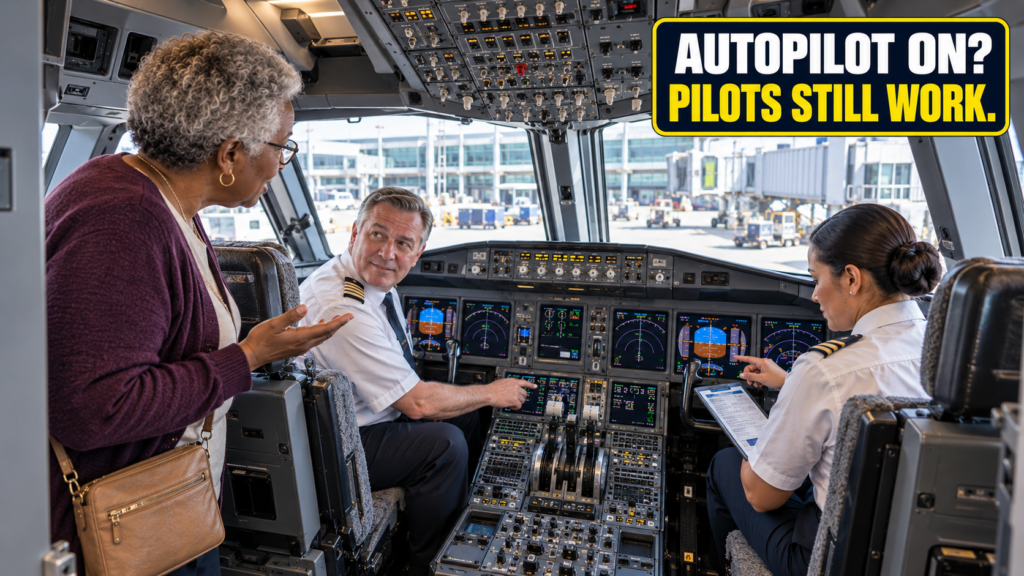
Imagine visiting a cockpit while the airplane is safely parked at the gate.
You see two pilots sitting in front of an enormous instrument panel.
You notice all the screens and controls and ask:
“So when autopilot takes over… you just sit here?”
A pilot would have good reason to say:
“Not even close.”
The problem is the phrase “takes over.”
It makes autopilot sound like a replacement pilot.
That’s not a good way to think about it.
A modern autopilot can control aspects of the aircraft’s flightpath according to the modes, targets and guidance being used. But the flight crew still has to manage and monitor what the airplane is doing.
FAA flightpath-management guidance specifically addresses both managing automated systems and pilot monitoring.
The crew needs awareness of where the aircraft is going, what the automation is commanding and whether the resulting flightpath is the one that is actually intended.
That means a pilot can be actively flying the airplane without continuously moving the physical flight controls by hand.
Think about the difference between doing every control movement yourself and being responsible for the entire result.
Those aren’t the same thing.
Autopilot may perform certain control tasks.
The pilots remain responsible for managing the flight.
What passengers often imagine
Autopilot ON = pilots OFF.
A better way to think about it
Autopilot ON = a powerful automated system is now part of how the pilots are managing the aircraft.
That’s a much more accurate mental picture.
2. Autopilot Doesn’t Simply Decide Where the Airplane Wants to Go
Here’s another common image:
The pilots enter the destination before departure.
Then the airplane’s computers figure out everything else.
That’s an enormous oversimplification.
Modern aircraft automation can follow sophisticated lateral and vertical guidance, but pilots still interact with automated systems, select and verify modes and targets, monitor aircraft performance and respond to changing instructions and operating conditions.
Consider something passengers hear all the time:
Air traffic control gives an aircraft a new altitude.
The airplane doesn’t independently decide:
“That sounds good. I’ll climb there.”
The flight crew receives and handles the clearance, uses the appropriate aircraft systems and verifies what the aircraft is doing.
The same general idea applies when flightpath instructions or operating circumstances change.
Automation can be extremely capable at executing commands.
But executing and deciding are not interchangeable concepts.
This is one reason mode awareness matters.
Pilots need to understand what automated system is engaged, what it is commanding and what the aircraft is expected to do next.
The cockpit isn’t a place where someone presses “Destination: Miami” and then watches the scenery for three hours.
It’s an environment of continuous management, verification and monitoring.
What passengers often imagine
The computer knows the destination, so it handles the trip.
What’s missing from that picture
The pilots are still managing how the aircraft follows the intended flightpath and responding when circumstances change.
3. Takeoff Isn’t Just “Push Autopilot”
Takeoff is probably where the “airplane flies itself” idea becomes especially misleading.
Imagine the sequence from a passenger’s perspective.
The aircraft lines up.
The engines become louder.
The airplane accelerates.
Seconds later, you’re climbing into the sky.
If the aircraft has sophisticated automation, it may be tempting to imagine that the pilots simply press an autopilot button and let the airplane handle the whole thing.
Real airline operations are much more involved.
Takeoff and departure require pilots to manage aircraft configuration, flightpath, procedures, communications and automation according to the aircraft and operation involved.
The exact procedures vary by aircraft type and operator.
That’s an important qualification.
There isn’t one universal moment when “all airline pilots switch on autopilot.” Nor should a passenger article pretend that every aircraft and airline uses automation identically.
What matters is the larger point:
Takeoff isn’t a push-button event that eliminates the pilots’ work.
Even when automation is introduced during the departure, the pilots still have to know what it is doing and ensure that the aircraft follows the intended flightpath.
And if you hear changes in engine sound or feel the airplane level temporarily during a departure, don’t automatically assume something unusual is happening.
There can be many normal operational reasons for changes in thrust, altitude, speed or configuration.
From seat 22A, you simply don’t have enough information to diagnose the flight by sound alone.
What passengers often imagine
Takeoff → autopilot button → pilots relax.
What actually matters
The crew is managing a dynamic departure in which automation may be one of several tools being used.
4. Pilots Still Need Manual Flying Skills
This fact surprises people who assume aviation is moving steadily toward eliminating manual flying.
Automation is extremely useful.
But pilots also need the ability to fly manually.
FAA flightpath-management guidance specifically includes manual flight operations alongside managing automated systems and pilot monitoring.
That combination is important.
A pilot who understands sophisticated automation but cannot comfortably manage the aircraft when a lower level of automation is appropriate would have an obvious gap.
That’s why the goal isn’t:
Use as much automation as possible at every moment.
A better goal is:
Use the appropriate level of automation for the situation while maintaining the skills and awareness necessary to manage the aircraft.
The FAA has specifically emphasized avoiding overreliance on automation and maintaining manual flight-operation skills.
There can be circumstances where pilots choose or need to use less automation.
That doesn’t automatically mean something has gone wrong.
Sometimes a passenger may notice the flight seems slightly different during a manually flown portion.
That isn’t evidence that the aircraft is suddenly unsafe.
It simply means that “flying the airplane” can involve different levels of automation.
What passengers often imagine
Manual flying is an old-fashioned backup that modern pilots barely need.
Reality
Manual flight remains an important part of pilot proficiency and flightpath management.
The technology has changed.
The need for pilot skill has not disappeared.
5. Autopilot Doesn’t Replace Human Judgment About Weather
Suppose there is significant weather ahead.
Does autopilot look at it and independently decide:
“I don’t like that storm. Let’s go around it”?
That’s not how passengers should think about cockpit automation.
Pilots have access to information and systems that help them understand operational conditions, and automation can help fly a selected or commanded flightpath.
But the broader decisions surrounding the flight still require human management and judgment.
Weather can affect routing.
It can affect altitude choices.
It can affect approaches and landings.
It can affect whether conditions are suitable for a particular operation at all.
Pilots may also be working with information and instructions involving air traffic control and other operational resources.
Autopilot is not a substitute for that decision-making process.
This distinction is useful because passengers sometimes interpret any course change as evidence that the airplane’s computer “detected” something and automatically avoided it.
Perhaps the airplane turns while you’re watching a thunderstorm out the window.
That doesn’t mean the autopilot independently saw the storm and made a strategic decision.
The flight crew remains responsible for managing the flightpath and operational situation.
What passengers often imagine
The airplane’s computers see the danger and decide what to do.
A better mental model
Humans make and manage operational decisions while automated systems can help execute the resulting flightpath.
That’s a very different relationship.
6. Yes, Automatic Landings Are Real—But There’s a Big Catch
Now we reach one of aviation’s most fascinating pieces of automation.
Autoland is real.
Certain properly equipped aircraft can use an automatic landing system during an appropriate precision instrument approach, potentially providing control through touchdown and, depending on the system, part of the landing rollout.
That sounds like confirmation of the original myth:
“So the airplane really can land itself!”
Technically, certain airplanes under appropriate conditions can perform an automatic landing.
But the phrase “lands itself” leaves out almost everything that matters operationally.
An automatic landing isn’t the pilots checking out while the airplane figures out where the runway is.
The operation requires the appropriate aircraft systems and procedures, and the flight crew must manage and monitor the operation.
FAA terminology describes an autoland system as providing control during a precision instrument approach, potentially through touchdown and, in some cases, rollout.
That capability is impressive.
But capability doesn’t mean independence.
Think of all the questions that still matter.
Is the aircraft properly equipped?
Are the required systems operating correctly?
Is the operation appropriate for the conditions?
Is the approach being flown and monitored correctly?
Are the pilots seeing what they expect to see?
Is the system performing as expected?
The pilots don’t disappear because an automatic landing is being performed.
In fact, sophisticated automation makes correct monitoring particularly important.
What passengers often imagine
Autoland = pilots don’t need to land the aircraft.
Better interpretation
Autoland = the crew can use a highly capable automated landing system when the aircraft, procedures and operating circumstances support it.
That’s impressive enough without pretending the cockpit is empty.
7. The Most Important Autopilot Skill May Be Knowing When to Intervene
This brings us to the fact that ties everything together.
Autopilot is useful when it does what the pilots expect it to do.
But pilots must also recognize when the automation isn’t appropriate for the situation—or when the aircraft isn’t following the expected flightpath.
FAA guidance is explicit about the importance of flightpath awareness even when an airplane is on autopilot.
The flight crew should remain aware of the aircraft’s flightpath and be able to intervene when necessary.
That word—intervene—is crucial.
A highly automated cockpit isn’t designed around blind trust.
Pilots need to monitor.
They need to understand automation modes.
They need to recognize unexpected behavior.
And they need to respond appropriately.
Depending on the situation, that response could involve changing the automation being used, selecting a different level of automation or manually controlling the aircraft.
This is also why the simplistic phrase “the computer is flying” misses the most interesting part of modern aviation.
The challenge isn’t merely knowing how to turn automation on.
It’s knowing how to manage it.
Imagine driving with cruise control
Cruise control can maintain a selected speed.
But you don’t climb into the back seat.
You still watch traffic.
You still follow the road.
You still make decisions.
And if circumstances require it, you intervene.
Aircraft automation is vastly more sophisticated than automotive cruise control, so the comparison only goes so far.
But the principle is useful:
Automation can perform a task without assuming responsibility for the entire journey.
In commercial aviation, trained flight crews retain that responsibility.
So What Are Pilots Doing During a Long Cruise?
After learning all this, you may still wonder:
“Fine—but what about those hours when the airplane seems to be doing absolutely nothing?”
Remember that a quiet cabin doesn’t mean an inactive cockpit.
Pilots’ duties can include monitoring the aircraft’s flightpath and systems, managing automation, communicating as required, handling operational changes and maintaining awareness of how the flight is progressing.
The exact workload varies throughout a flight.
Takeoff, departure, cruise, arrival and landing don’t create identical workloads.
And “not moving the controls constantly” is not the same thing as “not working.”
That’s one of the most persistent misunderstandings created by modern automation.
The better technology becomes, the less visible some of the human work can appear to passengers.
What Travelers Over 60 Should Take Away From This
You don’t need to understand autopilot modes to feel comfortable flying.
You don’t need to know how to program a flight-management system.
And you certainly don’t need to analyze every turn, engine-sound change or altitude adjustment from your passenger seat.
The useful takeaway is much simpler:
Autopilot is a tool pilots manage—not a replacement for the pilots.
Modern aviation combines human skill with increasingly capable technology.
Pilots still need manual flying skills.
They still monitor automated systems.
They still manage the aircraft’s flightpath.
They still make operational decisions.
And they must remain ready to intervene when automation isn’t doing what the situation requires.
So the next time you look toward the cockpit and think:
“I wonder what the pilots are doing if autopilot is on?”
Remember this:
The fact that you can’t see them constantly moving the controls is often exactly the point.
The airplane may be highly automated.
The responsibility isn’t.
