
AIRPORT TIPS
First Class vs Economy: 8 Differences Travelers Over 60 Should Know
Sep
You’re boarding the same airplane.
You’re leaving at the same time, flying to the same destination, and—assuming everything goes according to plan—arriving at exactly the same airport.
Yet the passenger sitting near the front may have paid hundreds of dollars more than the passenger sitting farther back.
So what are you actually buying when you pay for First Class?
For travelers over 60, that question matters more than simply asking which cabin is “better.”
First Class is obviously designed to offer a more premium experience. But some of the differences may genuinely make a long travel day easier, while others may have very little value to you.
And there is another complication: “First Class” does not mean exactly the same thing on every airline or every flight.
A domestic First Class seat on a shorter U.S. flight can be very different from a premium cabin offered on a long international route. Meals, lounge access, baggage benefits, seat design, and airport privileges can all vary.
Before paying for that upgrade, here are eight differences worth understanding.
1. The Seat Difference Can Be About More Than Width
This is the difference almost everyone notices first.
Walk through a typical premium cabin on the way to Economy and the seats often look larger.
But width is only part of the story.
Depending on the aircraft and product, a premium seat may offer additional legroom, more recline, wider armrests, more separation from the passenger beside you, or simply more personal space.
For a healthy traveler on a short flight, those differences may feel like a luxury.
For some older travelers, they can have practical value.
Getting into and out of a tightly spaced row may become less comfortable with age. The same can be true if you have difficulty bending, need to stand periodically, or simply don’t want to spend several hours with your knees close to the seat in front of you.
But don’t assume “First Class” automatically means a bed.
On many domestic U.S. flights, First Class is still a conventional reclining seat—just a larger and more spacious one.
Lie-flat seats are generally associated with particular premium products, aircraft, and routes.
For travelers over 60: Look at the actual aircraft seat before upgrading. Seat width, pitch, configuration, and recline may tell you much more than the words “First Class.”
2. Earlier Boarding Can Be More Useful Than It Sounds
Priority boarding doesn’t look particularly exciting when you’re comparing ticket prices.
But think about what boarding actually involves.
You may be standing in a crowded gate area, carrying a personal item, watching boarding groups form, finding your row, moving down a narrow aisle, locating overhead space, lifting a bag, removing what you need for the flight, and settling into your seat while other passengers are moving around you.
Premium-cabin passengers commonly receive earlier boarding priority than standard Economy passengers, although the exact order depends on the airline.
For some older travelers, that extra time is valuable.
You can settle into your seat before the aisle becomes crowded.
You may have more time to organize your glasses, medication, headphones, charger, book, or other essentials.
And if you need assistance, you are not necessarily choosing between rushing and holding up a long line of passengers behind you.
However, there’s an important point:
You may not need First Class to get extra boarding time.
Travelers who need additional time or assistance may qualify for preboarding under applicable airline procedures without purchasing a premium cabin.
So if early boarding is the main reason you’re considering a large upgrade, investigate your other options first.
3. Overhead-Bin Space May Feel Less Stressful
Few parts of boarding create more unnecessary anxiety than watching overhead bins fill up as you approach your row.
On a full flight, passengers farther back in the boarding sequence may have fewer nearby choices.
Some premium cabins or products offer dedicated overhead-bin arrangements, and premium boarding can also mean reaching the cabin earlier.
That combination can make the baggage experience feel easier.
But be careful with the word guaranteed.
Don’t purchase an expensive ticket based solely on the assumption that every First Class passenger on every aircraft is guaranteed a particular overhead-bin position.
Aircraft configurations and operating circumstances vary.
There’s also another question travelers over 60 should ask:
Do you really want your most important items overhead?
Medication, identification, glasses, hearing-device supplies, essential electronics, and other items you may need during the flight can be much more convenient in an appropriately sized personal item that remains accessible.
The premium experience may reduce overhead-bin stress, but smart packing can reduce it in any cabin.
4. Checked-Baggage Benefits Can Change the Upgrade Math
This is where comparing only the ticket prices can be misleading.
Suppose Economy costs less.
Then you add checked-bag charges.
Perhaps you’re traveling with a spouse, so there are multiple bags.
Suddenly the difference between the two fares may not be as large as it first appeared.
Premium cabins on major U.S. airlines commonly include more generous checked-baggage benefits than basic Economy products, although the exact allowance depends on the airline, route, fare, status, and other factors.
That doesn’t mean First Class automatically becomes the better deal.
It means you should compare the total trip cost.
Before buying, write down:
Economy fare.
Seat-selection cost, if applicable.
Checked-bag fees.
Any upgrade or extra-legroom fee you would otherwise buy.
Then compare that total with the premium fare and the benefits actually included with it.
A $400 upgrade is still a $400 upgrade if the premium benefits save you only $40.
But if you were already planning to pay separately for several services, the real price difference can become smaller.
For travelers over 60: Don’t compare the headline fares. Compare what you would actually pay from curb to destination.
5. The Premium Experience Can Begin Before You Reach the Airplane
One of the most overlooked differences between premium and Economy travel happens on the ground.
Depending on the ticket and airline, premium passengers may receive services such as priority check-in or priority baggage handling.
On a busy travel day, those benefits can matter.
Imagine arriving at a large airport during a holiday weekend.
The terminal is crowded.
You’re checking bags.
You have a connection later in the day.
Reducing friction before and after the flight can sometimes be more valuable than receiving a nicer meal onboard.
But this is also where marketing language can create unrealistic expectations.
Don’t assume every First Class ticket includes:
lounge access,
a special security lane,
chauffeur service,
or every other premium airport benefit you’ve seen advertised.
Eligibility varies enormously.
A domestic premium ticket can come with a very different ground experience from an international premium-cabin itinerary.
Before buying, open the airline’s benefit page for the exact product you’re considering.
Look at what is actually included.
If lounge access matters to you, verify lounge eligibility specifically.
Don’t infer it from the word “First.”
6. Food and Drink Service Can Be Noticeably Different
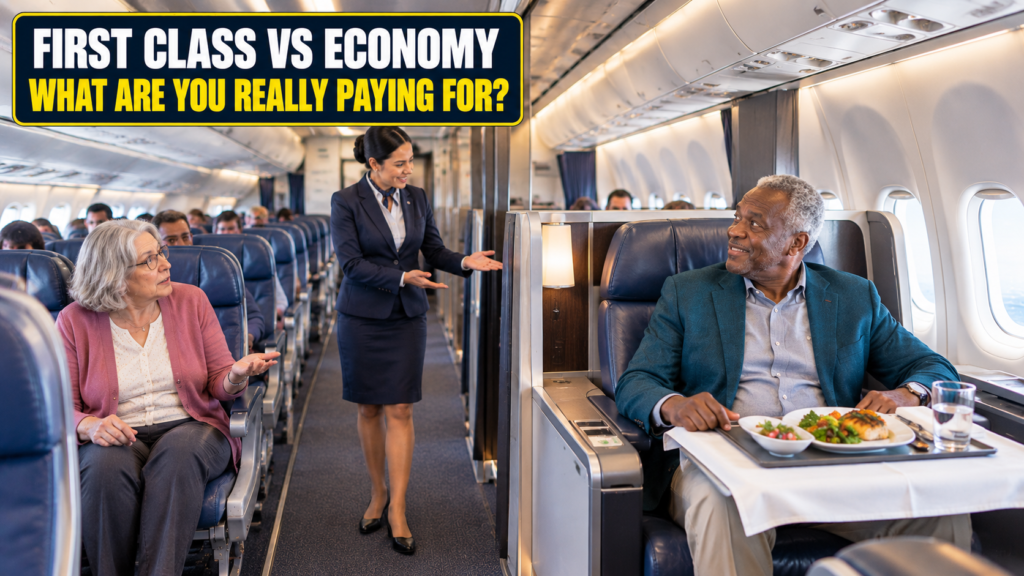
This is probably the easiest difference to show in a photograph.
One passenger receives a more substantial meal presentation.
Another receives the standard service offered in Economy.
Same airplane. Different cabin.
Premium cabins may offer upgraded snacks, complimentary alcoholic beverages, or meal service on eligible flights.
But flight length matters.
Route matters.
Departure time can matter.
And the airline’s service rules matter.
A short domestic First Class flight should not automatically be imagined as a flying fine-dining restaurant.
Sometimes the difference is substantial.
Sometimes it’s relatively modest.
This is why buying First Class primarily because you expect a particular meal can be disappointing.
Check the actual flight details first.
For many travelers over 60, the more important benefit may not be the food itself. It may be the combination of additional space, fewer passengers in the premium cabin, and a different service setup.
And remember: premium alcohol does not change the basic safety rules onboard.
If you carry your own alcohol, don’t assume that gives you permission to serve yourself during the flight. Follow the airline’s service procedures and crew instructions.
7. Service May Feel More Personal—But Don’t Think of It as “Better Employees”
This distinction matters.
The flight attendants serving Economy passengers aren’t somehow the “lower-level” crew.
Flight attendants throughout the aircraft have safety responsibilities.
What changes in a premium cabin is the service environment.
There may be fewer seats in the cabin.
The service may include more individual steps.
Meals and beverages may be presented differently.
Passengers may therefore experience more frequent or individualized interactions.
That’s very different from saying First Class receives good employees and Economy receives bad ones.
For travelers who value a quieter or less crowded experience, the cabin layout itself may be a meaningful benefit.
For others, it may not matter at all.
If you put on headphones after takeoff, read for two hours, and rarely request anything from the crew, paying heavily for a different service pattern may have limited value.
This is where “worth it” becomes personal.
You’re not buying status.
You’re buying a collection of differences.
Only some of those differences may matter to you.
8. Lounge Access Is One of the Biggest First-Class Misunderstandings
You bought First Class.
So you can walk into the airline lounge, right?
Not necessarily.
This is one of the most important assumptions to check before your trip.
Lounge eligibility can depend on the airline, route, cabin product, itinerary, frequent-flyer status, lounge membership, credit-card benefits, or other eligibility rules.
A traveler buying a domestic First Class ticket should never simply assume that the word “First” means complimentary lounge access.
International premium travel can be different.
Certain premium long-haul products may include lounge access and other enhanced ground benefits.
That’s why two travelers can both say they “flew First Class” while describing dramatically different experiences.
One may have received a larger domestic seat, priority services, drinks, and a meal.
Another may have had lounge access and a lie-flat seat on a qualifying premium international itinerary.
Those aren’t equivalent products.
Before upgrading: Find the exact fare or cabin name on the airline’s website and read the benefits attached to your itinerary.
That five-minute check can prevent a very expensive misunderstanding.
So, Is First Class Worth It After 60?
Sometimes.
But age alone isn’t a reason to upgrade.
Your body, itinerary, budget, and priorities matter much more.
Imagine two travelers.
The first is taking a 75-minute nonstop flight, traveling with only a small personal item, and doesn’t care about food or priority services.
A large First Class premium may provide very little practical value.
Now imagine another traveler.
She’s taking a much longer flight.
She finds tight rows uncomfortable.
She’s checking luggage.
She appreciates additional space and wants a less rushed boarding experience.
For her, the calculation can look completely different.
A connection can change the equation again.
So can the aircraft.
So can the price.
Instead of asking:
“Is First Class worth it?”
Ask:
“Which First Class benefits will I actually use on this specific trip?”
That’s a much better question.
Before Paying for the Upgrade, Check These Five Things
First, look at the aircraft and actual seat. Don’t buy based solely on the cabin name.
Second, compare the total cost. Include baggage, seat-selection fees, and extras you would otherwise purchase.
Third, check the flight length. Paying a large premium may feel very different on a 90-minute flight than on a six-hour journey.
Fourth, verify the benefits. Meals, baggage, priority services, lounge access, and seat types can vary.
Finally, decide what comfort is worth to you.
There’s nothing wrong with paying more simply because you want a more comfortable trip.
The mistake is paying more for benefits you assumed were included—but never actually were.
The Bottom Line
First Class and Economy passengers may arrive at the same destination at the same time, but their experiences can be noticeably different.
The premium can buy more space, earlier boarding priority, different baggage benefits, upgraded food and beverage service, a different onboard service experience, and—in some cases—additional airport privileges.
But the three words that matter are:
“In some cases.”
There is no universal First Class package covering every U.S. airline, aircraft, and route.
For travelers over 60, the smartest strategy is therefore not automatically choosing the cheapest seat—or automatically choosing the most expensive one.
Look at your specific flight.
Look at the actual seat.
Check the baggage rules.
Verify lounge access instead of assuming it.
See what food service is scheduled.
Then calculate what those benefits are worth to you.
Because the best upgrade isn’t necessarily the seat with the fanciest name.
It’s the one that makes your particular trip noticeably easier, more comfortable, or less stressful without paying for benefits you don’t need.
