
CRUISE NEW
Cruise Housekeeper Confesses The Disgusting Truth About Cruise Ship Cabins
Sep
You open the door to your cruise cabin, see crisp white sheets, neatly folded towels, a sparkling mirror, and a bathroom that appears ready for a new guest. Most travelers take one look and assume everything is clean.
But what if the cabin looks clean and something was still missed?
That is the uncomfortable question behind “Cruise Housekeeper Confesses The Disgusting Truth About Cruise Ship Cabins.” And while the title is intentionally dramatic, the real story is more useful than the rumors that circulate online.
There is no evidence that cruise cabins are universally filthy, nor is there an official confession proving cruise lines routinely hide dirty rooms from passengers. What official public-health guidance does show is that cabin cleaning and disinfection matter, especially because cruise ships bring large numbers of people together in a relatively confined environment. The CDC’s Vessel Sanitation Program (VSP) specifically evaluates cleaning practices for cabins and other areas as part of its public-health work aboard cruise ships.
So what should cruise passengers actually know before unpacking?
The Cruise Cabin Problem That Can Start the Moment You Board
Imagine stepping into your stateroom on embarkation day. The bed looks made. Your luggage is waiting. Everything seems normal.
Then you enter the bathroom.
Something smells wrong.
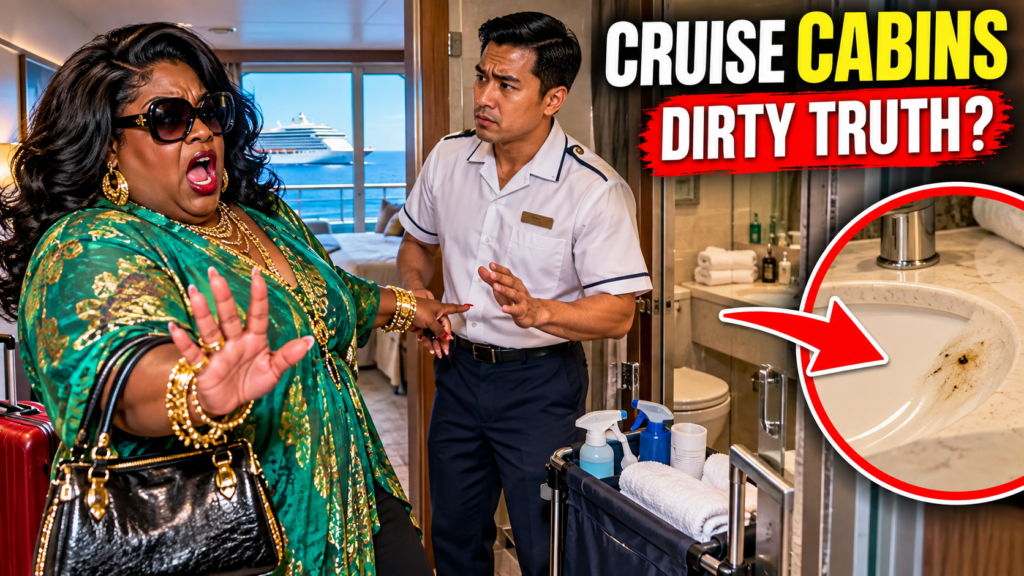
You notice an area around the sink that doesn’t look the way you expected. You immediately back out and confront the housekeeper.
“STOP! I just walked in there and it SMELLS disgusting! You’re telling me this cabin was already cleaned?!”
The housekeeper doesn’t argue.
“Ma’am, please don’t use the bathroom yet. Let me inspect it.”
Now the passenger is furious. She paid thousands of dollars for her vacation and doesn’t believe she should have to discover something another guest may have left behind.
Her final question gets to the heart of the issue:
“So what are you going to do—wipe it down and tell me it’s clean again?!”
It’s a fictional scenario, but the underlying concern is legitimate: a cabin that appears tidy and a cabin that has been properly cleaned are not necessarily the same concept.
That distinction is one reason sanitation procedures exist.
1. “Looks Clean” Isn’t the Same as Public-Health Cleaning
One of the biggest mistakes passengers can make is judging cleanliness entirely by appearance.
A perfectly straight bedspread tells you that someone serviced the room. It doesn’t tell you anything about microorganisms that cannot be seen.
CDC says its Vessel Sanitation Program evaluates cleaning practices for cabins, common areas, and childcare centers to remove germs and sanitize surfaces.
That doesn’t mean passengers should walk into their cabins terrified of every door handle. It means housekeeping is about more than making a room look attractive.
Visual presentation and sanitation serve different purposes.
A room can look beautiful while still requiring attention to a particular surface. Likewise, discovering one cleaning problem does not prove an entire ship is unsanitary.
2. Cruise Housekeeping Is Part of a Much Bigger Sanitation System
Your cabin housekeeper isn’t operating in isolation.
For ships within its jurisdiction, the CDC’s Vessel Sanitation Program conducts periodic, unannounced operational sanitation inspections. Ships are generally subject to two inspections per year, although ships spending extended periods outside the United States may not receive both before returning.
The inspection program evaluates eight broad areas, including housekeeping.
For housekeeping specifically, CDC inspectors meet with the housekeeping manager and review outbreak-prevention and management procedures. They also assess whether management understands general disinfection, disease-spread prevention, and what to do when vomiting or diarrhea cases increase or an outbreak occurs.
That’s much more substantial than simply checking whether the towels are folded nicely.
3. The Bathroom Deserves Your Attention
The bathroom is one of the first places many experienced travelers instinctively inspect.
That doesn’t mean cruise bathrooms are inherently dirty. It means bathrooms are spaces where proper sanitation obviously matters.
If you find an unexplained residue, persistent odor, visibly soiled area, or another genuine cleanliness problem when you first enter your cabin, don’t simply live with it.
Contact your stateroom attendant or Guest Services and calmly explain exactly what you’ve found.
Give the crew an opportunity to inspect and correct the problem.
Most importantly, don’t transform an uncertain observation into a dramatic medical conclusion. A strange smell doesn’t automatically mean norovirus. A mark near a sink doesn’t prove bodily-fluid contamination.
Report what you can actually observe.
4. High-Touch Surfaces Matter More Than Many Passengers Realize
Passengers often focus on the toilet while overlooking everything their hands touch.
Think about how frequently you interact with a cabin’s handles, switches, drawers and other shared surfaces during a sailing.
The public-health principle behind this matters because illness can spread through contact. CDC notes that sick people can spread illness person-to-person and through frequently touched objects and surfaces, including examples such as handrails, elevator buttons and shared utensils.
That doesn’t prove any particular cabin switch or handle is contaminated.
It does explain why proper cleaning practices and hand hygiene are important.
Your best defense isn’t paranoia. It’s good hygiene.
5. Norovirus Is Real—but Cruise Ships Aren’t Automatically “Dirty”
This is where cruise sanitation discussions often become misleading.
Norovirus and other gastrointestinal illnesses can spread rapidly in closed or semi-enclosed environments. But passengers themselves can introduce illness aboard a ship, and CDC explicitly notes this possibility.
Cruise ships also have formal illness surveillance and reporting requirements, which can make outbreaks particularly visible.
CDC’s 2026 outbreak list includes several reportable gastrointestinal outbreaks aboard ships within VSP jurisdiction. But an outbreak does not automatically prove that poor cabin housekeeping caused it.
That’s a crucial distinction.
Don’t turn:
“Norovirus outbreak occurred aboard a cruise ship”
into:
“Dirty cruise cabins caused norovirus.”
Those are not equivalent statements.
6. When Illness Does Spread, Cleaning Can Become Much More Aggressive
Here is where housekeeping becomes particularly important.
During an outbreak, cruise operators may increase cleaning and disinfection under their outbreak-response procedures.
A recent real-world example occurred aboard Caribbean Princess on its April 28–May 11, 2026 voyage. CDC reported 145 of 3,116 passengers and 15 of 1,131 crew members as ill during a norovirus outbreak. Among the actions reported by Princess Cruises and the crew was increased cleaning and disinfection procedures according to the ship’s outbreak prevention and response plan.
Similar enhanced cleaning was reported during the March 2026 norovirus outbreak aboard Star Princess.
These examples demonstrate why cleaning and disinfection procedures matter.
They do not demonstrate that housekeeping caused the outbreaks.
7. Vomiting and Diarrhea Aren’t Ordinary Housekeeping Problems
Here’s one of the less glamorous realities of cruise operations.
People sometimes become sick aboard ships.
When vomiting or diarrhea is involved, the situation has public-health implications beyond making the area look clean again.
CDC’s cruise inspection program specifically evaluates whether relevant staff understand procedures related to gastrointestinal illness and outbreak response. Housekeeping management is expected to understand disease-prevention measures and what to do when illness levels rise.
CDC also advises passengers who witness someone vomiting or experiencing diarrhea to leave the area, and passengers who become ill should report their illness to the ship’s medical center.
In other words, this isn’t something passengers should try to investigate themselves.
8. Your Housekeeper Can’t See Through Walls
There’s another truth passengers sometimes overlook: crew members can’t fix a problem they don’t know exists.
Maybe something smells unusual only after the shower runs.
Maybe a drain isn’t working correctly.
Maybe you discover a visibly dirty area after moving an object.
Maybe something that initially looked fine clearly needs another cleaning.
Tell the appropriate crew member.
Be specific:
“The area beside the sink appears dirty.”
is much more useful than:
“This entire cabin is disgusting!”
Specific information gives the crew something identifiable to inspect and address.
9. Don’t “Test” Your Cabin for Social Media
There’s a difference between reasonably inspecting your room and hunting for shocking footage.
You don’t need to dismantle furniture, crawl through inaccessible areas, or manufacture a cleanliness test to prove that your cabin is disgusting.
And finding dust in an obscure location doesn’t automatically demonstrate a public-health threat.
If something is visibly wrong, photograph it if necessary and report it.
If you believe there’s an actual health or sanitation concern, escalate it through the appropriate onboard channels.
Evidence is more valuable than exaggeration.
10. Your Hands May Matter More Than Your Disinfecting Wipes
Many travelers arrive with an arsenal of wipes and immediately begin disinfecting everything they can reach.
There’s nothing inherently wrong with wanting your immediate environment clean, but don’t let that replace one of the most important preventive measures available to you:
handwashing.
CDC advises cruise passengers to wash their hands often and specifically says they should not rely on hand sanitizer alone.
CDC’s norovirus guidance similarly says washing with soap and water for at least 20 seconds is the most effective method for reducing norovirus contamination when clean water is available; alcohol-based sanitizer should not be considered a substitute.
Wash before eating and after using the bathroom, and pay attention to hygiene throughout your cruise—not only during your first five minutes inside the cabin.
11. If You’re Sick, Tell the Ship
This may be the most important “cabin secret” of all.
If you develop vomiting or diarrhea, hiding inside your cabin without informing anyone can make it harder for the ship to identify and respond to illness patterns.
CDC advises passengers to notify the medical center when they’re sick. Cruise ships also report qualifying gastrointestinal illness cases under VSP requirements.
If medical staff advise you to isolate in your cabin, follow those instructions.
Nobody wants to lose vacation time.
But isolation can help prevent a contagious illness from spreading to other passengers and crew.
12. A Bad Cabin Experience Doesn’t Prove Every Cruise Cabin Is Dirty
Social media naturally rewards shocking claims.
“MY BATHROOM HAD A CLEANING PROBLEM” isn’t as clickable as:
“CRUISE SHIPS NEVER CLEAN THEIR CABINS!”
But those statements mean completely different things.
The second requires evidence that goes far beyond one passenger’s experience.
CDC’s own historical analysis adds useful perspective: rates of acute gastroenteritis illness on passenger cruise ships declined significantly over the period it studied, with evolving sanitation standards and cruise-industry hygiene practices among the likely contributing factors.
Cruise sanitation problems can occur.
Cruise illness outbreaks can occur.
Cleaning mistakes can occur.
None of those facts justify saying every cabin is disgusting.
13. You Can Check a Ship’s Inspection History
Passengers don’t have to rely entirely on viral videos and anonymous stories.
CDC publishes inspection scores and reports for ships covered by the Vessel Sanitation Program. The agency says its inspections are designed to determine how well ships operate and maintain sanitation standards under current VSP guidance.
You can use the official CDC Advanced Cruise Ship Inspection Search to look up available inspection information.
That’s far more useful than assuming a ship is clean—or dirty—because of one TikTok clip.
14. The Most “Disgusting” Truth May Be Less Dramatic Than You Think
So what would an experienced cruise housekeeper really teach passengers?
Probably something less sensational than the internet wants to hear:
Don’t confuse looking clean with sanitation. Don’t ignore a genuine cleaning problem. Don’t assume every stain is dangerous. Don’t assume every outbreak came from housekeeping. And don’t underestimate your own role in preventing illness.
A professional housekeeping operation exists not only to make cabins presentable but also within a broader onboard sanitation system.
CDC’s VSP evaluates housekeeping procedures, trains cruise-industry personnel on public-health practices, monitors illness, investigates outbreaks and conducts operational inspections.
That’s the real story.
What Should You Do Immediately After Entering Your Cruise Cabin?
You don’t need to turn embarkation day into a forensic investigation. A simple routine is enough:
- Look around before fully unpacking. Check the bathroom, bedding and obvious surfaces for visible problems.
- Report anything genuinely wrong immediately. Give your stateroom attendant or Guest Services a clear description.
- Don’t use an obviously soiled area while waiting for assistance.
- Wash your hands regularly with soap and water. This remains particularly important for gastrointestinal illness prevention.
- Report vomiting or diarrhea to the ship’s medical center. Don’t hide symptoms because you fear losing vacation time.
- Follow onboard instructions during an outbreak. Enhanced sanitation or temporary restrictions are designed to reduce transmission.
The objective isn’t to become afraid of your cabin.
It’s to notice legitimate problems early enough for the crew to address them.
Are Cruise Ship Cabins Safe and Clean?
There is no responsible yes-or-no answer that applies to every cabin on every ship on every sailing.
Cruise lines operate large fleets, thousands of cabins are serviced repeatedly, and individual experiences vary.
What we can establish is that ships within CDC VSP jurisdiction are subject to public-health standards and inspections, and housekeeping is explicitly part of that framework.
Problems should be reported.
Outbreaks should be taken seriously.
But neither should be exaggerated into the claim that cruise cabins are universally filthy.
Final Thoughts: What Cruise Housekeeping Can Really Teach You
A cruise cabin is your temporary home at sea. You’ll sleep there, shower there, change clothes there and touch dozens of surfaces without thinking twice.
So cleanliness matters.
The useful lesson behind Cruise Housekeeper Confesses The Disgusting Truth About Cruise Ship Cabins isn’t that passengers should panic when they open their cabin door.
It’s that appearance alone cannot tell you everything about sanitation.
If something genuinely looks or smells wrong, don’t scream at the employee and don’t silently accept it either. Point out the specific problem and allow housekeeping to correct it.
Then do your part.
Wash your hands. Report illness. Follow onboard health instructions. And when you encounter a viral claim about some horrifying “cruise cabin secret,” ask whether there’s evidence behind it.
Because sometimes the most important cruise secrets aren’t secret at all.
They’re simply the details passengers don’t think about until something goes wrong.
SEO PACKAGE
Primary Keyword: cruise ship cabin secrets
Secondary Keywords: cruise housekeeper secrets, cruise cabin cleaning, cruise ship cabin cleanliness, dirty cruise ship cabins, cruise housekeeping secrets, cruise cabin hygiene, cruise ship sanitation, cruise cabin tips, norovirus on cruise ships, cruise stateroom cleaning
SEO Title: Cruise Housekeeper Confesses The Disgusting Truth About Cruise Ship Cabins
Suggested URL Slug: cruise-housekeeper-disgusting-truth-cruise-ship-cabins
Meta Description: A cruise housekeeper reveals what passengers should know about cruise ship cabin cleaning, sanitation, bathrooms, high-touch surfaces, norovirus, and what to check after boarding.
Suggested H1: Cruise Housekeeper Confesses The Disgusting Truth About Cruise Ship Cabins
Suggested Excerpt: Your cruise cabin may look spotless when you board—but appearance isn’t the whole story. Here’s what passengers should know about cabin cleaning, sanitation, bathrooms, illness prevention, and the warning signs worth reporting.
Search Intent: Informational / cruise tips / cruise cabin hygiene / first-time cruiser advice.
Fact-check note: The “housekeeper confesses” framing is an editorial storytelling device, not a claim that a specific real-world cruise employee made these statements. The public-health claims above are grounded primarily in current CDC Vessel Sanitation Program guidance and outbreak records.
