
CRUISE NEW
What ACTUALLY Happens in the 8 Hours Between Cruises?
Sep
At breakfast, one group of passengers is still taking its final photos aboard the ship. A few hours later, thousands of completely different passengers may be walking aboard, ordering lunch, exploring the pool deck, and asking when they can enter their cabins.
So what happened in between?
The answer is one of the most fascinating parts of cruise operations: turnaround day.
For passengers, it can look almost effortless. One cruise ends, another begins, and the enormous floating resort appears ready to start over. Behind the scenes, however, multiple departments are working simultaneously against a tight schedule—unloading luggage, turning over staterooms, cleaning public areas, handling supplies, preparing food-service operations, moving new luggage aboard, and getting the ship ready for its next guests.
And there’s one important clarification before we start: eight hours is not a universal cruise-industry rule. The exact turnaround window varies according to the ship, port, arrival schedule, boarding schedule, itinerary, operational requirements, and cruise line.
But a same-day turnaround can happen remarkably quickly.
Here’s what actually goes on.
A Passenger Walks Aboard—and Immediately Gets Stopped
Imagine you’ve finally boarded your cruise.
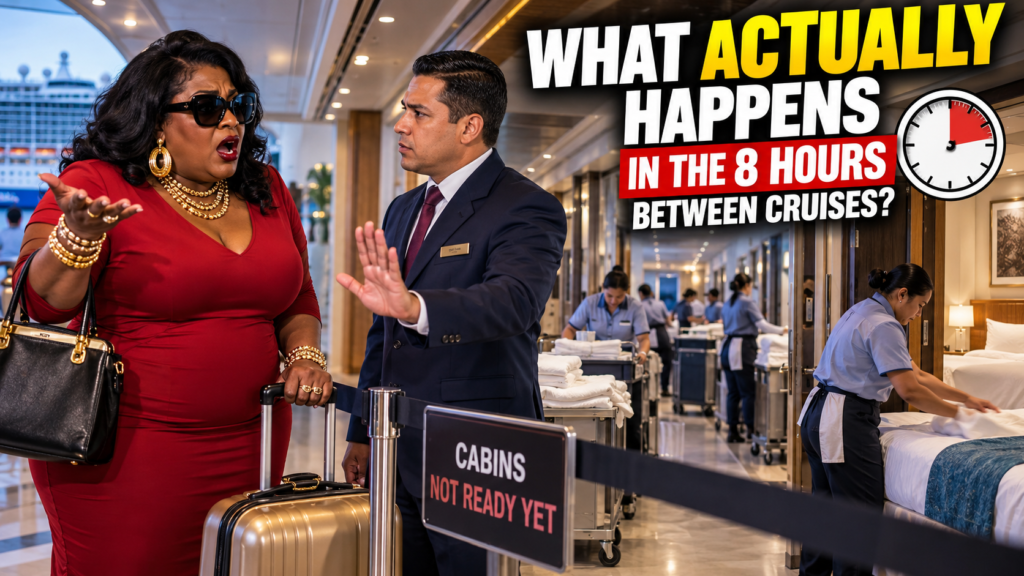
You’ve cleared the terminal, walked onto the ship, and you’re dragging your suitcase toward the stateroom corridor when a cruise employee raises his hand.
“Ma’am, this cabin section hasn’t been released yet. The crew is still preparing the rooms.”
You’re confused.
The previous passengers left hours ago.
“STILL preparing them?! What have you people been doing all this time?!”
The employee points down the corridor.
Housekeeping carts are parked outside open cabin doors. Fresh linens are moving through the hallway. Crew members are disappearing into one stateroom and emerging from another.
“Turning over hundreds of cabins before the next guests move in.”
Suddenly the question changes.
Instead of wondering why your room isn’t ready, you start wondering:
How does a cruise ship reset itself between two completely different groups of passengers?
That’s where turnaround day begins.
What Is Cruise Ship Turnaround Day?
Cruise ship turnaround day is the day one voyage ends and another begins, usually at a homeport.
It’s simultaneously a departure day and an arrival day.
Passengers from the previous cruise need to disembark. Their baggage must leave the ship. Cabins need to be prepared. Operational work continues. Supplies may need to move aboard. New luggage arrives. And eventually the next group of passengers begins embarkation.
These activities don’t necessarily happen one after another.
Many happen simultaneously.
That’s the key to understanding how a giant cruise ship can transition between voyages so quickly.
1. The Previous Cruise Starts Ending Before Passengers Leave
The turnaround doesn’t simply begin when the last passenger steps onto the pier.
Preparations can begin earlier.
For example, Carnival currently instructs guests using its checked-luggage debarkation process to pack their bags and place them outside their stateroom doors before the specified deadline on the final night. Crew then collect the luggage and arrange it for offloading after arrival.
That means part of the logistical process is already underway while passengers are sleeping.
The next morning, guests eat breakfast, retrieve anything they kept with them, and prepare to leave the ship.
Carnival also instructs guests to vacate their staterooms by 8:30 a.m. on debarkation morning.
Once cabins become vacant, another enormous operation can accelerate.
Housekeeping.
2. Thousands of Pieces of Luggage Have to Leave the Ship
Think about the luggage operation alone.
A large cruise ship may have thousands of passengers ending their vacation at approximately the same time.
Many have checked bags.
Those bags must be organized, moved off the vessel and made available for collection in the terminal.
Carnival’s current debarkation information describes luggage being collected, stored in a secure area and then offloaded into the cruise terminal’s baggage-claim area according to the appropriate zone.
Meanwhile, passengers themselves are moving off the vessel.
That’s why debarkation isn’t simply:
Open the doors → everyone leaves.
It’s a controlled logistical process involving passengers, baggage and shore-side operations.
3. Hundreds—or Thousands—of Cabins Enter Turnover Mode
This is probably the part most passengers imagine when they think about the gap between cruises.
Housekeeping crews begin preparing staterooms for the next occupants.
But “preparing a cabin” shouldn’t be confused with simply straightening the bed.
CDC’s Vessel Sanitation Program specifically evaluates cleaning practices in passenger cabins and other shipboard areas as part of its public-health work. Its inspections also examine housekeeping procedures, general disinfection and outbreak-management practices.
On turnaround day, housekeeping teams are working against an unusual challenge:
Every departing cabin needs attention within a relatively compressed period.
A room that housed one family in the morning may house an entirely different family that afternoon.
4. Beds and Linens Have to Be Reset
One of the most visually obvious parts of cabin turnover is bedding.
Departing passengers leave behind used linens and towels. Housekeeping teams must prepare the stateroom for its next occupants according to the cruise line’s procedures.
That requires coordination beyond the individual room attendant.
Fresh linens need to be available where they’re needed. Used linens have to move out of cabins. Housekeeping carts need supplies. Crew members must work through their assigned areas efficiently.
Multiply that by hundreds of staterooms and you begin to understand why a cabin corridor can remain temporarily closed even after new passengers have started boarding.
It’s not necessarily evidence that the ship is running late.
It can simply mean your section hasn’t been released yet.
5. The Bathroom Has to Be Prepared for a Completely New Guest
The bathroom is another obvious priority during turnover.
A new passenger doesn’t care that someone occupied the room three hours earlier. They reasonably expect the stateroom to be prepared for their arrival.
This is also where the distinction between appearance and sanitation becomes important.
CDC’s Vessel Sanitation Program doesn’t merely look at whether a ship appears attractive. Its public-health role includes evaluating cleaning and sanitizing practices aboard vessels.
That matters because cruise sanitation is about much more than making towels look pretty.
Housekeeping is part of a broader public-health system aboard the vessel.
6. Public Areas Can’t Simply Shut Down While Everything Happens
Here’s where turnaround becomes especially complicated.
A hotel can sometimes clean rooms while most arriving guests remain in a lobby.
A cruise ship is different.
New passengers may already be boarding and exploring public areas while parts of the ship are still completing turnaround work.
Princess currently tells embarking passengers that once aboard they can explore the ship, enjoy food and drinks, and access their stateroom once it is ready.
That small detail reveals a lot about turnaround operations.
Boarding the ship does not necessarily mean every cabin is immediately available.
Some spaces are already serving new guests while other spaces are still being prepared.
7. Food Operations Are Preparing for an Entire New Voyage
Now imagine what is happening beyond the passenger corridors.
A cruise ship isn’t only a hotel.
It’s also a massive food-service operation.
Thousands of passengers may eat multiple meals every day. Galleys, restaurants, buffets and food-storage areas therefore operate under extensive sanitation requirements.
CDC’s operational inspections examine food storage, preparation, service, equipment and employee hygiene as part of the Vessel Sanitation Program.
Turnaround day can involve food-service preparation and provisioning associated with the upcoming voyage.
But here’s where viral cruise videos often exaggerate.
It would be misleading to claim:
“All food from the previous cruise is thrown away and completely replaced every turnaround.”
Official sources do not support that as a universal rule.
The accurate story is already impressive enough: a huge food-service operation must remain compliant and ready as one passenger population is replaced by another.
8. Supplies May Be Moving Onto the Ship
Passengers aren’t the only things boarding.
Cruise vessels require enormous quantities of operational supplies.
Depending on the ship and port call, turnaround operations can include provisioning and loading supplies required for the upcoming voyage.
Imagine the categories involved:
food products, beverages, housekeeping materials, linens, operational supplies and other consumables.
But don’t picture random boxes being dragged through the passenger atrium.
Cruise turnaround logistics are coordinated operations involving designated loading and service areas.
Much of what keeps the next voyage running happens completely outside the passenger’s view.
9. Drinking Water Is Part of a Larger Public-Health System
Water is another behind-the-scenes system passengers rarely consider.
CDC Vessel Sanitation standards cover potable-water operations including bunkering, storage, distribution and protection against contamination.
That doesn’t mean every cruise ship completely empties and refills all its drinking water between voyages.
That would be an inaccurate universal claim.
What it does mean is that water safety is another major operational responsibility running behind the vacation experience.
Passengers see a faucet.
Crew and ship operators see an entire potable-water system.
10. Waste and Used Materials Have to Move the Other Direction
Turnaround isn’t only about bringing new things aboard.
A cruise has just ended.
That means the ship has generated waste and used materials during the voyage.
Operational teams have to manage these streams according to applicable procedures and port requirements.
Passengers rarely notice any of it because the entire purpose of good ship operations is to keep much of the logistical machinery separate from the guest experience.
While you might be standing in the atrium holding a welcome drink, service corridors and operational areas can tell a completely different story.
11. Maintenance Doesn’t Stop Because Passengers Are Boarding
Cruise ships are enormous mechanical systems.
A turnaround port call provides an important operational window for work that may be difficult to perform while guests are occupying certain spaces.
That does not mean the ship is completely overhauled between every cruise.
It means maintenance, inspections and operational tasks can continue as necessary while other departments handle passenger turnover.
Again, the fascinating part isn’t one dramatic task.
It’s the number of different departments working at the same time.
12. Housekeeping Is Racing Against Cabin Release
Return to that angry passenger standing at the barrier.
She sees an employee preventing her from walking down the hallway.
From her perspective:
“My cruise has started. Why can’t I enter my room?”
From housekeeping’s perspective:
The room should not be released until it’s ready for its next guest.
Princess explicitly tells passengers that stateroom access comes once the room is ready.
That makes the barrier suddenly easier to understand.
The employee isn’t necessarily keeping passengers away for no reason.
He may be protecting the work window housekeeping needs to finish the section.
13. Then the Direction of the Luggage Flow Reverses
Earlier that morning, luggage was leaving.
Now luggage begins moving the opposite direction.
The next cruise’s passengers arrive with thousands of new bags.
Some passengers carry their smaller luggage aboard themselves. Other bags enter the cruise line’s checked-luggage process and are eventually delivered onboard.
So within the same turnaround period, the ship experiences two enormous luggage flows:
OLD LUGGAGE → OFF
and
NEW LUGGAGE → ON
That’s one reason turnaround day resembles an airport ground operation as much as a hotel checkout.
The logistics don’t stop just because passengers don’t see them.
14. New Passengers Begin Boarding Before Every Behind-the-Scenes Task Is Finished
This is one of the biggest misconceptions about embarkation day.
Passengers often assume:
“If they’re letting me board, the entire ship must be completely finished.”
Not necessarily.
Princess’s guidance makes clear that guests can board, explore the vessel and enjoy available food and beverages before accessing their stateroom once it becomes ready.
Different areas can therefore be at different stages of readiness.
The atrium can welcome passengers.
Restaurants can operate.
Guests can explore public areas.
Meanwhile, a stateroom corridor may still be temporarily restricted.
That’s not contradictory.
It’s how overlapping operations can make an extremely short turnaround possible.
15. Sometimes an Unannounced CDC Inspection Is Happening Too
Here’s a fascinating complication—but one that needs careful wording.
CDC’s Vessel Sanitation Program conducts unannounced operational sanitation inspections on cruise ships under its jurisdiction while they’re in U.S. ports. The agency says ships generally undergo two unannounced inspections per year, and a typical inspection takes approximately six to eight hours, depending on the ship’s size.
Yes, six to eight hours.
That happens to sound remarkably similar to the turnaround window in our title.
But don’t confuse the two.
CDC does NOT inspect every cruise ship between every voyage.
An operational inspection is a periodic public-health inspection, not a mandatory event every turnaround day.
When one does occur, however, it’s another example of how much can potentially be happening while passengers see only the polished public-facing side of the ship.
16. What Happens If Something Goes Wrong?
Turnaround schedules are tight, but operational readiness matters more than pretending everything is perfect.
A cabin may need additional attention.
A maintenance issue may have to be resolved.
A particular stateroom section may take longer to release.
A logistical problem can delay part of the process.
That’s why passengers shouldn’t automatically interpret “your cabin isn’t ready yet” as incompetence.
Sometimes waiting another few minutes is preferable to being admitted into a room before the responsible crew has finished preparing it.
17. What About Norovirus and Enhanced Cleaning?
Turnaround becomes even more complicated when gastrointestinal illness has been reported.
CDC’s Vessel Sanitation Program monitors reportable gastrointestinal illness aboard ships under its jurisdiction, and cruise lines can implement increased cleaning and disinfection as part of outbreak response.
For example, during a reported norovirus outbreak aboard Caribbean Princess in April–May 2026, Princess Cruises and the crew increased cleaning and disinfection procedures according to the ship’s outbreak prevention and response plan.
That doesn’t mean every turnaround involves outbreak-level cleaning.
And it definitely doesn’t mean every arriving cruise ship has norovirus.
It demonstrates that sanitation procedures can escalate when circumstances require them.
18. The Ship Has to Be Ready to Sail Again
Eventually, the frantic-looking transition becomes invisible.
Cabin corridors open.
Passengers find their rooms.
Luggage appears.
Restaurants fill.
Music starts.
People gather on open decks.
And the ship begins feeling less like a workplace under intense operational pressure and more like a floating vacation resort again.
That’s the remarkable part.
The machinery of turnaround disappears almost as quickly as it appeared.
By departure time, most passengers will never know how many people worked behind the scenes to transform the ship from the end of one vacation into the beginning of another.
Is It Really Exactly 8 Hours Between Cruises?
No.
This is the most important factual qualification in the entire article.
There is no universal rule saying cruise ships receive exactly eight hours between voyages.
The turnaround duration depends on factors including:
- scheduled arrival and departure times,
- ship size,
- passenger capacity,
- homeport operations,
- itinerary,
- debarkation progress,
- embarkation schedule,
- provisioning requirements,
- operational conditions,
- and cruise-line procedures.
“8 Hours” works as a compelling representation of a compressed same-day turnaround, not as a fixed industry standard.
Some turnaround windows may be shorter or longer.
So when you see the headline What ACTUALLY Happens in the 8 Hours Between Cruises?, think:
“What happens during those remarkably few hours between one passenger group leaving and another taking over the ship?”
That’s the real question.
What Passengers Should Do on Turnaround Day
If you’re boarding and discover your cabin isn’t available yet, there’s usually no benefit in arguing with the employee guarding the corridor.
Instead, keep medications, travel documents, valuables, electronics and other immediate essentials in the bag that remains with you.
Then use the time to explore whatever areas are available, eat lunch, familiarize yourself with the ship and complete any required embarkation tasks.
Most importantly, don’t cross barriers into a cabin section that hasn’t been released.
Crew members aren’t trying to keep you from the vacation you paid for.
They’re trying to finish preparing part of it.
Why Cruise Turnaround Day Is So Impressive
A cruise ship is simultaneously a hotel, restaurant complex, entertainment venue, transportation system and working maritime vessel.
On turnaround day, those functions don’t simply stop.
Instead, one customer population leaves while another arrives.
Luggage goes out.
Luggage comes in.
Staterooms change occupants.
Housekeeping moves through cabin decks.
Food-service operations prepare for another voyage.
Supplies and operational materials move where needed.
Technical work continues.
Public spaces transition back into guest mode.
New passengers board.
And eventually the gangway closes.
It’s less like cleaning a hotel and more like resetting a small floating city while the clock keeps running.
Final Thoughts: The 8 Hours Passengers Almost Never See
Go back to our passenger standing beside the barrier.
“HUNDREDS?! You’re telling me all of that has to happen between one cruise ending and the next one starting?!”
The employee could answer with one word:
Yes.
Not necessarily in exactly eight hours.
Not with every task happening on every ship.
And certainly not according to the exaggerated versions often seen on social media.
But the basic reality is remarkable.
Between debarkation and embarkation, cruise crews and shoreside teams coordinate a massive turnover operation while passengers experience only fragments of what’s happening.
By the time you finally walk into your cabin, put your suitcase beside the bed and look out at the harbor, the previous occupant may already be on a flight home.
Your vacation is beginning.
For the ship and its crew?
The clock simply started over.
SEO PACKAGE
Primary Keyword: what happens between cruises
Secondary Keywords: cruise ship turnaround day, what happens between cruise sailings, cruise turnaround process, cruise embarkation day, cruise ship cabin turnover, cruise housekeeping turnaround, behind the scenes cruise ship, cruise ship cleaning between cruises, cruise ship provisioning, cruise debarkation and embarkation
SEO Title: What ACTUALLY Happens in the 8 Hours Between Cruises?
Suggested URL Slug: what-happens-8-hours-between-cruises
Meta Description: What happens after cruise passengers leave and before the next group boards? Discover the hidden turnaround operation involving cabins, luggage, housekeeping, supplies, sanitation and embarkation.
Suggested H1: What ACTUALLY Happens in the 8 Hours Between Cruises?
Suggested Excerpt: One cruise ends in the morning and another can begin the same day. Here’s what actually happens behind the scenes as luggage leaves, hundreds of cabins are turned over, supplies move aboard and the next passengers arrive.
Search Intent: Informational / cruise tips / cruise behind-the-scenes / embarkation-day education.
Fact-check framing: “8 Hours” represents a compressed same-day cruise turnaround and should not be presented as a universal fixed duration. CDC inspections, enhanced outbreak cleaning and individual operational tasks also should not be portrayed as occurring during every turnaround.
