
CRUISE NEW
The Top 25 Cruise Disembarkation Hacks You Need to Know!
Sep
Cruise disembarkation looks simple until the final morning arrives. Suddenly, thousands of passengers are trying to leave, suitcases are moving into the terminal, departure groups are being called, transportation is waiting outside, and one small packing mistake can turn the end of a relaxing vacation into a stressful mess.
Imagine discovering that mistake after your suitcase has already been collected.
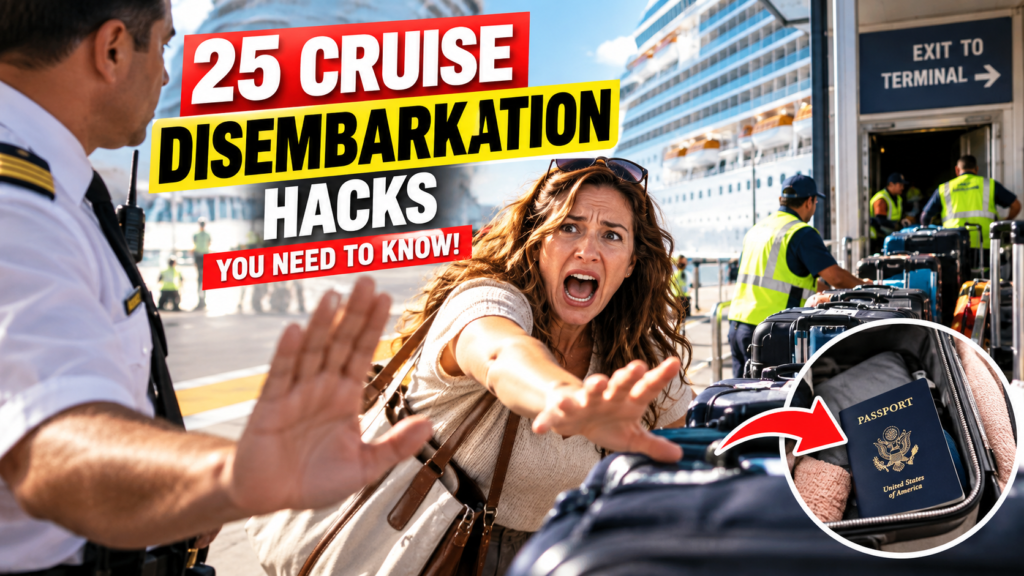
“MOVE! My PASSPORT is in that suitcase, and I’m getting it back RIGHT NOW!”
The cruise employee blocks the restricted luggage area.
“Ma’am, STOP. You cannot enter the luggage handling area.”
The passenger points toward the bags disappearing down the service corridor.
“Then YOU go get it! Your crew took my bag!”
The problem? She had placed her suitcase outside her cabin the night before—and packed her passport inside it.
That scenario is dramatized, but the underlying mistake is very real. Carnival specifically tells passengers using checked-luggage debarkation not to pack medicine or important documents and to keep proof of citizenship and photo identification with them. Royal Caribbean similarly instructs regular-departure guests to retain passports, citizenship documents, flight tickets and valuables.
Avoiding mistakes like that is exactly why these 25 cruise disembarkation hacks matter.
What Is Cruise Disembarkation?
Cruise disembarkation—also called debarkation by some cruise lines—is the process of leaving the ship at the end of your voyage.
But it isn’t simply a matter of walking off whenever you want.
Depending on the cruise, you may have an assigned departure group, checked luggage waiting in the terminal, customs or immigration procedures, transportation arrangements and documentation requirements.
Princess notes that disembarkation generally begins only after the vessel receives clearance from local authorities. The process can take several hours, with passengers leaving in phases.
That’s why a good disembarkation strategy actually begins before the final morning.
1. Read the Disembarkation Instructions Before You Start Packing
Don’t assume disembarkation works exactly as it did on your last cruise.
Procedures can differ by cruise line, vessel, port and itinerary.
Review the information delivered to your cabin or provided through the cruise line’s onboard systems. Pay particular attention to your luggage instructions, departure group, meeting location and the time bags must be placed outside your cabin if you’re using checked-luggage service.
Princess, for example, says guests are generally assigned disembarkation groups based on factors such as transportation arrangements and logistical considerations.
Cruise hack: Take a screenshot or photo of your departure information so you don’t have to search for it while you’re packing.
2. Decide Between Self-Assist and Regular Departure
This can completely change your final morning.
Royal Caribbean describes Self-Assist Early Departure as an option for passengers who want to leave early and can handle all their luggage themselves. Regular departure allows passengers to use the cruise line’s luggage service and leave according to an assigned departure time.
Carnival offers a similar distinction between Express Debarkation/Self-Assist and checked luggage.
Neither choice is automatically best.
Choose based on your luggage, mobility, transportation schedule and cruise line’s procedures.
3. Don’t Choose Self-Assist Unless You Can Really Handle Your Bags
Self-Assist sounds attractive:
Keep your suitcase. Leave earlier. Skip terminal luggage claim.
But there’s a catch.
You carry everything.
Carnival warns that Self-Assist passengers may encounter escalators, stairs and lines while managing their own luggage. Royal Caribbean also specifies that Self-Assist is intended for guests capable of handling their luggage themselves.
If you have three giant suitcases, two carry-ons and mobility limitations, getting off earlier may not be worth wrestling everything through the ship.
4. If You’re Using Self-Assist, Keep Your Luggage in Your Cabin
This sounds obvious, but it’s an important distinction.
With Self-Assist, don’t follow checked-luggage instructions and put your suitcase outside your cabin the night before.
Royal Caribbean instructs Self-Assist guests to keep their luggage in their stateroom overnight and carry it off themselves. Carnival gives essentially the same instruction for its Express Debarkation option.
Once you surrender a bag to the checked-luggage process, you should not assume you can casually retrieve it onboard.
5. If You’re Checking Bags, Follow the Tag Instructions Exactly
Checked-luggage disembarkation is convenient—but organization matters.
Carnival currently instructs passengers using checked luggage to attach the new debarkation tags delivered to their staterooms and retain the tear-off section for reference. The bags are collected, secured onboard, offloaded and placed in the terminal baggage area by zone.
Cruise hack: Don’t treat that little luggage-tag number as disposable information.
You’ll probably want it when hundreds of similar bags are sitting in the terminal.
6. Remove Old Luggage Tags When Instructed
Old airline and embarkation tags can create unnecessary confusion.
Carnival specifically tells passengers to remove their original Carnival luggage tags before attaching the new debarkation tags. Princess also advises removing old airline flight or embarkation tags in its disembarkation guidance.
One bag should tell one clear story about where it needs to go.
7. Photograph Your Suitcase and Luggage Tag
This one is a practical traveler hack rather than a universal cruise-line requirement.
Before putting your suitcase outside, take two quick photos:
your entire suitcase + its disembarkation tag.
If you later struggle to find it among hundreds of bags, you’ll have a visual reference.
It’s particularly useful if you’re traveling with a generic black suitcase that looks like half the luggage in the terminal.
Princess specifically warns that many bags look similar and tells guests to check luggage tags before claiming a suitcase.
8. NEVER Put Your Passport in Checked Luggage
This is one of the most important tips on this list.
Your passport, proof of citizenship and other documents required for your onward journey should remain accessible to you.
Carnival explicitly tells passengers using checked luggage to keep proof of citizenship and photo ID out of the bags collected the night before. Royal Caribbean tells regular-departure passengers to retain their passport or proof of citizenship.
That’s why our opening passenger made such a serious mistake.
Her suitcase may be going exactly where it is supposed to go.
Her passport isn’t supposed to be inside it.
9. Keep Medication With You Too
Your passport isn’t the only thing that shouldn’t disappear with your checked suitcase.
Medication belongs with you.
Carnival explicitly warns passengers not to pack medicine in luggage being collected for debarkation. Princess likewise strongly recommends hand-carrying medication.
This becomes even more important if disembarkation or your onward transportation is delayed.
Pack medication in your personal carry-off bag according to applicable travel and security requirements.
10. Keep Valuables in Your Carry-Off Bag
Jewelry, wallets, important electronics and other valuables should not casually disappear into a suitcase you’re surrendering overnight.
Royal Caribbean explicitly instructs regular-departure passengers to keep valuables with them. Princess similarly recommends hand-carrying valuables.
Think of your final-night personal bag as your survival bag.
It should contain the things you cannot comfortably function without before being reunited with your checked luggage.
11. Leave Out Clothes for the Final Morning
It sounds ridiculous.
Until someone packs every pair of pants they own.
Carnival specifically reminds guests using checked luggage to leave out an outfit for the final day.
Your final-night checklist should therefore include:
clothes, shoes, toiletries you need, medication, identification, travel documents, phone and charger.
Don’t seal your final pair of shoes inside a suitcase sitting outside your cabin door.
12. Keep Your Cruise Card Accessible
Don’t bury your cruise card at the bottom of your handbag just because the vacation is technically ending.
Royal Caribbean’s Self-Assist and regular-departure instructions both tell guests to proceed to the gangway with their SeaPass card. Carnival similarly tells checked-luggage guests to keep their Sail & Sign card with them.
Your final morning isn’t the moment to lose track of it.
13. Check Your Onboard Account Before You Leave
Don’t wait until you’re standing near the gangway to notice a charge you don’t recognize.
Review your onboard account before disembarkation morning if possible.
If something looks wrong, address it according to your cruise line’s procedures while you’re still aboard and able to seek assistance.
Cruise hack: Do this before the final-night rush rather than joining a potentially busy Guest Services line at the last possible moment.
14. Don’t Rush to the Gangway Just Because You’re Awake
Being dressed at 6:30 a.m. doesn’t automatically mean you’re allowed to leave at 6:31.
Ships need appropriate clearance, and cruise lines often organize departures into groups.
Princess says disembarkation begins after the vessel receives clearance from local authorities, while Royal Caribbean’s regular-departure process has passengers wait until their number is called.
Going to the gangway before you’re supposed to can simply create more congestion.
15. Know Where You’re Supposed to Wait
Regular departure often involves waiting in an assigned location or following a designated group.
Royal Caribbean tells regular-departure passengers they can relax in their designated departure lounge until their number is called.
That means you shouldn’t automatically camp beside the exit with all your carry-ons.
Know your group.
Know your meeting point.
Listen for instructions.
16. Have Breakfast Before Your Group Is Called
The last morning can feel rushed, but you may still have time to eat.
Royal Caribbean’s regular-departure guidance specifically says guests can enjoy breakfast or relax in their designated departure lounge until their number is called.
Check the operating hours for your specific sailing rather than assuming your normal sea-day breakfast schedule applies.
A calm breakfast is much better than starting a travel day hungry because you spent an hour waiting near an exit you weren’t supposed to use yet.
17. Remember: Docked Does NOT Mean Cleared
You wake up.
Look outside.
There’s the terminal.
The ship is obviously docked.
So why can’t you leave?
Because physically arriving at the pier and being cleared for passenger disembarkation are not the same thing.
Princess states that disembarkation begins after clearance from local authorities, and its current guidance notes that the full process may take several hours.
This is why you should never build an onward travel plan around the assumption that you’ll step ashore the instant the ship reaches the pier.
18. Build Buffer Into Your Post-Cruise Travel
This may be the cruise disembarkation hack that saves you the most stress.
Don’t treat a scheduled ship-arrival time as a guaranteed time you’ll be standing outside the terminal.
Clearance, phased disembarkation, luggage collection, immigration/customs procedures, traffic and transportation all take time.
Princess warns that disembarkation may take up to four hours after scheduled arrival in some circumstances involving immigration and customs clearance.
There is no single universally safe flight time for every cruise port and itinerary.
Follow the cruise line’s guidance for your specific voyage and give yourself appropriate margin.
19. Make Your Suitcase Easy to Recognize
The terminal baggage area can be a sea of nearly identical luggage.
Princess explicitly reminds passengers that many bags look alike.
A distinctive but secure identifier can help:
a recognizable luggage strap, a unique tag or another appropriate visual marker.
Our fictional passenger’s enormous teal suitcase with a black strap and yellow tag?
That would be considerably easier to identify than “the medium black suitcase.”
20. Check the Tag Before Taking a Bag
Recognizing the color isn’t enough.
Check the actual luggage tag.
Princess specifically tells passengers to verify each luggage tag so they don’t accidentally claim someone else’s bag.
This takes seconds and can prevent a much bigger problem.
Imagine reaching the airport before realizing the black suitcase in your trunk belongs to someone named Robert.
21. Have Your Required Travel Documents Ready
Don’t wait until you reach an official checkpoint to begin digging through four bags.
The exact immigration and customs process depends on the voyage and destination.
For U.S. arrivals, CBP’s own documentation distinguishes between closed-loop and open-loop cruise arrivals. CBP defines closed-loop cruises as itineraries that originate and terminate in the United States under the applicable conditions; other arrivals can be processed differently.
So don’t assume the procedure from your previous cruise will be identical this time.
Keep the documentation required for your itinerary readily accessible.
22. Know What You Need to Declare
International travel doesn’t stop being international travel because you arrived on a cruise ship.
Princess tells passengers that customs officials may review declarations involving items purchased in foreign ports or aboard the vessel and recommends keeping relevant receipts handy.
Requirements vary by country, itinerary, residency and what you’re carrying.
The smart hack isn’t trying to memorize a viral social-media customs rule.
It’s checking the requirements that actually apply to your arrival and declaring items when required.
23. Don’t Assume Every U.S. Cruise Uses the Same CBP Process
This deserves its own hack because cruise advice online often oversimplifies U.S. re-entry.
CBP documentation distinguishes closed-loop from open-loop cruise arrivals, and the agency uses different processing systems and procedures in the cruise environment. CBP documentation also describes facial biometric processing in certain sea-entry/debarkation contexts.
The practical lesson is simple:
Follow the instructions for the cruise you’re actually taking.
Don’t tell your family, “We didn’t need that last time,” and assume it settles the question.
24. Have Your Transportation Plan Ready Before Morning
Disembarkation morning is not the ideal time for six family members to begin debating how they’re getting to the airport.
Know your plan before going to bed.
Depending on your trip, that could involve:
a cruise-line transfer, rideshare, taxi, rental car, hotel shuttle, private transfer or someone meeting you at the pier.
Princess notes that guests who purchased certain ship-to-airport transfers are directed to designated transfer departure points after disembarkation.
Whatever you choose, understand where you need to go after leaving the terminal.
25. Do a FINAL Cabin Sweep
This is the easiest hack to understand—and one of the easiest to forget.
Before closing your cabin door for the final time, perform a deliberate sweep.
Check:
the safe.
Then check it again.
Look under the bed.
Open every drawer.
Check bathroom shelves.
Look behind curtains.
Check electrical outlets for chargers.
Look inside closets.
Check bedside storage.
Inspect the balcony if you had one.
Princess specifically advises passengers to make a final check of the cabin and stateroom safe for personal belongings.
Five careful minutes can save you days of trying to recover something after you’ve gone home.
The Biggest Cruise Disembarkation Mistake of All
If there is one lesson to remember from these 25 tips, it’s this:
Don’t surrender anything the night before that you may critically need before or during disembarkation.
That includes your required identification and travel documentation, essential medication and valuables.
The checked-luggage system is designed to make leaving the ship easier. Once your bag enters that process, however, you should expect to retrieve it according to the cruise line’s procedure—not whenever you suddenly remember something inside.
That’s why the angry passenger from our opening scene has a genuine problem.
The employee isn’t refusing to help simply to be difficult.
He also can’t necessarily allow a passenger to walk into a restricted operational area and start searching through luggage.
The better solution happened the night before:
Her passport should never have gone into that suitcase.
Self-Assist vs. Checked Luggage: Which Is Better?
Neither option wins for everyone.
Self-Assist may make sense if you want an earlier departure, your cruise line offers it, and you can comfortably manage every piece of luggage yourself.
Regular/checked departure may make sense if you have heavier luggage, don’t need to be among the earliest passengers off and prefer having the cruise line move checked bags into the terminal process.
Royal Caribbean explicitly frames the choice this way: Self-Assist for guests seeking an early departure who can manage their own bags, versus regular departure for guests who want luggage service and can follow an assigned departure time.
Carnival similarly warns Self-Assist guests that they may encounter stairs, escalators and lines while carrying their bags.
So don’t choose Self-Assist simply because somebody on social media called it “the secret fastest way off every cruise ship.”
That’s too broad.
What Should Stay in Your Carry-Off Bag?
If your large suitcase is being collected the night before, build a dedicated final-morning bag.
At minimum, consider the items you’ll genuinely need before reuniting with checked luggage: required travel documents and identification, medication, valuables, wallet, phone, necessary electronics, essential toiletries, transportation information and anything needed for your onward journey.
Your exact list will depend on your circumstances and applicable travel/security rules.
The guiding question is:
“If I don’t see my checked suitcase again until the terminal, can I safely complete disembarkation with what I’m carrying?”
If the answer is no, reconsider what you’re packing.
Why Cruise Disembarkation Feels So Chaotic
Passengers see the end of a vacation.
The ship’s crew sees a huge operational transition.
While you are leaving, luggage is being offloaded, passenger groups are moving through the ship, cabins are being vacated, terminal operations are underway, transportation is arriving—and preparations for the next sailing may already be beginning.
Princess notes that passengers typically leave in phases rather than everyone disembarking simultaneously.
That organization exists for a reason.
A ship carrying thousands of people can’t efficiently empty itself through one exit if everyone decides to leave at the exact same moment.
5 Cruise Disembarkation Hacks Worth Remembering Above Everything Else
If you forget the other twenty, remember these five:
Keep your passport and required documents with you.
Keep medication and valuables with you.
Choose Self-Assist only if you can genuinely handle your luggage.
Don’t assume docking means you’re immediately free to leave.
Check your cabin—and especially the safe—one final time.
Those five habits eliminate several of the easiest ways to turn the last morning of a cruise into an unnecessary emergency.
Final Thoughts
Cruise disembarkation doesn’t need to be the worst morning of your vacation.
Most of the stress comes from three things:
rushing, poor packing and incorrect assumptions.
Prepare the night before. Understand whether you’re using Self-Assist or checked luggage. Keep critical belongings with you. Follow your assigned departure procedure. Allow enough time for the realities of leaving a large ship and moving through the terminal.
And before putting that suitcase outside your cabin door, stop for ten seconds.
Passport?
Medication?
Wallet?
Travel documents?
Valuables?
Tomorrow’s clothes?
If all of those are where they should be, zip the suitcase.
Because the best cruise disembarkation hack isn’t finding a clever way to recover your passport from a bag that’s already being moved off the ship.
It’s making sure your passport never ends up in that bag in the first place.
