
CRUISE NEW
She Left Her Belongings Overnight to Claim a Cruise Pool Chair
PART 1 — “Leave Everything There”
By the time the sun began dropping toward the horizon, the pool deck looked nothing like it had that morning.
Hours earlier, nearly every lounger had been occupied. Passengers had carried drinks between tables, families had moved between the pool and their chairs, and attendants had spent most of the afternoon collecting towels and straightening furniture whenever someone left.
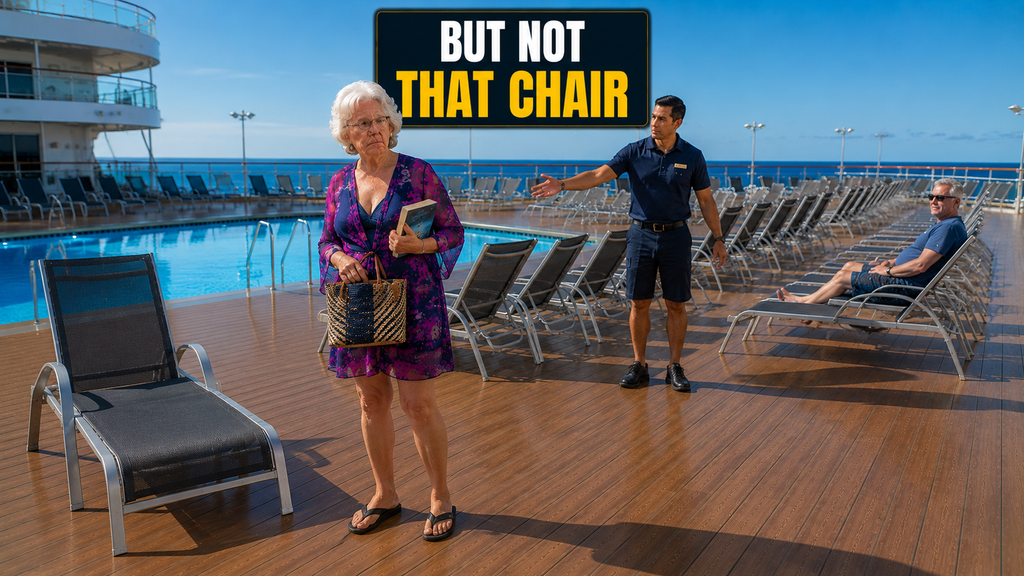
Now the deck was quiet.
And one passenger was still there.
The older woman had claimed a lounger near the pool early that morning. It wasn’t technically different from the dozens surrounding it, but its position was unusually good.
From there, she could see the pool without being directly beside the busiest walkway. She had a clear view toward the ocean and enough distance from the speakers that the afternoon music wasn’t overwhelming.
She liked that chair.
A lot.
Her blue towel covered part of the lounger. Her beach bag sat beside her hip. A paperback book and sunglasses rested nearby.
Throughout the day, passengers around her came and went.
She didn’t.
She read.
She dozed.
She watched the pool.
She left briefly and returned.
By evening, most of the surrounding chairs were empty.
A pool attendant had begun the routine process of straightening unused loungers.
The woman finally looked around and seemed to realize how late it had become.
She closed her book and slowly sat upright.
Then she stood.
But she didn’t pick anything up.
The towel remained exactly where it was.
So did the bag.
So did the book.
So did the sunglasses.
The attendant noticed.
At first, he assumed she had simply forgotten them.
“Ma’am, please take your things when you leave.”
She stopped.
Instead of returning for her belongings, she looked at the attendant as though he’d misunderstood something obvious.
“No. Leave everything there. I want this same chair tomorrow.”
The attendant glanced at the lounger.
Then back at her.
“Sorry, you can’t reserve a pool chair overnight.”
Her expression hardened immediately.
She walked back toward the lounger and placed one hand on its upper edge.
“I’ve had it all day. Nobody touches my stuff!”
The attendant remained calm.
He explained that the pool deck would be reset and the loungers would be available again for passengers the following day.
But the woman wasn’t interested in another chair.
She wanted that chair.
“I’ll be back early,” she said.
The attendant tried again.
Leaving belongings behind wouldn’t turn a shared lounger into a reservation for the following morning.
She shook her head.
“I was here first today.”
“That doesn’t reserve it for tomorrow, ma’am.”
For several seconds, neither moved.
Then the woman made her decision.
She left.
Without the towel.
Without the beach bag.
Without the paperback.
Without the sunglasses.
The attendant watched her walk toward the doors leading inside the ship.
She never looked back.
Apparently, as far as she was concerned, the discussion was finished.
Her belongings had been left behind.
Therefore, in her mind, the chair had been claimed.
But the pool deck still had to be prepared for another day.
And the crew had never agreed to her reservation.
PART 2 — “Where’s My Chair?”
The next morning, she returned earlier than most passengers.
She walked onto the pool deck with the confidence of someone who already knew exactly where she was going.

She didn’t scan the rows looking for an available lounger.
She didn’t compare sunny spots with shaded ones.
She headed directly toward the place where she’d spent the previous day.
Then she stopped.
Something was wrong.
The deck had been completely reset.
The loungers stood in clean, orderly rows.
Fresh towels were available nearby.
Nothing marked one particular chair as belonging to her.
More importantly, her beach bag wasn’t there.
Neither was her book.
Neither were her sunglasses.
She stared at the row.
Then she counted the chairs.
Once.
Then again.
Perhaps she’d approached from the wrong direction.
She walked several feet to one side and looked back toward the pool.
No.
This was definitely the place.
Her chair was still physically part of the row.
But it was no longer her chair.
Another passenger had already settled into the area.
The woman stared.
The passenger wasn’t doing anything unusual. He had simply arrived that morning, found an available lounger and sat down.
That didn’t matter to her.
She turned sharply and began looking for an employee.
A pool attendant was arranging towels nearby.
She approached quickly.
“Where’s my chair?”
The attendant looked toward the loungers.
“The chairs were reset for today, ma’am.”
“I reserved that one last night.”
The attendant paused.
“You left belongings on it.”
“Exactly.”
The woman pointed toward the chair.
“That means I was coming back.”
The attendant calmly explained that belongings left on a lounger overnight did not make that lounger hers the following day.
Her frustration increased.
“Then why did you move everything?”
The other passenger glanced over.
The woman noticed and lowered her voice slightly, but not enough to hide her irritation.
“I specifically told the employee last night not to touch my things.”
The attendant didn’t argue about what she’d said.
Instead, he explained that items left behind during the evening reset could be collected and handled according to the ship’s normal procedures for unattended belongings.
That changed the argument instantly.
For the first time, the chair seemed temporarily less important.
“My bag?”
The attendant nodded.
“And my sunglasses?”
He indicated that she could ask about the collected belongings.
“And my book?”
Again, he directed her toward the appropriate place to retrieve what had been found.
The woman stared at him.
“You moved all of it?”
The attendant remained composed.
She looked back toward the chair.
The other passenger was still there.
Then she looked toward the entrance.
She had expected to walk onto the deck, find yesterday’s setup untouched and simply continue where she’d left off.
Instead, within minutes of arriving, she had no chair and no belongings.
She turned back to the attendant.
“I want my things first.”
That, at least, was something the crew could help her with.
The chair was another matter.
After asking where the collected items could be retrieved, she disappeared inside.
A short time later, she returned carrying her beach bag.
The paperback was with her.
So were the sunglasses.
Nothing had vanished.
Nothing had been taken by another passenger.
She had her property back.
But the moment she returned to the pool deck, her eyes went directly to the same lounger.
Still occupied.
Her expression tightened.
She walked toward the attendant again.
“You found my things.”
“Yes, ma’am.”
“So you knew I was coming back.”
The attendant looked at her.
Finding her belongings and reserving a shared pool chair were two completely different things.
She didn’t see it that way.
And now that she knew her belongings were safe, the argument was about to return to exactly where it had started.
PART 3 — “You Moved My Things?”
The woman placed her beach bag down beside her feet.
“So explain something to me.”
The attendant waited.

“If you knew those things belonged to someone, why couldn’t you leave them exactly where they were?”
“Because the chairs are shared seating, ma’am.”
“But I was using that one.”
“Yesterday.”
She blinked.
It was probably the shortest answer he’d given her.
And somehow, it irritated her more than the longer explanations.
“I was planning to use it today.”
The attendant nodded.
“You can use an available chair today.”
She immediately pointed toward the occupied lounger.
“I want that one.”
The passenger sitting there looked away, clearly trying not to become part of the conversation.
The attendant did not ask him to move.
That made the woman even more frustrated.
She explained again that she’d arrived early the previous morning.
She’d spent the entire day in that location.
She liked the view.
She liked the distance from the busiest part of the pool.
She liked where the sun reached the chair in the afternoon.
She’d even told the employee she was returning.
The attendant listened.
Then he repeated the same basic point.
Using a chair one day did not give a passenger ownership of it the following day.
The woman crossed her arms.
“So every morning I have to find another chair?”
“You can use any available chair.”
She looked around as though he’d just proposed something completely unreasonable.
Then came the detail that made the entire argument almost absurd.
Only a short distance away, another lounger was empty.
It wasn’t hidden.
It wasn’t broken.
It wasn’t squeezed between a crowd of people.
It was simply a different chair.
The attendant gestured toward it.
“That one’s available right now.”
The woman looked at it.
Then she looked at her preferred lounger.
Then back at the empty one.
“No.”
The attendant waited.
“I don’t want that one.”
“It’s available.”
“I can see that.”
For a moment, the real problem became unmistakably clear.
She didn’t need a chair.
She needed that chair.
The one she’d decided was hers.
The one she’d attempted to carry from one day into the next by leaving her belongings behind.
The attendant remained patient.
The woman tried one final argument.
“What if I leave my towel on it tonight?”
“That still wouldn’t reserve it for tomorrow.”
“What if I come back before everyone else?”
“Then you can choose from the chairs available when you arrive.”
She didn’t like that answer either.
But there wasn’t much left to argue about.
Her belongings had been returned.
Nobody had accused her of anything.
Nobody had fined her.
Nobody had threatened to remove her from the pool deck.
And nobody was preventing her from sitting down.
The only thing she wasn’t getting was exclusive control over one shared lounger from one day to the next.
She looked again at the empty chair.
Finally, with obvious reluctance, she picked up her beach bag.
She walked over.
The bag went beside the chair.
The book went down next.
Then the sunglasses.
She unfolded a towel and sat.
For a few moments, she adjusted everything around herself with considerably more force than necessary.
The attendant returned to his work.
The other passenger remained where he was.
The pool deck slowly grew busier as more people arrived.
Several minutes passed.
The woman opened her paperback.
She read half a page.
Then her eyes drifted over the top of the book.
Straight toward yesterday’s chair.
The other passenger appeared perfectly comfortable.
She frowned.
Then returned to her book.
A little later, the attendant passed nearby.
The woman looked up.
“Just so we’re clear.”
He stopped.
“If that chair becomes empty later, I can take it?”
“If it’s available, yes.”
That answer finally seemed acceptable.
Not satisfying.
But acceptable.
She nodded once.
The attendant continued walking.
The strange confrontation had ended without security, without punishment and without the dramatic victory she’d apparently expected.
She had spent an evening trying to preserve a perfect poolside position by leaving her possessions behind.
Instead, the deck had been reset, her belongings had been collected, and another passenger had arrived before she could reclaim the spot.
By the following morning, she had recovered the towel arrangement she wanted.
She had recovered her beach bag.
She had recovered her paperback.
She had recovered her sunglasses.
And she still had somewhere perfectly comfortable to sit.
There was only one thing she hadn’t managed to save.
The chair.
