
AIRPORT TIPS
Passenger Refuses ID Check — Staff Forces Her to Leave the Counter
Sep
The Check-In Line Was Moving—Until One Passenger Pulled Her ID Back
At 9:40 on a busy morning, the international departure hall was already full.
Roller bags clicked across polished floors. Families reorganized passports beside luggage carts. Business travelers stared at phones while watching the line inch toward a row of check-in counters.
At one counter, an airline employee named Danielle Brooks had settled into the familiar rhythm of the morning rush.
Check a reservation.
Verify the travel documents needed for the itinerary.
Tag a bag.
Answer a question.
Move to the next passenger.
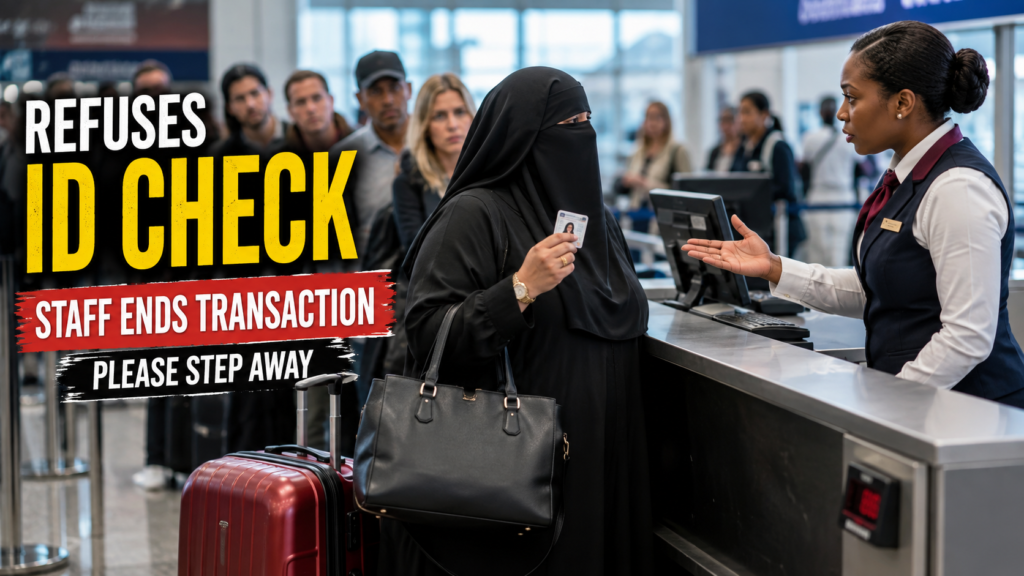
Then a woman dressed in a black abaya and niqab stepped to the front of the line.
Her name was Mariam.
A bright red hard-shell suitcase stood beside her. A black handbag rested against her side.
Danielle pulled up the reservation.
Everything seemed ordinary.
Until she needed Mariam’s identification.
“Ma’am, I need to see your ID to verify your identity.”
Mariam had an identification card in her hand.
That was what made the situation unusual.
She hadn’t forgotten it at home.
She wasn’t searching desperately through her handbag.
She wasn’t explaining that her wallet had been stolen.
Instead, as Danielle reached out with an open hand, Mariam pulled the card back toward her chest.
“I already told you my name,” she said. “You don’t need my ID.”
Danielle paused.
Behind Mariam, another passenger shifted his suitcase forward.
A woman farther back looked up from her phone.
Danielle remained calm.
“I can’t continue your check-in without completing the required verification.”
Mariam’s posture stiffened.
“No. Just give me my boarding pass.”
And suddenly a routine airport interaction became a standoff.
The important question wasn’t whether Mariam possessed an ID.
She clearly did.
The question was whether an airline employee should simply continue processing a passenger when a required identity or document-verification step has not been completed.
And there was another question that would become even more important:
What happens when a passenger refuses the process but also refuses to leave the counter?
PART 1 — THE ID STANDOFF-Passenger Refuses ID Check
“I Already Told You My Name”
Mariam stared at Danielle through the narrow opening of her niqab.
The photo ID remained in her right hand.
Danielle didn’t try to grab it.
She didn’t reach across the counter.
She didn’t raise her voice.
She simply repeated the problem.
The check-in couldn’t continue if the verification required for the transaction wasn’t completed.
For Mariam, that answer seemed unacceptable.
She had purchased the ticket.
She knew her reservation information.
She knew where she was traveling.
Why, she appeared to be asking, wasn’t that enough?
But buying a ticket and completing the airport processes needed to use that ticket are not the same thing.
The U.S. Department of Transportation advises travelers that they will need government-issued photo identification when flying and that the name on a ticket should match the identification being used. For international travel, DOT also emphasizes that passengers themselves are responsible for arriving with the valid travel documents required for their trip.
U.S. Department of Transportation — Fly Rights
That doesn’t mean every employee at every airline counter performs precisely the same ID procedure for every itinerary.
The exact documents and checks can depend on the flight, destination, carrier procedures and the service being requested.
And it is important not to confuse an airline check-in counter with a TSA security checkpoint.
They are different environments with different personnel and functions.
But none of that helped the line behind Mariam move.
Danielle turned slightly toward her computer.
“I can’t do that if you refuse the verification.”
Mariam’s eyes narrowed.
She was still holding the card.
She still wasn’t letting Danielle inspect it.
Then her voice rose.
“I paid for this flight! I’m not leaving this counter!”
Several passengers behind her looked up.
The dispute had moved beyond a simple misunderstanding.
Now Mariam wasn’t merely declining the requested step.
She was insisting that Danielle complete the transaction anyway.
Paying for a Ticket Doesn’t Eliminate Airport Requirements- Passenger Refuses ID Check
This is one of the easiest airport misconceptions to understand.
A traveler buys a ticket and naturally thinks:
I paid. Therefore, the airline has to put me on the plane.
But air travel doesn’t work quite that simply.
A ticket comes with conditions, and airlines maintain contracts of carriage containing carrier-specific rules. DOT explicitly reminds travelers that individual airlines have their own contract terms and that those terms can differ among carriers.
There are also government security requirements separate from airline commercial policies.
For international trips, passengers can face additional passport, visa, entry and transit-document requirements.
DOT makes an especially important point here: airlines are not responsible for supplying passengers with the documents needed to complete international travel. Travelers are responsible for ensuring they arrive with appropriate documentation.
So “I paid for my ticket” is not a universal override.
It doesn’t automatically eliminate check-in deadlines.
It doesn’t eliminate security screening.
It doesn’t eliminate passport requirements for international travel.
And it doesn’t mean an employee must bypass a required verification step because a customer demands it.
In our fictional scene, Danielle doesn’t tell Mariam that she has committed a crime.
She doesn’t threaten her with arrest.
She simply refuses to complete a transaction that has reached an unresolved verification step.
That distinction is critical.
Then Danielle Ends the Transaction
Mariam places one hand on the counter.
Her red suitcase remains planted beside her.
The line behind her has stopped completely.
Danielle looks at her.
“Then I’m ending this transaction. Please step away from the counter.”
For a second, Mariam doesn’t move.
Her eyes widen.
“You can’t make me leave!”
Danielle still doesn’t touch her.
She doesn’t call her names.
She doesn’t mention Mariam’s clothing.
She doesn’t make any statement about Islam.
She doesn’t threaten jail.
Instead, she gestures toward the public walkway beside the counter.
“Ma’am, step away from the counter. I have other passengers waiting.”
That is the real turning point in the story.
The title says staff “forces her to leave the counter.”
But “force” here does not mean Danielle physically grabs Mariam and drags her through the terminal.
It means the employee ends the active transaction and firmly directs the passenger to stop occupying the service position.
Mariam stands motionless for another moment.
Then she lowers the ID.
She grabs the telescoping handle of her red suitcase.
The wheels turn.
She moves away from the counter.
The next passenger steps forward.
And the line starts moving again.
But the confrontation raises several questions travelers should understand before they find themselves in a similar situation.
PART 2 — WHAT U.S. AIRPORT ID RULES ACTUALLY SAY-Passenger Refuses ID Check
Airline Counter vs. TSA Checkpoint: Don’t Confuse Them
One of the biggest mistakes in viral airport videos is labeling every uniformed airport worker as “TSA.”
The person checking your bag at an airline counter is generally an airline employee or contractor.
The Transportation Security Administration handles aviation security functions including passenger screening at TSA checkpoints.
That distinction matters when discussing identification.
DOT advises adult passengers to bring government-issued photo ID when traveling by air.
At the TSA checkpoint, federal identification requirements are particularly important.
REAL ID enforcement began on May 7, 2025. For federal purposes covered by the REAL ID Act—including boarding federally regulated commercial aircraft—state-issued driver’s licenses or identification cards generally need to be REAL ID-compliant to serve as the relevant state-issued credential, although TSA accepts other qualifying forms of identification.
That does not mean a passport suddenly became useless for domestic air travel.
It means travelers using state driver’s licenses or state identification cards need to understand REAL ID requirements or use another TSA-accepted credential.
So there are really several questions a traveler might be asking:
What does my airline need at check-in?
What does TSA require at the security checkpoint?
What documents does my destination require?
Those are related questions.
They are not interchangeable.
Why Names Matter- Passenger Refuses ID Check
Suppose a ticket says:
Sarah Marie Johnson
but the traveler’s identification presents a materially different identity.
That can create complications.
DOT advises travelers to use the form of their name that appears on the photo ID they plan to show at the airport. It also recommends addressing necessary corrections promptly and carrying documentation when a name has recently changed.
This helps explain why identity verification isn’t merely an employee being nosy.
The aviation system needs to connect a reservation to the traveler who is actually using it.
In our fictional story, Mariam saying:
“I already told you my name.”
doesn’t necessarily complete that process.
A spoken name isn’t inherently equivalent to allowing required identification or travel documents to be verified.
Again, the exact check-in procedure can vary.
But the broader principle is straightforward:
Travelers should expect identity and document checks during air travel and should prepare accordingly.
REAL ID Changed the Airport Conversation
REAL ID has generated years of confusion.
Some travelers heard repeated deadline extensions and stopped paying attention.
But the federal enforcement date arrived on May 7, 2025. -Passenger Refuses ID Check
DOT’s government-issued identification toolkit explains that, beginning on that date, federal agencies may accept state-issued driver’s licenses or identification cards for REAL ID official purposes only when they comply with REAL ID requirements; otherwise, travelers need another form of identification accepted by the relevant federal agency.
For current airport-security information, travelers should use TSA’s official guidance rather than screenshots from old social-media posts.
Transportation Security Administration
This matters because airport-ID content ages quickly.
A video recorded several years ago can circulate today with a caption implying that the procedure shown is still current.
It may not be.
For a 2026 trip, check 2026 requirements.
What If You Don’t Have the Expected ID?
This is another area where viral content often becomes too absolute.
A video might claim:
“No ID? You can never fly.”
Another might claim the opposite:
“You don’t actually need ID at the airport.”
Neither slogan is a safe substitute for current official guidance.
There are circumstances in which TSA may have procedures for travelers who arrive without acceptable identification, including additional identity-verification processes. But that is fundamentally different from a passenger who possesses an ID and deliberately refuses the applicable verification process.
And procedures can change.
The practical lesson is simple:
If you realize before traveling that your driver’s license isn’t acceptable for the trip you’re planning, don’t build your travel strategy around arguing at the airport.
Check TSA’s current accepted-ID guidance before departure.
For an international itinerary, check passport validity and destination-specific documentation requirements as well.
DOT specifically warns that travelers who arrive without proper documentation for international travel will not be allowed to travel.
Refusing an ID Check Does Not Automatically Mean “You’re Under Arrest”
Now we reach the most important fact-checking limitation in this story.
Imagine Danielle suddenly shouts:
“Refusing to show me your ID is a federal crime! You’re going to jail!”
That would dramatically increase the video’s intensity.
It would also go beyond what this scenario establishes.
The fictional facts here do not provide a sound basis for automatically declaring that Mariam committed a federal crime merely because she refused to let an airline counter employee inspect her ID.
Likewise, we should not automatically claim:
- she will be arrested;
- she will receive a federal fine;
- she will be permanently banned from flying;
- police must remove her;
- she will go to jail.
Those consequences do not automatically follow from the facts we’ve established.
What we can say is much narrower.
If a required verification step has not been completed, the employee may be unable to complete the requested transaction under the applicable procedures.
And if a customer refuses to move after that interaction has ended, that creates a separate operational conflict at the counter.
That’s enough drama.
We don’t need to invent a criminal charge.
PART 3 — THE NIQAB IS NOT THE ISSUE
Religious Clothing Must Not Become a Shortcut for Suspicion
Mariam wears a niqab in this story.
That visual detail makes it especially important to explain what the story is not about.
It is not about portraying Muslim passengers as suspicious.
It is not about suggesting a niqab is evidence of wrongdoing.
It is not about an airline employee refusing service because she dislikes religious clothing.
And it is certainly not about terrorism.
Federal law prohibits airlines from discriminating against passengers on the basis of characteristics including religion, race, color, national origin, sex and ancestry. DOT’s current nondiscrimination guidance says airline safety and security responsibilities must be carried out in a nondiscriminatory manner.
DOT — Non-Discrimination in Air Travel
That means an airline employee should not turn someone’s religious appearance into an unsupported security conclusion.
If another passenger in identical operational circumstances would need to complete a particular verification step, the fact that Mariam wears a niqab should not transform that neutral requirement into a hostile confrontation about her faith.
In our story, Danielle never says:
“Take that thing off.”
She never insults the niqab.
She never claims Mariam is dangerous because she is Muslim.
She never singles her out because of religion.
The dispute begins for one defined reason:
Mariam refuses to let the employee complete the verification required to continue this fictional check-in transaction.
That distinction is not cosmetic.
It’s fundamental.
What If a Traveler Believes an Employee Is Discriminating Against Her?
A passenger doesn’t surrender her right to raise legitimate concerns simply because she enters an airport.
If a traveler believes airline personnel have discriminated against her because of religion or another protected characteristic, DOT provides an aviation consumer complaint process and specifically addresses discrimination in air travel.
The useful response is not necessarily to turn the counter into a shouting match.
A traveler can ask calmly:
“Can you explain what verification is required?”
If privacy is the concern:
“Is there a private way to complete the required verification?”
If the traveler believes she is being treated differently:
“Is this the same procedure applied to other passengers in my situation?”
And when necessary, she can request a supervisor or document what occurred for a later complaint.
That protects the traveler’s ability to question the process without pretending that refusing every verification step automatically requires the employee to issue a boarding pass anyway.
Both ideas can be true simultaneously:
Airlines must not discriminate based on religion.
And:
Passengers may still have to complete legitimate, nondiscriminatory identity and document requirements.
Privacy Concerns Are Not the Same as Refusing All Verification
Airport technology has made this distinction increasingly important.
Some travelers are uncomfortable with biometrics.
Others object to facial-recognition systems.
Others simply don’t understand what information is being collected.
Those concerns shouldn’t automatically be mocked.
But refusing a particular optional biometric process can be very different from refusing identity verification altogether.
That’s why our story deliberately avoids making the conflict about facial recognition.
Mariam isn’t saying:
“I don’t consent to an optional facial-recognition system; please verify me through the available alternative.”
That would be a different scenario requiring different analysis.
Instead, she has an ID card in her hand and insists that Danielle should issue the boarding pass without allowing the verification needed for this fictional transaction.
That is the conflict.
Travelers who have privacy concerns should ask what is mandatory, what is optional, and what alternative procedure is available rather than assuming every airport technology operates under identical rules.
What Mariam Could Have Done Differently
By the time Mariam says, “I’m not leaving this counter,” the disagreement has stopped being productive.
There were better options.
She could have asked Danielle to explain why the ID was needed.
She could have asked whether another form of identification was acceptable.
She could have requested a supervisor.
If she had a religious or privacy concern about how identity verification would occur, she could have stated that concern directly and asked whether an appropriate alternative or private procedure existed.
If she believed she was being discriminated against because she was Muslim, she could have documented the interaction and used the airline’s or DOT’s complaint process.
What doesn’t help is demanding that an employee bypass a process while simultaneously blocking the counter indefinitely.
The same applies to almost any airport dispute.
Ask questions.
Request clarification.
Escalate appropriately.
Document the problem.
But don’t assume that becoming louder changes the underlying requirement.
What the Employee Could Have Done Right
Danielle’s strongest behavior in this fictional scenario is not that she “wins.”
It’s that she stays focused.
She doesn’t debate Mariam’s religion.
She doesn’t make personal comments.
She doesn’t threaten consequences she cannot guarantee.
She doesn’t grab the ID.
She doesn’t grab Mariam.
She explains the operational problem:
“I can’t continue your check-in without completing the required verification.”
When Mariam refuses, Danielle explains the consequence for the transaction.
When Mariam refuses to step away, Danielle becomes firmer.
This is far more credible than the exaggerated version common in short-form airport dramas where an employee instantly announces:
“You’re banned for life!”
Real airport procedures are usually more complicated than viral scripts suggest.
The safest storytelling principle is to show the consequence that is actually supported.
In this case:
No completed verification → no completed check-in transaction in the scenario → employee ends the interaction → passenger is told to step away from the active counter.
No invented arrest is needed.
The Line Starts Moving Again
Back at the counter, Mariam has finally turned away.
Her red suitcase follows behind her.
She is furious.
But no one has touched her.
There are no handcuffs.
No police officers suddenly appear.
No crowd cheers.
No employee announces that Mariam has been permanently banned from air travel.
Danielle turns toward the line.
The next passenger steps forward.
“Good morning,” Danielle says.
The airport returns to its normal rhythm.
Mariam’s problem, however, has not magically disappeared.
Walking away from the counter doesn’t mean she has completed check-in.
It means the transaction ended unresolved.
If she still wants to travel, she now needs to resolve the underlying issue through whatever legitimate airline process applies—perhaps by cooperating with the necessary verification, seeking clarification, speaking with a supervisor or addressing any genuine documentation concern.
The confrontation itself solved nothing.
And that may be the most useful lesson in the entire story.
Five Things Travelers Should Remember About Airport ID Checks in 2026
The rules can feel complicated, but travelers don’t need to become aviation lawyers before every vacation. A few habits prevent many airport problems:
- Bring acceptable identification and required travel documents. For international travel, make sure you understand passport, visa, transit and destination requirements. DOT says the traveler is responsible for having the proper international documentation.
- Understand REAL ID. Since May 7, 2025, REAL ID requirements matter when using state-issued driver’s licenses or ID cards for covered federal purposes such as commercial air travel; TSA also recognizes other acceptable credentials.
- Don’t confuse the airline counter with TSA. The airline’s check-in process and TSA security screening are different stages.
- Ask for clarification instead of guessing. If an employee requests a document or verification you don’t understand, ask what is required, whether alternatives exist, and whether a supervisor can help.
- Know your nondiscrimination rights. Airline security and operational duties must be carried out without unlawful discrimination based on religion or other protected characteristics.
The Bottom Line
The most dramatic version of this story would end with security officers storming toward the counter.
But the more accurate version is actually more useful.
Mariam has an ID.
She refuses to allow the employee to complete the verification required in this fictional check-in transaction.
Danielle cannot simply pretend the step happened.
Mariam demands a boarding pass anyway.
Danielle refuses.
Mariam then refuses to leave the active counter.
So Danielle ends the transaction and firmly tells her to step away.
That’s the confrontation.
Mariam’s niqab isn’t the problem.
Her religion isn’t the problem.
The employee doesn’t get to discriminate against her because she is Muslim, and DOT explicitly prohibits religious discrimination in air transportation.
At the same time, a passenger’s protected religious identity does not mean ordinary, legitimately applicable travel requirements simply disappear.
The best airport strategy is rarely to turn a procedural disagreement into a standoff.
Know which documents you need.
Check current requirements before leaving home.
Ask questions if something is unclear.
Request a supervisor when necessary.
Understand the difference between an airline employee and TSA.
And if you believe you’ve experienced discrimination, document what happened and use the appropriate complaint channels.
Because once you’re standing in a crowded terminal with departure time approaching, the worst moment to discover how an airport requirement works is after you’ve already decided you won’t comply with it.
Official Resources for Travelers
For current airport-security identification requirements, use the Transportation Security Administration’s official website. For passenger rights and general air-travel guidance, see DOT Fly Rights and DOT guidance on buying a ticket and international travel documents. Travelers concerned about discriminatory airline treatment can review DOT’s Non-Discrimination in Air Travel guidance. These are preferable to relying on old social-media posts because identification and airport procedures can change.
SEO Blog Image Set — 1 Cover + 5 Mid-Article Images
All images are 16:9, ultra-photorealistic live-action, and maintain the locked ID-PASSENGER-01, ID-EMPLOYEE-01 and AIRLINE-CHECKIN-COUNTER-01 continuity.
COVER — High CTR
Create ONE ultra-photorealistic cinematic 16:9 high-click blog cover inside a busy modern U.S. international airport airline check-in hall.

LEFT FOREGROUND:
ID-PASSENGER-01, a 52-year-old plus-size Muslim American woman wearing a traditional black niqab showing ONLY the narrow eye area, matching black head covering and long loose black abaya.

No hair visible.
No mouth visible.
No face visible except eyes.

She holds ONE generic photo ID tightly against her own chest, deliberately pulling it away from the employee.

A bright crimson-red hard-shell roller suitcase stands beside her.

RIGHT:
ID-EMPLOYEE-01, 38-year-old Black American female airline employee with deep warm-brown skin, sleek jet-black low bun with fixed center part, white blouse, dark-navy vest and trousers, burgundy scarf.

Employee stands behind check-in counter with EMPTY OPEN HAND waiting for ID.

Clear visible gap between ID and employee's hand.

Long impatient airport passenger line behind woman.

Strong eye contact and tension.

IMPORTANT:
The Muslim passenger's religious clothing must NOT be visually portrayed as suspicious or threatening.
The conflict is clearly about the ID card being withheld.

Add ONLY short bold high-CTR text:

“SHE REFUSED THE ID CHECK”

Large readable text away from faces and hands.

NO police.
NO TSA.
NO security.
NO arrest.
NO violence.
NO terrorism imagery.
NO airline logos.
NO readable ID information.

Ultra-photorealistic cinematic American airport drama, 16:9.
Cover SEO alt text: Passenger refusing ID verification at an airline check-in counter while an employee waits for identification.
IMAGE 2 — The ID Is Pulled Back
Create ONE ultra-photorealistic cinematic 16:9 live-action airport image.

Maintain EXACT locked character continuity.

ID-PASSENGER-01 stands in front of the airline check-in counter wearing her black niqab, black head covering and long black abaya.

She has JUST pulled her generic photo ID back toward her chest.

ID-EMPLOYEE-01 remains behind the counter with one empty open hand extended calmly.

Clearly show the physical gap between the ID and employee's hand.

Passenger's crimson-red suitcase beside her.

Long airport queue behind her.

No physical contact.
No police.
No TSA.
No readable personal information.
No religious hostility.
No text.

Cinematic 16:9.
Insert after: “Instead, as Danielle reached out with an open hand, Mariam pulled the card back toward her chest.”
IMAGE 3 — The Argument Escalates
Create ONE ultra-photorealistic cinematic 16:9 airport check-in confrontation.

Maintain EXACT character continuity.

ID-PASSENGER-01 stands rigidly at the counter in black niqab and abaya.

One hand holds her ID close to her own body.

Her other hand rests firmly on the counter.

Her visible eyes communicate frustration and defiance.

ID-EMPLOYEE-01 remains professional behind the counter and gestures calmly toward the check-in computer/document-verification area.

Several secondary travelers waiting behind the passenger exchange impatient looks.

No yelling mouth visible through niqab.
No transparent fabric.
No physical aggression.
No police.
No security.
No Islamophobic imagery.
No text or logos.

Cinematic realistic 16:9.
Insert after: “I paid for this flight! I’m not leaving this counter!”
IMAGE 4 — Employee Ends the Transaction
Create ONE ultra-photorealistic cinematic 16:9 live-action image at the same U.S. airport check-in counter.

ID-EMPLOYEE-01 stands behind the counter with calm authoritative posture.

She uses ONE restrained open-palm directional gesture toward the public walkway, indicating that the transaction has ended and the passenger should step away.

ID-PASSENGER-01 remains in front of the counter holding her ID, visibly stunned and angry through her eye expression and rigid posture.

Employee does NOT touch passenger.

No physical removal.
No grabbing.
No police.
No TSA.
No handcuffs.
No threats.
No religious hostility.

Waiting passengers remain secondary.

Cinematic 16:9.
Insert after: “Then I’m ending this transaction. Please step away from the counter.”
IMAGE 5 — Passenger Leaves the Service Position
Create ONE ultra-photorealistic cinematic 16:9 airport image maintaining exact continuity.

ID-PASSENGER-01 has turned away from the active check-in position.

She wears the same black niqab and abaya.

She pulls her bright crimson-red roller suitcase beside her and carries the same black handbag.

Her visible eyes and posture communicate anger and frustration.

ID-EMPLOYEE-01 remains calmly behind the counter.

The next waiting passenger begins moving forward but remains a secondary character.

Clearly communicate that the passenger is leaving voluntarily after being firmly instructed to step away.

NO employee touching her.
NO security escort.
NO arrest.
NO police.
NO crowd celebration.
NO religious hostility.
NO text.

Ultra-photorealistic cinematic 16:9.
Insert after: “She grabs the telescoping handle of her red suitcase. The wheels turn. She moves away from the counter.”
IMAGE 6 — Know Before You Fly
Create ONE ultra-photorealistic cinematic 16:9 closing travel image inside the same modern U.S. airport check-in hall.

Maintain exact locked ID-PASSENGER-01 appearance.

Show the Muslim female traveler standing calmly away from the active counter, still wearing her black niqab and abaya, with her crimson-red suitcase beside her.

She looks down at her generic photo ID and travel documents as if reconsidering what she needs to complete before continuing her trip.

In the background, ID-EMPLOYEE-01 professionally serves the next passenger.

The atmosphere is calm after the confrontation.

The visual message should be:
UNDERSTAND THE REQUIREMENTS BEFORE YOU FLY.

Do not portray the Muslim woman as dangerous, criminal, suspicious, or humiliated because of religion.

NO police.
NO security.
NO arrest.
NO terrorism imagery.
NO airline logos.
NO readable personal information.
NO text.

Ultra-photorealistic cinematic travel journalism style, 16:9.
Insert immediately before the final “The Bottom Line” section.
