
CRUISE TIP
9 LIGHTER CRUISE DINNERS THAT STILL FEEL SPECIAL

Sep
Cruise dinners are supposed to feel like part of the vacation.
You dress for the evening, sit down in a beautiful dining room, look through a menu you did not have to cook yourself, and enjoy a meal while the ship carries you toward the next port.
But after several nights onboard, another rich dinner can sometimes sound like too much.
That does not mean dinner has to become a bowl of lettuce.
Many cruise menus offer—or can be adapted around—fish, seafood, poultry, vegetables, soups, sushi, and smaller portions of richer favorites. What is available depends on the cruise line, ship, restaurant, itinerary, and that evening’s menu, so these are ideas to look for rather than dishes every ship is guaranteed to serve.
For travelers over 60 who simply prefer a lighter-feeling evening meal, the goal does not have to be “diet food.” The better approach can be choosing dishes that still have color, presentation, flavor, and that unmistakable feeling of sitting down to dinner at sea.
Here are nine options worth looking for.
1. Grilled Fish With Seasonal Vegetables
If there is one dinner that proves lighter does not have to mean boring, grilled fish may be it.
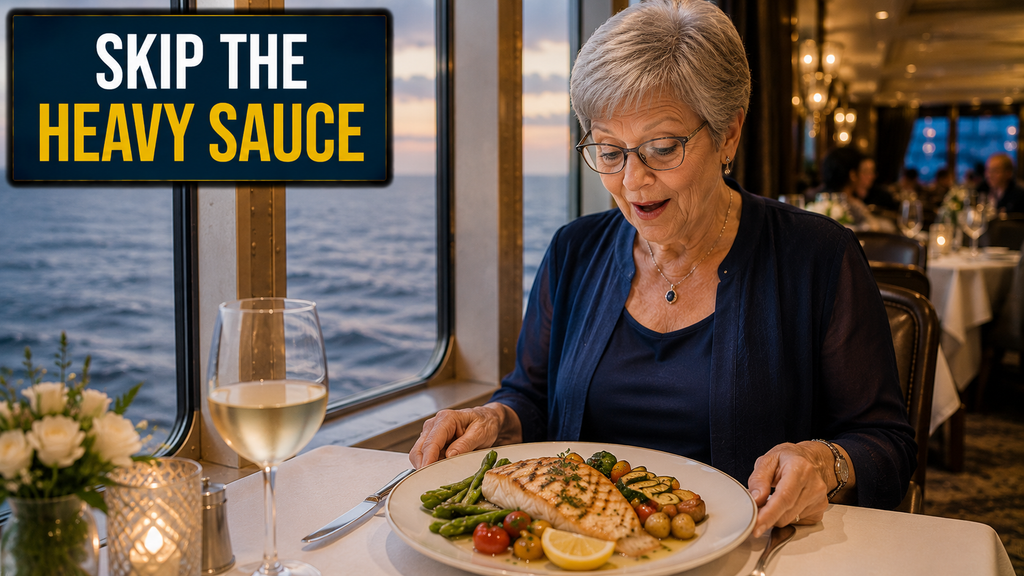
A well-presented salmon, sea bass, snapper, cod, or other fish entrée can look every bit as special as a heavier main course. Add roasted or grilled vegetables, a few potatoes, fresh herbs, lemon, and a restrained sauce, and the plate still feels complete.
This is also one of the easiest choices to spot on many restaurant-style menus.
Instead of focusing only on the name of the fish, read the entire description. The preparation can make a major difference in how substantial the meal feels.
For example, compare a fish entrée served with a rich cream sauce and heavy sides with one accompanied by grilled vegetables, citrus, herbs, or a lighter sauce.
If the menu description is unclear, ask the dining staff how the dish is prepared and what comes with it.
You may also be able to ask whether a sauce can be served on the side or whether a different listed side is available. Whether substitutions are possible depends on the restaurant and ship, so treat it as a question rather than an expectation.
The result can look much like the plate in our video: a beautifully grilled piece of salmon, asparagus, zucchini, roasted tomatoes, a few baby potatoes, lemon, and herbs.
Nothing about that looks like punishment food.
It looks like dinner.
2. Shrimp or Prawns With Bright, Simple Sides
Shrimp and prawns can deliver the “special dinner” feeling surprisingly well.
Presentation helps enormously here.
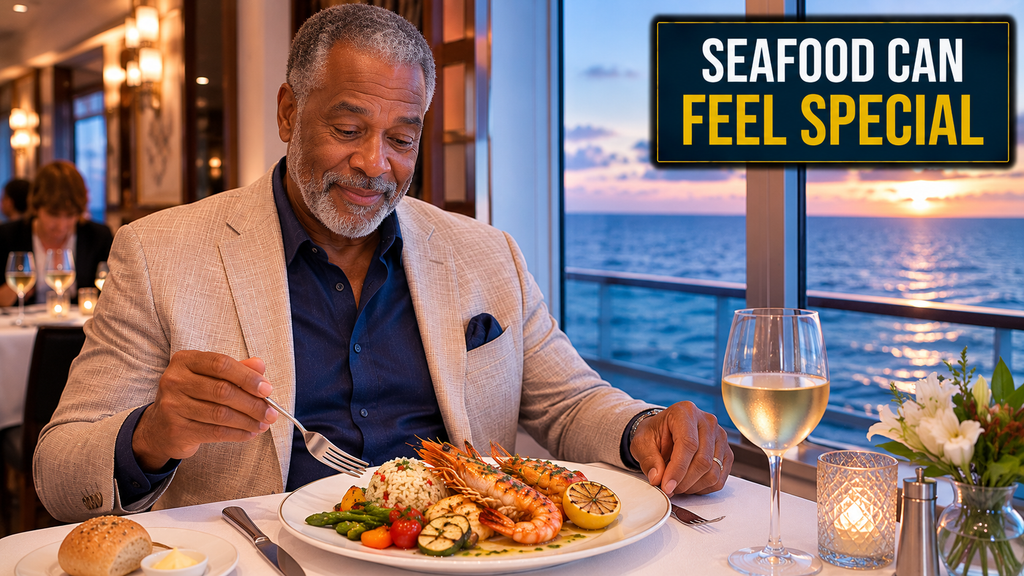
A carefully plated seafood entrée with vegetables, rice, citrus, herbs, or a fresh salsa can look elegant without requiring an enormous portion.
The important thing is to look beyond the word shrimp.
Shrimp can appear in dramatically different preparations—from grilled seafood to fried dishes or rich pasta entrées. If your objective is simply a lighter-feeling dinner, pay attention to what accompanies it.
Look for words such as grilled, roasted, citrus, herbs, tomato, vegetable, or broth-based.
And remember that the most visually dramatic option is not necessarily the one you have to order.
If tonight’s shrimp special comes with several substantial sides, ask what alternatives are available.
There is another advantage to seafood entrées on a cruise: they can still feel celebratory.
Ordering a beautifully presented seafood plate does not create the psychological feeling that everyone else is “having vacation food” while you are settling for something dull.
That matters.
A good lighter dinner should still feel like part of your cruise experience.
3. Roasted or Grilled Chicken With Vegetables
Chicken may not sound like the most exciting recommendation in a cruise guide.
But do not dismiss it too quickly.
The difference between an ordinary chicken dinner and a very good cruise dinner can be preparation and presentation.
A roasted or grilled chicken entrée accompanied by vegetables, herbs, perhaps a modest potato or grain side, and a flavorful sauce can be both familiar and satisfying.
This can be particularly appealing several days into a sailing.
After buffets, desserts, specialty dinners and unfamiliar dishes, some passengers eventually reach an evening when they simply want something recognizable.
The mistake is assuming recognizable must mean boring.
Check the menu for how the chicken is prepared. If the listed version comes with particularly rich accompaniments, ask whether other sides already available in the restaurant can be substituted.
Again, substitutions are not guaranteed.
The kitchen may be able to accommodate a simple request, or it may need to serve the dish as listed, especially depending on the venue and service conditions.
The point is to ask.
A straightforward grilled or roasted chicken plate can provide a useful middle ground between an enormous dinner and ordering something so small that you are hungry again an hour later.
4. Seared Scallops When They’re Available
This is where a lighter dinner can genuinely feel luxurious.
Scallops are often served in comparatively restrained portions and lend themselves naturally to elegant plating.
When offered as an entrée, they may be accompanied by vegetables, purées, grains, citrus elements, or sauces depending on the restaurant.
They are not available on every ship, every menu, or every sailing, and they may appear in a specialty venue rather than an included dining room.
So consider this a menu opportunity, not a cruise guarantee.
If you see scallops, read the accompaniments before ordering.
A dish built around several beautifully seared scallops and vegetables will feel very different from seafood buried beneath a rich sauce or paired with several heavy components.
And visually?
This can be one of the prettiest dinners on the table.
That is exactly the larger point of this list.
You are not trying to identify the smallest or plainest plate in the dining room. You are looking for an evening meal that feels somewhat lighter while preserving the experience of going out to dinner.
A carefully plated scallop entrée can do that exceptionally well.
5. Mediterranean-Style Fish
Tomatoes. Herbs. Lemon. Vegetables. Olives. Fish.
Those ingredients can create a plate that is colorful, aromatic and unmistakably dinner-worthy without depending entirely on a heavy sauce.
Cruise menus will not necessarily call a dish “Mediterranean-style,” so look at the description rather than waiting for that exact phrase.
You may encounter fish preparations incorporating tomato, citrus, herbs, vegetables, capers, olives, or similar flavors.
The precise combination varies enormously.
This is also an excellent example of why passengers should avoid thinking of lighter meals as one specific category.
There does not need to be a special “senior menu.”
There does not need to be a “diet menu.”
And being over 60 does not automatically provide a special dining entitlement.
You are simply learning to scan the same dinner menu differently.
Instead of automatically choosing between the biggest steak and the richest pasta, start by looking at the preparation, sauce and sides.
You may discover that one of the most colorful plates on the menu is also the one that best fits what you feel like eating that evening.
6. A Broth-Based Seafood Soup
Not every memorable cruise dinner needs to begin with a giant entrée.
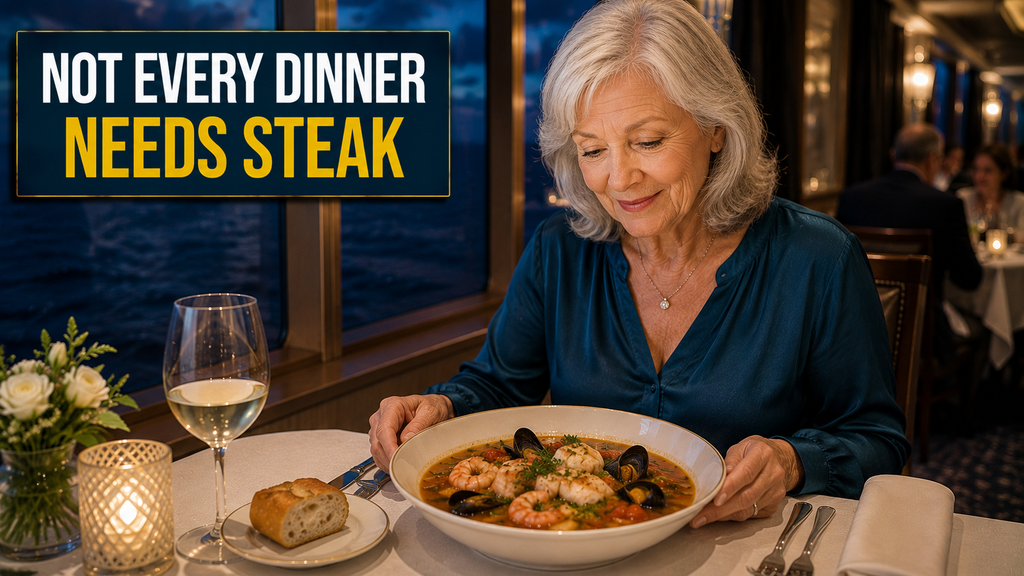
On an evening when you want something different, a seafood soup built around a flavorful broth can be worth considering.
Depending on the ship and restaurant, you might encounter preparations inspired by fish soup, seafood stew, bouillabaisse, cioppino, or another regional style.
Do not assume these will be available, and do not assume all seafood soups are light.
Some are rich, creamy or extremely substantial.
The menu description matters.
But when you find a broth-based version filled with seafood, tomato, herbs or vegetables, it can deliver something that a plain “light meal” often lacks: depth of flavor.
Pairing a soup with an appetizer, vegetable dish, or another modest menu item may also create a satisfying dinner without requiring one enormous main course.
Before building your own combination, however, check what is included and whether individual dishes carry additional charges in that venue.
Cruise dining structures vary.
An item that is included in one main dining room may work very differently at a specialty restaurant.
That is why this guide is about what to look for and ask about, rather than promising a fixed menu across cruise lines.
7. Grilled Vegetables Paired With Fish or Chicken
Sometimes the easiest way to change the feel of dinner is not changing the main entrée.
Change the sides.
Imagine two plates.
Both have grilled chicken.
The first arrives with a large portion of creamy potatoes, a rich sauce, and another substantial side. The second comes with grilled zucchini, asparagus, tomatoes, mushrooms, or other seasonal vegetables, perhaps with a modest potato or grain portion.
They can feel like completely different dinners.
This is why it is worth reading the entire menu description, not just the name of the protein.
When vegetables already appear elsewhere on the menu, you can politely ask whether they are available as a side with your chosen entrée. The answer may be yes or no depending on the restaurant, kitchen, and current menu.
Do not assume substitutions are automatic.
Another good strategy is to start with the preparation you already prefer. Grilled fish with vegetables requires fewer changes than ordering a particularly rich entrée and asking the kitchen to rebuild the entire plate.
And keep some perspective: “lighter” does not require removing everything enjoyable.
A few baby potatoes, an interesting sauce, roasted vegetables, herbs, or an attractive garnish can help the plate still feel complete.
The objective is not to create the emptiest plate in the dining room.
It is to find a combination you genuinely want to eat.
8. Sushi or Sashimi for a Completely Different Dinner
After several nights of traditional cruise dinners, sometimes the best change is choosing an entirely different style of meal.
Sushi can provide that change.
Depending on the ship, Japanese dining might be offered through a specialty restaurant, casual venue, buffet station, or another onboard outlet. Availability and pricing vary considerably, so check the ship’s actual dining options rather than assuming sushi is included.
If available, the flexibility can be part of its appeal.
Instead of automatically ordering a large combination, you may be able to build dinner around a smaller selection of sushi, sashimi, rolls, soup, or another accompaniment.
But there is an important distinction here.
Sushi does not automatically mean “light.”
Some rolls can contain fried ingredients, rich sauces, cream cheese, or numerous components. A giant specialty roll may feel very different from a modest selection of sashimi and simpler rolls.
So once again, the lesson is not to judge dinner by its category.
Look at what is actually in it.
For passengers who enjoy seafood, a carefully chosen Japanese dinner can also preserve the sense of occasion that matters on vacation.
The presentation can be beautiful. The flavors are different from what you may have eaten in the main dining room all week. And visiting another venue can turn dinner itself into an evening activity.
That makes this option particularly useful around the middle of a longer sailing, when another conventional three-course meal may no longer sound as exciting as it did on night one.
9. A Smaller Steak With Vegetable Sides
Yes, steak belongs on a list of lighter-feeling cruise dinners.
Not because steak is inherently a “light food,” but because portion and accompaniments matter.
Suppose you want steak night.
Your choices do not necessarily have to be:
A: Order the biggest steak with every rich side available.
or
B: Give up steak entirely and eat salad.
There may be a middle ground.
If different cuts or portion sizes are offered, consider whether a smaller steak would satisfy what you actually want. Pairing it with vegetables or another simpler side can create a dinner that still feels indulgent without automatically becoming the largest meal of your day.
This is especially relevant when you know dessert is coming.
Cruise dining is an experience, and sometimes you may prefer to leave room for the part of that experience you enjoy most.
The exact steak selection, portion sizes, side choices, included items, and surcharges vary by venue. Specialty steakhouses can operate very differently from main dining rooms.
Check before ordering.
If the menu does not offer the combination you have in mind, ask what alternatives are actually available rather than expecting an off-menu preparation.
The larger lesson is useful far beyond steak:
You do not always need to eliminate a favorite food to change the overall feel of the meal.
Sometimes the portion, sauce, preparation, and sides make the bigger difference.
How to Find a Lighter Dinner Without Turning Dinner Into a Project
By this point, you may be thinking:
Do I really need to analyze every menu on vacation?
Absolutely not.
The whole purpose of cruising is to enjoy yourself.
A simpler approach is to scan the menu for four things:
Preparation.
Grilled, roasted, seared, broth-based, fried, breaded, creamy—these words quickly tell you a great deal about how a dish is constructed.
Sauce.
If the sauce sounds particularly rich and that is not what you want tonight, ask whether it can be served separately when practical.
Sides.
Do not ignore them. They can substantially change the character of the plate.
Portion.
More food does not automatically create a more special dinner.
That is essentially what happened in our opening example.
One passenger saw “lighter dinner” as a choice between another heavy plate and eating salad.
The experienced passenger saw a third option.
A beautifully grilled piece of fish, colorful vegetables, a few potatoes, lemon, herbs, and a flavorful sauce could still arrive looking like something worth dressing for.
That difference in mindset opens considerably more of the menu.
Don’t Assume Every Ship Will Have These Nine Options
Cruise dining varies enormously.
A large new ship with numerous specialty restaurants can offer a completely different selection from a smaller vessel. Menus can also vary by itinerary, sailing length, restaurant, region, availability, and cruise line.
That means you should not board expecting to find all nine examples exactly as described here.
Instead, use them as categories to look for:
- grilled or roasted fish,
- shrimp or prawns,
- simply prepared chicken,
- scallops when offered,
- Mediterranean-inspired preparations,
- broth-based seafood dishes,
- vegetable-forward combinations,
- sushi or sashimi where available,
- and smaller portions of richer favorites.
You may find several.
You may find different dishes that accomplish exactly the same thing.
Also remember that included dining and specialty dining are not interchangeable. A dish or venue may carry an additional charge depending on the cruise.
If price matters to you, confirm whether a venue or item is included before ordering.
Over 60 Doesn’t Mean You Need a Special “Senior Dinner”
There is an important reason the title of this guide says “over 60” rather than promising special senior meals.
Age alone does not mean every traveler wants the same food.
One 70-year-old passenger may happily order a large steak dinner.
Another may prefer grilled fish.
A third may want sushi.
Someone else may decide that tonight is absolutely the night for pasta and dessert.
There is nothing wrong with any of those choices.
Nor should passengers assume that crossing a particular birthday automatically creates special dining benefits, menus, discounts, or accommodations.
Those policies and options vary.
The practical reason this topic can resonate with older travelers is much simpler: after years of learning what you personally enjoy, you may care less about ordering the largest or richest item simply because it is vacation.
You can choose the dinner that makes the evening enjoyable for you.
If you have medically required dietary restrictions, food allergies, or other specific dietary needs, that becomes a different planning issue. Contact the cruise line and review its current procedures rather than relying on a general food article or assuming an onboard restaurant can accommodate every request without advance notice.
The Best Dinner May Be the One That Leaves Room for the Evening
There is another reason to rethink what makes a cruise dinner “special.”
Dinner may not be the end of your night.
You might have a theater reservation.
There may be live music you want to hear.
You might walk the promenade afterward, visit an observation lounge, meet friends, or simply sit outside and watch the water.
And yes, perhaps you have already spotted a dessert you intend to order.
A memorable dinner does not need to leave you feeling as though the only reasonable next activity is going directly back to the cabin.
That is where these nine ideas come together.
A grilled salmon entrée can feel special.
So can beautifully presented scallops.
A seafood soup can be the centerpiece of dinner.
A Japanese venue can make an ordinary evening feel completely different.
Even steak night can remain steak night without automatically choosing the biggest possible version.
The common thread is not dieting.
It is choice.
Final Takeaway
Cruise dining should be one of the enjoyable parts of being at sea, not a nightly contest to see how much food you can order.
If another very rich dinner does not appeal to you, do not assume your only alternative is salad.
Look more closely at the menu.
You may find grilled fish with vegetables, shrimp, roasted chicken, scallops, Mediterranean-style seafood, a flavorful broth-based soup, vegetable-forward combinations, sushi, or simply a smaller version of a classic favorite.
Availability will vary by cruise line, ship, restaurant, and sailing, and substitutions or special preparations should never be assumed.
But the basic strategy travels well:
Look at the preparation. Look at the sides. Ask reasonable questions. Then order something that still makes you look forward to dinner.
Because a lighter-feeling plate can still be colorful.
It can still be beautifully presented.
It can still taste like vacation.
And it can absolutely still feel like a special dinner at sea.
