
CRUISE TIP
10 SEAFOOD DISHES TO TRY ON NEXT CRUISE AFTER 60
Sep
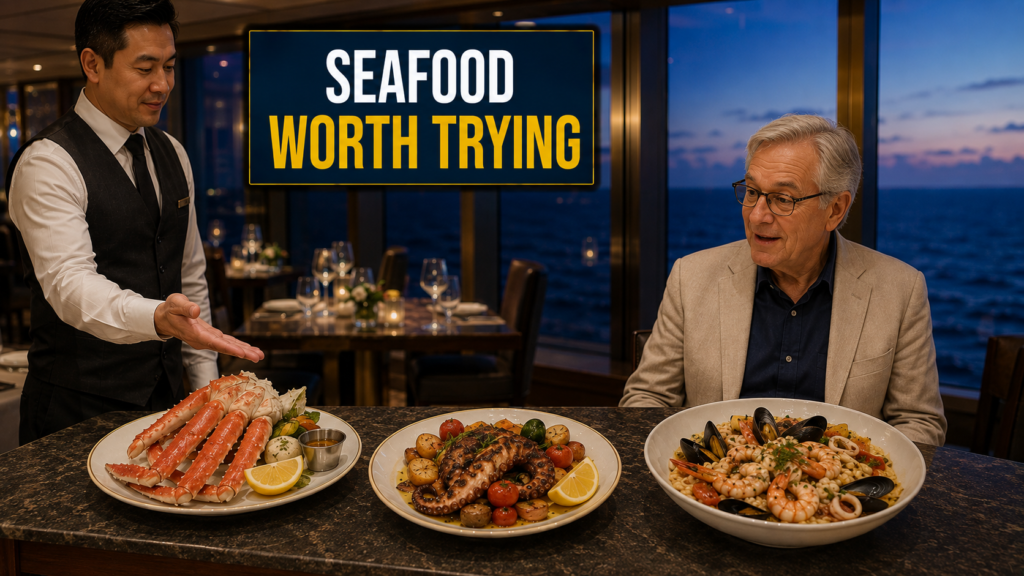
Cruise ships and seafood seem like they should naturally go together.
You are surrounded by the ocean, dinner is one of the highlights of the day, and many ships give passengers several restaurants to explore during a single vacation. Yet plenty of cruisers still fall into the same routine: they find a familiar fish fillet, shrimp cocktail, or fried seafood dish and order variations of it again and again.
There is nothing wrong with familiar favorites.
But if you stop looking only for the word “fish,” cruise menus can become much more interesting.
Depending on the cruise line, ship, restaurant, itinerary, and sailing, you may encounter seafood influenced by Alaska, Greece, Spain, France, Italy, Portugal, the Caribbean, Japan, and other coastal food traditions.
One night might mean cracking into king crab. Another could bring a beautifully charred piece of octopus with lemon and herbs. Somewhere else, the interesting choice might be garlic shrimp bubbling in olive oil, a bowl of seafood risotto, or a deeply flavored French-style seafood stew.
That variety is exactly what makes seafood worth exploring on a cruise.
The 10 dishes below are ideas worth looking for when offered, not a promise that every cruise ship or itinerary will serve all of them. Menus change, ingredients vary, and some dishes may appear only in specialty restaurants or carry an additional charge.
But if one of these names appears on your next cruise menu, you may want to look twice before ordering the same fish you always choose.
1. Alaskan King Crab
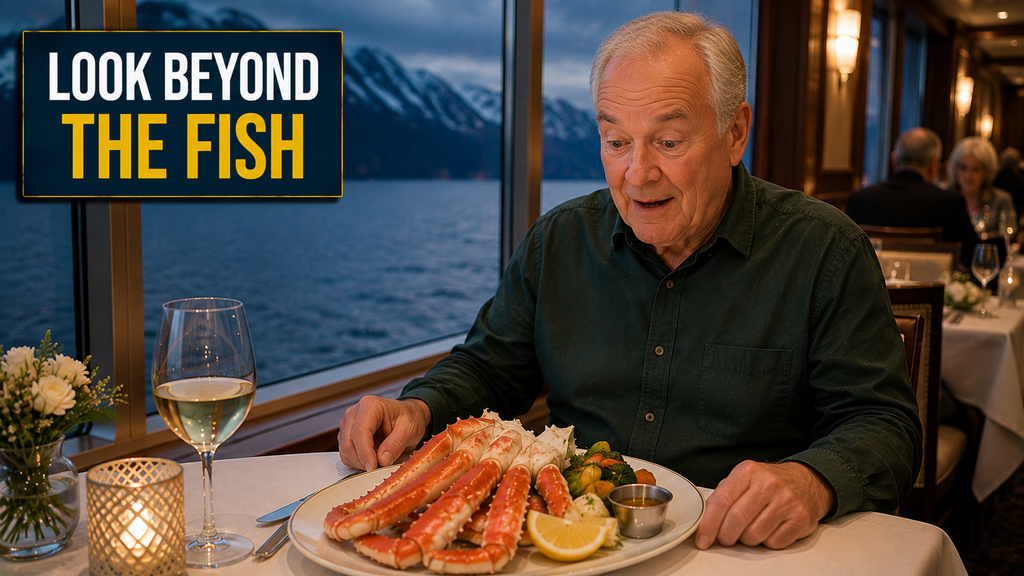
Few seafood dishes announce “special occasion” as dramatically as king crab.
Large red-orange crab legs arriving at the table create an experience before you have even taken the first bite. Crack the shell, expose the white meat, add a little lemon, and suddenly dinner becomes something you participate in rather than simply eat.
That makes king crab particularly interesting on an Alaska cruise.
Alaska is strongly associated with cold-water seafood, and regional seafood can become part of the destination experience for passengers who enjoy exploring food while traveling.
The key word, however, is availability.
Do not assume that booking an Alaska itinerary automatically means unlimited king crab will appear in the main dining room. Seafood programs vary by cruise line and ship, and premium crab offerings may be associated with a particular restaurant, dining event, seasonal menu, or additional charge.
When you see it offered, check how it is served and whether there is a surcharge before ordering.
A well-designed king crab dinner does not need much decoration. Crab legs, lemon, vegetables, and perhaps a small amount of butter or sauce can make a striking plate.
For passengers who normally order a conventional fish entrée, this is an easy way to make one night of the cruise feel completely different.
And it is exactly the kind of dish worth asking about when sailing through a region famous for seafood.
2. Wild Alaska Salmon
Salmon sounds much more familiar.
That is precisely why passengers can overlook it.
Many travelers have eaten salmon dozens of times at home. Seeing it on a cruise menu may not produce the same excitement as king crab or lobster.
But regional context can change the experience.
On an Alaska itinerary, a well-prepared salmon dish can fit naturally into the destination-focused side of the cruise. Instead of treating it as the “safe fish option,” look at how the kitchen is preparing it.
Is it grilled?
Roasted?
Paired with seasonal vegetables?
Finished with herbs, citrus, or another regional-inspired accompaniment?
Those details can turn an ordinary-sounding salmon dinner into something much more memorable.
This is also where reading the entire menu description becomes useful.
Two salmon entrées can feel completely different depending on the sauce, sides, preparation, and portion.
If you are interested in regional seafood, ask the dining staff what the menu is featuring that evening rather than assuming every salmon dish is the same.
And remember: seeing the words “Alaska cruise” in your itinerary does not guarantee that every piece of salmon onboard is locally sourced. If origin matters to you, ask rather than assuming.
Salmon may be one of the least surprising names on this list.
But when preparation and setting come together, familiar can still be special.
3. Greek-Style Grilled Octopus
Now we leave familiar territory.
For many American passengers, grilled octopus is the kind of menu item that creates an immediate decision:
Do I really want to try that?
On Mediterranean-inspired menus, the answer may be worth considering.
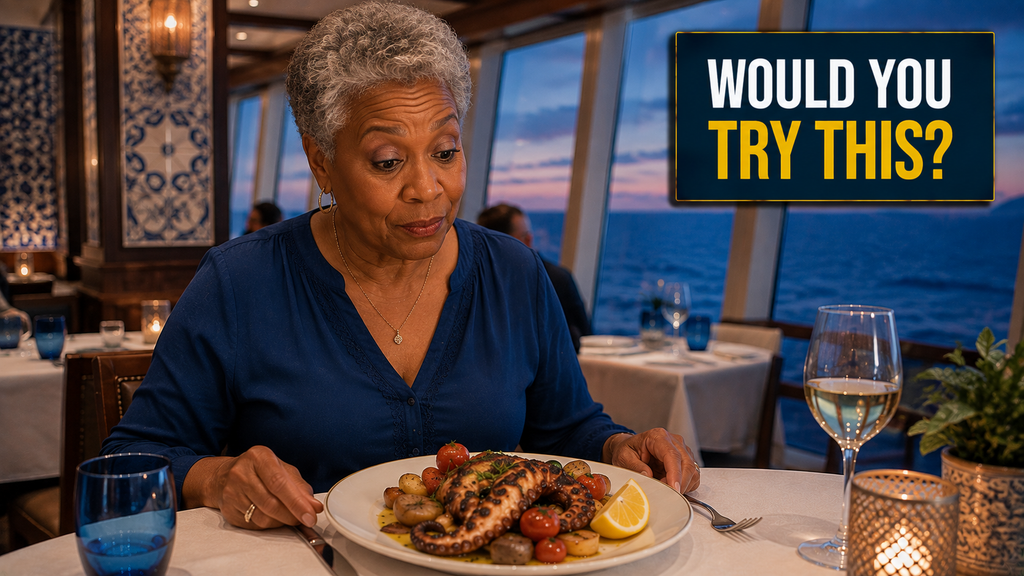
Greek-style grilled octopus can be dramatically different from the image some people have when they hear the word “octopus.” A restaurant-style presentation may feature a carefully portioned tentacle with charred edges, lemon, olive oil, herbs, tomatoes, potatoes, or vegetables.
The texture and smoky exterior become the focus.
And visually, it can be one of the most striking seafood plates at dinner.
The trick is not to approach it expecting it to taste like a conventional fish fillet.
It is supposed to be different.
That is the appeal.
Cruising gives passengers a relatively easy environment in which to experiment. You can spend one evening ordering something you would rarely consider at your neighborhood restaurant and return to familiar favorites the following night.
If grilled octopus appears in a Mediterranean or Greek-inspired venue, ask the server about the preparation if you are unsure.
Is it served as an appetizer or entrée?
What accompanies it?
How large is the portion?
Those simple questions can prevent surprises.
For an experienced cruiser who feels as though every seafood menu is beginning to look the same, this may be exactly the dish that changes the conversation.
4. Gambas al Ajillo — Spanish Garlic Shrimp
Shrimp is familiar.
Gambas al ajillo makes it exciting again.
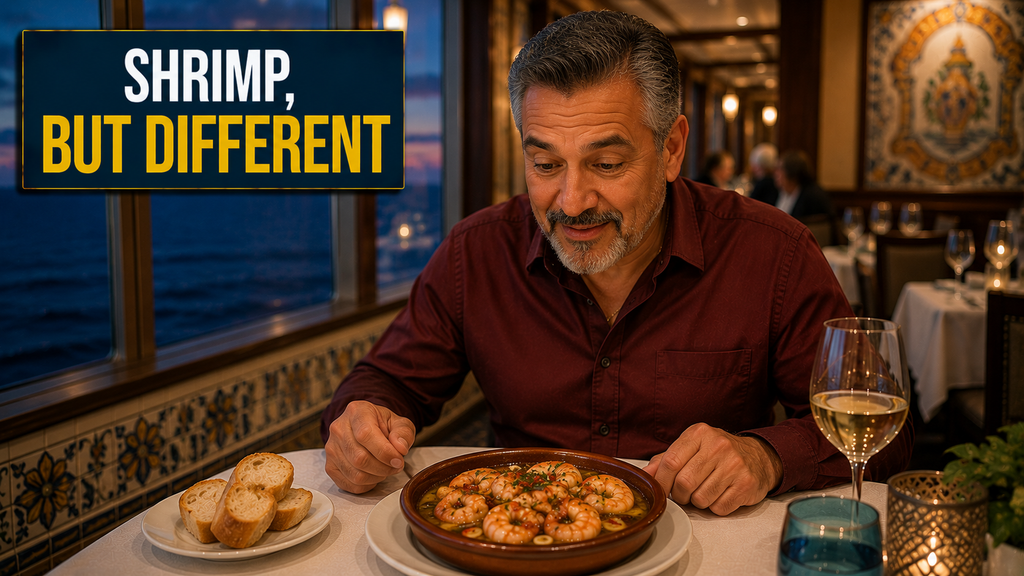
This Spanish preparation is built around a combination that sounds simple: shrimp, garlic, olive oil, and often chili and parsley or other herbs.
But when served hot, the aroma alone can make the dish stand out.
Instead of a chilled shrimp cocktail or heavily breaded fried shrimp, you get seafood surrounded by intensely flavored oil and garlic. Bread may accompany the dish, making the sauce part of the experience.
This is often the type of seafood item that works particularly well for passengers who want to become a little more adventurous without making an enormous leap.
You still recognize the main ingredient immediately.
The difference is the preparation.
If a Spanish or tapas-inspired restaurant onboard offers garlic shrimp, check whether it is designed as a small plate, appetizer, or full entrée. You may need to combine it with other dishes if you want a complete dinner.
Also remember that “small plate” dining can add up quickly when items are individually priced. Check the venue’s dining structure before ordering several plates.
What makes gambas al ajillo valuable for this list is that it demonstrates an important point:
Trying different seafood does not always mean trying a different animal.
Sometimes taking an ingredient you already know and experiencing how another coastal cuisine prepares it is enough to make dinner feel new.
5. French Bouillabaisse
Some seafood dishes are about a perfectly plated fillet.
Bouillabaisse goes in the opposite direction.
Associated with the Mediterranean coast of France, particularly Provence and Marseille, bouillabaisse is a seafood preparation built around broth, fish, and other seafood, with recipes and interpretations varying considerably.
A cruise restaurant may serve a traditional-inspired version rather than a strict regional preparation.
That distinction is worth remembering.
What matters for the passenger is the experience: instead of choosing one seafood item as the star, you may encounter a bowl containing fish, mussels, shrimp or other seafood surrounded by a fragrant broth incorporating tomato, herbs, aromatics, or other ingredients.
It is warming, aromatic, and completely different from grilled fish.
That makes it an especially interesting choice after several nights of plated entrées.
Read the menu carefully, because seafood soups and stews can vary enormously. Some are light and broth-forward; others can be extremely rich or substantial.
If you do not recognize the description, ask what seafood is included.
That question is also useful for anyone with food allergies or dietary restrictions. A mixed seafood dish can contain several ingredients that are not obvious from its appearance alone.
When the preparation suits you, however, bouillabaisse-style seafood can turn dinner into something closer to exploring a destination through a bowl.
6. Italian Seafood Risotto
This is one of the three dishes we chose to feature in the video for a reason.
Seafood risotto photographs beautifully.
A shallow bowl of creamy rice dotted with shrimp, mussels, calamari, herbs, and perhaps tomato accents can immediately look like something worth ordering on vacation.
But appearance is only part of the appeal.
Risotto provides a completely different seafood experience from king crab or grilled octopus.
Here, seafood is integrated into the dish rather than sitting alone as the centerpiece.
The rice absorbs flavor from the preparation, while different seafood ingredients provide changes in texture from bite to bite.
On an Italian-inspired cruise menu, seafood risotto can therefore work well for someone who wants seafood but does not necessarily want another standalone fish fillet.
As always, the name alone does not tell you everything.
Ask what seafood is included if the menu is vague.
Some versions may contain shellfish, and ingredients can vary.
Also check whether the dish belongs to an included restaurant or specialty venue.
For passengers who are hesitant about trying grilled octopus by itself, risotto can sometimes provide a more approachable route into mixed seafood.
There may be familiar shrimp alongside mussels or calamari.
One bowl, several flavors.
It is a good example of why looking beyond the most obvious seafood section of the menu can pay off.
7. Portuguese Bacalhau-Style Cod
Cod sounds ordinary.
Bacalhau does not.
Salt cod has an important place in Portuguese cooking and appears in numerous preparations rather than one single universal dish.
That makes “bacalhau-style cod” a category worth understanding rather than a specific recipe every cruise kitchen will reproduce identically.
Depending on the preparation, cod may be paired with potato, onion, olive oil, herbs, eggs, vegetables, or other ingredients.
The result can look and taste very different from the plain baked cod many passengers might imagine when they first see the word.
This is another dish where context adds interest.
A Portuguese-inspired menu or dining event can introduce passengers to an ingredient they already know through a preparation they may not.
If you see bacalhau on a menu and are unfamiliar with it, ask the server how that particular version is prepared.
That question matters because salt cod preparations can differ significantly in texture, seasoning, and presentation.
Do not order it expecting an ordinary fresh cod fillet.
Approach it as a regional food experience.
For travelers over 60 who have spent decades eating familiar seafood at home, dishes like this are a reminder that “trying something new” does not always require choosing an exotic ingredient.
Sometimes the transformation comes from culinary tradition.
8. Caribbean Jerk-Style Fish
A Caribbean sailing calls for at least one dinner with some personality.
Jerk-style fish can provide it.
Rather than letting a rich cream sauce dominate the seafood, this style puts seasoning and spice at the center of the experience.
Depending on the chef’s interpretation, a grilled white fish might be paired with jerk-inspired seasoning, lime, vegetables, rice, fruit salsa, or another Caribbean-influenced accompaniment.
The exact recipe can vary widely.
And because jerk seasoning can have noticeable heat, passengers who prefer milder food should ask about the spice level before ordering.
That does not make it a dish to avoid.
It simply makes it one to understand.
This is also an excellent example of why itinerary-inspired dining can be fun.
After spending a day surrounded by Caribbean scenery, returning to the ship and choosing flavors associated with the region can extend the destination experience into dinner.
Again, do not assume that every Caribbean cruise serves jerk fish or that a dish labeled “Caribbean” represents one definitive regional recipe.
Cruise kitchens interpret regional cuisines in different ways.
Treat the menu as an invitation to explore, not as a guarantee of culinary authenticity.
If the flavor profile appeals to you, this can be one of the most colorful and memorable fish dinners of the sailing.
9. Japanese Chirashi Sushi
Most passengers know what a sushi roll looks like.
Chirashi offers a different presentation.
Rather than arranging everything into individual rolls, chirashi typically presents sushi rice in a bowl or dish topped with assorted ingredients, often including slices of raw fish and other accompaniments.
The result can be visually spectacular.
Different colors and textures appear together, yet the meal still feels organized and deliberate rather than like a giant sushi platter.
On ships with Japanese-inspired specialty dining, this can be worth looking for if you already enjoy sushi and sashimi but want to order something different.
However, there are several things to check.
First, find out exactly what seafood is included.
Second, remember that raw seafood may not be appropriate for every traveler. Anyone who has been advised to avoid raw or undercooked seafood should follow their healthcare professional’s guidance rather than treating a general cruise-food list as medical advice.
Third, check the venue pricing.
Japanese specialty restaurants may operate under different packages or à la carte structures depending on the cruise line.
For passengers who are comfortable with raw seafood, chirashi can turn dinner into one of the most visually distinctive meals of the trip.
And after eight nights of Western-style plated entrées, that change alone can be refreshing.
10. Mediterranean Sea Bass With Lemon and Herbs
After king crab, octopus, garlic shrimp, seafood stew, risotto, salt cod, jerk seasoning, and chirashi, our final dish returns to something beautifully simple.
Sea bass.
But simple does not have to mean forgettable.
A Mediterranean-inspired preparation may combine fish with lemon, olive oil, herbs, tomato, olives, capers, or seasonal vegetables depending on the chef and menu.
That gives passengers who prefer a straightforward fish entrée a way to participate in the regional-food idea without ordering something far outside their comfort zone.
And that matters.
A good cruise-food list should not suggest that the “best” traveler is always the person ordering the strangest thing available.
Trying something new is optional.
Perhaps grilled octopus sounds fantastic to you.
Perhaps it does not.
Maybe king crab is the dinner you have been waiting for.
Or maybe a beautifully prepared sea bass with lemon and herbs is exactly what you want while looking out at the Mediterranean.
The point is to notice the possibilities.
Ask how the fish is prepared.
Look at the accompaniments.
Check whether the venue is included.
And choose the dish that makes dinner feel like part of your vacation.
How to Find the Best Seafood Options on Your Ship
You do not need to memorize all 10 dishes before boarding.
Instead, use a few simple habits.
Start by looking at restaurant menus early in the cruise rather than waiting until the final night. If your ship has several specialty venues, compare what they offer before making reservations.
Pay attention to regional or destination-inspired menu descriptions.
Ask dining staff what seafood dishes are currently being featured.
And when you see something unfamiliar, ask how it is prepared instead of dismissing it immediately.
You should also confirm pricing.
Cruise dining can include a mixture of included venues, specialty restaurants, dining packages, à la carte charges, and occasional premium menu items. Never assume a seafood dish is included simply because another restaurant on the same ship is complimentary.
Availability is another reason to remain flexible.
Menus can change.
Ingredients can change.
A dish promoted on one sailing may not appear on yours.
That does not ruin the strategy.
You are looking for the idea behind these choices: regional seafood, unfamiliar preparations, and dishes that offer a different experience from the same order you make at home.
Over 60? Familiar Doesn’t Have to Mean Boring
There is no rule saying travelers over 60 need to become adventurous eaters.
Age does not determine what you should order.
But experience can make you more selective.
After decades of restaurant meals, vacations, and familiar favorites, you probably already know what you enjoy.
A cruise gives you an opportunity to keep those favorites while occasionally moving one step beyond them.
If you always order fish, perhaps try sea bass prepared differently.
If you always order shrimp, look for Spanish garlic shrimp.
If you already enjoy sushi, consider chirashi.
If you want something genuinely unfamiliar, grilled octopus may be your evening.
And if Alaska seafood has been part of the reason you wanted that itinerary in the first place, check what regional options your ship is actually offering.
There is no prize for ordering all 10.
The victory is discovering one dinner you would happily order again.
One Important Seafood Reminder
Seafood deserves a little extra attention when allergies or medical dietary restrictions are involved.
Mixed dishes such as bouillabaisse, seafood risotto, and sushi presentations can contain multiple species or ingredients. Sauces, broths, and garnishes may also contain ingredients that are not obvious simply by looking at the plate.
If you have a food allergy or medically necessary dietary restriction, follow the cruise line’s current procedure for communicating it and discuss the specific dish with appropriate dining staff.
Do not rely on appearance alone.
Likewise, passengers who have been medically advised to avoid raw or undercooked seafood should follow that advice when considering sushi, sashimi, or similar preparations.
For everyone else, the practical rule remains simple:
Know what you are ordering.
Final Takeaway
Your next memorable cruise seafood dinner may not be the dish you normally search for first.
It could be Alaskan king crab that turns dinner into an event.
It could be familiar salmon prepared in a way that fits the destination.
Perhaps Greek-style grilled octopus becomes the surprise of the trip.
Maybe it is sizzling Spanish garlic shrimp, aromatic French bouillabaisse, creamy Italian seafood risotto, Portuguese-inspired bacalhau, spicy Caribbean jerk-style fish, colorful Japanese chirashi, or beautifully simple Mediterranean sea bass.
You will not necessarily find all 10 on one ship.
You should not expect to.
Instead, use the list as a reason to look beyond the first familiar seafood entrée you recognize.
Check the menus.
Ask what is being featured.
Find out what is included and what costs extra.
And pay attention to the cuisines and destinations represented around the ship.
Because sometimes the most interesting cruise dinner begins with one simple decision:
Order something you would not normally order at home.
