
AIRPORT TIPS
Over 60? 12 Airplane Questions Passengers Always Ask — But Rarely Get a Straight Answer
Sep
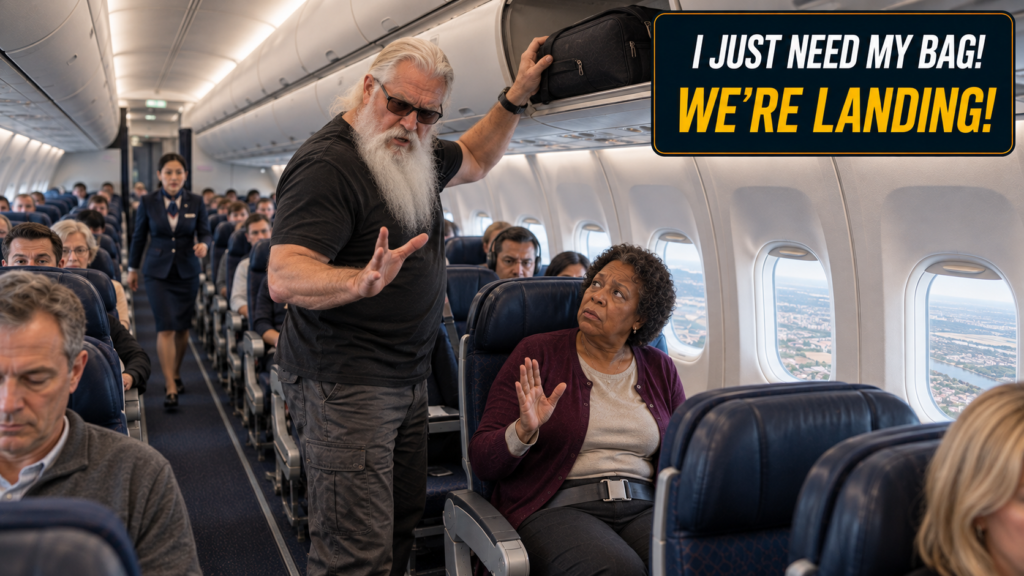
“I just need my bag! It’ll take two seconds—mind your own business!”
The airplane was already preparing to land.
Nearly everyone was seated. Seatbelts were fastened. Tray tables were stowed. Most overhead bins were closed.
But one older passenger had decided he needed something from his bag right now.
He stood beside his aisle seat, opened the overhead bin, and started pulling his black travel bag toward him.
A woman seated nearby looked up.
“Sir, we’re landing! You need to sit down and close that bin!”
Instead of sitting, he snapped back.
“I just need my bag! It’ll take two seconds—mind your own business!”
Then a flight attendant returned toward the row.
“Sir. Close the bin and take your seat now.”
That ended the argument.
The bag went back into the compartment. The bin closed. The passenger sat down.
But his original assumption raises a surprisingly useful question:
Can you open an overhead bin during a flight?
The frustrating answer is that many airplane questions don’t have a useful one-word answer.
Something that may be possible during one part of a flight may be inappropriate during another. Airline procedures differ. Aircraft differ. Service differs. And when the crew gives passengers a safety instruction, that instruction matters more than what someone remembers doing on a previous trip.
For travelers over 60—especially anyone returning to flying after a long break—here are 12 common airplane questions worth understanding before your next flight.
#12 — Can I Open the Overhead Bin During the Flight?
The passenger in our opening story was asking the wrong version of the question.
The overhead compartment physically opened.
That didn’t automatically mean it was an appropriate time to use it.
During ordinary portions of a flight, passengers may sometimes need access to properly stowed belongings. But circumstances can change.
If passengers have been instructed to remain seated, the seatbelt sign is illuminated, or the cabin is being secured for landing, don’t assume that retrieving something from the overhead bin is worth standing up.
There is another reason to use care whenever an overhead compartment is opened: belongings may have shifted during flight.
An item that looked secure when the bin was closed may not be in exactly the same position later.
So instead of asking only:
“Can I open it?”
A better question is:
“Is this an appropriate time to open it?”
If you’re uncertain, follow the signs and crew instructions rather than guessing.
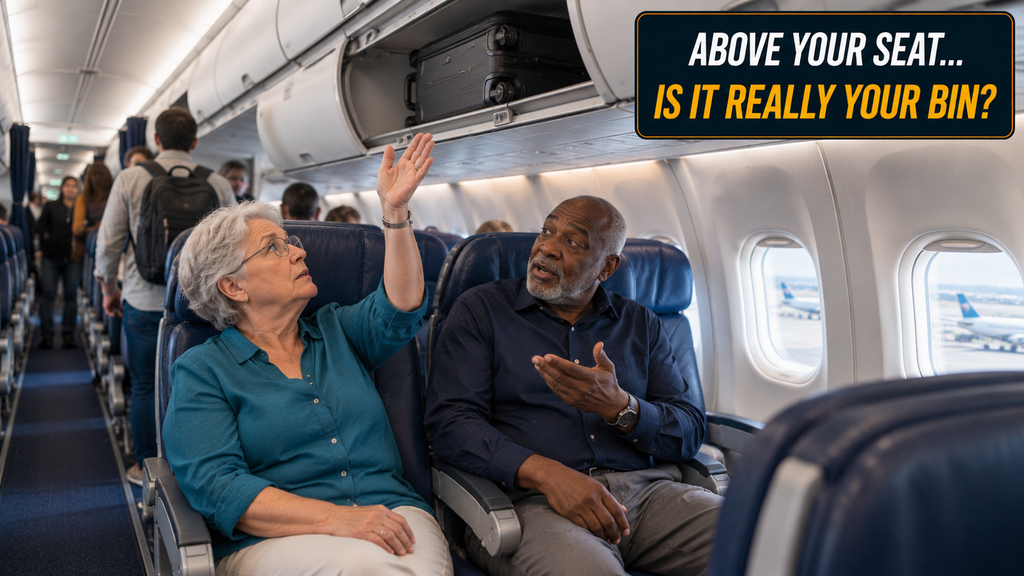
#11 — Does the Overhead Bin Above My Seat Belong to Me?
You reach your row, look up, and discover another suitcase already occupying part of the compartment above your seat.
The reaction is understandable:
“Why is somebody else’s bag in my bin?”
But don’t automatically treat the compartment directly above your seat as a private locker assigned exclusively to you.
Aircraft configurations, available space, boarding conditions and crew stowage directions can all affect where belongings are placed.
Most importantly, don’t start removing another passenger’s luggage because you believe your seat number gives you ownership of that particular section.
If you’re unsure where your permitted bag should go, ask the crew rather than creating your own solution.
Sometimes another appropriate space may be available.
The useful distinction is simple:
The seat is assigned to you. Don’t automatically assume every inch of storage directly above it is too.

#10 — Can I Ask Someone to Switch Seats With Me?
Suppose you and your spouse discover you’re sitting several rows apart.
Can you ask someone to switch?
You can certainly make a polite request.
But a request is different from an obligation.
The passenger you’re asking may have deliberately selected that particular seat. They may have paid for it. They may need the aisle for easier access. They may prefer the window. Or they may simply want the seat they were assigned.
You don’t necessarily know why.
So avoid sitting in another person’s seat first and expecting them to accept the arrangement afterward.
Instead, ask politely when appropriate.
And be prepared for:
“Sorry, I’d rather keep my seat.”
A refusal doesn’t automatically make that passenger inconsiderate.
If a seating issue requires assistance, speak with airline staff rather than turning a request into an argument between passengers.
#9 — Can I Recline My Seat Whenever I Want?
Few airplane questions produce arguments faster than this one.
One traveler says:
“The seat reclines, so I’m allowed to use it.”
The passenger behind them says:
“You’re taking away my space.”
The useful answer requires more context.
Not every seat or situation is identical, and seat position may be subject to crew instructions during particular phases of flight.
Courtesy also matters.
If reclining is appropriate at that moment, moving the seat in a controlled manner gives the passenger behind you more opportunity to react than suddenly throwing your weight backward.
They may have a drink.
They may be using their tray.
They may be adjusting something in their own space.
This doesn’t create a universal rule that you must obtain permission from the passenger behind you every time your seat moves.
It simply recognizes that your seatback is also part of the space directly in front of another traveler.
The better question isn’t always:
“Do I have the right to recline?”
Sometimes it’s:
“Can I do this without unnecessarily surprising the person behind me?”
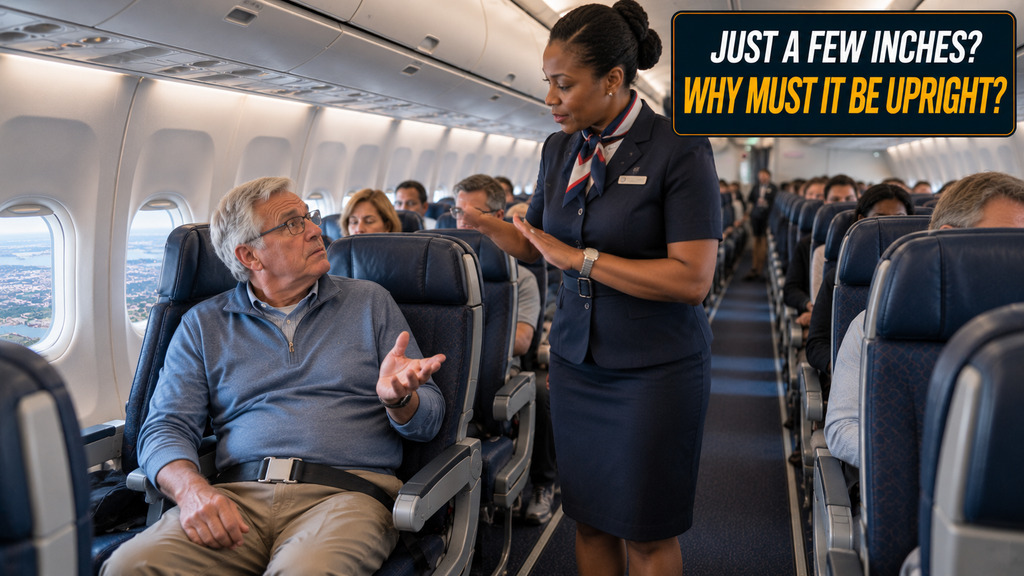
#8 — Why Does My Seat Have to Be Upright for Takeoff and Landing?
It may seem insignificant.
Your seat is only reclined a little.
So why does a flight attendant care?
Takeoff and landing are phases when the cabin is configured according to safety procedures. Passengers may be instructed to return seats to the required position and secure other parts of their seating area.
This isn’t the time to debate whether a few inches personally feel important.
If crew members tell you to put the seat upright, do it.
The same principle applies when you’re asked to stow a tray table or secure belongings.
Cabin preparation involves more than one passenger’s comfort.
And because aircraft and seat designs differ, passengers shouldn’t assume that something they remember from another aircraft automatically applies to the one they’re currently flying on.
When the crew checks the cabin, the simplest response is usually the best one:
Follow the instruction.
#7 — Can I Get Up When the Seatbelt Sign Is On?
This is another question passengers often try to answer for themselves.
“I’ll only be gone a minute.”
“The restroom is right there.”
“The flight feels smooth.”
None of those observations switches off the illuminated sign.
If the seatbelt sign is on, pay attention to it and to any accompanying crew instructions.
Don’t create your own universal exception because the cabin currently feels calm.
Conditions can change.
If you have an urgent problem or need assistance, communicate with the crew when possible rather than assuming you know what the current conditions allow.
And when you’re seated, keeping your seatbelt fastened can also protect you from unexpected movement that arrives without much warning.
The important lesson is that your senses don’t always tell you everything the crew knows about the situation.
#6 — Why Did the Flight Attendants Suddenly Stop Service and Sit Down?
Imagine the drink cart is moving normally through the cabin.
Then service stops.
The cart is secured.
The flight attendants sit down.
A nervous passenger immediately whispers:
“What’s wrong with the airplane?”
Not necessarily anything unusual with the aircraft itself.
Cabin service can be interrupted for operational or safety reasons, including conditions in which crew members need to secure themselves.
The mistake is treating every crew movement as a secret diagnostic code.
If the crew tells passengers to remain seated and fasten their seatbelts, that’s the useful information you need.
You don’t have to determine the mechanical condition of the airplane from your seat.
Watch for instructions.
Listen to announcements.
And resist turning a change in cabin service into your own emergency conclusion.
#5 — Why Did the Engine Suddenly Sound Different After Takeoff?
This one can be particularly unsettling for nervous flyers.
The aircraft climbs.
The engines sound powerful.
Then the sound changes.
Suddenly someone looks toward the window and asks:
“Did we just lose power?”
A change in engine or aircraft sound alone is not enough for a passenger to diagnose what is happening.
Different phases of flight can involve changes in power settings, aircraft configuration and other normal operations that passengers may hear or feel.
That doesn’t mean you should try to identify every sound yourself.
And it certainly doesn’t mean every unfamiliar noise should be dismissed without question.
The useful middle ground is this:
Don’t diagnose an aircraft problem from one change in sound.
If the crew gives an instruction, follow it.
Otherwise, remember that an airplane doesn’t necessarily sound identical from takeoff to landing.
#4 — Can I Ask for Another Drink or Snack?
“Can I have another one?”
Usually the real question hiding underneath is:
“Will it cost me?”
There isn’t one universal answer for every flight.
Food and beverage service can vary by airline, route, cabin, fare, flight length, available supplies and other circumstances.
Something included on one flight may work differently on another.
So instead of relying on what happened during your previous trip, ask directly.
A particularly useful question is:
“Is another one available, and is there a charge?”
Now you’ve answered both uncertainties at once.
There is no need to feel embarrassed about asking.
It is much easier to clarify before accepting something than to become irritated afterward because you assumed the service worked differently.
#3 — What Should I Do If Another Passenger Is Disturbing Me?
Maybe someone is playing videos aloud.
Maybe they’re repeatedly invading your space.
Maybe there’s an argument over a seat.
Your first instinct may be to confront them immediately.
Sometimes a calm, polite request is enough—if the situation feels appropriate and you’re comfortable making it.
“Would you mind using headphones?”
“Excuse me, your bag is in my foot space.”
Small issues don’t always need to become major confrontations.
But if the problem continues, escalates, or you need assistance, involving cabin crew can be more appropriate than trying to win the dispute yourself.
Avoid retaliating.
Don’t grab another passenger’s belongings.
Don’t turn a disagreement over a few inches of space into a shouting match.
Your goal isn’t to prove who is tougher.
It’s to solve the problem with as little escalation as possible.
#2 — Can a Flight Attendant Put My Heavy Carry-On in the Bin for Me?
This question matters especially for travelers who have difficulty lifting heavy items overhead.
But don’t board assuming:
“The flight attendant will lift it for me.”
Procedures and circumstances can differ, and cabin crew assistance should not be treated as a guaranteed heavy-luggage lifting service.
If you already know that you cannot safely manage a particular carry-on, think about your baggage and assistance options before you’re standing underneath an overhead bin during boarding.
Ask the airline what options are available for your circumstances.
Pack with your own lifting ability in mind when possible.
And if you need assistance, ask rather than attempting a movement that feels unsafe.
There is an important difference between:
“I need some assistance. What are my options?”
and:
“Here, put this up there for me.”
Planning before boarding can make this much easier.
#1 — Is Turbulence Actually Dangerous?
Some passengers barely react to turbulence.
Others grip the armrests the moment the first bump arrives.
Neither reaction tells you how to operate the aircraft.
Turbulence varies, and it would be misleading to tell passengers that every encounter is “completely harmless.”
But panicking at every bump isn’t useful either.
The practical issue for a passenger is much simpler.
If you’re instructed to fasten your seatbelt, do it.
When you’re seated, keeping your belt fastened can help protect you if unexpected movement occurs.
If cabin crew stop service or take their seats, don’t interpret that as an invitation to stand up and investigate.
Follow their instructions.
You don’t need to decide from seat 22A exactly what atmospheric conditions the pilots are dealing with.
Your job as a passenger is much more manageable:
Stay secured when required and pay attention to the crew.
5 Questions That Work Better Than Guessing
One reason passengers get into unnecessary arguments is that they make assumptions before asking a simple question.
Try these instead:
“Is there a charge for that?”
Useful when you’re unsure about food, drinks or another service.
“Where would you like me to stow this?”
Better than moving someone else’s bag because the compartment above you looks full.
“Is this the right time for me to get up?”
Useful when circumstances in the cabin have changed and you’re unsure what is appropriate.
“Could you explain what you need me to do?”
Much better than arguing about an instruction you don’t understand.
“I need some assistance. What are my options?”
Especially useful when a physical task, baggage issue or travel arrangement is difficult for you.
Sometimes the smartest passenger isn’t the person who already knows every answer.
It’s the person who knows when not to guess.
“But It Only Takes Two Seconds”
Return to the passenger standing beneath the open overhead bin.
His argument sounded reasonable to him:
“I just need my bag! It’ll take two seconds.”
But the amount of time wasn’t really the issue.
The cabin was being prepared for landing.
Other passengers were already seated.
The flight attendant returned and gave him a direct instruction:
“Close the bin and take your seat now.”
At that point, the answer was no longer ambiguous.
The passenger pushed his bag back inside, closed the compartment and sat down.
That moment captures something important about many of the questions on this list.
The answer can depend on when you’re asking, what’s happening in the cabin, what aircraft or service you’re using, and what instructions have been given.
So instead of asking only:
“Can I open the overhead bin?”
Ask:
“Is it appropriate for me to open it right now?”
Instead of:
“Can I switch seats?”
Ask whether the other passenger actually agrees.
Instead of assuming a service is free, ask whether there’s a charge.
And instead of deciding that a safety instruction doesn’t apply because you’ll “only take two seconds,” pay attention to what the crew is telling you.
On an airplane, what was perfectly ordinary ten minutes ago may not be appropriate ten minutes later.
Knowing that difference can make your next flight calmer, easier—and far less likely to end in an argument in the aisle.
