
Uncategorized
3 ITEMS YOU MUST NEVER PUT IN YOUR CARRY-ON
Sep
You zipped your suitcase. You checked your boarding pass. You made it to the airport with time to spare.
Then your carry-on goes through security—and suddenly, an everyday object you barely thought about becomes the reason your bag needs a closer look.
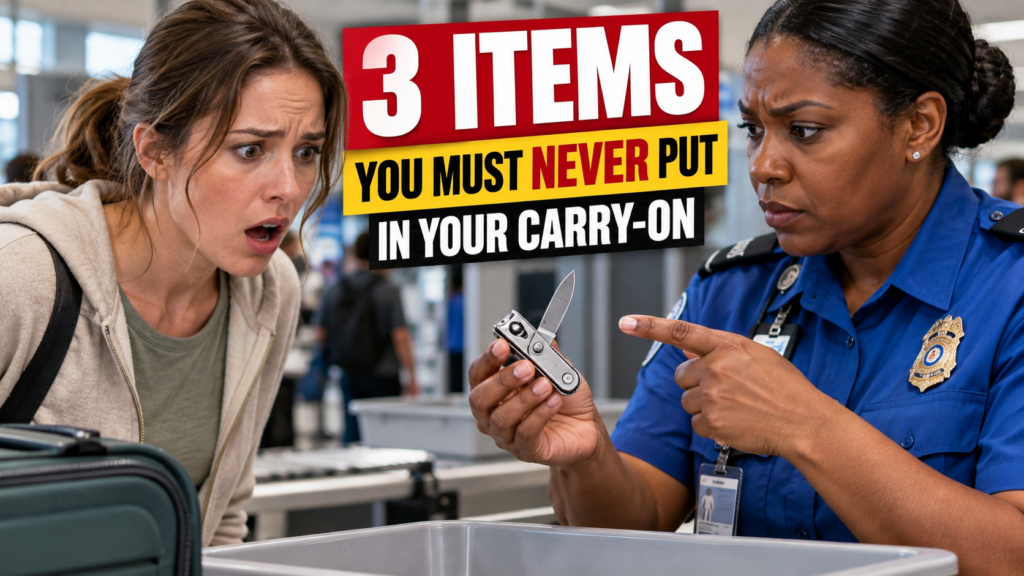
Imagine a traveler standing at an airport security checkpoint while an officer examines a tiny silver nail clipper.
“Wait—it’s just a nail clipper!”
The officer turns it over.
“The nail clipper isn’t the problem. This is.”
A tiny folding knife blade swings out from the tool.
“What? That tiny blade?”
“Yes. There’s a small folding knife built into it.”
The traveler stares at the object in disbelief.
“But it’s part of the nail clipper!”
And that is exactly where travelers can get confused.
The outside of an object does not necessarily tell you how it will be treated at airport security. A grooming tool can contain a blade. A harmless-looking souvenir can contain something restricted. And an item that belongs in your cabin bag may actually be prohibited from your checked suitcase.
If you’re flying in the United States, understanding the difference can save you from an unpleasant surprise at the checkpoint.
Here are three carry-on mistakes worth checking before you leave for the airport.
First, Understand This: “Carry-On Prohibited” Does Not Mean “Banned From Flying”
This distinction matters.
Airport baggage rules are not simply divided into “safe” and “dangerous.”
Some objects may be permitted in a checked suitcase but not a carry-on. Some must stay in the cabin and cannot go into checked baggage. Others are prohibited from passenger baggage altogether.
There are also two different regulatory issues travelers frequently mix together.
The Transportation Security Administration, or TSA, handles security screening and restrictions involving prohibited items such as weapons and sharp objects. The Federal Aviation Administration, or FAA, regulates dangerous goods and hazardous materials carried aboard aircraft.
Those categories can overlap, but they are not identical.
That is why the smartest question isn’t:
“Can I fly with this?”
Instead, ask:
“Can this exact item go in this exact bag?”
That small change in thinking can prevent a lot of packing mistakes.
3. A MULTI-TOOL THAT CONTAINS A KNIFE BLADE
One of the easiest mistakes to make involves a familiar object that has an unexpected second function.
Think about compact travel tools.
A small grooming gadget might include several folding components. A keychain tool might contain a file, screwdriver and cutting blade. A nail-care tool might look primarily like a nail clipper while also containing a small folding knife.
The main object may look harmless.
The blade is what changes the situation.
TSA restrictions cover knives and other prohibited sharp objects in carry-on baggage. So travelers should not assume that a knife blade becomes acceptable simply because it is tiny or incorporated into another product.
This is the key lesson from our airport scenario.
The traveler sees:
A nail clipper.
Security sees the entire object, including:
A folding knife blade.
Those are two very different ways of describing the same tool.
Ordinary Nail Clippers Are Not the Point
This distinction is important because otherwise a dramatic airport story can easily become misinformation.
You should not walk away believing:
“TSA bans nail clippers.”
That is not the takeaway.
The concern in our example is the integrated knife blade.
That means travelers should inspect multifunction tools carefully before placing them in a carry-on. Don’t rely only on the product’s name or its primary purpose.
Open every attachment.
Check every folding component.
Ask whether the tool contains a knife or another restricted sharp object.
This is especially useful when packing older travel accessories that have been sitting in a drawer for years. You may remember using something as a grooming tool while forgetting that it also contains a miniature knife.
“But the Blade Is Tiny” Isn’t the Right Test
Another common assumption is that an extremely small blade must automatically be acceptable.
That is risky reasoning.
Travelers should check the TSA guidance for the type of item, rather than inventing their own size rule based on how harmless the object appears.
A tiny blade can still be a knife blade.
And hiding inside another everyday tool doesn’t change what that component is.
So before leaving home, examine your multi-tools, pocket tools, keychain gadgets and combination grooming tools.
That 20-second inspection is much easier than discovering the blade while your belongings are being screened.
2. FIREWORKS—EVEN THE ONES THAT LOOK SMALL
Some prohibited items are much less ambiguous.
Fireworks are a perfect example.
A traveler might understand why a large aerial firework shouldn’t be packed on an airplane but assume that a tiny celebratory item is different.
That assumption can be a serious mistake.
TSA’s current travel checklist states that fireworks contain explosive materials and are not permitted in either checked or carry-on baggage.
The FAA also treats explosives and fireworks as dangerous goods.
So this is not a situation where you can simply move the item from your backpack into your checked suitcase.
“I’ll Just Check It” Doesn’t Solve Everything
This is one of the most important lessons in air travel packing.
When security says something cannot go in a carry-on, travelers sometimes immediately think:
“Fine. I’ll put it in my checked bag.”
Sometimes that is an option for a particular item under applicable rules.
Sometimes it absolutely is not.
Fireworks demonstrate why you should never assume checked baggage is a universal backup plan.
The cargo hold is not a place where every item rejected from the cabin suddenly becomes acceptable.
Aircraft experience changes in pressure and temperature, and hazardous materials can create risks involving fire, leakage, toxic fumes or explosions. The FAA specifically warns that many ordinary products can become dangerous when transported by air.
Don’t Judge an Item by How Innocent It Looks
A sparkler may feel more like a celebration accessory than an explosive product.
That doesn’t make it appropriate airline baggage.
The same principle applies broadly when you’re packing.
If something burns, ignites, explodes, contains fuel or produces sparks, don’t make assumptions based on its size or retail packaging.
Check the rule for the exact product.
And if the official guidance says it cannot travel in passenger baggage, leave it home rather than trying to find a different suitcase for it.
1. FLAMMABLE OR OTHERWISE PROHIBITED HAZARDOUS PRODUCTS
The most complicated packing mistakes often involve products that don’t look threatening at all.
People understand that explosives are dangerous.
They may be much less suspicious of a bottle, aerosol, adhesive, battery-powered device or household product.
Yet the FAA’s PackSafe guidance explains that many everyday products qualify as dangerous goods when transported by air.
That does not mean every aerosol, liquid, battery or household chemical is prohibited.
In fact, many are permitted under specific conditions.
That’s exactly why this category causes confusion.
Flammable Doesn’t Automatically Mean “Just Follow the 3-1-1 Rule”
The TSA liquid rule and FAA hazardous-material regulations answer different questions.
A small bottle does not automatically become acceptable merely because it is under 3.4 ounces.
For example, the FAA says most model glues, rubber cements and industrial-strength adhesives that are flammable are not permitted in carry-on or checked baggage.
By contrast, nonflammable, nontoxic school glue and glue sticks are not restricted as hazardous materials, although carry-on liquids remain subject to TSA liquid limits when applicable.
Same general-looking category.
Very different rule.
This is why travelers should identify what is actually inside a container rather than focusing only on container size.
Toiletries Are Another Good Example
Don’t overcorrect and assume all aerosols or toiletries are forbidden.
They’re not.
FAA guidance provides exceptions for many medicinal and toiletry articles, including products such as hairspray, perfumes, colognes, shaving cream, sunscreen and certain other personal-care products, subject to applicable quantity and packaging limits.
Carry-on liquids, gels and aerosols also remain subject to TSA checkpoint liquid restrictions.
So the correct lesson is not:
“Never pack aerosols.”
It is:
“Know exactly what product you’re packing and which rule applies to it.”
That is less sensational—but much more useful when you’re standing in your bedroom deciding what goes into which bag.
THE SURPRISING REVERSE RULE: SOME ITEMS SHOULD BE IN YOUR CARRY-ON
Here’s where baggage rules become especially counterintuitive.
Sometimes your carry-on isn’t the problem.
It’s the solution.
Lithium batteries are the classic example.
Many travelers have heard warnings about batteries and conclude:
“Batteries are dangerous, so I’ll put my power bank in my checked suitcase.”
That can be exactly the wrong move.
FAA guidance says spare lithium batteries are prohibited in checked baggage and must travel in carry-on baggage, subject to applicable battery-size restrictions and protection against short circuits.
Power banks are treated as spare batteries.
The FAA’s current PackSafe guidance also states that power banks, spare batteries and lithium batteries under the applicable 160 Wh ceiling must remain with passengers in the aircraft cabin, while rechargeable devices above 160 Wh are not allowed on passenger aircraft.
So:
Do not create your own rule that “dangerous things belong in checked luggage.”
Different hazards are managed differently.
A prohibited knife blade may need to stay out of your carry-on.
A spare lithium battery generally needs to stay in the cabin rather than your checked suitcase.
Fireworks don’t belong in either.
Three objects.
Three different packing outcomes.
WHAT ABOUT LIQUIDS?
Liquids are another category where viral travel advice frequently becomes misleading.
You may see headlines suggesting:
“Never put liquids in your carry-on.”
That’s false as a general statement.
TSA’s travel guidance continues to allow liquids, gels and aerosols in carry-on baggage under the familiar 3-1-1 framework for ordinary items: containers of 3.4 ounces (100 milliliters) or less, placed in a quart-size clear zip-top bag, with one such bag per passenger.
There are also exceptions and special procedures for certain items.
So a bottle being liquid does not automatically make it prohibited.
At the same time, meeting the volume limit doesn’t override other safety restrictions.
A hazardous product doesn’t become safe merely because someone pours it into a tiny container.
Always identify the product first.
Then check the relevant quantity and baggage rules.
WHY MULTI-TOOLS CAUSE SO MUCH CONFUSION
Let’s return to that nail clipper.
The fictionalized checkpoint conversation works because it highlights a very real packing problem: combination products can belong to more than one category.
Imagine a tool containing:
- a nail clipper,
- a nail file,
- a screwdriver,
- and a folding knife blade.
The traveler may mentally categorize the entire object as a “nail clipper.”
But airport security doesn’t have to ignore the other components just because the manufacturer gave the product a grooming function.
The same issue arises with multi-tools.
The FAA has specifically advised that multi-tools containing small knives or cutting scissors need to be checked, while TSA remains the authority travelers should consult for current sharp-object security restrictions.
The lesson is simple:
Inspect the features, not just the label.
WHAT HAPPENS IF SECURITY FINDS SOMETHING?
Another place where travel content often becomes exaggerated is what happens next.
A prohibited carry-on item being discovered does not automatically mean you’re getting arrested.
And TSA should not be portrayed as automatically issuing some fictional airport fine every time a passenger accidentally packs the wrong everyday object.
What happens depends on the item and circumstances.
A dangerous or illegal item can obviously create much more serious consequences than an ordinary packing mistake.
The FAA also warns that dangerous goods that are improperly packaged, prohibited, leaking or deliberately concealed may be subject to civil or criminal penalties as appropriate.
The safest strategy is therefore extremely simple:
Check before you arrive.
Don’t wait until your bag is already on the screening belt to find out whether your unusual item is allowed.
A 60-SECOND CARRY-ON CHECK BEFORE YOU LEAVE HOME
Before zipping your bag, give yourself one final minute.
Start with an empty or thoroughly checked carry-on whenever possible. TSA itself recommends beginning with an empty bag so something left behind from an earlier trip doesn’t unexpectedly appear during screening.
Then look specifically for objects that are easy to forget:
Old pocket tools.
Multi-tools.
Combination grooming accessories.
Unusual liquids.
Aerosols.
Flammable products.
Spare batteries.
Power banks.
Anything capable of producing flame, sparks or significant heat.
Anything with a concealed or folding blade.
For unfamiliar items, don’t guess.
Use the TSA “What Can I Bring?” guidance for security restrictions and FAA PackSafe for dangerous-goods questions.
If an item still isn’t clear, check with your airline as well, particularly for international travel, because carrier and international requirements can be more restrictive.
THREE PACKING ASSUMPTIONS TO STOP MAKING
If you remember nothing else, stop making these three assumptions.
“It’s tiny, so it must be allowed.”
Size alone doesn’t determine whether an object belongs in your carry-on.
A miniature knife blade is still a blade.
“If it can’t go in my carry-on, I’ll check it.”
Not necessarily.
Fireworks demonstrate why this logic fails: some things belong in neither passenger carry-on nor checked baggage.
“If it’s hazardous, it belongs in checked luggage.”
Also false.
Spare lithium batteries and power banks demonstrate the opposite. Under applicable limits, they belong with the passenger in the cabin and are prohibited from checked baggage.
Understanding those three distinctions will make you a much smarter packer.
THE BOTTOM LINE
The biggest carry-on mistakes aren’t always caused by travelers deliberately breaking rules.
Sometimes they’re caused by assumptions.
A passenger sees a nail clipper.
Security sees the knife blade folded inside it.
A passenger sees a tiny celebratory sparkler.
Aviation regulations see fireworks containing explosive material.
A passenger sees a battery and thinks it should be kept away from the cabin.
FAA guidance may require that spare lithium battery to remain with the passenger instead.
That’s why the safest packing rule isn’t simply “pack light.”
It’s:
Know what you’re actually packing.
Before your next flight, inspect combination tools for hidden blades, leave fireworks and prohibited hazardous products at home, and double-check unusual batteries, aerosols, liquids and chemicals against current official guidance.
Because the worst time to learn what is inside your carry-on is when an airport security officer is already holding it in front of you.
