
CRUISE TIP
10 Carnival Dinner Buffet Foods That Can Rival a Specialty Restaurant
Sep
A lot of Carnival passengers make the same assumption at dinner:
If you want the really good food, you have to pay extra.
So they walk past the buffet and start thinking about a specialty restaurant before they have even looked at what is being served that night.
That can be a mistake.
Carnival’s dinner buffet can include much more than quick snacks and basic comfort food. Depending on the ship and evening, you may find carved meats, steak, chicken, pasta, salads, rotating hot dishes, sides, and desserts that can turn into a surprisingly satisfying dinner.
Does that mean the buffet replaces the specialty restaurants?
No.
Specialty dining offers a different menu, atmosphere, service style, and overall experience. But if your main goal tonight is simply to eat something delicious, it’s worth walking through the buffet before deciding you need to spend extra.
Menus and availability vary by ship and sailing, but these are 10 dinner buffet choices worth watching for.
1. Freshly Carved Prime Rib
Start at the carving station.
If there’s a large roast being sliced to order, don’t judge it by what you normally expect from buffet beef.
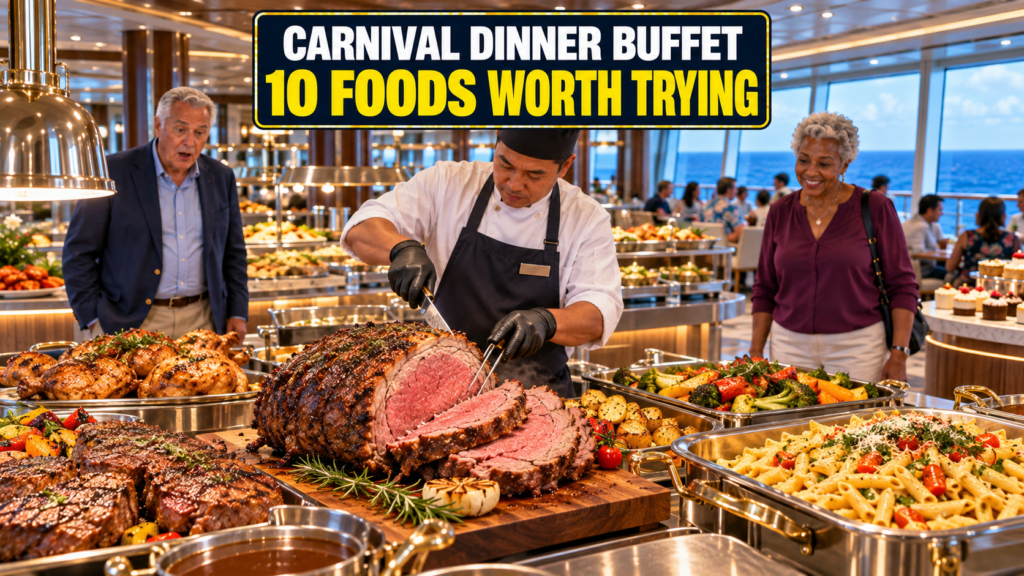
A freshly carved slice can deliver exactly the kind of dinner many passengers are hoping to find elsewhere: a browned roasted exterior, tender center, savory juices, and enough substance to build an entire plate around.
Add roasted potatoes and vegetables and suddenly your buffet plate doesn’t look particularly “basic.”
The biggest advantage is control.
Want a smaller portion? Take one.
Want to skip heavy sides and add vegetables instead? You can do that too.
For travelers over 60 who may prefer controlling portion size rather than receiving a large fixed restaurant entrée, that’s a useful benefit.
If you see a carving station operating at dinner, take a look before automatically walking past it.
It could become the centerpiece of your meal.
2. Steak From the Dinner Buffet
Many cruisers mentally associate steak with one place: the steakhouse.
But Carnival’s own dining information lists steak among possible dinner buffet offerings.
That’s worth knowing.
A buffet steak obviously shouldn’t be assumed to provide exactly the same cut, preparation, presentation, or service experience you’d expect from a specialty steakhouse.
That’s not the point.
The question is simpler:
Does the steak being served tonight look good enough for the dinner you actually want?
Look at it before deciding.
Pair a serving with potatoes, vegetables, salad, or another side and you may have exactly the kind of hearty dinner you were craving.
If your priority is the full steakhouse experience, specialty dining may still win easily.
But if your priority is simply having steak for dinner, check what’s already available first.
3. The Chef’s Special
This may be the most important buffet stop for passengers who think they’ve already seen everything.
Don’t assume tonight’s buffet will be identical to yesterday’s.
A rotating Chef’s Special can introduce something different from the predictable foods you noticed earlier in the cruise.
That’s why experienced buffet diners don’t necessarily walk directly to the first familiar station.
They look around first.
Before putting anything on your plate, make one complete pass through the available dinner selections.
See what has changed.
Check the hot-food stations.
Look at the carving area.
Find the evening’s rotating choices.
Then build your plate.
Otherwise, you can fill up on the first foods you recognize and discover something far more interesting five minutes later.
4. Hot Pasta
Pasta can be easy to dismiss because it sounds ordinary.
But a good hot pasta dish can become one of the most satisfying foods at dinner.
The attraction isn’t necessarily complexity.
It’s the combination of hot pasta, flavorful sauce, vegetables or protein, and the ability to choose exactly how much you want.
You can also use pasta as part of your plate rather than treating it as the entire meal.
A smaller serving beside carved meat or chicken can create a more varied dinner without requiring several full entrées.
And that’s one of the buffet’s biggest advantages.
You aren’t locked into someone else’s idea of the perfect plate.
You build your own.
5. Roasted or Grilled Chicken
Chicken isn’t going to generate the same excitement as a giant roast at the carving station.
But don’t overlook it.
A properly roasted or grilled piece of chicken paired with vegetables, potatoes, salad, or another hot side can create a straightforward restaurant-style dinner without making the meal unnecessarily complicated.
It can also be useful on nights when you’ve already had several rich cruise meals and don’t want another extremely heavy entrée.
Look for chicken that appears freshly prepared rather than choosing something simply because it’s familiar.
Then build the rest of your plate around it.
Sometimes the best cruise dinner isn’t the most extravagant one.
It’s the one you actually feel like eating.
6. International and Rotating Hot Entrées
One reason to walk the entire buffet before filling your plate is variety.
Don’t stop after seeing meat, potatoes, and pasta.
Depending on what’s being offered that evening, other hot selections may give you an opportunity to try flavors you wouldn’t have ordered as a full restaurant entrée.
That’s particularly useful at a buffet.
Curious about something?
Take a modest portion.
If you love it, return for more.
If it isn’t for you, you haven’t committed your entire dinner to it.
That ability to sample several flavors is something a conventional restaurant menu doesn’t always offer as easily.
Just remember that selections change.
Treat what you find as part of that particular evening’s experience rather than expecting the exact same dishes on every Carnival ship.
7. Specialty Salads That Become a Real Meal
Cruise dinners can get heavy quickly.
After several days of large breakfasts, lunches, desserts, drinks, and multi-course dinners, you may reach an evening when another huge meal simply isn’t appealing.
That’s when the salad selection becomes more interesting.
Instead of thinking of salad as something you put beside your “real” dinner, build it into the meal.
Start with greens and vegetables, then look around the buffet for a protein or other ingredients that complement them.
A little grilled chicken or another available protein can transform a basic salad into a satisfying lighter dinner.
This is especially useful if you want flexibility.
You control the ingredients.
You control the portion.
And you can always return for something else if you’re still hungry.
8. Roasted Vegetables, Potatoes and Hot Sides
A good entrée can get all the attention, but the sides determine whether the final plate feels complete.
Imagine that freshly carved beef by itself.
Now put it beside golden roasted potatoes, colorful vegetables, and a little sauce.
It’s a completely different meal.
The same principle works with steak and chicken.
Rather than piling every available side onto your plate, choose two or three that actually complement your main food.
You’ll get a more coherent dinner and still have room to try something else later.
For older travelers who prefer smaller portions, this strategy works particularly well.
You don’t need an enormous plate to experience several foods.
Take modest portions and go back only if you genuinely want more.
9. Desserts Worth Saving Room For
Here’s where buffet strategy matters.
Don’t arrive at dessert already uncomfortable because you treated the first plate like your last opportunity to eat.
Before dinner, or while you’re making your initial walk around the buffet, take a quick look at dessert.
You don’t have to take anything yet.
Just see what’s available.
If something catches your attention, you’ll know to leave room.
Dessert selections can vary, so avoid going into dinner expecting one specific cake or pastry.
Instead, treat the dessert station like the rotating hot-food stations: inspect what’s actually being served tonight.
Then choose the item that looks worth it.
One dessert you genuinely want is usually more satisfying than taking several simply because they’re there.
10. The Dinner You Build Yourself
This may be the buffet’s biggest advantage over a conventional restaurant.
You aren’t really choosing one entrée.
You’re building your own dinner.
Maybe you want a modest slice of carved beef, a small amount of pasta, roasted vegetables, and dessert afterward.
Someone else may prefer chicken, salad, and potatoes.
Another passenger may want to sample two rotating dishes in small portions instead of committing to one large meal.
That flexibility is valuable.
And it explains why comparing the buffet directly with a specialty restaurant isn’t quite fair to either one.
A specialty restaurant can offer a more structured experience with dedicated service and a menu designed around that venue.
The buffet gives you something different:
choice.
You can look before committing, combine foods from different stations, adjust portions, and change direction halfway through dinner.
For some nights, that’s exactly what you need.
Before You Pay Extra for Dinner, Do This
There’s a simple habit that can save you from making a dinner decision too early.
Walk through the buffet first.
Don’t even pick up a plate initially.
Take a few minutes and see what’s actually being served.
Check the carving station.
Look at the hot entrées.
See whether steak, chicken, pasta, or an interesting rotating dish catches your attention.
Check the sides.
And yes, look at dessert.
Then decide.
If nothing appeals to you and you want the menu, service, atmosphere, or particular dishes offered by a specialty restaurant, go enjoy that experience.
But don’t pay extra simply because you assumed the buffet wouldn’t have anything worth eating.
The Bottom Line
Carnival’s dinner buffet doesn’t need to “beat” a specialty restaurant to be worth your attention.
They’re different dining experiences.
The surprise is how easy it can be to overlook an appealing dinner that’s already available because you’ve mentally classified the buffet as the basic option.
On some evenings, a freshly carved roast with vegetables and potatoes may be exactly what you wanted.
On another night, it might be steak, pasta, chicken, a rotating hot entrée, or simply a lighter plate built exactly the way you like it.
Selections vary by ship and sailing, so don’t board expecting these exact foods every night.
Instead, remember one rule:
Look before you book—or pay extra—for dinner.
You may discover that one of the most satisfying meals of your cruise was waiting at the buffet all along.
