
AIRPORT TIPS
Black Woman Humiliated on a Plane — Then the Flight Attendant Stepped In!
Sep
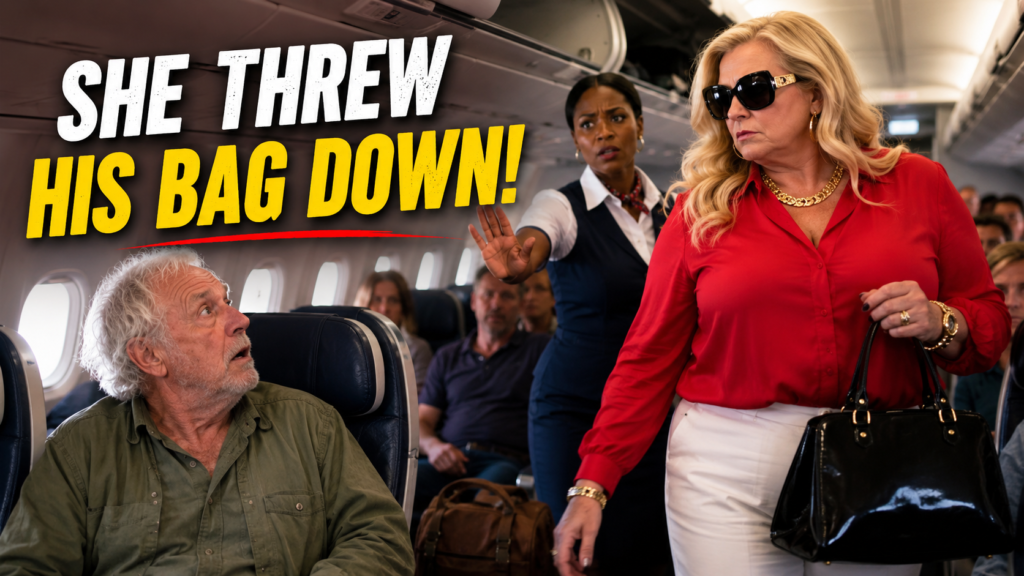
She was already sitting in the seat printed on her boarding pass when another passenger stopped beside her and demanded that she move. At first, it sounded like an ordinary airplane seat dispute. Then came one sentence that changed the entire cabin: “I’m not sitting next to a Black woman.” What happened next turned an uncomfortable confrontation into a lesson about dignity, discrimination, and what happens when a passenger refuses to let a flight attendant end a disturbance.
Editor’s note: The passengers, names, dialogue, and specific incident in this story are fictionalized for storytelling. The aviation-rights context at the end is based on current U.S. Department of Transportation and Federal Aviation Administration guidance. This should not be presented as a report of a specific real-world flight.
Part 1 — The Seat Was Hers
At 10:30 on a bright weekday morning, the aircraft was still attached to the jet bridge.
Most passengers were already aboard.
The overhead bins were filling quickly, the aisle had narrowed into the familiar pre-departure obstacle course of rolling bags and winter jackets, and flight attendants were moving between rows trying to get everyone settled.
In seat 14C sat Denise Carter.
At 58, Denise had the kind of presence that made people notice her without her trying to be noticed.
Her emerald-green pantsuit was tailored perfectly. A cream blouse softened the sharp lines of the jacket. Gold earrings caught the light whenever she turned her head, and long black curls fell below her shoulders in carefully defined waves.
She had spent years learning that elegance did not require an announcement.
You simply carried it with you.
Her cream handbag was tucked securely near her seat. Her phone was already on airplane mode. Her boarding pass had been checked twice—not because she was nervous, but because Denise was the sort of traveler who liked to know exactly where she was supposed to be.
14C.
Left side.
Aisle.
Exactly where she was sitting.
She had arrived early enough to avoid rushing through the terminal, bought a coffee she had only half finished, and boarded when her group was called.
Nothing about the morning had been remarkable.
That was about to change.
A woman stopped in the aisle beside her.
Denise initially assumed she needed to pass.
She shifted her knees slightly.
But the woman didn’t move.
Denise looked up.
The passenger appeared to be in her mid-50s. Platinum-blonde hair fell neatly around her shoulders. Large black sunglasses covered her eyes even though she was inside the aircraft. She wore a crimson-red blazer, white trousers and gold jewelry, and carried a glossy black handbag.
She stood directly beside Denise’s row.
For several seconds, neither woman spoke.
Then the blonde woman said:
“Excuse me. You need to move.”
Denise blinked.
There are certain sentences that take a second to process because they arrive without enough context.
This was one of them.
Maybe the woman believed Denise had taken her seat.
Maybe she was traveling with someone in the row.
Maybe the gate agent had changed something.
Denise wasn’t interested in starting an argument over a misunderstanding.
She looked down at the seat number, then back at the woman.
“Why? This is my assigned seat.”
The answer should have been enough to turn the situation into an ordinary boarding problem.
If two passengers held boarding passes showing the same seat, a flight attendant could sort it out.
If someone wanted to trade seats, she could ask.
Denise could say yes.
Or no.
Either way, there was a normal way for the conversation to continue.
Instead, the woman remained standing over her.
She tightened her grip on the black handbag.
Then she said:
“I’m not sitting next to a Black woman. Move somewhere else.”
For a moment, Denise didn’t respond.
The cabin around her seemed to get quieter even though it hadn’t actually gone silent.
A passenger across the aisle looked up from his phone.
Someone one row forward turned around.
Another passenger froze halfway through pushing a backpack under the seat.
Denise stared at the woman.
She had spent enough of her life encountering prejudice to recognize what she had just heard.
Still, there was something surreal about hearing it stated so plainly.
Not coded.
Not disguised as a complaint about boarding order.
Not hidden behind a vague accusation that someone was making another passenger “uncomfortable.”
The woman had said exactly what she meant.
Denise’s expression changed.
The confidence didn’t disappear.
Neither did the composure.
But hurt reached her eyes.
“Did you really just say that to me?”
The blonde woman didn’t apologize.
She didn’t pretend Denise had misunderstood.
Instead, she stood there as if Denise’s presence in the seat were the inconvenience.
That was the moment a flight attendant several rows behind them began moving forward.
Her name was Danielle Brooks.
Danielle had noticed the stopped boarding traffic first.
Then the body language.
One passenger standing rigidly in the aisle.
Another sitting perfectly still.
Several passengers staring.
Experienced cabin crew learn quickly that a disturbance does not always begin with shouting.
Sometimes the silence around an argument tells you enough.
Danielle approached.
“Is everything all right here?”
Denise didn’t answer immediately.
The other woman did.
“She needs to move.”
Danielle looked toward Denise, then at the row markers.
“Is there a problem with the seating assignment?”
Denise reached for her boarding pass.
“This is 14C. That’s my seat.”
Danielle checked.
It was.
There was no mystery.
No duplicate assignment.
No computer error for her to resolve.
Denise was exactly where she was supposed to be.
Danielle turned toward the standing passenger.
“Ma’am, she is seated in her assigned seat.”
The woman didn’t move.
Then Danielle heard enough of the dispute to understand that this wasn’t really about a seat number.
The issue was who was sitting in the seat.
And that changed the character of the confrontation.
The blonde woman folded one arm across her body.
Denise remained seated.
Passengers nearby had stopped pretending they weren’t listening.
Danielle kept her voice controlled.
She didn’t shout.
She didn’t insult the woman.
She didn’t turn the aisle into a courtroom.
She simply made the immediate issue clear:
Denise was in her assigned seat.
She wasn’t being ordered to move.
And the confrontation needed to stop.
The blonde woman responded:
“Then move her—or I’m not sitting here.”
Denise exhaled slowly.
There was a temptation to answer.
A dozen possible responses came to mind.
But she didn’t give the woman the confrontation she seemed determined to create.
Instead, Denise sat upright and waited for the crew to handle it.
Danielle’s response was short.
“No. She is staying in her assigned seat.”
That should have ended it.
It didn’t.
Part 2 — The Flight Attendant Drew the Line
The blonde passenger’s posture stiffened.
Until that moment, the confrontation had still contained an obvious exit.
She could have stopped.
She could have taken her assigned seat.
She could have apologized.
She could even have walked away without apologizing and allowed boarding to continue.
Instead, she raised her voice.
“I refuse to sit next to her!”
Several heads turned.
A child farther down the cabin looked toward his mother.
A passenger across the aisle lowered his phone.
The atmosphere had changed.
What had begun as one woman’s demand was now interfering with the process of getting a cabin full of people seated and ready for departure.
Danielle did not match the passenger’s volume.
That mattered.
In tense public situations, raising your voice can feel satisfying while making the actual problem harder to solve.
Danielle instead stepped slightly closer, maintaining enough distance that the interaction did not become physically confrontational.
Her hand remained open at her side.
Her voice became firmer.
“Then I need you to stop disrupting boarding and follow my instructions.”
The passenger stared back at her.
“No. I won’t.”
There it was.
The conflict had reached a different stage.
This distinction is important outside the fictional story, too.
A passenger making an offensive or racist statement is reprehensible, but it is not accurate to tell travelers that one discriminatory remark automatically triggers a specific federal punishment or mandatory removal from an aircraft.
Real cases depend on their circumstances, applicable law, the airline’s policies, safety considerations and the conduct that follows.
Here, the fictional passenger had continued the disturbance after the flight attendant intervened and then directly refused the crew member’s attempt to end it.
Danielle’s expression hardened—not with anger, but with authority.
“Then you’ll need to leave the aircraft.”
The blonde woman froze.
For the first time since she had stopped beside Denise, she appeared uncertain.
“You’re removing me?”
Danielle did not turn it into a debate.
The aircraft was still parked.
The door had not closed.
The flight had not departed.
The crew needed the cabin settled.
And Denise was still sitting in the seat assigned to her.
The blonde woman glanced around.
That may have been the moment she realized how many people had heard the exchange.
Nobody cheered.
Nobody needed to.
The absence of support was obvious.
Denise remained seated.
She didn’t smile.
She didn’t celebrate.
This had never been about winning something.
She had wanted to take her flight.
That was all.
She had walked onto the aircraft with a boarding pass and sat in the seat printed on it.
Then another passenger had made her race the center of a confrontation she had never asked to have.
That was the humiliation.
Not that Denise had done anything wrong.
But that someone had attempted to make her defend her right to occupy an ordinary airline seat because she was Black.
Danielle stayed beside the row while the situation was resolved.
The blonde passenger eventually turned toward the front of the cabin.
Her black handbag was still in her hand.
Her movements were abrupt now.
Gone was the certainty with which she had first stopped beside Denise.
As she moved toward the aircraft door, passengers made room.
The aisle slowly reopened behind her.
Danielle waited until she was clear before returning her attention to Denise.
“Are you okay?”
It was the first question anyone had asked Denise about how she felt.
She nodded automatically.
Then stopped.
“I will be.”
Danielle gave her a moment.
There was no grand speech.
No applause.
No dramatic announcement over the public-address system.
Just a flight attendant standing beside a passenger who had been publicly demeaned and acknowledging that something unacceptable had happened.
Sometimes professionalism looks less dramatic than people expect.
It can be a calm voice.
A clear boundary.
A refusal to make the person being targeted carry the burden of fixing the situation.
Danielle asked whether Denise needed anything before departure.
Denise shook her head.
“No. Thank you.”
A passenger across the aisle quietly said, “I’m sorry you had to hear that.”
Denise looked over.
“Thank you.”
Then the cabin began moving again.
Bags disappeared under seats.
Seat belts clicked.
Passengers returned to their phones.
Someone asked whether there was still space in an overhead bin.
The ordinary machinery of air travel restarted.
But Denise couldn’t simply switch off what had happened.
She looked out the window.
The terminal building filled most of the view.
Ground equipment moved below.
She had taken hundreds of flights in her life.
Business trips.
Family visits.
Vacations.
Weddings.
Funerals.
Trips that began with excitement and others that began with exhaustion.
She knew airports could bring out impatience in people.
She knew seat disputes happened.
She knew passengers sometimes became irrational over overhead-bin space, armrests, boarding groups and reclining seats.
But this had been different.
The woman had not complained that Denise was in the wrong seat.
She had objected to Denise.
That distinction mattered.
And it is also where the legal and regulatory context deserves precision.
The U.S. Department of Transportation states that airlines are prohibited from discriminating against passengers on the basis of race, color, national origin, religion, sex or ancestry. DOT also says airline personnel, including flight crews and customer-service personnel, must carry out safety and security responsibilities in a nondiscriminatory manner.
That rule concerns discrimination by airlines and their personnel. It should not be distorted into the claim that every offensive passenger-to-passenger interaction is automatically a federal airline-discrimination violation attributable to the carrier.
Those are not the same thing.
In our fictional scenario, the racist statement comes from another passenger.
The flight attendant intervenes rather than discriminating against Denise.
That difference is essential.
DOT’s current guidance to airline personnel emphasizes fact-based decision-making, reasonable inquiry, adherence to policy, and consideration of non-confrontational ways to resolve situations. When removal is justified for safety or security reasons, DOT says it should be handled respectfully and discreetly.
In other words, a professional response is not supposed to be:
Someone complained, therefore remove the person they complained about.
The facts matter.
The reason matters.
The behavior matters.
And protected characteristics cannot lawfully become the determinative reason an airline decides to remove someone.
DOT’s passenger guidance says a passenger’s race, color, national origin, religion, sex—including sexual orientation—or ancestry may not be the determinative factor in an airline’s decision to deny boarding or remove that passenger. The same guidance recognizes that airlines may refuse transportation in certain circumstances, including legitimate safety or security concerns and other permissible reasons.
That makes the flight attendant’s role in our story more meaningful.
Danielle doesn’t look at Denise and think:
Moving her would be easier.
She looks at the facts.
Denise is in her assigned seat.
Denise isn’t disrupting boarding.
Denise isn’t threatening anyone.
Denise isn’t refusing a crew instruction.
The other passenger is the one continuing the confrontation.
So Danielle addresses the behavior actually causing the problem.
That is very different from choosing the most convenient person to inconvenience.
Part 3 — What the Cabin Remembered
By the time the aircraft door was ready to close, the energy inside the cabin had changed again.
The confrontation had lasted only minutes.
To Denise, it felt much longer.
She adjusted the sleeve of her emerald jacket and checked her phone one last time.
A message from her sister was waiting.
Landed yet?
Denise smiled faintly.
Haven’t even left yet. I’ll tell you later.
She put the phone away.
Danielle passed through the cabin performing her final checks.
Seat backs.
Tray tables.
Bags.
Seat belts.
When she reached Denise’s row, their eyes met.
Danielle gave a small nod.
Denise returned it.
Nothing else needed to be said.
The flight would continue.
But the episode left behind several lessons that matter far beyond one fictional cabin.
A seat dispute should begin with facts, not assumptions
Airplane seating disagreements are common enough that many travelers have experienced one.
Someone reads the row incorrectly.
A family gets separated.
A passenger wants a window instead of a middle.
A traveler discovers another person sitting in the seat shown on their boarding pass.
The safest and simplest response is usually to verify the seat assignment and involve the crew if the disagreement cannot be resolved calmly.
A passenger can ask another passenger to swap.
The other passenger can decline.
That alone doesn’t need to become a confrontation.
In Denise’s case, she never needed to justify why she wanted 14C.
It was the seat on her boarding pass.
More importantly, she certainly did not need to defend her right to occupy it on the basis of her race.
Being offended and being operationally disruptive are different issues
This is where social-media versions of airline stories often become misleading.
A headline might say:
“Passenger Makes Racist Comment and Is Immediately Kicked Off Plane.”
That formulation suggests a simple automatic rule.
Real aviation decisions are more nuanced.
Our fictional story deliberately includes an escalation.
The passenger makes an explicitly racist demand.
The flight attendant intervenes.
The passenger continues the dispute.
The crew member tells her to stop disrupting boarding and follow instructions.
The passenger refuses.
Only then does the story move to removal.
That sequence is important because current FAA materials emphasize the seriousness of unruly behavior and interference with crewmembers. The FAA says it maintains a zero-tolerance policy toward unruly passengers, and federal regulations prohibit assaulting, threatening, intimidating or interfering with a crewmember performing duties. FAA guidance specifically notes that failing to obey a flight attendant’s safety instructions can constitute crewmember interference.
That does not mean every disagreement with a flight attendant automatically becomes a federal offense.
Nor does it mean every instruction has identical legal consequences.
Context matters.
The nature of the instruction matters.
The conduct matters.
The point for ordinary passengers is much simpler: once a cabin dispute reaches the crew, escalating the confrontation or interfering with crew duties can turn a petty argument into a far more serious situation.
A targeted passenger doesn’t have to “win” the argument
Denise’s strongest action in the story is almost invisible.
She stays seated.
She answers clearly.
Then she lets the crew handle the operational dispute.
That isn’t passivity.
It’s control.
If you are subjected to discriminatory treatment by another passenger, getting pulled into an escalating shouting match can make a bad situation harder for everyone to evaluate.
When possible, tell the crew what happened.
Identify witnesses if necessary.
Preserve relevant details.
And distinguish between what another passenger did and what airline personnel did in response.
That distinction can become particularly important if you later make a complaint.
DOT’s civil-rights complaint process specifically addresses allegations of discriminatory treatment by airlines or their contractors. DOT says its Office of Aviation Consumer Protection investigates complaints alleging discrimination by airlines on protected grounds including race, color, national origin, religion, sex and ancestry.
Travelers who believe they experienced unlawful discriminatory treatment by airline employees or contractors can use DOT’s consumer complaint process.
DOT — File a Consumer Complaint
But again, precision matters.
If another passenger insults you and the airline appropriately intervenes, that is not the same allegation as saying the airline itself discriminated against you.
Document what actually occurred.
The crew’s authority isn’t unlimited either
It is easy to tell an airline story as though cabin crew can make any decision for any reason.
That’s not accurate.
Airlines have substantial responsibility for maintaining safety and order, but DOT’s nondiscrimination framework makes clear that those responsibilities must be exercised without unlawful discrimination.
Current DOT guidance tells airline personnel to distinguish legitimate safety or security concerns from assumptions or stereotypes and to make decisions based on the facts and circumstances.
DOT’s updated passenger guidance likewise says airline discretion is not unfettered and that protected characteristics cannot be the determinative factor in a removal decision.
That principle changes how we should think about Denise’s story.
Imagine a different ending.
Imagine the blonde passenger complains about Denise.
Instead of checking the seat assignments or asking what happened, the crew simply tells Denise:
Just move. It’ll be easier.
Now the story raises very different questions.
Why was Denise selected to bear the consequence?
What facts did the crew consider?
Was the decision based on legitimate operational considerations?
Did race play a determinative role?
Those questions would matter.
Our fictional story intentionally goes in the opposite direction.
Danielle checks the situation.
She recognizes who is seated where.
She doesn’t treat the racist passenger’s discomfort as evidence that Denise has done something wrong.
And she focuses on ending the actual disruption.
The humiliation wasn’t Denise’s
This may be the most important part of the story.
When someone is publicly targeted because of race, the immediate emotional experience can feel deeply personal.
People look.
The cabin becomes quiet.
Suddenly an ordinary trip turns into a public spectacle.
Denise feels that.
She is hurt.
She is stunned.
But the shame in that cabin doesn’t belong to her.
She hasn’t done anything shameful.
She boarded an airplane.
She sat down.
She existed in a public space.
Another passenger decided that her race was a reason she should be displaced.
That behavior reflects on the person making the demand—not the person forced to hear it.
As the aircraft finally pushed back from the gate, Denise watched the terminal begin to slide past the window.
The confrontation was over.
The woman in the red blazer was no longer aboard.
Danielle was preparing the cabin for departure.
Passengers who had watched the argument were once again settling into the anonymous routines of travel.
Headphones went on.
Window shades moved.
Phones disappeared.
A few minutes later, Denise felt the aircraft turn toward the taxiway.
She rested her hands in her lap.
She thought about what she would tell her sister.
Maybe she would be furious when she told it.
Maybe she would laugh at the absurdity eventually.
Maybe both.
But one detail would stay with her.
Not the insult.
Not the sunglasses.
Not the red blazer.
It would be the moment Danielle arrived and refused to treat Denise as the easiest person to move.
The flight attendant didn’t need a dramatic speech.
She didn’t need applause.
She needed facts.
She needed professionalism.
And she needed to make clear that the person peacefully sitting in her assigned seat was not the problem.
Denise looked down the aisle.
Danielle was several rows away now.
The aircraft accelerated.
For the first time since the confrontation began, Denise relaxed against her seat.
She was still in 14C.
Exactly where she had been supposed to be all along.
What U.S. Passengers Should Know
This story is fictional, but the underlying protections are real. The U.S. Department of Transportation states that airlines may not discriminate against passengers because of race, color, national origin, religion, sex or ancestry, and airline personnel must carry out safety and security responsibilities in a nondiscriminatory manner.
At the same time, a racist comment by another passenger should not be presented as automatically producing a particular federal penalty, arrest or mandatory removal. When conduct escalates into unruly behavior or interference with crew duties, separate FAA rules and enforcement considerations can become relevant.
For travelers, the practical takeaway is straightforward: don’t interfere with another passenger because of race or another protected characteristic; don’t turn seat disagreements into personal confrontations; involve the crew when a dispute cannot be resolved calmly; and once crew members are managing a safety or boarding situation, don’t escalate or interfere with their duties.
If you believe airline personnel or an airline contractor unlawfully discriminated against you, DOT provides a formal consumer/civil-rights complaint process.
U.S. DOT — Non-Discrimination in Air Travel
DOT — Current Guidance for Airline Personnel
DOT — Passengers’ Right to Fly Free from Discrimination
FAA — Unruly Passengers
