
CRUISE TIP
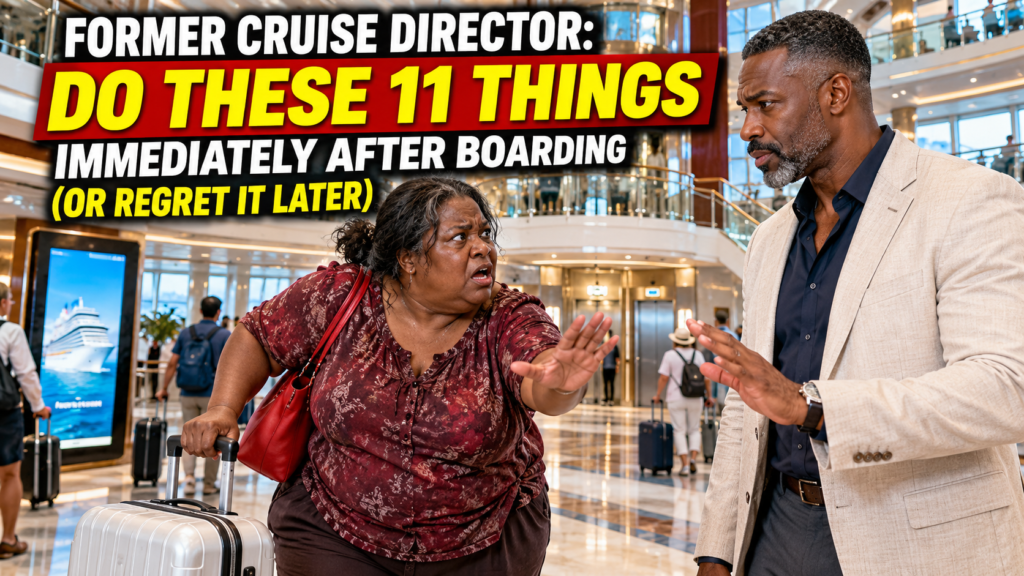
Do These 11 Things Immediately After Boarding (Or Regret It Later)
Sep
The first hour of a cruise feels like the moment you’ve been waiting months for.
You finally step aboard. Music is playing. Crew members are welcoming passengers. The atrium looks spectacular. Your vacation has officially begun, and your first instinct may be to head straight to your cabin, find the buffet, order a drink, or start exploring the ship.
But that first hour can also be one of the most important parts of your cruise.
Experienced cruisers know that embarkation day isn’t just about getting onboard. It’s about getting several small but important things handled before thousands of other passengers settle in, reservations become harder to find, activities begin, and the ship leaves port.
A former cruise director would likely tell you something many first-time cruisers don’t expect:
Don’t waste your first hours onboard wandering around without a plan.
Some embarkation-day tasks involve mandatory safety procedures. Others are simply smart moves that can save time, prevent confusion, or help you avoid discovering a problem when it is much harder to fix.
Here are 11 things worth doing as soon as practical after boarding a cruise ship.
1. Complete Your Muster Requirements Early
This should be near the top of your embarkation-day priorities.
Every cruise passenger needs to pay attention to the ship’s safety procedures, but the exact process can differ by cruise line and ship.
Modern muster procedures may include watching safety information electronically and then reporting to an assigned muster or assembly station so crew members can confirm completion.
Don’t assume you can simply ignore it until later.
The muster process exists so you know where to go and what to do in an emergency.
Royal Caribbean’s Muster 2.0, for example, allows guests to review certain safety information individually before visiting their assigned assembly station. Other cruise lines have their own procedures and deadlines.
The smart move is simple:
Find out what your ship requires and get it done early.
Once it’s completed, you can enjoy the rest of embarkation day without having an unfinished safety requirement hanging over you.
Why cruisers regret waiting
The first few hours onboard disappear surprisingly quickly.
You start exploring, meet friends, get lunch, order a drink, unpack, and suddenly the ship is preparing to depart.
Taking care of your muster requirements early removes one important task from the rest of your day.
2. Connect to the Ship’s App and Onboard Wi-Fi
Your cruise line’s mobile app can become one of the most useful tools you have onboard.
Depending on the cruise line and ship, the app may give you access to:
- Daily activities
- Restaurant information
- Dining reservations
- Entertainment
- Excursions
- Deck maps
- Venue hours
- Your onboard account
- Personal schedules
Some cruise lines allow passengers to use important app functions through the ship’s onboard Wi-Fi without purchasing a full internet package.
Royal Caribbean, for example, directs guests to connect to the ship’s Guest Wi-Fi to use its app onboard. Carnival similarly provides HUB App functionality through its shipboard Wi-Fi system.
This doesn’t mean every cruise app works exactly the same way.
It means you should get your ship’s digital tools working before you actually need them.
Do this before wandering around
Open the app.
Connect to the appropriate ship network.
Make sure your reservation is showing correctly.
Then look at the day’s schedule.
Five minutes spent doing this can make the ship feel much easier to navigate.
3. Check Your Dining Reservations
Don’t wait until you’re hungry to figure out dinner.
One of the first things I would check after boarding is whether my dining arrangements look the way I expected.
Confirm your dining time if your sailing uses assigned dining.
Check any specialty restaurant reservations you’ve already made.
If you’re using a flexible dining program, learn how it works on your particular ship.
And if something looks wrong, find out where dining requests are being handled on embarkation day.
Cruise lines differ considerably in how they manage dining, and many reservations can now be made before sailing.
That’s actually a good reason to check rather than assume.
Why this matters
Imagine getting dressed for dinner and only then realizing your dining assignment isn’t what you thought it was.
Now you’re trying to fix the problem at the same time everyone else is trying to eat.
Royal Caribbean, for example, advises guests seeking certain dining-assignment changes to speak with the appropriate dining staff onboard.
If you spot a problem early, you give yourself more time to ask about possible alternatives.
Availability is never guaranteed.
But earlier is usually better than discovering the issue at dinner time.
4. Look for Any Dining Reservations You Still Want
Checking an existing reservation and making a new reservation are two different things.
If there is a specialty restaurant you really want to try and you haven’t booked it yet, check availability after boarding.
The same principle applies to any dining experience on your particular sailing that accepts reservations.
Don’t make the mistake of assuming:
“I’ll deal with it tomorrow.”
Popular times can become difficult to obtain.
However, this tip comes with an important qualification.
Many cruise lines let guests reserve restaurants well before embarkation day. If you know there is a must-do restaurant on your cruise, booking in advance may be better than deliberately waiting until you board.
Think of embarkation day as your second chance, not necessarily your first opportunity.
5. Check Shows and High-Demand Activities
This is one of the biggest areas where cruisers need to understand their specific ship.
Some entertainment is open seating.
Some activities don’t require reservations.
Other ships and sailings may use reservations for certain productions, attractions, or experiences.
Therefore, don’t follow internet advice that says every passenger must immediately reserve every show.
Instead:
Check what your ship actually requires.
Open the app or daily planner and identify the experiences you care about most.
If reservations are required or offered and availability remains, make your decisions early.
Don’t assume every ship works the same way
A large modern cruise ship can have completely different entertainment procedures from another ship—even within the same cruise company.
Royal Caribbean and Norwegian both provide ways for guests to manage various onboard reservations, but availability and reservation requirements depend on the sailing, venue, ship, and activity.
Your goal isn’t to reserve everything.
Your goal is to avoid discovering on Day 3 that the one experience you desperately wanted required planning on Day 1.
6. Read the Daily Planner Before You Start Exploring
This may be the simplest tip on the list, yet it can completely change your first day.
Before you wander through the ship, spend a few minutes looking at the daily schedule.
Cruise ships can have an enormous number of things happening simultaneously.
Trivia.
Live music.
Welcome events.
Kids’ activities.
Spa promotions.
Dining events.
Shows.
Games.
Fitness activities.
Sailaway events.
You don’t need to attend all of them.
In fact, you shouldn’t try.
But you should know what’s happening before you accidentally miss something you would have loved.
Build your day around priorities
Choose two or three things that actually matter to you.
Then explore around them.
Modern cruise apps make this much easier. Royal Caribbean’s app, for example, includes a Daily Planner and allows guests to add activities to their personal calendar.
Carnival’s HUB App similarly provides onboard event information and planning functionality.
The goal isn’t to schedule every minute of your vacation.
It’s to avoid hearing someone at dinner say:
“You missed that? It was this afternoon!”
7. Check Your Onboard Account
This takes only a few minutes.
Look at your onboard account and make sure everything appears reasonably consistent with what you expected.
Depending on your booking and cruise line, that might include:
- Payment arrangements
- Onboard credit
- Pre-purchased items
- Packages
- Initial charges
Not every credit or purchase necessarily appears in exactly the same way or at exactly the same time across every cruise line.
So don’t panic immediately if something looks unfamiliar.
But do familiarize yourself with where your onboard account is located and how to review it.
Cruise lines such as Royal Caribbean and Norwegian provide digital methods for guests to access onboard account information.
Why check early?
Because the worst time to learn how your onboard account works is the final night of your cruise when you’re trying to understand several days of charges.
Know where the information is from Day 1.
Then check it periodically during the sailing.
8. Find Your Muster Station—and Learn the Ship’s Basic Layout
Cruise ships can be enormous.
The first few hours onboard can feel like walking through a floating city.
You don’t need to memorize every deck.
But there are several places you should be able to locate quickly.
Start with your assigned muster or assembly station as required by your cruise line.
Then learn the basic geography of the ship.
Where is your cabin?
Where are the main dining venues?
Where is Guest Services?
Which elevator bank is closest to your room?
Which direction is forward?
Which direction is aft?
Where are the major entertainment venues?
Learn landmarks, not every hallway
A common first-time-cruiser mistake is trying to memorize the entire ship.
You don’t need to.
Pick a few major landmarks.
The central atrium, theater, pool deck, main dining room, and your elevator or stairwell can help you orient yourself.
After a day or two, navigating the ship usually becomes much easier.
9. Traveling With Kids? Check the Youth Program Early
This one doesn’t apply to everyone.
But if you’re traveling with children and expect them to participate in the ship’s youth program, don’t wait until the moment you desperately need childcare to figure out how it works.
Check:
- Registration requirements
- Operating hours
- Age groups
- Pickup procedures
- Program schedules
- Any reservation requirements that may apply
Cruise-line youth programs vary.
Some registration steps may be available before sailing, while others may require additional onboard action.
That’s why the correct advice isn’t:
“Every parent must register their kids immediately after boarding.”
The better advice is:
If your family plans to use the youth program, understand the process early.
That way, when your children want to participate—or when the adults finally want some quiet time—you already know what to do.
10. Fix Special Requests or Problems Before Everyone Else Has the Same Idea
Something isn’t right.
Maybe your dining arrangement isn’t what you expected.
Maybe you have a question about a reservation.
Maybe something connected to your booking needs clarification.
Your instinct might be:
“I’ll deal with it later.”
Sometimes that’s fine.
But if the issue matters to your vacation, embarkation day is a good time to determine where it should be handled.
The key is not to automatically join the Guest Services line for every tiny question.
Many issues can be solved in the app, at a specific dining desk, through the relevant venue, or by asking a crew member where to go.
Go to the right place
This is the difference between experienced cruisers and passengers who spend half of embarkation day standing in lines.
Don’t assume Guest Services handles every request most efficiently.
Dining issue?
Start with the dining team.
Excursion question?
Look for the excursion desk or applicable digital information.
Spa reservation?
Check with the spa.
You don’t need to solve every hypothetical problem the second you board.
But genuine problems are easier to address when you know where to take them.
11. Keep Your First-Day Essentials With You Until Your Luggage Arrives
This is the embarkation-day mistake that can make the first afternoon far more frustrating than necessary.
When you arrive at the cruise terminal, larger bags are often handed over for delivery to your stateroom.
That means you may board the ship before your checked luggage reaches your cabin.
So ask yourself:
What would happen if I couldn’t open my main suitcase for several hours?
If the answer is “my entire first day would be ruined,” you packed the wrong things in that bag.
Keep essential items you may need shortly after boarding with you in an appropriate carry-on or personal bag.
Depending on your needs, that could include:
- Passport or identification
- Cruise documents
- Wallet
- Prescription medications
- Phone
- Charging essentials
- Important valuables
- Other immediate personal necessities
And if you plan to use the pool shortly after boarding, consider whether you’ll want appropriate clothing readily available rather than buried in luggage awaiting delivery.
Never pack critical medication where you can’t access it
This is more important than convenience.
Prescription medication and other genuinely essential items should remain accessible to you rather than being placed somewhere you may temporarily lose access to.
Your luggage will normally make its way to you.
But your vacation shouldn’t depend on exactly when that happens.
The Biggest Embarkation-Day Mistake: Trying to Do Everything
After reading a list like this, some cruisers make the opposite mistake.
They turn embarkation day into a military operation.
Don’t.
You’re on vacation.
The point of these 11 tips isn’t to spend your first six hours completing chores.
Most of them take only a few minutes.
The goal is to handle the things that are time-sensitive, safety-related, reservation-dependent, or difficult to fix later.
Then go enjoy your ship.
Get lunch.
Order that drink.
Walk around the pool deck.
Take photos.
Watch sailaway.
Your vacation should still feel like a vacation.
What Should You Do First After Boarding a Cruise Ship?
If I had to simplify the entire list into an easy sequence, I would think about embarkation day in this order:
Safety first.
Complete the muster requirements your cruise line gives you.
Technology second.
Get the ship’s app working and look at the day’s schedule.
Reservations third.
Verify dining and check any entertainment or activities that matter to you.
Problems fourth.
If something important is wrong, determine where to fix it.
Exploration fifth.
Once the essentials are handled, start enjoying the ship.
That’s far more efficient than wandering around for three hours and then trying to remember everything you were supposed to do.
What NOT to Do Immediately After Boarding
There are also several behaviors I would avoid.
Don’t assume your cabin will necessarily be ready the instant you step aboard.
Don’t assume your checked luggage will immediately be waiting outside your door.
Don’t assume every restaurant, show, or activity can be booked whenever you feel like it.
Don’t assume the app will magically work when you need it if you haven’t even connected it.
Don’t ignore muster instructions.
And don’t spend your entire first afternoon standing in unnecessary lines because someone online told you every cruiser has to visit Guest Services.
Embarkation day is about making smart decisions—not completing a universal checklist that applies identically to every ship.
Do You Really Need to Do All 11 Things Immediately?
No.
And this distinction matters.
Some tasks are mandatory safety requirements.
Others are recommendations.
Some may already have been completed before your cruise.
Some won’t apply to you at all.
If you don’t have children, youth-program registration obviously doesn’t matter.
If you booked every specialty restaurant months ago, you may only need to confirm your plans.
If your ship doesn’t require reservations for the entertainment you want, there is nothing to reserve.
If your onboard account looks correct, checking it might take 30 seconds.
That’s why the title says these are things worth doing after boarding—not that every passenger is legally required to perform the same 11 tasks in the same order.
Cruise lines, ships, itineraries, and onboard systems differ.
Always follow the current instructions provided by your own cruise line and crew.
Why Experienced Cruisers Treat Embarkation Day Differently
First-time cruisers often view boarding as the finish line.
Experienced cruisers understand that it is actually the transition point.
You’re moving from months of planning into a temporary floating environment with its own schedule, safety procedures, reservation systems, dining arrangements, and logistics.
A few smart decisions during that transition can eliminate a surprising amount of frustration later.
That’s the real secret.
It’s not about rushing.
It’s about knowing what deserves your attention before you relax.
Final Takeaway: Spend a Few Minutes Now to Save Hours Later
The best embarkation day doesn’t feel frantic.
It feels effortless.
You board.
You complete the required safety steps.
You get connected.
You verify the plans that matter.
You identify any genuine problems.
You keep important belongings accessible.
Then you stop worrying about logistics and start enjoying your vacation.
That’s the mindset behind these 11 things to do immediately after boarding a cruise ship.
Not every item is mandatory.
Not every item applies to every ship.
But ignoring the important ones can turn small, easily preventable issues into frustrating problems later.
So before you rush straight to your cabin, buffet, bar, or pool deck, give yourself a few minutes.
Your future vacation self may be very glad you did.
