
CRUISE NEW
HE ORDERED A MOUNTAIN OF CRUISE FOOD TO HIS CABIN — THEN CAME THE UNEXPECTED CHARGE

Sep
PART 1 — “I Paid for It”
By the third evening of the cruise, Marcus Reed had developed a theory about getting value from a vacation.
If something was included in the fare, leaving any of it unused felt like leaving money on the table.
Marcus was 69, broad-shouldered and heavyset, with the kind of confidence that made every opinion sound like a conclusion. His wife, Vivienne, was almost his opposite. Tall, slender, and elegantly dressed even for a casual evening at sea, she had spent thirty-seven years learning when arguing with Marcus was useful—and when it was better to let reality do the work.
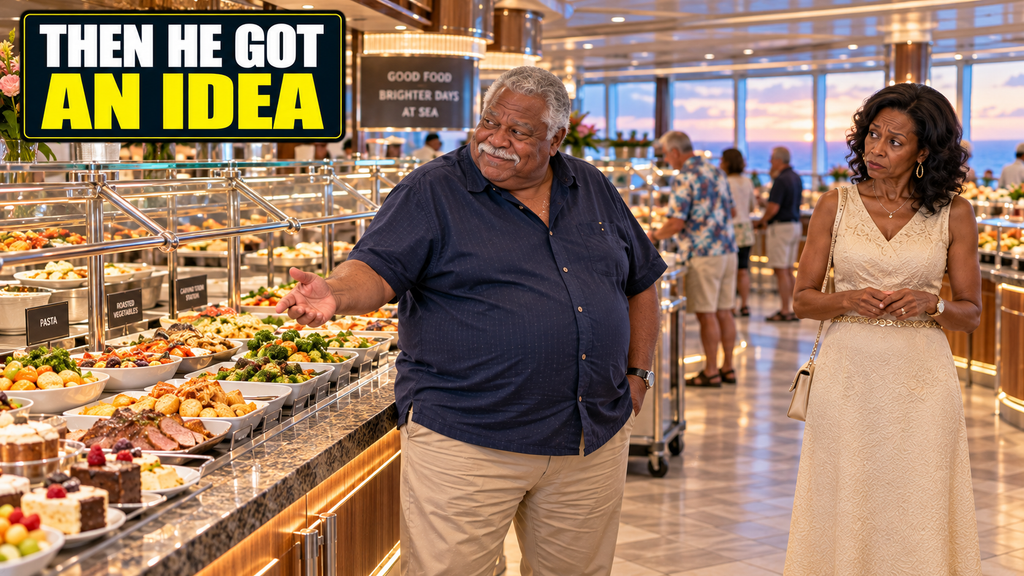
That evening, they walked through the buffet before returning to their suite.
Marcus slowed down at every station.
Roasted meat.
Pasta.
Potatoes.
Salads.
Fresh bread.
Fruit.
Cakes and pastries.
By the time they reached the desserts, he was staring at the displays as though he had discovered buried treasure.
“I’ve got an idea,” he said.
Vivienne stopped.
She knew that tone.
“That sentence has cost us money before.”
Marcus ignored her.
Instead of having a normal dinner, he began asking about having food brought back to their suite. One request became another. Marcus wanted pasta. Then meat. Then vegetables because, as he explained, “you need something healthy.”
Then bread.
Then desserts.
Then another dessert because the first one “looked too small.”
Vivienne stared at him.
“Marcus, there are two of us. Not twenty.”
“We don’t have to eat it all at once.”
“That is not the reassuring answer you think it is.”
Marcus continued.
Eventually, their suite looked less like a cabin prepared for two passengers and more like a private dinner had been arranged for a small conference.
Plates covered most of the dining table.
Additional dishes occupied a service cart beside it.
Marcus lowered himself into his chair with obvious satisfaction.
“Now this,” he announced, “is what I call getting your money’s worth.”
Vivienne looked from him to the food.
“You’re not getting your money’s worth. You’re feeding an imaginary family.”
Marcus laughed and started eating.
For the first twenty minutes, he attacked the meal with impressive confidence.
Then the pace slowed.
He pushed away half a plate of pasta and tried the meat.
A few bites later, he switched to potatoes.
Then bread.
Then cake.
Soon Marcus was no longer eating dinner. He was sampling evidence of his own bad decision.
Vivienne had taken one modest plate for herself.
She finished it.
Marcus still had a table full of food.
“You can help,” he suggested.
“I did help.”
“With what?”
“I told you not to do this.”
Marcus leaned back and exhaled.
“I’ll finish some later.”
Vivienne glanced at the dozens of portions surrounding him.
“Which week?”
Marcus frowned.
Before he could answer, someone knocked on the cabin door.
Vivienne looked toward the entrance.
Marcus remained seated.
Another knock followed.
When the door opened, a crew member named Daniel stood outside.
His expression was professional at first.
Then his eyes moved past Marcus.
He saw the table.
Then the cart.
Then all the barely touched food.
Daniel paused.
Marcus noticed.
“What?”
Daniel looked down at the document in his hand.
Then he looked back at the mountain of unfinished food.
And Vivienne quietly folded her arms.
PART 2 — THE CABIN ARGUMENT
Daniel stepped far enough into the suite to speak comfortably, but kept a professional distance from Marcus.
“Sir, you ordered all this food, and most of it is untouched.”
Marcus immediately sat straighter.

“I paid for this cruise! I can order whatever I want!”
Daniel remained calm.
“The issue isn’t simply whether you finished your dinner, sir.”
Marcus pointed toward the food.
“It’s food. The food is included.”
Vivienne closed her eyes for a second.
She had heard Marcus use this argument several times already.
Included.
To Marcus, that word seemed to mean unlimited, unconditional and beyond discussion.
Daniel held up the document.
“There were additional service arrangements connected with what you requested. I’m trying to explain the charge.”
That word changed Marcus’s expression.
“Charge?”
Daniel nodded.
Marcus looked at Vivienne.
Vivienne looked at the ceiling.
“What charge?” Marcus demanded.
Daniel began explaining, but Marcus was already talking again.
“Nobody said anything about paying extra.”
“Sir, I need you to let me explain—”
“I paid for the cruise.”
“Yes, sir.”
“The buffet is included.”
“Certain food is included, but—”
“Then what are we talking about?”
Vivienne finally turned toward her husband.
“Wonderful. Maybe your next brilliant idea can pay the charge too.”
Marcus stared at her.
For perhaps the first time that evening, he had no immediate response.
Then his eyebrows rose.
“Whose side are you on?”
“The side that ordered one plate.”
Daniel tried not to react.
Marcus noticed anyway.
“This isn’t funny.”
“No,” Vivienne replied. “The funny part was when you ordered enough cake for people who don’t exist.”
Marcus pushed his chair back slightly but remained seated.
“I am not paying a penalty because I couldn’t finish dinner.”
Daniel answered carefully.
“I didn’t say this was a penalty for not finishing dinner.”
“Then why are you standing here with a bill?”
“It isn’t that simple.”
“It looks pretty simple.”
Vivienne stepped in again.
“Marcus, did you actually listen when they explained how all of this was being handled?”
Marcus looked at her.
“I listened.”
“You were pointing at desserts while they were talking.”
“I can do two things at once.”
“You apparently can’t eat two things at once.”
Marcus gave her a sharp look.
Daniel kept his expression neutral.
Marcus then extended a hand.
“Give me the paper.”
Daniel did not approach. Instead, he held it where Marcus could read the relevant information without creating an awkward physical interaction.
Marcus leaned forward.
His eyes scanned the document.
For the first time since Daniel arrived, the volume of his voice dropped.
He read it again.
Then a third time.
His confident expression disappeared.
“I want to speak to a supervisor.”
Daniel nodded.
“That’s fine, sir.”
“Because somebody is going to explain exactly what I’m being charged for.”
“I agree.”
That answer seemed to irritate Marcus even more.
Daniel left to contact a supervisor.
The cabin became quiet.
Marcus looked at Vivienne.
She looked at the untouched desserts.
“Don’t,” Marcus warned.
“I didn’t say anything.”
“You were about to.”
“I don’t need to anymore.”
A few minutes later, there was another knock.
This time a supervisor was waiting outside.
Marcus straightened in his chair.
He was ready for round two.
PART 3 — WHAT THE CHARGE ACTUALLY MEANT
The supervisor introduced herself as Elena.
She listened while Marcus explained the situation from beginning to end—or at least his version of it.
“I paid for an included buffet,” Marcus said. “I ordered food, I didn’t finish all of it, and now I’m being charged. Is that correct?”
Elena shook her head.
“No, sir. That is not what I’m saying.”
Marcus paused.
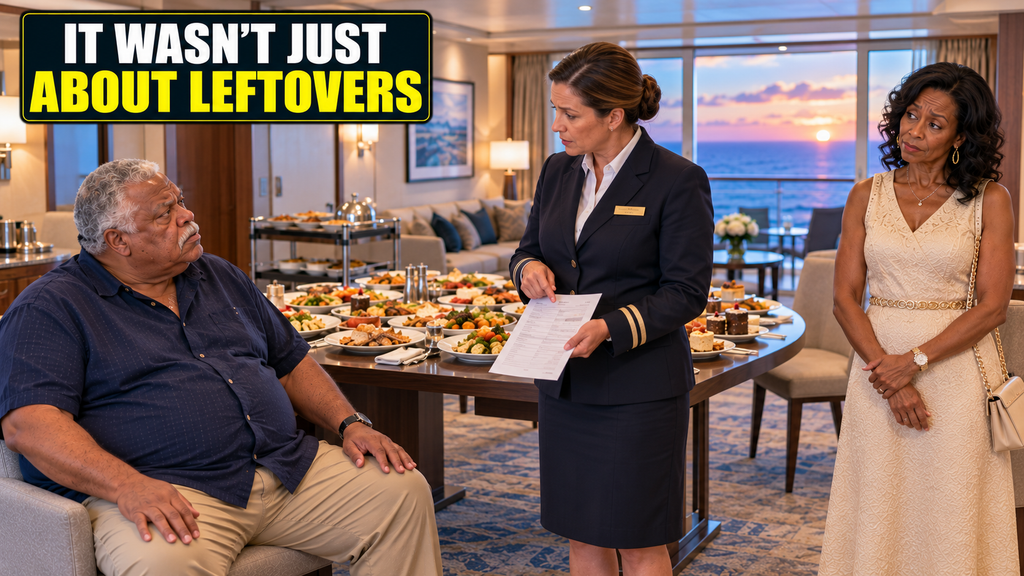
Elena explained that the charge shown on the document was not being presented as a general fine for leaving buffet food unfinished.
The issue concerned the unusual service request Marcus had made and the additional arrangements associated with fulfilling it in this fictional scenario.
That distinction mattered.
Marcus had been arguing as though someone had counted his leftovers and issued a punishment.
That wasn’t what Elena was describing.
Marcus looked at Daniel.
“Then why wasn’t that made clear before all this arrived?”
Daniel started to answer.
Vivienne beat him to it.
“It was.”
Marcus slowly turned toward his wife.
“What?”
Vivienne unfolded her arms.
“The young man who helped with the order tried to explain something to you.”
Marcus frowned.
“When?”
“When you were asking for the second cake.”
“That doesn’t mean I agreed to a charge.”
“No. But it does mean you weren’t listening.”
Marcus looked toward Elena.
“I still want it reviewed.”
“That’s reasonable,” Elena said.
Her answer immediately lowered the temperature in the room.
She examined the document and asked Daniel several questions about how the request had been recorded and what had been communicated to Marcus.
For the first time that evening, everyone stopped arguing long enough to establish what had actually happened.
The review did not produce the dramatic victory Marcus wanted.
But it did not become the automatic punishment he had imagined either.
Elena found that part of the communication surrounding the unusual request could have been clearer.
She adjusted one portion of the charge.
Other documented service costs remained.
Marcus was still unhappy.
But now he understood what he was disputing.
He had not received a mysterious “leftover fine.”
He had made an excessive request without paying much attention to how that request was being handled.
Vivienne watched him study the revised document.
“Well?” she asked.
Marcus folded it.
“They adjusted it.”
“That wasn’t my question.”
“What was your question?”
“Was ordering half the buffet worth it?”
Marcus looked around.
The evidence surrounded him.
Pasta he had barely touched.
Bread he had never opened.
Vegetables he had insisted they needed.
Several desserts he had sampled once.
A plate of meat that had seemed absolutely essential two hours earlier.
Marcus sighed.
“I may have slightly overestimated.”
Vivienne stared at him.
“Slightly?”
“All right. I overestimated.”
She waited.
Marcus knew there was more.
“By a lot.”
Vivienne smiled for the first time since Daniel had arrived.
“There he is.”
Daniel and Elena prepared to leave.
Marcus looked toward them.
His voice was finally calm.
“I should’ve listened before I kept ordering.”
Elena gave him a professional nod.
“That would have helped.”
After the door closed, Marcus and Vivienne were alone again.
For several seconds neither spoke.
Marcus looked at the remaining desserts.
Then he looked at his wife.
“You want some cake?”
Vivienne picked up her small purse and headed toward the balcony.
“No.”
“There’s chocolate.”
“No.”
“Cheesecake?”
She stopped and looked back at him.
“Marcus, I wanted dinner.”
She gestured toward the absurd collection of dishes.
“You ordered a catering department.”
Marcus stared at the table.
Vivienne continued toward the balcony.
For once, Marcus didn’t have a comeback.
He simply sat there surrounded by the leftovers of an argument he had been determined to win.
And perhaps that was the most expensive part of the evening—not the amount written on the document, but how far he had gone simply because he believed “included” meant there could never be a limit, condition, or question worth listening to.
The lesson wasn’t that cruise passengers are automatically fined whenever they leave food behind.
Marcus’s mistake was much simpler.
He stopped listening the moment he heard what he wanted to hear.
And by the time he finally paid attention, dinner had already become a much bigger problem than it ever needed to be.
