
CRUISE NEW
WHAT THEY DID WHEN I FIRST STEPPED ABOARD
Sep
I expected my first few seconds aboard the cruise ship to be simple.
Scan the boarding documents. Walk through the entrance. Find the elevator. Figure out where my cabin was.
Instead, the moment I stepped into the atrium, I stopped.
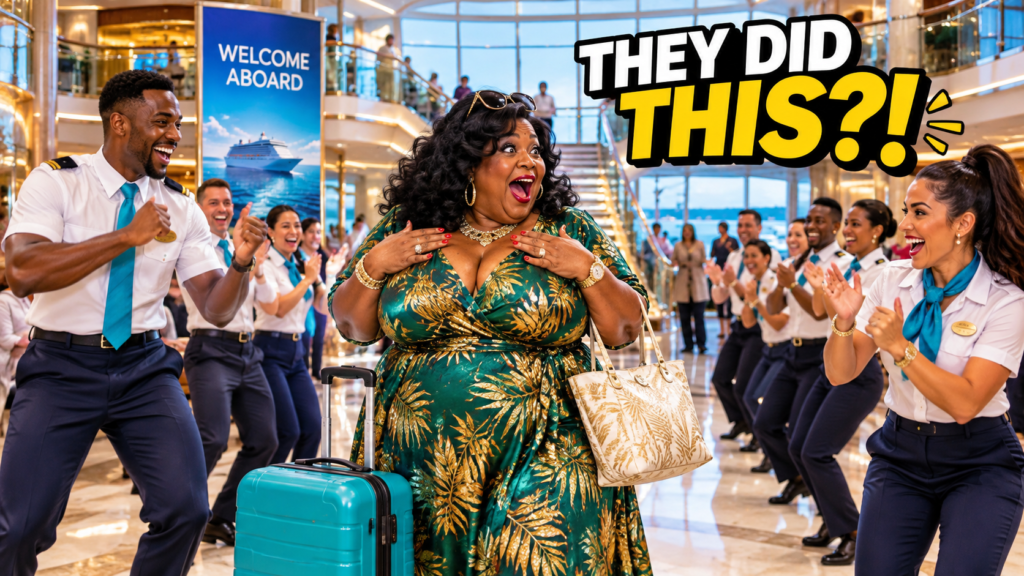
A line of smiling crew members was clapping and moving to the music.
One of them spotted me immediately.
“Welcome aboard! How are you feeling today?”
I looked behind me, convinced they had to be talking to someone else.
“WAIT… are you all dancing for ME?!”
Another crew member laughed and waved me forward.
“Then don’t just stand there! Come dance with us!”
Five seconds earlier, I had been tired from traveling.
Now I was laughing.
“I was tired five seconds ago—NOW I’M READY TO PARTY!”
I rolled my suitcase to the side.
“Oh, you picked the WRONG woman to challenge!”
The crew started cheering.
“COME ON! SHOW US!”
So I did.
And suddenly, my first cruise wasn’t beginning with an elevator, a cabin number or a map.
It was beginning in the middle of a welcome dance.
That kind of energetic greeting is not a universal cruise-industry boarding procedure. Different cruise lines and ships create different embarkation experiences, and you should not expect a dance line every time you sail.
But the surprise captures something very real about embarkation day:
The moment you step aboard, your vacation changes gears fast.
There may be photographers, crew directions, food, activities, a cabin that isn’t ready yet and one safety requirement you absolutely cannot ignore.
Here’s what you should really expect during those first important hours aboard a cruise ship.
Stepping Aboard Is the Moment the Cruise Finally Feels Real
Cruise embarkation is unusual because the vacation doesn’t gradually begin.
One moment you’re standing inside a terminal with documents and luggage.
The next, you’re inside a floating resort.
The atmosphere can change immediately.
The terminal’s security lines and check-in counters give way to music, lounges, restaurants, pools, staircases and excited passengers exploring a ship they’ve been researching for months.
Some cruise lines deliberately emphasize that transition.
Disney Cruise Line, for example, currently tells guests that its Cast Members and Characters are excited to welcome passengers on Embarkation Day. Norwegian’s departure-day guidance similarly treats boarding as the start of the vacation experience and walks passengers through what happens once they reach the ship.
But don’t turn one memorable welcome into a universal expectation.
You might encounter enthusiastic crew.
You might hear music.
You might enter through a spectacular atrium.
Or your boarding experience might be much quieter.
Cruise line, ship, port, sailing and timing can all change the experience.
Could Crew Really Welcome You With Music and Dancing?
Absolutely possible.
But this is where social-media storytelling needs an important disclaimer.
There is no industry-wide rule requiring cruise employees to form a dancing welcome line for every passenger.
A high-energy greeting can be part of a particular ship’s entertainment atmosphere, special sailing, embarkation event or welcome activity.
Royal Caribbean’s own material discussing its safety briefing even references the first-day “welcome party” as part of the onboard experience.
That supports the broader idea that first-day celebration and entertainment can begin quickly after boarding.
It does not establish that every passenger receives an individual dance welcome.
So if you step aboard and nobody starts dancing, nothing has gone wrong.
And if the crew does start dancing?
You might as well enjoy the moment.
You May Meet a Photographer Almost Immediately
One of the first surprises for new cruisers can be the camera.
Norwegian’s current embarkation guidance explicitly says its photographers take a first photo as passengers board, with the resulting image available for purchase in the Photo Gallery.
For a first-time cruiser, this can feel strangely ceremonial.
You’ve barely arrived, you’re still carrying a backpack, and suddenly someone is ready to capture the beginning of your vacation.
The important distinction is that embarkation photography should not be presented as a universal ritual performed identically by every cruise company.
Availability and procedures can vary.
But if a photographer appears during boarding, don’t be surprised.
If you want the picture, smile.
If you’re traveling with family, this can also be one of the easiest opportunities to get everyone together before the group begins scattering across the ship.
Your Big Suitcase May Not Be With You Yet
This catches first-time cruisers off guard.
Depending on how your cruise line handles checked luggage, the suitcase you handed over before boarding may be delivered later rather than following you onto the ship immediately.
That means your first few hours onboard can happen without access to everything you packed.
Norwegian specifically recommends bringing a small bag containing essentials you’ll need on the first day while luggage is being delivered to the stateroom.
That small-bag strategy is one of the smartest embarkation-day habits.
Think about what you would regret putting in your checked suitcase if you couldn’t reach it for several hours.
Keep necessary travel documents and other essential personal items with you, subject to the cruise line’s rules.
If you plan to use the pool before your luggage arrives, packing appropriate swimwear in your carry-on can also save you from spending the afternoon watching everyone else swim.
The key idea is simple:
Pack your embarkation carry-on as though your checked suitcase will not immediately be available.
Don’t Assume Your Cabin Will Be Ready When You Board
You made it onto the ship.
Naturally, you want to drop everything in the cabin.
That may not be possible yet.
Embarkation day is also turnaround day. Earlier passengers have disembarked, and crew members have a limited period to prepare cabins for the next group of guests.
Current Norwegian guidance says Haven Suites are generally ready around noon and other staterooms around 3:00 p.m., while emphasizing that those times can change because of itinerary adjustments.
Royal Caribbean publishes different guidance for particular markets and ships; for example, some current “know before you go” information says staterooms are ready around 1:30 p.m.
That’s exactly why cruisers should avoid memorizing one supposed universal cabin-ready time.
There isn’t one.
Follow the information for your ship and sailing.
If your cabin isn’t available, don’t spend the first hour standing outside the door.
You have a ship to explore.
Go Eat Something
This may be the easiest embarkation-day decision.
You’re onboard.
You’re hungry.
Your cabin isn’t ready.
Lunch solves several problems at once.
Royal Caribbean’s current first-day recommendations specifically suggest enjoying a meal at available venues before heading to the stateroom.
Norwegian likewise recommends exploring the ship or grabbing lunch if the room isn’t ready.
The most obvious venue may also be the busiest because hundreds of passengers are having exactly the same thought.
Depending on your ship, other included or specialty venues may be open.
Check the cruise line’s app, daily schedule or onboard information instead of assuming the first buffet you see is your only choice.
And remember: embarkation day is not a race to consume everything included in the fare.
You’ll be onboard for days.
Explore Before Everyone Learns the Ship
Those first hours offer a useful opportunity.
Most passengers don’t know where anything is yet.
Neither do you.
That’s exactly why exploring early makes sense.
Find the main dining areas.
Locate Guest Services.
Identify the theater.
See where the pools are.
Find the elevators closest to your stateroom.
Check where you need to go for your safety briefing.
Look for restaurants or activities you already know you want to try.
Disney Cruise Line’s current guidance encourages guests to familiarize themselves with the ship and enjoy its amenities after boarding.
Royal Caribbean similarly recommends first-day activities ranging from meals and youth-program registration to spa appointments and dining arrangements.
The advantage of doing this early becomes obvious later.
When the ship is busy and you have five minutes to reach a show, knowing whether the theater is forward or aft suddenly matters.
Check the App and Daily Schedule Early
A cruise ship is packed with choices.
Shows.
Live music.
Trivia.
Restaurants.
Parties.
Fitness classes.
Kids’ programs.
Special events.
Sales.
Spa appointments.
Excursions.
You won’t necessarily want all of them.
But you should know what’s available before the most desirable times fill up.
Royal Caribbean specifically recommends making certain appointments and arrangements on the first day because popular options can fill. Its current first-day guidance points passengers toward spa appointments, specialty dining and family-program registration among other activities.
The cruise line’s app or daily schedule becomes your operational map for the vacation.
Check it before you settle into a chair and lose two hours scrolling through your phone.
Families Should Check Kids’ Programs Early
Parents have an additional embarkation-day task.
If you’re planning to use the ship’s youth program, learn where it is and what registration or check-in steps are required.
Royal Caribbean’s first-day guidance specifically recommends visiting Adventure Ocean for children traveling with the family.
Procedures vary by cruise line and age group, so don’t assume the process you used on a previous ship will be identical on the next one.
This is particularly important if there is an activity later that evening and you expect your child to participate.
Figuring out registration requirements ten minutes before the activity begins is not the ideal way to start the trip.
Then Comes the One Thing You Cannot Simply Skip: Safety
The music is playing.
The drinks are arriving.
Your new friends want to explore the pool deck.
And then there is the muster requirement.
This is not optional entertainment.
Royal Caribbean describes the muster drill or safety briefing as a mandatory safety exercise designed to familiarize guests with their assigned assembly location and other emergency information. Its current system allows portions of the briefing to be completed digitally, followed by a visit to the assigned muster station so crew can verify completion.
Carnival currently uses a self-mustering process. Guests visit their assigned muster station, check in with a crew member and receive safety information; Carnival says all guests must complete the process before sailing.
Norwegian likewise tells passengers to pay attention to announcements and visit the assigned muster station identified on their key card.
The exact implementation varies.
The requirement to take the ship’s passenger safety briefing seriously does not.
“I’ve Cruised Before” Is Not a Reason to Ignore Muster
Experienced cruisers sometimes act as though they’ve heard everything already.
That’s the wrong mindset.
Your assembly station can be different.
Your cabin is different.
Your ship can be different.
And knowing where you need to go during an actual emergency is not something you want to figure out for the first time during the emergency.
Royal Caribbean explicitly states that its mandatory safety process applies to embarking passengers, including those who have sailed previously.
Carnival similarly says its embarkation safety briefing must be completed by all guests before sailing.
Complete it.
Then get back to the party.
Don’t Make the First-Day Mistake of Trying to Do Everything
The first hour onboard can create a strange form of vacation panic.
You want to:
See the cabin.
Eat lunch.
Find the pool.
Book dinner.
Tour the spa.
Take photos.
Buy a drink.
Find the theater.
Register the kids.
Watch sail-away.
Explore every deck.
And apparently, in our story, challenge an entire welcome crew to a dance battle.
You do not need to accomplish the entire cruise before the ship leaves port.
Prioritize.
First, handle anything required or time-sensitive.
Complete your safety obligations.
Confirm important reservations.
Learn the basic ship layout.
Eat if you’re hungry.
Then relax.
The whole point of cruising is that your hotel moves with you.
You don’t need to keep packing and changing destinations every morning.
What Should Stay in Your Carry-On?
Embarkation day becomes much easier when your carry-on is planned intentionally.
Your exact packing list depends on your itinerary, cruise line and personal needs, but the principle is straightforward:
Keep with you anything important that you cannot afford to be without while waiting for checked luggage.
Norwegian explicitly recommends a small bag for first-day essentials while luggage is being delivered.
Travel documents are obvious.
So are essential personal items.
If you need something at a specific time, don’t bury it in a suitcase that is somewhere in the ship’s luggage-delivery operation.
And don’t overload the carry-on.
You’ll potentially be walking around with it until your room becomes available.
The perfect embarkation bag is useful enough to cover the first few hours but light enough that it doesn’t become the first thing you hate about your vacation.
Don’t Forget Where You Put Your Room Key
Cruise ships differ in how and when guests receive their onboard card or room key.
Norwegian’s current departure guidance says guests receive a key card after check-in and need it when boarding or disembarking the ship.
Some current Royal Caribbean guidance says the SeaPass may be waiting at the stateroom door around the time rooms become available, while passengers use their SetSail pass for certain functions beforehand.
Again, the useful lesson is not to memorize one cruise line’s system and apply it everywhere.
Learn the procedure for your sailing.
Whatever credential your ship uses, treat it as important.
It may be tied to room access, onboard purchases and identification during the cruise.
The Welcome Is Fun—But Watch the Clock
Imagine our glamorous passenger again.
She has dropped her turquoise carry-on safely to the side.
The crew is clapping.
She’s dancing in the middle of the atrium.
Passengers walking behind her are smiling.
It is exactly the kind of spontaneous moment people remember years later.
Enjoy it.
Take the picture.
Dance.
Laugh.
But embarkation day still has a schedule.
Cruise lines publish arrival and final-boarding requirements, and passengers should follow the timing in their own travel documents rather than relying on generic internet advice.
Norwegian, for example, currently tells guests to follow the embarkation time in their eDocs and publishes specific final-boarding guidance.
Once onboard, safety requirements must also be completed within the applicable timeframe.
A good embarkation day balances celebration with the few tasks that actually matter.
What First-Time Cruisers Often Get Wrong
The biggest mistake is expecting every ship to operate like a hotel on land.
Cruising has its own rhythm.
Your checked luggage may arrive later.
Your cabin may not be immediately available.
Your room-key process may differ by cruise line.
You have a mandatory safety requirement.
Activities and reservations may begin before departure.
And the ship itself is large enough that learning the layout early pays off.
The second mistake is assuming every cruise experience seen on social media will happen to you.
A viral clip may show crew members dancing at embarkation.
Another might show characters greeting families.
Another might show a huge sail-away party.
Those can all be real experiences without being universal experiences.
Cruising varies enormously by brand, ship and itinerary.
Treat the surprise as part of the fun.
So, Will They Dance for You When You Step Aboard?
Maybe.
But don’t book a cruise expecting a personal dance line.
The scene in this story represents one possible celebratory embarkation experience—not a promise made by the entire cruise industry.
Official cruise-line material supports the broader reality that embarkation can include welcoming crew, photography, food, ship exploration, first-day activities and safety procedures.
Exactly how those pieces come together depends on the sailing.
And that’s part of what makes that first step onto a new ship exciting.
You know where you’re going.
You don’t necessarily know what the first five minutes will feel like.
Final Takeaway
Our passenger thought she was simply boarding a ship.
Instead, she stepped into music, clapping and a crew that invited her to join the fun.
“WAIT… are you all dancing for ME?!”
A crew member welcomed her and asked how she was feeling.
Five seconds later, her travel fatigue was gone.
She moved the suitcase aside.
The crew challenged her.
And she danced.
That exact welcome isn’t guaranteed on your next cruise.
But the larger feeling behind it is real: embarkation day can change from travel day to vacation in seconds.
Once you’re aboard, enjoy that moment.
Take the photo if you want it.
Explore.
Grab lunch.
Learn the ship.
Check your schedule.
Wait for your cabin if necessary.
Keep your essentials with you until your luggage arrives.
And most importantly, complete your required safety briefing and muster process.
Then, when the practical things are handled, go enjoy the reason you booked the cruise in the first place.
Because sometimes the best part of stepping aboard isn’t what you planned to do.
It’s what they did when you first arrived.
