
CRUISE TIP
10 CRUISE SCAMS & DUMB MISTAKES THAT COULD COST YOU MONEY

Sep
The man showed him a watch and asked for fifty dollars in cash.
It looked like a quick bargain near the cruise port. The traveler paid, took the watch, and watched the seller suddenly hurry away.
That is the kind of moment when a “deal” can stop feeling like a deal very quickly.
But cruise-related money problems are not always obvious scams. Sometimes the bigger problem is a simple assumption: trusting the wrong person, connecting to the wrong network, leaving valuables unattended, believing somebody who says the ship will wait, or focusing on the cheapest advertised fare instead of the total cost of the vacation.
Cruise ports, terminals and ships can be busy places. You’re dealing with luggage, transportation, schedules, purchases, Wi-Fi, excursions and unfamiliar surroundings—often all in the same day.
That makes one habit especially valuable:
Slow down before money, personal information or valuables change hands.
Here are 10 cruise scams and costly mistakes worth recognizing before your next sailing.
1. Don’t Buy From an Unverified Seller Just Because the Deal Looks Good
Imagine you’re walking near a cruise terminal when someone approaches with a watch.
“Brand-new. Fifty bucks. Cash only.”
It looks convincing enough. The price sounds good. You hand over the money, receive the watch—and seconds later, the seller is moving quickly away.
At that point, you may have very little useful information about the person who sold it to you. You may not know the business name, return policy, authenticity of the product or even where to find the seller again.
That doesn’t mean every independent seller around a cruise destination is dishonest.
It means you should know who you’re buying from before you pay.
For a significant purchase, consider whether you can identify the business, understand what you’re actually buying, obtain appropriate documentation and know what options exist if something goes wrong.
Be especially cautious when someone combines an unusually attractive offer with pressure such as:
“Cash only.”
“Right now.”
“Last one.”
“You have to decide before you get back on the ship.”
Urgency can make travelers skip questions they would normally ask at home.
A bargain is much less attractive when you cannot verify the seller after the transaction.
Better move: Verify the seller and understand the purchase before handing over your money.
2. Don’t Assume Someone Works With the Cruise Line Because They Say They Do
Cruise passengers encounter a lot of people during a trip.
There may be terminal personnel, transportation operators, excursion representatives, port workers, shop employees and cruise crew.
To an unfamiliar traveler, determining who represents whom may not always be obvious.
That’s why a statement such as:
“I work with your ship.”
or:
“This is a cruise-line charge.”
should not automatically end your questions.
If somebody unexpectedly requests money or sensitive information while claiming an official connection, use an appropriate official channel to verify the request.
Don’t rely solely on a convincing shirt, clipboard, lanyard or confident explanation.
And don’t assume the presence of a cruise ship nearby makes every business or person in the area part of the cruise line.
Better move: When an unexpected request is supposedly from your cruise line, verify it through an official cruise-line or authorized terminal channel before acting.
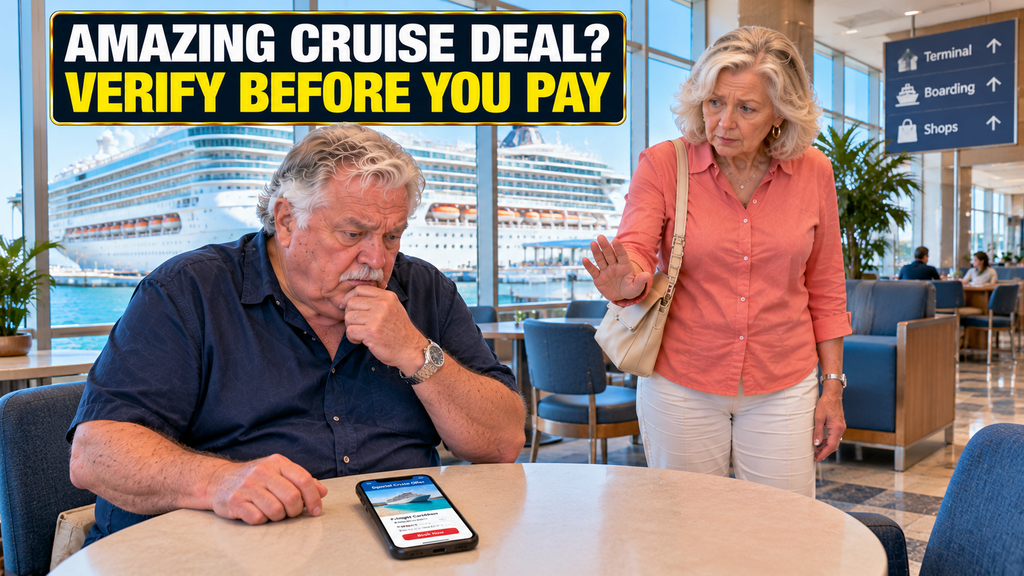
3. Don’t Let a Too-Good-to-Be-True Cruise Deal Rush You Into Paying
A deeply discounted vacation can get anyone’s attention.
The danger is allowing the excitement of the advertised price to replace basic verification.
Suppose you encounter an offer promising an unusually inexpensive cruise, but there is a catch:
You have to pay immediately.
The seller is difficult to verify.
The terms are unclear.
Or you’re pushed toward a payment method before you’ve had time to understand what you’re actually purchasing.
Those are reasons to slow down.
Before paying for a cruise, identify the company you’re dealing with, understand what the advertised price includes and review the applicable terms.
Also distinguish between the cruise fare and the total vacation cost.
An advertisement can emphasize an attractive starting price without representing every expense you personally may incur.
Don’t let a countdown clock or “today only” pitch stop you from checking the basics.
Better move: Verify the seller, booking details and applicable terms before sending money.

4. Don’t Connect to Wi-Fi Just Because the Network Name Looks Official
You’re in a terminal or port.
You open your phone’s Wi-Fi settings and see several network names.
One looks like it belongs to the terminal.
Another contains the word “guest.”
Another looks vaguely related to your ship.
Which one is legitimate?
The name alone isn’t enough reason to guess.
A network name can look convincing without proving who operates it.
Instead of selecting a network simply because its name sounds official, look for connection instructions provided through a trusted source for the location or service you’re actually using.
Be particularly careful when you’re about to enter passwords, financial information or other sensitive data.
Convenience can encourage people to connect first and ask questions later.
Reverse that order.
Better move: Confirm the correct network or connection instructions before using unfamiliar Wi-Fi for anything sensitive.
5. Don’t Leave Your Phone, Wallet or Cruise Card Behind to “Save Your Spot”
This mistake doesn’t require a sophisticated scam.
Imagine you’re eating at the buffet and want another plate.
Your phone is on the table.
Your wallet is beside it.
You think:
“I’ll only be gone for a minute.”
Or you’re at the pool and leave important belongings on a lounger while walking away.
A cruise vacation can feel contained and comfortable, but shared passenger spaces are still shared spaces.
The safest habit is simple: don’t use valuable belongings as placeholders.
The same principle applies ashore.
A busy café, beach, excursion meeting area or port shopping district isn’t a good place to become casual about items that would be difficult to replace during the trip.
Losing a phone isn’t only about replacing the device. Your phone may contain travel information, communication tools and access to important accounts.
Better move: Keep essential valuables appropriately secured rather than leaving them unattended in public areas.

6. Don’t Believe Someone Who Casually Says, “The Ship Will Wait”
You’re ashore having a great day.
Someone tells you:
“Don’t worry. The ship won’t leave without you.”
That sentence should not become your schedule.
The important information is the official timing that applies to your sailing and port call, including the instructions provided to passengers.
Don’t substitute the opinion of a shopkeeper, driver, fellow passenger or other stranger for those instructions.
Also pay attention to the distinction between different times you may see during a port day. What matters is following the official instructions provided for returning to your ship—not making your own calculation based solely on when you believe the vessel will depart.
A traveler who thinks there is plenty of time may decide to visit one more store, order one more drink or make one more stop.
That’s when a comfortable margin can disappear.
Traffic, distance, confusion about the meeting point and other delays can all complicate the return.
Better move: Follow the official return instructions for your sailing and build reasonable time into your own plans.
7. Don’t Pay a Surprise Charge Until You Understand What It Is
Imagine someone presents you with an unexpected charge.
Your first reaction may be:
“I don’t remember buying this.”
Your second reaction should not automatically be:
“Fine, I’ll pay it.”
First determine what you’re looking at.
Is the charge actually connected to your booking or onboard account?
What service or purchase does it relate to?
Who is requesting payment?
What is the appropriate official channel for resolving questions about it?
There is also an important distinction here:
An unfamiliar charge is not automatically fraudulent.
It could be legitimate and simply unfamiliar to you.
That’s precisely why verification matters.
Instead of immediately accusing someone of fraud—or immediately paying—check the details through the appropriate official channel.
Better move: Understand and verify an unfamiliar charge before deciding what action to take.
8. Don’t Buy Expensive Jewelry or “Authentic” Goods Just Because You’re Under Time Pressure
Port shopping can be part of the fun of cruising.
Jewelry, watches, art, souvenirs and other purchases can also involve substantial amounts of money.
The mistake is not shopping in port.
The mistake is allowing vacation excitement and time pressure to replace the level of care you’d normally use for an expensive purchase.
Statements such as:
“Special price today.”
“Guaranteed authentic.”
“You won’t find another one.”
or:
“Your ship is leaving soon.”
shouldn’t prevent you from understanding the transaction.
For a high-value purchase, know what the seller is representing the item to be, what documentation accompanies it, and what return or dispute terms apply.
If you don’t understand what you’re buying, walking away can be a perfectly reasonable decision.
There are legitimate businesses in cruise destinations. The goal isn’t to treat every merchant as suspicious.
It’s to avoid assuming that a confident sales pitch proves value or authenticity.
Better move: Treat an expensive vacation purchase with the same care you’d use for an expensive purchase at home.
9. Don’t Hear the Word “Free” and Stop Asking Questions
“Free” is one of the easiest words to notice on vacation.
Free sample.
Free consultation.
Free presentation.
Free offer.
Free upgrade opportunity.
But before accepting an offer, understand what is actually being offered and whether any conditions apply.
Something can genuinely have no upfront charge while still being connected to another decision, requirement or sales presentation.
That doesn’t automatically make the offer deceptive.
The mistake is assuming the word free tells you everything you need to know.
Ask what you’re agreeing to.
Ask whether there’s any purchase requirement.
Understand what information you’re being asked to provide.
And don’t give payment details simply because someone says they’re needed to “hold” something unless you understand why and trust the transaction.
Better move: Ask about conditions before saying yes—not after.
10. Don’t Confuse the Cheapest Cruise Fare With the Cheapest Vacation
This is the mistake that can quietly change the entire budget.
You compare two cruises.
Cruise A appears cheaper.
Cruise B costs more.
Easy decision, right?
Not necessarily.
The advertised fare is only one part of what you may spend.
Your real comparison should consider the things you actually expect to use or purchase during your vacation.
Depending on your trip and choices, that might include transportation, gratuities or service charges where applicable, beverages, specialty dining, internet access, excursions, selected onboard activities or services, and other personal spending.
That doesn’t mean those items are always required or that every cruise line prices them the same way.
Quite the opposite.
Pricing structures, inclusions and policies vary.
That’s why comparing only the headline fare can be misleading for your personal budget.
One traveler may be perfectly happy buying almost nothing beyond the components already included in their trip.
Another may know before booking that they want internet access, several excursions, specialty meals and other extras.
Those two travelers shouldn’t necessarily evaluate the same advertised fare in the same way.
Better move: Compare the expected total cost of the vacation you actually intend to take—not just the number that initially gets your attention.
The Most Expensive Cruise Mistake May Be Acting Too Quickly
Not every strange situation is a scam.
Not every port seller is dishonest.
Not every unfamiliar charge is fraudulent.
And not every inexpensive cruise deal hides a problem.
But several costly situations have something in common:
The traveler acts before verifying.
Someone asks for cash, and you pay.
A Wi-Fi network looks official, and you connect.
Someone says the ship will wait, and you believe them.
A seller says an expensive item is authentic, and you don’t ask questions.
A fare looks cheapest, and you book without calculating the vacation you actually want.
A few extra minutes of verification can be worth far more than the time it takes.
Before your next cruise, remember three simple actions:
STOP. CHECK. VERIFY.
Know who you’re paying. Understand what you’re buying. Follow official sailing information. Protect important belongings. And when something doesn’t make sense, use an appropriate official channel to check it before making a decision.
Because the best cruise bargain isn’t the one that looks cheapest for thirty seconds.
It’s the one you still feel good about after you know exactly what you’re getting.
