
CRUISE TIP
CRUISING WITH KIDS? DON’T MAKE THESE 10 MISTAKES

Sep
Taking your kids or grandkids on a cruise can be an incredible family vacation.
You unpack once, wake up somewhere new, have food and entertainment close by, and usually have far more activities available than you could fit into one day.
But a cruise ship is not simply a floating hotel.
There are busy buffet areas, exterior decks, balconies, pools, organized youth programs, shore excursions, safety procedures, and travel-document requirements to think about. When adults assume everything will work the same way it does at home or at a resort, small mistakes can become surprisingly stressful.
Sometimes the problem is as simple as a child wandering ahead while everyone is distracted.
Other times, it can involve damaged property, a missed activity, an unsuitable excursion, or—in the worst possible moment to discover it—a documentation problem before boarding.
If you’re planning a family cruise, here are 10 mistakes worth avoiding.
1. DON’T Let the Buffet Become a Play Area
Picture this.
You’re sitting near the buffet talking to your spouse. Your child finishes eating and gets bored.
For a minute, nobody is paying close attention.
Then you notice a crew member approaching.
Something at the serving area has been knocked over or damaged, and suddenly what seemed like harmless playing has become a conversation about responsibility, cleanup, or actual damage.
That’s the lesson—not that cruise ships have some universal “$2,000 buffet fine.”
They don’t.
A specific bill for damage should never be confused with a standard penalty that applies whenever a child misbehaves.
The practical rule is much simpler:
Keep children supervised around the buffet.
Buffets contain food, serving utensils, other passengers carrying plates and drinks, and crew trying to keep the area operating smoothly.
Don’t let children run between passengers or treat serving stations like something to explore with their hands.
If your child has finished eating and is getting restless, one adult can take them away from the serving area while the other finishes.
That small decision can prevent a much bigger problem.
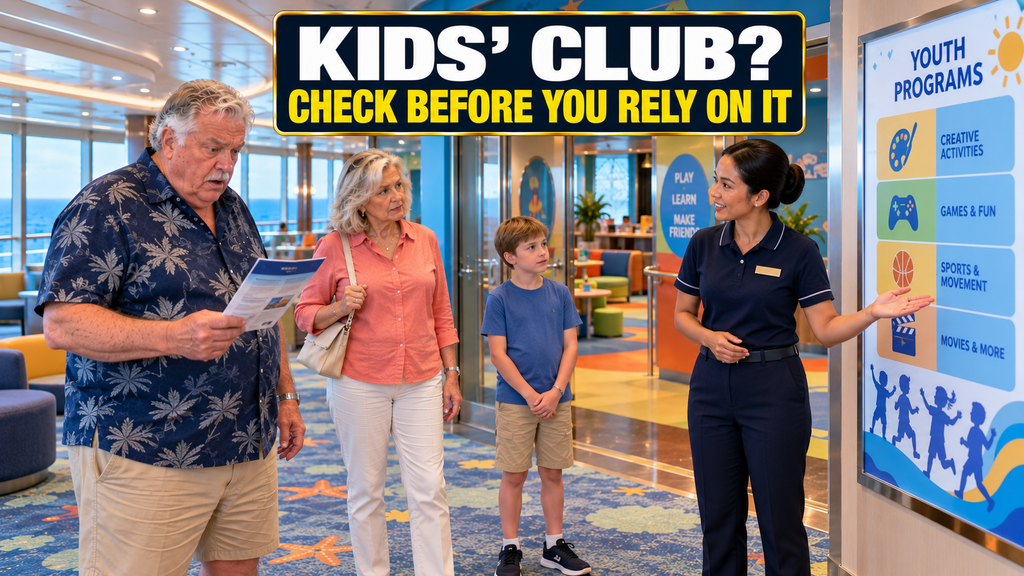
2. DON’T Assume the Kids’ Club Is Automatic Babysitting
A youth program can completely change a family cruise.
Children get activities designed for their age group, while parents or grandparents may get some time to enjoy the ship on their own.
But don’t build your entire vacation schedule around the assumption that you’ll simply walk up, leave your child, and return several hours later.
Before sailing, investigate the youth program available on your particular ship.
Check the applicable age groups, registration arrangements, operating information, and any other requirements that matter to your family.
And once onboard, confirm the current details.
This is particularly important if you’ve cruised before.
What happened on another ship—or even on a previous sailing—shouldn’t automatically become your expectation for this one.
If you have a dinner reservation, spa appointment, or other activity that depends on the children’s program, find out how the program works before that reservation becomes urgent.
3. DON’T Book a Cabin Based Only on the Number of People It Holds
You find a cabin that can accommodate your family.
Perfect, right?
Not necessarily.
There’s a difference between:
“This cabin can accommodate four people.”
and:
“Four people will be comfortable living in this space for seven nights.”
Look beyond the occupancy number.
Investigate the actual sleeping configuration for the cabin you’re considering. Where will everyone sleep? What happens to usable space when additional beds or sleeping arrangements are in use?
Then think about your family’s routine.
Where will everyone’s luggage go?
Can people realistically get ready at the same time?
Will someone need to sleep while another person is moving around the cabin?
How much privacy does your family need?
This matters even more when grandparents, parents and children are sharing space.
Sometimes spending more for a different configuration makes sense.
Sometimes it doesn’t.
The important thing is to understand what you’re actually booking instead of discovering the layout after everyone walks into the cabin with luggage.

4. DON’T Assume Kids Can Always Find Their Way Back
A cruise ship can feel remarkably easy to navigate after a few days.
On embarkation day, however, it can be another story.
Long corridors can look similar. There may be multiple staircases, elevators, restaurants, lounges and deck areas.
An adult may quickly learn the layout.
A child may not.
That’s why “Just go back to the cabin if you can’t find us” shouldn’t be your entire family plan.
Establish simple rules appropriate for the child’s age and circumstances.
Choose an obvious meeting point.
Make sure children understand what they should do if separated from the adults responsible for them.
Teach them how to identify appropriate crew members if they need assistance.
And don’t let a family meeting plan become an excuse to provide less supervision than the child needs.
A meeting point is a backup plan.
It isn’t a substitute for supervision.
5. DON’T Treat the Balcony Like a Children’s Play Space
A balcony may be one of the reasons you chose your cabin.
Adults imagine coffee overlooking the ocean.
Children see an exciting outdoor space.
Those are two very different perspectives.
If you’re traveling with young children, treat an exterior cabin balcony as an area requiring appropriate adult supervision—not as somewhere to send children while the adults get ready inside.
Don’t encourage climbing or playing around balcony furniture or railings.
And don’t assume that because your child behaves safely on a balcony at home, a shipboard environment should automatically be treated the same way.
The simplest approach is the strongest:
When young children are using the balcony, an adult should be paying attention.
The ocean view will still be there after everyone is ready.

6. DON’T Assume Every Pool and Water Attraction Works for Every Child
The pool deck can become the first destination after your family boards.
But before children rush toward the water, stop and look around.
Check the posted information for the pool or attraction you’re planning to use.
Look at depth markings.
Pay attention to applicable restrictions and instructions.
For water attractions, check whether age, height or other participation requirements apply rather than promising a child they can ride something before you’ve verified it.
That last point can save you from a surprisingly large vacation argument.
Imagine spending weeks telling your child about a particular attraction only to reach the entrance and discover that they don’t meet an applicable requirement.
Check first.
Promise second.
The same principle applies to supervision.
Don’t assume the presence of crew or other adults around a pool transfers responsibility for your child away from you.
Follow the posted instructions and the requirements for the specific facility you’re using.
7. DON’T Wait Until Embarkation Day to Think About the Child’s Documents
This mistake belongs in an entirely different category.
Forgetting a swimsuit is inconvenient.
A problem with required travel documentation can affect whether the trip happens at all.
Exactly what a child needs can depend on factors such as the itinerary, citizenship, the travel documents being used, and who is traveling with the child.
That means a checklist from another family—or advice from someone who took a different cruise—may not answer your situation.
This is especially important for grandparents traveling with grandchildren or when a minor isn’t traveling with all parents or legal guardians.
Don’t guess.
Well before departure, check the current documentation requirements applicable to your itinerary and circumstances, including information from the cruise line and relevant government authorities.
Check names and document validity carefully.
Then keep the documents you’ll need during the boarding process accessible rather than burying them somewhere inconvenient.
This is one part of the vacation where “I’m pretty sure that’s enough” isn’t a good strategy.
8. DON’T Book a Shore Excursion Because the Photos Look Fun
A family standing under a waterfall.
Kids snorkeling in clear blue water.
A beautiful beach.
An exciting boat ride.
Excursion photos are designed to make you imagine the experience.
Your job is to investigate what happens between those photographs.
How much walking is involved?
How long is the excursion?
What transportation is used?
Are there age or height restrictions?
Does the activity have participation requirements?
Is the experience appropriate for your child’s abilities and comfort level?
A tour that sounds easy to one family may feel exhausting to another.
This is particularly worth considering when grandparents and grandchildren are traveling together because the activity needs to work for both ends of the age range.
Don’t choose solely because the destination looks spectacular.
Choose an excursion your actual family can comfortably enjoy.
9. DON’T Put Every Child Essential in Checked Luggage
Embarkation day creates an easy packing mistake.
You hand over larger luggage and suddenly realize something you need is inside it.
For adults, that might just be annoying.
With children, it can turn into several uncomfortable hours.
Think about what your family may genuinely need between arriving at the terminal and having convenient access to the rest of your belongings.
Depending on your family’s needs, that may include required travel documents, essential medications, a basic change of clothes, and other important child essentials.
The goal isn’t to stuff your carry-on with half the contents of your house.
It’s to ask one useful question:
“If I can’t conveniently access my larger luggage for a while, what would I really regret putting inside it?”
Keep those essentials with you, subject to the applicable security, cruise-line and travel requirements.
That little bit of planning can make embarkation day dramatically easier.
10. DON’T Tune Out the Safety Information Because You’re Managing the Kids
Embarkation day can be chaotic for families.
Someone wants food.
Someone wants to see the pool.
Someone can’t find something.
The adults are trying to understand the ship while simultaneously keeping the children together.
That makes it tempting to treat safety information as something you’ll figure out later.
Don’t.
Pay attention to the safety procedures and instructions provided for your sailing.
Understand the relevant muster information.
Make sure the adults responsible for the children know what they need to do.
Don’t assume that because you’ve cruised before, the procedure on this sailing will be identical to what you remember.
And if you’re traveling with grandchildren or several children, think through how your group will stay organized if instructions need to be followed quickly.
You don’t need to frighten children.
You simply need the adults to understand the plan.
The Biggest Family Cruise Mistake Is Assuming the Ship Will Do the Parenting for You
Cruise ships can make family vacations feel remarkably convenient.
Food is nearby.
Entertainment is everywhere.
Children’s activities may be available.
There are pools, attractions and excursions.
But convenience doesn’t eliminate parental or guardian responsibility.
A buffet employee isn’t automatically watching your child because you’re eating nearby.
A youth program shouldn’t be assumed to work exactly the way you imagined without checking its arrangements.
A meeting point doesn’t replace age-appropriate supervision.
And a beautiful balcony or pool doesn’t become risk-free simply because you’re on vacation.
The families who often have the easiest cruises aren’t necessarily the ones who plan every minute.
They’re the ones who check the important things before those things become problems.
Understand your cabin.
Check children’s program information.
Verify documents early.
Research excursions.
Keep important embarkation-day essentials accessible.
Pay attention to posted safety information.
And above all, remember that the rules, facilities and procedures can vary by cruise line, ship, itinerary and sailing.
A little preparation before departure can mean a lot less correcting, arguing and worrying once your family is finally at sea.
