
CRUISE NEW
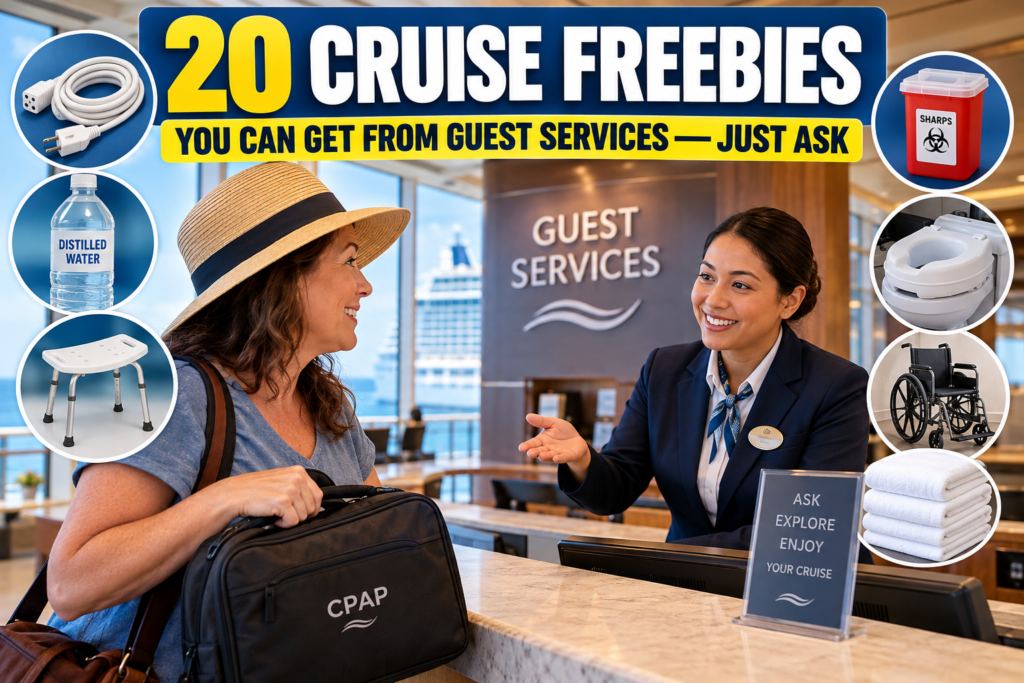
20 CRUISE FREEBIES YOU CAN GET FROM GUEST SERVICES — JUST ASK
Sep
You’re standing at Guest Services halfway through your cruise when you realize you forgot something important. Maybe your CPAP machine needs an extension cord. Maybe you need distilled water. Maybe someone in your cabin needs a shower stool, a sharps container, or another accessibility item.
Your first instinct might be to find an onboard shop and start spending money.
But before you reach for your wallet, ask.
Cruise ships can provide more complimentary equipment, accessibility aids, and practical assistance than many passengers realize. Some requests can be handled at Guest Services once you’re onboard, while others should be arranged before sailing through the cruise line’s accessibility or special-needs department.
There is one big warning, though: there is no universal list of 20 free products that every cruise line keeps behind the Guest Services counter. Policies vary by cruise line and ship, availability can be limited, and some requests are handled by Housekeeping, the Medical Center, or an Accessibility/Special Needs team instead.
With that distinction clear, here are 20 useful items and services that major cruise lines officially document as available, provided, or requestable in certain circumstances.
1. An Extension Cord for a CPAP Machine
This is one of the most useful things CPAP users should know before sailing.
Norwegian Cruise Line says passengers traveling with CPAP, BiPAP machines, or nebulizers should ideally bring their own approximately six-foot extension cord without a surge protector. However, NCL also says that a limited supply of extension cords is available onboard through Guest Services, subject to availability.
Royal Caribbean goes even further in its Guest Special Needs information, stating that guests bringing a CPAP/BiPAP machine can have distilled water and an extension cord provided in their stateroom.
The lesson is simple: if your medical equipment needs a cord, don’t assume your only option is buying one onboard. Ask—but ideally arrange the requirement before you sail.
2. Distilled Water for a CPAP Machine
Distilled water is another request that varies significantly by cruise line.
Norwegian Cruise Line officially offers distilled water upon request for passengers using CPAP, BiPAP machines, or nebulizers. NCL strongly recommends requesting it at least four days before sailing to help ensure availability. If you miss that deadline, NCL says you may still request it onboard at the Guest Services Desk.
Royal Caribbean also lists distilled water among its accessibility equipment and services and specifically states that distilled water will be provided in the stateroom for CPAP/BiPAP users who make the appropriate request.
But don’t assume this is free everywhere. Carnival currently treats CPAP distilled water differently: its official policy says distilled water can be purchased before sailing or onboard.
That difference is exactly why asking your specific cruise line before departure matters.
3. A Sharps Container
Passengers who use injectable medication should never improvise when disposing of needles, syringes, or lancets.
Royal Caribbean includes sharps containers among the equipment passengers can request as part of its accessibility services.
Disney Cruise Line says a small sharps container is located in each stateroom bathroom. If it is missing, passengers can tell the crew member who services the room and one will be provided. Disney also places sharps containers in public restrooms.
This is a perfect example of why asking is better than assuming you need to bring or buy an additional disposal container.
4. A Shower Stool
For passengers with limited mobility, a shower stool can make a major difference.
Royal Caribbean lists shower stools among the special equipment and services that can be arranged for passengers who need accessibility accommodations.
Disney Cruise Line also lists shower stools among the special equipment available upon request for use in staterooms.
This is a request worth making before departure rather than waiting until you are already onboard.
5. A Raised Toilet Seat
A raised toilet seat is another accessibility item some passengers may not realize can be arranged.
Royal Caribbean lists raised toilet seats among its requestable accessibility equipment. Disney also identifies raised toilet seats as special equipment available upon request for use in guest staterooms.
Passengers with mobility limitations should contact the cruise line’s accessibility team as early as possible.
6. A Commode Chair or Portable Toilet
Depending on the cruise line and passenger’s needs, additional bathroom equipment may also be available.
Royal Caribbean’s official accessibility equipment list includes a commode chair.
Disney Cruise Line lists a portable toilet among the special equipment that guests with disabilities may request for their stateroom.
Again, this isn’t a generic cabin freebie for anyone who asks. It is an accessibility accommodation intended for guests who need it.
7. A Transfer Bench
A transfer bench can help passengers with mobility disabilities move more safely in the bathroom or shower area.
Both Royal Caribbean and Disney Cruise Line list transfer benches among equipment that may be requested for passengers who need accessibility accommodations.
Because quantities and configurations can vary, advance arrangements are much smarter than waiting until embarkation day.
8. A Medical Refrigerator
Medication storage can become a serious concern on a cruise, especially when medication requires reliable refrigeration.
Royal Caribbean includes a medical refrigerator on its list of equipment and services requiring advance notice.
Disney advises that passengers needing to refrigerate medication may use the refrigerator provided in their stateroom.
If temperature control is medically important, contact the cruise line before departure rather than assuming an ordinary cabin cooler or refrigerator will meet your medication’s requirements.
9. Large-Print Materials
Accessibility isn’t only about physical mobility.
Royal Caribbean lists large-print material among the services passengers can request with advance notice.
For travelers with low vision, accessible versions of important onboard information can make navigating the ship much easier.
The important move is to communicate the need early.
10. A TTY Device
TTY technology can assist some passengers who are deaf or hard of hearing.
Royal Caribbean lists TTY among its accessibility services requiring advance notice.
Disney’s stateroom communication kits on applicable ships can include a stateroom TTY along with additional alert technology.
Availability and equipment vary by ship, so passengers should confirm what their specific vessel offers.
11. A Visual-Tactile Alert System
A passenger who cannot rely on ordinary audible alerts may need another way to receive important notifications.
Royal Caribbean includes a visual-tactile alert system among its documented accessibility services.
These systems are not novelty cabin gadgets. They are important accommodations designed to make the onboard environment more accessible.
If you need one, arrange it in advance whenever possible.
12. A Stateroom Communication Kit
Disney Cruise Line documents communication kits for guests with hearing disabilities on applicable ships.
Depending on the ship, these kits can include equipment such as a TTY, door-knock and telephone alerts, a bed-shaker notification device, and a strobe-light smoke detector. Disney notes that some newer ships instead have communication staterooms with built-in features.
That means passengers should not assume the same setup exists fleetwide.
Ask which system your ship uses.
13. An Assistive Listening Device
Royal Caribbean also lists assistive listening devices among the accessibility services passengers can arrange.
For travelers who benefit from hearing assistance, this is worth discussing with the cruise line before sailing rather than simply assuming theaters and other venues will work exactly like venues on land.
14. Closed-Captioned Television
Accessible entertainment can extend into the cabin.
Royal Caribbean’s current accessibility equipment list includes closed-captioned television among the services that can be arranged.
If this is important to your cruise experience, include it when communicating your accessibility needs before departure.
15. Bed Bumpers
Families and passengers with specific accessibility needs may be surprised to learn that some cruise lines document bed-related equipment as well.
Disney Cruise Line lists bed bumpers among special equipment available upon request for use in staterooms.
Rather than packing bulky equipment without checking, contact the cruise line first and find out what can be arranged onboard.
16. A Service-Animal Relief Area
Passengers traveling with qualified service animals have additional logistical needs at sea.
Royal Caribbean lists a service-animal relief area among the services requiring advance notice.
This is another reason passengers traveling with accessibility requirements should communicate with the cruise line well before embarkation. Some arrangements require planning that cannot be handled as easily as a simple request after the ship has sailed.
17. Assistance With Oxygen-Supply Delivery Arrangements
This one needs careful wording.
Royal Caribbean lists oxygen supply delivery among services requiring advance notice.
That does not mean a cruise line is handing every passenger free oxygen equipment at Guest Services. Rather, it demonstrates that accessibility teams can help coordinate certain medically necessary arrangements when the proper procedures are followed.
Passengers who use oxygen should always consult the cruise line’s specific medical and accessibility requirements before sailing.
18. Assistance With Dialysis-Supply Delivery Arrangements
Similarly, Royal Caribbean lists dialysis-supply delivery among services that require advance notice. Its Guest Special Needs information also directs passengers requiring certain forms of dialysis to contact the Access Department for assistance.
This should never be treated like an ordinary “cruise hack.”
It is a medical accommodation that requires proper planning.
But it illustrates the larger point: the ship’s accessibility infrastructure may be able to help with needs passengers would never expect Guest Services alone to solve.
19. Emergency Accessibility Features in the Stateroom
Some accessibility features may already exist in an accessible cabin but require activation or assistance.
Disney Cruise Line, for example, notes that guests can contact Guest Services onboard to activate certain emergency features, including an emergency pull cord. Disney also identifies emergency alarm buttons next to the bed in its accessible-stateroom information.
If you have been assigned an accessible cabin and aren’t sure how one of its safety systems works, ask rather than guessing.
20. Basic First-Aid Supplies or OTC Remedies on Some Ships
This is another category where cruise-line-specific rules matter.
Disney Cruise Line states that its Health Center stocks over-the-counter medications, bandages, and other remedies for minor first aid. Disney also says first aid and over-the-counter drugs are available at the Guest Services Desk and select onboard shops.
However, “available” should not automatically be interpreted as “unlimited free medicine.”
Medical services, medications, and onboard retail policies vary, and passengers should not depend on Guest Services as a replacement for packing their regular medications or a sensible travel first-aid kit.
For something minor, however, asking where to obtain appropriate assistance may save you from wandering around the ship looking for it.
The Biggest Mistake: Assuming Every Cruise Line Has the Same Freebies
This is where viral cruise-tip lists often become misleading.
A tip may be completely accurate on one cruise line and wrong on another.
CPAP distilled water is an excellent example. Norwegian Cruise Line says it offers distilled water upon request and allows passengers who missed the pre-request deadline to ask at Guest Services onboard. Royal Caribbean’s Guest Special Needs information says distilled water and an extension cord will be provided in the stateroom for CPAP/BiPAP users.
Carnival’s current policy is different: CPAP distilled water is sold rather than simply presented as a complimentary Guest Services item.
Three major cruise lines. Similar passenger need. Different procedures.
That’s why the smartest cruise hack isn’t memorizing a giant list.
It’s asking the right question before you spend money.
Ask Before You Buy Anything Onboard
Imagine discovering that you need an extension cord for your CPAP setup.
You could immediately start searching onboard shops. But if you’re sailing on Norwegian, its official policy says Guest Services has a limited supply of extension cords available, subject to availability.
That single question could solve the problem.
The same principle applies to accessibility equipment. If you need a shower stool, transfer bench, raised toilet seat, sharps container, communication aid, or another accommodation, don’t assume you must personally transport every piece of equipment until you’ve checked your cruise line’s policies.
The answer may be yes, you need to bring it.
It may be available by advance request.
It may already be in your accessible cabin.
Or the crew may direct you to the correct onboard department.
Asking takes a minute.
Guest Services Is Not the Only Place to Ask
The phrase “ask Guest Services” is convenient, but passengers should understand how ships actually operate.
Some needs are handled by Guest Services. Others belong with Housekeeping, the Medical Center, your stateroom attendant, or a shoreside Accessibility/Special Needs team.
Disney, for example, tells passengers who cannot find the sharps container in their stateroom to ask the crew member who attends the room.
Royal Caribbean encourages passengers to notify the company of accessibility needs at booking and says certain equipment and services should receive 30 days’ advance notice.
NCL strongly recommends requesting CPAP distilled water at least four days before sailing, even though passengers who miss that deadline may still ask Guest Services onboard.
So Guest Services can be a great starting point once you’re aboard—but advance planning remains the better strategy for anything medically or functionally important.
Request Important Items Before Your Cruise
There’s a major difference between:
“It would be nice if they have one.”
and
“I medically need this equipment during the cruise.”
If the item is essential, don’t wait until you’re standing at Guest Services on embarkation day.
Royal Caribbean says it encourages passengers to notify the cruise line of their needs at booking and lists 30 days’ notice for numerous special-needs equipment and services.
NCL recommends requesting distilled water for CPAP use at least four days before sailing to help ensure availability.
Planning ahead gives the cruise line time to understand the request and tell you whether you need to bring anything yourself.
What You Should NOT Assume Is Free
This is just as important as knowing what you can request.
Don’t automatically assume Guest Services will give you free toothbrushes, toothpaste, razors, deodorant, chargers, adapters, umbrellas, slippers, robes, laundry detergent, playing cards, or other items simply because you’ve seen them mentioned in a social-media cruise hack.
Policies change. Ships differ. Inventory differs.
And some items may be sold onboard rather than provided.
The safest rule is:
If your cruise line doesn’t officially promise it, treat it as a possible request—not a guaranteed freebie.
This protects both your budget and your vacation plans.
One More Warning About Extension Cords
If you’re traveling with medical equipment, don’t assume any extension cord or power device is acceptable onboard.
Norwegian specifically tells CPAP users to bring an extension cord in good working condition that does not include a surge protector. It also warns that an unsafe cord may be confiscated during luggage screening for safety inspection.
Carnival likewise notes that extension cords, power strips, and multi-outlet adapters without surge protection may be allowed but can be removed if considered unsafe.
Electrical safety rules at sea matter.
A cheap power accessory that works in your bedroom at home isn’t automatically appropriate aboard a ship.
The Smartest Guest Services Question to Ask
You don’t need to walk up to the desk and demand “free stuff.”
Instead, describe the problem.
Try:
“I need an extension cord for my CPAP. Is there anything onboard you can provide or help me arrange?”
Or:
“I need a shower stool for accessibility. Which department can help me?”
This gives the crew enough information to direct you properly.
Sometimes the answer will be Guest Services.
Sometimes it will be your stateroom attendant.
Sometimes it will be the Medical Center.
And sometimes the answer will be that the item should have been requested before departure.
That’s still more useful than buying something unnecessarily or discovering too late that the ship doesn’t stock what you need.
Final Takeaway: Just Ask—But Ask Early
There really are useful items, equipment, and accommodations cruise passengers can receive or request without simply walking into an onboard shop and paying retail.
An extension cord for a CPAP machine may be available through Guest Services on NCL, although supplies are limited. Distilled water can be requested for CPAP use on NCL and arranged through Royal Caribbean’s special-needs process. Royal Caribbean documents numerous accessibility services and equipment, while Disney lists several stateroom accessibility items and communication aids available upon request.
But the real cruise tip is bigger than any list of 20.
Don’t assume. Don’t demand. And don’t wait until the last minute when the item is important.
Check your cruise line’s current policy before sailing. Submit medical and accessibility requests early. Once onboard, if a small problem appears, ask Guest Services or your stateroom crew before spending money trying to solve it yourself.
You may discover the ship already has exactly what you need.
And after learning that an extension cord, distilled water, accessibility equipment, communication aids, and other practical assistance can sometimes be arranged simply by making the right request, there’s one question almost every cruiser will eventually ask:
What else have I been paying for—or packing from home—that I could have asked about first?
