
CRUISE NEW
She Resold Drinks From Her Cruise Package—Then a $3,200 Charge Appeared on Her Account
Sep
PART 1 — THE LITTLE SIDE BUSINESS
Margaret Hale had been talking about her beverage package since the first afternoon of the cruise.
At sixty-nine, she considered herself an experienced traveler, the kind of passenger who read every promotion twice and hated the feeling that someone else might be getting a better deal.
So when she bought a beverage package for the voyage, she was determined to get her money’s worth.
By the third sea day, Margaret had developed a routine.
She would arrive at the pool deck shortly before lunch, claim a shaded table near the outdoor bar, push her oversized sunglasses onto her silver-blonde hair, and spend the afternoon watching passengers drift between the pool and the loungers.
At first, nothing she did attracted much attention.
A friend wanted a drink.
Margaret picked one up.
Someone sitting nearby joked about the prices at the bar.
Margaret laughed and tapped the card associated with her package.
“I already paid enough,” she said. “Believe me, I’m getting my money’s worth.”
But sometime during that afternoon, sharing stopped being the whole story.
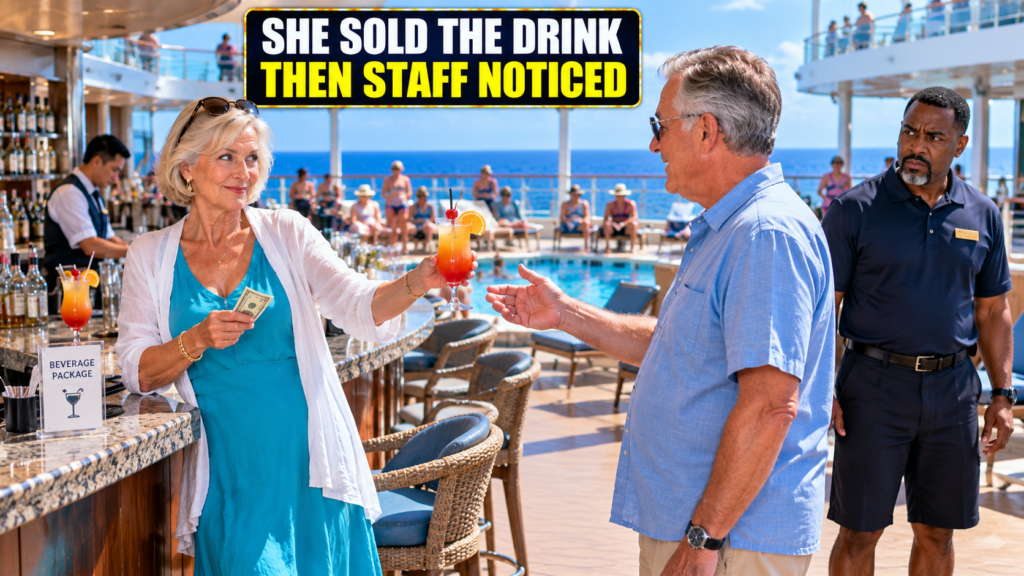
An older passenger named Richard had been sitting several tables away. He approached Margaret after watching her return from the bar.
“You can get another one of those?” he asked.
Margaret glanced at his empty hand.
“Probably.”
Richard smiled.
“What if I give you ten bucks?”
Margaret laughed at first.
Then Richard pulled out a folded bill.
That changed the conversation.
Margaret looked toward the bar. Bartenders were moving quickly between orders, and dozens of passengers filled the surrounding pool deck.
She seemed to think about it for only a moment.
“I paid for this package,” she said. “Might as well use it.”
Richard extended the money.
Margaret took it.
Not halfway.
Not as a joke.
The bill passed completely into her hand.
Only after the payment was finished did Margaret turn toward the bar.
A prepared cocktail was waiting near her side of the counter.
She picked it up with her other hand, turned back toward Richard and extended it.
Richard accepted the glass.
“There you go.”
He smiled.
Margaret folded the bill once more and kept it in her hand.
To her, the transaction apparently seemed insignificant.
A few dollars.
One cocktail.
One passenger.
On a crowded pool deck where almost nobody appeared to be paying attention.
Almost nobody.
Several feet down the bar, a supervisor in a dark navy uniform had stopped what he was doing.
He had seen Richard extend the money.
He had seen Margaret take it.
And, more importantly, he had watched Margaret wait until the payment was completed before handing Richard the drink.
Richard lifted the cocktail toward his mouth.
Margaret turned casually back toward the bar.
Then she noticed the supervisor walking directly toward her.
His expression wasn’t confused.
He wasn’t coming over to take another drink order.
Margaret’s smile faded.
The supervisor stopped several feet away and looked first at the cocktail in Richard’s hand.
Then he looked at the folded bill still in Margaret’s.
“Ma’am,” he said.
Margaret raised an eyebrow.
“Yes?”
His eyes returned to the money.
“Those drinks are on your personal package.”
Margaret straightened.
Then came the sentence that instantly changed the mood at the bar.
“You can’t resell them.”
PART 2 — “I PAID FOR THE PACKAGE!”
Margaret stared at the supervisor as though he had accused her of something completely absurd.
Richard stopped raising the cocktail toward his mouth.
For a moment, nobody moved.
Then Margaret held up the hand containing the folded bill.
“I paid for the package!”
The supervisor remained calm.
He wasn’t arguing about whether Margaret had purchased it.
His concern was what he had just watched happen.
Another passenger had handed her money.
Margaret had accepted it.
Then she had given that passenger a drink obtained through the package associated with her account.
Margaret wasn’t interested in that distinction.
“If I paid for it,” she said, “why do you care who drinks it?”
A couple seated nearby glanced toward the confrontation.
Richard looked increasingly uncomfortable.
The supervisor kept his voice controlled.
“This isn’t about you ordering a drink for yourself.”
Margaret crossed her arms.
“I bought the package.”
“Yes, ma’am.”
“So the drinks are paid for.”
The supervisor didn’t take the bait.
Instead, he retrieved the account information connected to Margaret.
That only made her more confident.
“Go ahead,” she said. “Look at it. You’ll see exactly what I paid.”
The supervisor studied the information for several seconds.
Margaret glanced at Richard with the expression of someone expecting to be vindicated.
Richard didn’t return the smile.
He was still holding the cocktail.
Finally, the supervisor turned the screen toward Margaret.
Her expression changed.
There was an additional entry on the account.
The number beside it was impossible to miss.
$3,200.
Margaret leaned closer.
Her forehead tightened.
“What is that?”
The supervisor pointed toward the account entry.
“Your account now shows an additional thirty-two-hundred-dollar charge.”
Margaret froze.
For perhaps two seconds, the woman who had been ready with an answer for everything had absolutely nothing to say.
Then her eyes widened.
“Thirty-two hundred?!”
Richard slowly lowered his cocktail.
Margaret looked from the screen to the supervisor and back again.
“You cannot be serious.”
The supervisor didn’t raise his voice.
Margaret did.
“I paid for that package!”
Several more passengers were now looking toward them.
Margaret pointed toward the screen.
“I want that removed.”
The supervisor started to answer.
Margaret cut him off.
“No. Get your manager.”
Richard quietly placed his cocktail on the bar.
Margaret noticed.
“What are you doing?”
Richard took a small step backward.
“I don’t want to be part of this.”
“Oh, now you don’t?”
The supervisor asked Margaret to wait while the situation was escalated.
Margaret seemed convinced this was good news.
She straightened her cardigan and pushed her sunglasses farther back on her head.
“Good,” she said. “Get somebody who actually understands what I purchased.”
In Margaret’s version of events, the argument was simple.
She had bought a beverage package.
Therefore, she believed she should decide what happened to the drinks obtained through it.
But there was one detail she couldn’t make disappear.
The supervisor hadn’t walked over because he’d seen Richard holding a drink.
He had walked over because he’d seen what happened immediately before Richard received it.
The cash.
The completed payment.
Then the drink.
And now Margaret had demanded that a manager review the situation.
She seemed certain that would end the argument.
It didn’t.
PART 3 — THE TRANSACTION SHE COULDN’T EXPLAIN AWAY
When the manager arrived, Margaret immediately changed the emphasis of her story.
“I was sharing a drink,” she said.
Richard looked at her.
The supervisor remained quiet until Margaret finished.
Then he described exactly what he had observed.
Richard offered Margaret money.
Margaret accepted it.
The money was completely in her possession before she handed Richard the cocktail.
There was no need to exaggerate what had happened.
The sequence itself was enough to explain why the supervisor had intervened.
Margaret shook her head.
“This is ridiculous. He gave me a few dollars.”
The manager looked toward Richard.
Richard clearly wished he were anywhere else on the ship.
The cocktail he had received was now sitting untouched on the bar.
“Did you give her money before she gave you that drink?” the manager asked.
Richard hesitated.
Margaret immediately turned toward him.
“Richard.”
That one word sounded like a warning.
The manager waited.
Richard looked at Margaret, then at the folded bill still visible in her hand.
Finally, he answered.
“Yes.”
Margaret threw both hands outward.
“Oh, come on!”
Richard continued.
“I gave her the money. Then she gave me the drink.”
That was the entire problem distilled into two sentences.
Margaret tried another approach.
“It was ten dollars! You’re acting like I opened a business!”
Nobody had claimed she had.
Nobody needed to.
The manager kept the discussion focused on the transaction that had actually occurred and the account they were reviewing.
Margaret returned to the argument she had been using from the beginning.
“But I paid for the package.”
The manager nodded.
“That doesn’t make this transaction the same thing as buying a drink for yourself.”
Margaret looked back at the account.
The $3,200 additional charge was still there.
Her anger was slowly being replaced by something else.
Not agreement.
Certainly not an apology.
But the confidence she’d had five minutes earlier was gone.
Richard stepped farther away from the bar.
Margaret noticed him leaving.
“You’re seriously walking away?”
Richard looked back at the cocktail.
“I paid ten dollars for a drink that’s now involved in a thirty-two-hundred-dollar argument.”
A passenger nearby tried unsuccessfully to hide a laugh.
Margaret glared at him.
Richard kept walking.
The manager continued reviewing the matter with Margaret, but she no longer had the crowd on her side.
The people who had been watching weren’t hearing a story about someone innocently handing a friend a drink.
They had heard Richard confirm that money changed hands first.
That distinction mattered.
Margaret could argue that the package had cost her money.
She could argue that she thought she should be allowed to use every benefit she believed she’d purchased.
She could complain that the additional charge was outrageous.
What she couldn’t do was turn the exchange everyone had just discussed into something it hadn’t been.
Richard had paid.
Margaret had accepted the money.
Then Margaret had supplied the drink.
By the time the confrontation ended, Margaret was no longer smiling.
She remained at the bar, staring at the account while the manager continued speaking with her.
The folded bill that had seemed so insignificant earlier was still in her hand.
Ten dollars.
That was what had started the argument.
Margaret looked down at it, then back at the much larger number displayed on her account.
For the first time all afternoon, she didn’t have a clever response.
She had been right about one thing.
She had paid for the package.
What she hadn’t paid for was the right to turn it into her own little bar.
