
AIRPORT TIPS
6 Dumb Mistakes That Could Get You Kicked Off a Plane
Sep
Most travelers assume getting removed from an airplane requires doing something extreme.
Starting a fight. Threatening someone. Becoming dangerously intoxicated.
Those behaviors can certainly cause serious problems, but onboard trouble does not always begin with a dramatic incident. Sometimes it starts with something much smaller: a passenger refuses an instruction, becomes increasingly argumentative, and turns an ordinary disagreement into a safety or security problem.
That distinction matters.
Being impatient, complaining about a seat, or disagreeing with an airline employee does not automatically mean you will be removed from a flight. Airlines make decisions based on the circumstances, safety concerns, passenger behavior, applicable rules, and their conditions of carriage.
But there are behaviors that can push a situation much further than many travelers realize.
Here are six mistakes worth avoiding before and during your next flight.
1. Refusing a Crew Instruction and Turning It Into a Showdown
Picture this.
The aircraft is still at the gate preparing for departure.
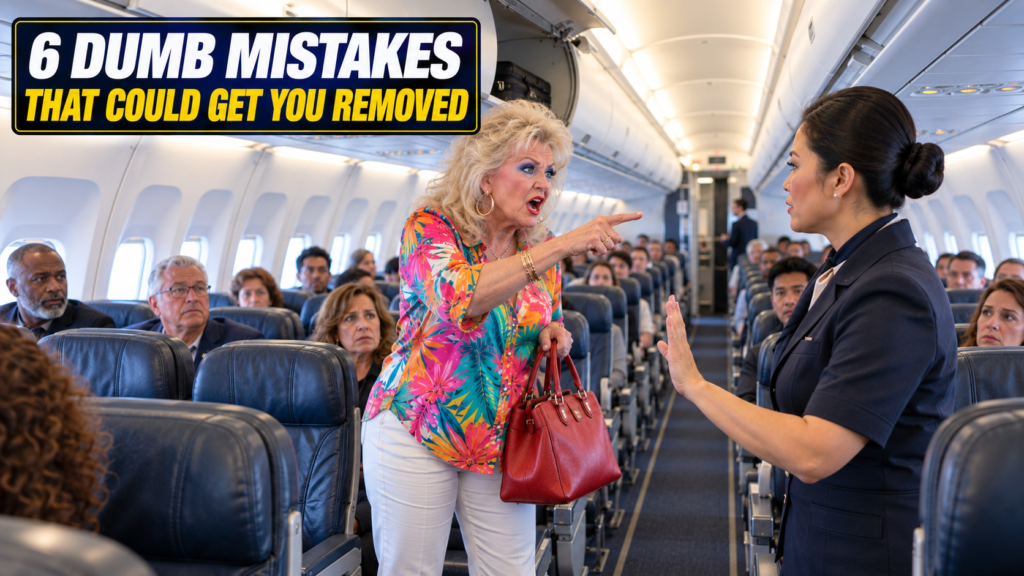
A passenger suddenly stands up and opens an overhead bin because she wants something from her bag.
A flight attendant asks her to finish what she is doing and sit down.
Instead, the passenger becomes angry.
“I only need ten seconds!”
Then she starts arguing.
The original issue was simple. The escalation is what changes the situation.
Flight attendants have safety responsibilities, and federal aviation rules require passengers to comply with crewmember instructions concerning certain federal safety requirements.
More serious federal law also prohibits assaulting, intimidating, or threatening a flight crewmember or flight attendant in a way that interferes with the performance of their duties.
That does not mean every disagreement with a flight attendant is automatically a federal offense or results in removal.
Context matters.
But continuing to refuse a legitimate safety instruction while becoming increasingly disruptive is a terrible strategy.
If a crewmember tells you to sit down, secure something, stop a particular action, or otherwise comply with a safety requirement, arguing louder does not strengthen your position.
It can turn a minor inconvenience into an operational problem.
If you do not understand an instruction, ask calmly.
If you disagree with something unrelated to an immediate safety issue, there may be a better time and place to address it.
The worst choice is transforming a ten-second inconvenience into a confrontation that affects the entire cabin.
2. Showing Up for Your Flight Visibly Intoxicated
The airport bar can make a long delay feel shorter.
But there is a major difference between having a drink and becoming visibly intoxicated before boarding.
Federal aviation regulations prohibit a certificate holder from allowing a person who appears to be intoxicated to board an aircraft, with limited exceptions that generally do not apply to ordinary passengers.
That means your boarding pass does not guarantee you will be allowed onto the airplane regardless of your condition.
And the consequences of drinking too much can extend beyond boarding.
Alcohol can lower inhibitions and make already frustrating travel situations harder to handle calmly. A disagreement about a seat, baggage space, delay, or crew instruction can escalate much faster when someone is impaired.
For older travelers, there is another practical reason to be cautious: alcohol may affect people differently depending on health, medications, food intake, and other individual factors.
The simple lesson is not “never drink at an airport.”
It is this:
Do not assume purchasing a ticket gives you an unconditional right to board while visibly intoxicated.
If you choose to drink before your flight, moderation can protect more than your comfort. It can protect the trip itself.
3. Bringing Your Own Alcohol and Deciding to Serve Yourself
This catches some travelers by surprise.
A passenger may think:
“I legally have this bottle with me, so why shouldn’t I be allowed to drink it?”
Because possession and onboard consumption are different questions.
Under federal aviation rules, a person generally may not drink an alcoholic beverage aboard an aircraft unless the certificate holder operating the aircraft has served that beverage.
So finding a way to bring alcohol onboard does not give you permission to open it and start pouring drinks for yourself.
This is where a small mistake can become a bigger one.
Imagine a flight attendant notices a passenger drinking personal alcohol and tells the passenger to stop.
The passenger argues.
Then the passenger continues drinking.
Now the situation is no longer merely about misunderstanding a rule. The passenger is deliberately continuing the behavior after crew intervention.
The smarter response is simple.
If a flight attendant tells you that you cannot consume your personal alcohol onboard, put it away.
Do not hide it.
Do not pour another drink when the crewmember walks away.
And do not turn the issue into a confrontation.
A misunderstanding can often end in seconds.
Defiance can make it much more serious.
4. Threatening or Intimidating a Flight Attendant
There is a line between being unhappy and becoming threatening.
A traveler can be angry about a delay.
A traveler can dislike a seat assignment.
A traveler can complain about service.
None of those things gives someone permission to threaten, intimidate, or physically interfere with a crewmember.
Federal law addresses interference with flight crew members and attendants, including assaulting or intimidating a crewmember in a way that interferes with the performance of their duties.
This is why phrases such as “I was just angry” or “I didn’t mean anything by it” should never be used as an excuse for threatening behavior.
Your words, physical movements, proximity, and conduct matter.
Imagine a passenger is upset about overhead-bin space.
Complaining is one thing.
Stepping aggressively toward the flight attendant, making threats, blocking the aisle, or physically preventing the employee from performing a safety duty creates a completely different situation.
And once the situation becomes a genuine safety or security concern, the consequences can extend well beyond losing your preferred seat or missing a departure.
If you are furious, lower the temperature instead of raising it.
Speak normally.
Keep physical distance.
Do not touch the employee.
Do not block the aisle.
Do not make threats, even as a joke.
You can pursue a legitimate complaint without turning yourself into the bigger problem.
5. Turning a Passenger Argument Into a Cabin Disruption
Airplanes force strangers into a small shared environment.
That creates plenty of opportunities for irritation.
Someone reclines a seat.
An armrest becomes disputed territory.
A passenger believes someone else took “their” overhead-bin space.
A child is making noise.
Someone bumps a seat while walking down the aisle.
Most of these problems are ordinary travel annoyances.
The mistake is treating them as invitations to personally enforce your own rules.
Suppose another passenger puts a bag in an overhead bin near your seat.
You become angry.
You demand that the bag be moved.
The other passenger refuses.
Now both of you are standing in the aisle shouting.
A flight attendant asks you to stop.
You keep arguing.
What started as a baggage-space disagreement has now become a disruption involving the crew and potentially delaying everyone else.
If another passenger is doing something you believe violates an airline rule, ask the crew for help instead of escalating the confrontation yourself.
Do not grab another passenger’s belongings.
Do not threaten them.
Do not block their movement.
And do not continue shouting after the crew intervenes.
You do not need to “win” an argument at 35,000 feet.
Sometimes the smartest travel decision is ending it.
6. Thinking “I Paid for This Ticket” Means Crew Instructions Are Optional
This attitude causes unnecessary conflict in many customer-service situations:
“I paid for my ticket, so you can’t tell me what to do.”
Buying an airline ticket gives you transportation subject to the airline’s rules and applicable laws. It does not turn an aircraft cabin into your private space.
Airlines also publish contracts or conditions of carriage that can address circumstances in which transportation may be refused.
Safety and security decisions are especially important.
Consider a passenger who is told to stop a particular action.
Instead of complying, the passenger responds:
“I paid $600 for this seat. You work for me.”
That argument does not erase a legitimate safety instruction.
Neither does elite status.
Neither does a premium cabin.
Neither does being a frequent flyer.
And neither does age.
Being over 60 or 70 does not mean you should be treated disrespectfully. But age also does not create a general exemption from onboard safety requirements.
If you believe an airline employee has treated you unfairly, there are better ways to address it.
Record the relevant details when appropriate and lawful.
Note the flight number, date, and what occurred.
After the immediate safety issue is resolved, use the airline’s customer-service or complaint process.
For certain consumer issues, travelers can also learn about complaint options through the U.S. Department of Transportation.
The cabin aisle during departure is rarely the best place to litigate the argument.
What Actually Gets Someone “Kicked Off”?
This is where viral travel posts often oversimplify the issue.
There is no universal checklist where committing “Mistake #3” automatically produces removal.
Real situations depend on what happened, when it happened, how serious the conduct became, whether safety was affected, whether instructions were followed, and the airline’s applicable policies.
There is also a major difference between being denied boarding before departure, being removed while the aircraft is still at the gate, and a serious incident occurring after departure.
Those situations should not be treated as interchangeable.
The safest takeaway is therefore not:
“Do these six things and you WILL be kicked off.”
It is:
These are six behaviors that can create or escalate the kinds of situations in which your ability to continue traveling may be put at risk.
That is why the word “could” matters.
What to Do When You Think the Crew Is Wrong
You can disagree without creating a confrontation.
If an instruction is unclear, ask:
“Could you explain what you need me to do?”
If the issue needs to be resolved immediately for safety, comply first rather than turning the aisle into an argument.
If the dispute can wait, write down the details and address it through the appropriate customer-service channel afterward.
And if the problem involves another passenger, ask a crewmember for assistance rather than trying to physically resolve it yourself.
There is an enormous difference between calmly questioning something and screaming, threatening, blocking, grabbing, or repeatedly refusing instructions.
Experienced travelers understand that distinction.
The Five-Minute Argument Is Never Worth the Trip
Air travel can be frustrating.
Seats are tight.
Bins fill up.
Flights get delayed.
People misunderstand one another.
And sometimes airline employees make decisions passengers strongly dislike.
But losing your temper rarely improves the outcome.
The Karen standing in the aisle screaming about her purse may believe she is defending her rights.
In reality, she is turning a small problem into a much bigger one.
The same principle applies to all six mistakes in this guide.
Don’t let a bag become a showdown.
Don’t let alcohol make decisions for you.
Don’t assume personal alcohol can simply be consumed onboard.
Don’t threaten or intimidate crew.
Don’t turn a disagreement with another passenger into a cabin-wide disruption.
And never assume purchasing a ticket makes legitimate safety instructions optional.
You can be annoyed.
You can ask questions.
You can make a complaint.
But when a simple disagreement starts escalating into a safety or operational problem, the smartest move is usually the simplest:
Stop escalating, follow legitimate safety instructions, and deal with the complaint through the proper channel afterward.
Your vacation is worth more than winning an argument in the aisle.
