
CRUISE TIP
DROP SOMETHING OVERBOARD? CAN YOU GET IT BACK?
Sep
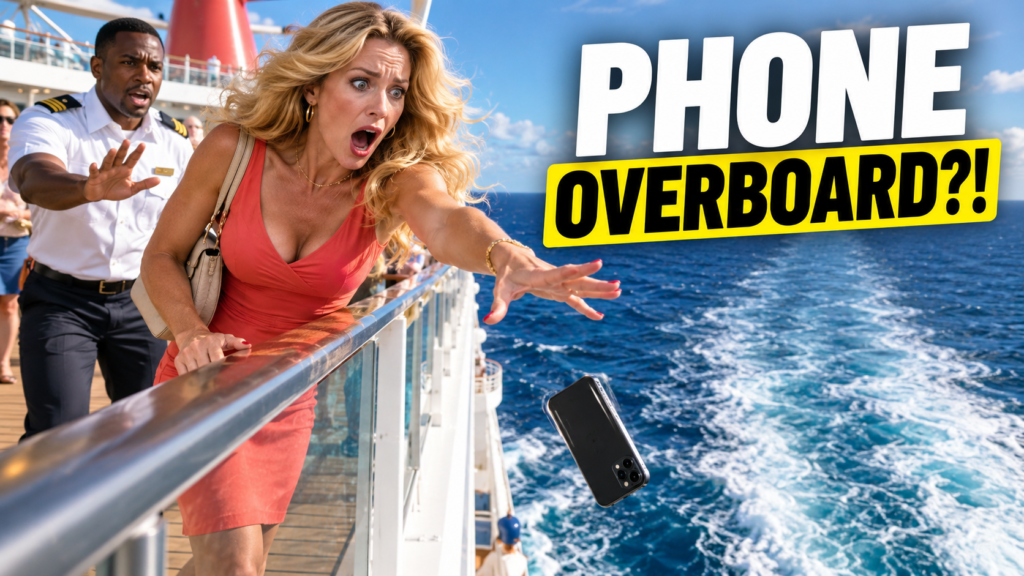
One second, your phone is in your hand. The next, it is on the other side of the railing.
You watch it fall.
Maybe it is a $1,500 smartphone. Maybe it is an expensive camera, a pair of sunglasses, a piece of jewelry, or something with sentimental value that cannot simply be replaced.
Your first instinct might be obvious:
“Stop the ship! I can still see it!”
But what actually happens when you drop something overboard from a cruise ship? Will the captain turn around? Can a crew member retrieve it? Could someone send a boat—or even a diver—to get it back?
The answer is less dramatic than many passengers expect.
You should report the lost item to the crew immediately, but recovery is never guaranteed. And under no circumstances should you attempt to retrieve an item yourself by climbing over a railing or entering the water.
There is also a huge difference between dropping an object overboard while a ship is docked and watching something disappear into the ocean while a cruise ship is underway.
Here is what cruise passengers need to know.
FIRST: DO NOT TRY TO GET IT YOURSELF DROP SOMETHING OVERBOARD?
This is the most important rule in this entire article.
If your phone, camera, sunglasses, jewelry or another personal item falls overboard, do not climb onto, through or over the ship’s railing to retrieve it.
Do not lean dangerously over the side.
Do not climb onto furniture to reach farther.
Do not jump into the water.
Do not ask another passenger to attempt it.
Your phone can be replaced.
Your life cannot.
Cruise ship railings and barriers exist for a reason, and cruise lines maintain strict rules against dangerous behavior around them.
For example, Carnival’s current ticket contract specifically prohibits sitting, standing, lying or climbing on, over or across exterior or interior railings or other protective barriers. Carnival also warns that dangerous behavior can result in serious consequences onboard.
Royal Caribbean likewise addresses unsafe behavior in its guest policies and prohibits conduct that creates safety risks.
So if something falls, your next move should be away from the edge—not closer to it.
Find a crew member.
WHAT SHOULD YOU DO IMMEDIATELY?DROP SOMETHING OVERBOARD?
Speed matters, but not because you should attempt your own rescue mission.
It matters because the crew needs accurate information.
Tell a crew member:
What fell.
Approximately when it fell.
Exactly where you were standing.
Which side of the ship it fell from.
Whether the ship was docked or moving.
If you can remember the deck number and your approximate position—forward, midship or aft—that can also be useful.
Do not spend ten minutes arguing with your travel companion before reporting it.
And do not assume that because you can still see the item, it is safe to reach for it.
Let the crew decide what happens next.
WILL THE CRUISE SHIP TURN AROUND?
This is probably the biggest question.
Imagine dropping a brand-new $1,500 phone into the ocean.
You run to a crew member and say:
“Turn the ship around! My phone is right back there!”
It sounds reasonable when you’re the person who just lost $1,500.
But you should not expect a cruise ship to reverse course simply to recover ordinary personal property.
A large cruise ship is not a small speedboat.
Changing its movement involves navigation, traffic, weather, sea conditions, operating requirements and safety considerations that are far more important than recovering a consumer item.
More importantly, there is no universal cruise-industry rule saying a captain must turn a ship around because a passenger dropped an expensive possession overboard.
The price of the object does not magically change that.
A $1,500 smartphone is expensive.
A $5,000 camera is extremely expensive.
A sentimental wedding ring might feel priceless.
But none of those automatically creates a requirement for the ship to reverse course.
The crew can take your report.
That does not mean the bridge will turn a cruise ship around to retrieve your property.
WHAT IF YOU CAN STILL SEE THE ITEM?
This is where passengers can make dangerous decisions.
From a high cruise ship deck, an object may appear closer or easier to reach than it actually is.
The water may also look deceptively calm.
But once an object is outside the ship’s protective barrier, passengers should treat it as inaccessible unless crew members specifically determine otherwise.
If the ship is moving, the distance between you and the object can increase incredibly quickly.
Even if something floats temporarily, that does not mean a passenger should attempt to retrieve it.
A floating phone case, hat or bag is not an invitation to climb over a barrier.
Report it.
Step back.
Follow crew instructions.
WILL THE CREW SEND SOMEONE INTO THE WATER?
Do not count on it.
There is no universal cruise policy requiring a crew member or diver to enter the water to recover a passenger’s personal property.
And the reason should be obvious.
Sending a human into the water introduces a much larger safety problem than the lost object itself.
The question stops being:
“Can we save this phone?”
and becomes:
“Should we put a human being at risk to save this phone?”
Those are completely different calculations.
That is why social-media stories claiming cruise lines routinely “send a diver” after dropped phones, watches or jewelry should be treated skeptically unless there is reliable evidence about the specific incident.
A cruise line may assess unusual circumstances individually.
That is very different from saying retrieval is standard procedure.
It isn’t something a passenger should expect.
DROPPING SOMETHING WHILE DOCKED IS DIFFERENT
Now imagine a completely different scenario.
Your cruise ship is tied up at the pier.
You are standing on an exterior deck and accidentally drop your phone into the water immediately beside the ship.
You can see exactly where it went.
Is recovery possible?
Potentially.
But possible does not mean guaranteed.
When a ship is docked, crew members may be able to coordinate with appropriate ship or port personnel to determine whether an item can be safely retrieved.
The circumstances are dramatically different from losing something in open ocean.
The ship is stationary.
The approximate location may be known.
The object may remain accessible.
There may be shoreside resources nearby.
But the same rule still applies:
Do not retrieve it yourself.
Ports are working industrial environments.
Water between a ship and pier can be extremely dangerous. Ship movement, currents, machinery, harbor traffic and the physical space between a vessel and dock can create hazards passengers may not recognize.
Tell the crew.
Let authorized personnel determine whether recovery is feasible.
WHAT IF THE ITEM FALLS OVERBOARD WHILE THE SHIP IS MOVING?
Your odds become much worse.
Consider what happens after a small object falls from a moving cruise ship.
It hits the water.
The ship continues traveling.
The object may sink.
Wind and currents can move it.
The wake can disturb its position.
Within a short time, even knowing exactly where the object entered the water may not tell you exactly where it is now.
A smartphone is tiny compared with the ocean.
This is why the phrase “I know exactly where it fell!” can become meaningless very quickly once a ship is underway.
You may know where it entered the water.
That does not mean it will still be there.
A LOST PHONE IS NOT A MAN-OVERBOARD EMERGENCY
This distinction is crucial.
If a person goes overboard, that is an emergency.
Cruise ships have procedures for responding to potential man-overboard incidents, and international maritime rules establish requirements relating to lifesaving and emergency operations.
A phone falling overboard is not the same event.
Neither is a hat.
Neither is a camera.
Neither is a handbag.
Neither is a pair of sunglasses.
Do not create confusion by screaming that a person has gone overboard when what actually fell was your property.
Give the crew accurate information.
Say:
“My phone fell overboard.”
Not:
“Man overboard!”
unless a human being has actually fallen.
Emergency terminology matters.
WHAT ABOUT AN EXPENSIVE PIECE OF JEWELRY?
This is emotionally harder.
Suppose a passenger is standing on a balcony and a wedding ring slips from their hand.
Financially, it may be valuable.
Emotionally, it may be irreplaceable.
Would that make the crew more likely to recover it?
You should absolutely explain the significance of the item when making your report.
But emotional or financial value still does not eliminate the physical realities of recovery.
If the ship is sailing in deep water and the ring sinks, recovery may simply be impossible.
The ocean does not care what an object costs.
And there is no reasonable way to guarantee the recovery of something as small as a ring after it disappears into open water.
This is one reason passengers should be especially careful with loose jewelry on balconies and exterior decks.
WHAT ABOUT A PHONE?
Phones deserve special attention because they are probably one of the easiest expensive objects to lose on an exterior deck.
Passengers constantly hold them near railings.
They take selfies.
They film the wake.
They stretch their arms outward for photographs.
They hold phones with one hand while carrying drinks with the other.
Add wind, wet hands or an unexpected movement, and one slip can end badly.
The safest strategy is prevention.
Use your phone well inside the railing.
Keep a secure grip.
Avoid balancing it on the railing.
Never place it on an exterior ledge.
And do not extend your body outside a protective barrier simply to capture a dramatic video.
The ocean view will still look good from two feet farther back.
CAN YOU BE FINED FOR ACCIDENTALLY DROPPING SOMETHING?
This needs careful wording.
International maritime environmental rules are strict about garbage discharged from ships.
The International Maritime Organization’s MARPOL Annex V addresses the prevention of pollution by garbage from ships and generally prohibits the discharge of garbage into the sea except under specific circumstances.
Plastic is particularly restricted.
But there is an important difference between deliberately throwing garbage overboard and accidentally losing a personal item.
Passengers should not interpret anti-pollution rules as permission to throw anything into the sea.
At the same time, it would be misleading to claim that accidentally dropping your phone automatically results in a specific universal fine.
There is no simple worldwide rule that says:
“Drop a phone = $500 fine.”
or:
“Anything accidentally dropped overboard results in a $1,000 penalty.”
Rules and consequences can depend on the circumstances, jurisdiction and conduct involved.
The safe rule is simple:
Never intentionally throw anything overboard.
If something falls accidentally, report it.
INTENTIONALLY THROWING SOMETHING OVERBOARD IS DIFFERENT
Imagine two situations.
Passenger A is taking a photograph and accidentally loses grip on a phone.
Passenger B finishes a drink and deliberately throws the container into the ocean.
Those are not the same behavior.
MARPOL Annex V exists specifically to prevent garbage pollution from ships.
Cruise lines also maintain environmental and guest-conduct rules.
Throwing trash or other objects into the sea is not something passengers should treat casually.
Apart from pollution, an intentionally thrown object can create safety and operational concerns.
If you no longer want something, put it in an appropriate waste receptacle onboard.
The ocean is not a trash can.
WHAT HAPPENS AFTER YOU REPORT THE LOST ITEM?
The exact response depends on the cruise line, ship and circumstances.
A crew member may ask where the incident happened and what you lost.
They may direct you to Guest Services or another appropriate department.
The incident may be documented.
If there is a realistic recovery option—particularly while docked—ship or port personnel can determine what is appropriate.
If recovery is impossible, the next steps may involve lost-property procedures, insurance documentation or simply accepting that the item is gone.
If the lost item is a phone, tablet or another connected device, there are additional steps you should take quickly.
IF YOUR PHONE GOES OVERBOARD, PROTECT YOUR DATA
The physical phone may be gone, but your digital life does not have to disappear with it.
As soon as you are somewhere safe, use another device to access the appropriate account-management tools for your phone.
For an iPhone, Apple’s Find My system may allow you to mark a device as lost and take other protective actions.
For Android devices, Google’s device-finding tools provide similar functionality depending on the device and settings.
You may also want to contact your mobile carrier.
If necessary, suspend the cellular line or SIM/eSIM access.
Change passwords for particularly sensitive accounts if you believe there is any realistic possibility someone else could access the device.
And if you have travel insurance or device insurance, document what happened before submitting a claim.
Do not let the panic of losing the hardware cause you to forget about the information stored inside it.
WILL TRAVEL INSURANCE PAY FOR IT?
Possibly—but never assume.
Travel insurance policies vary dramatically.
Some provide coverage for lost, stolen or damaged baggage and personal effects.
Others impose individual-item limits.
Electronics may have special restrictions.
Jewelry may have lower sublimits.
Some policies require documentation.
Deductibles can apply.
And exclusions matter.
For example, losing a $1,500 smartphone does not necessarily mean an insurer will reimburse $1,500.
The maximum reimbursement for one electronic device could be substantially lower depending on your policy.
Before your cruise, read the baggage and personal-property section of your insurance documents.
Know what is covered.
Know the limits.
And keep purchase records for expensive items when practical.
WHAT ABOUT YOUR CABIN BALCONY?
Balconies deserve special attention because passengers often become more relaxed there.
You’re in your own cabin.
You aren’t surrounded by crowds.
You may feel as though you’re standing on a private hotel balcony.
But below that railing is still the ocean.
Do not balance phones, cameras, glasses, bottles or other objects on the balcony railing.
Do not leave lightweight items where wind can catch them.
Do not attempt to hang anything outside the balcony.
And never climb onto furniture near the railing to get a better photo.
A cabin balcony is private space.
It is not risk-free space.
WHAT IF SOMETHING BLOWS AWAY?
Wind creates another common scenario.
A hat suddenly leaves your head.
A receipt or piece of paper blows from a table.
A lightweight personal item gets caught by a gust.
Again, don’t chase it toward a railing.
The instinct to grab something before it disappears can make people move faster than they think.
That is exactly when accidents happen.
If the item goes outside the protective barrier, stop.
Let it go.
Report it if appropriate.
A $30 hat is not worth turning into a maritime emergency.
Neither is a $1,500 phone.
WHY THE CREW MAY SOUND SO FIRM
Imagine you’re the crew member in this situation.
A passenger has just dropped a phone.
She is screaming.
She moves toward the railing.
She says she can still see it.
Then she starts talking about reaching over the side.
Your first responsibility is no longer the phone.
It’s the passenger.
That explains why a crew member might immediately say:
“Step away from the railing.”
The passenger may interpret that response as cold.
It isn’t necessarily cold at all.
The employee is prioritizing the thing that matters most.
Human safety.
Once the passenger is safely away from the edge, everyone can discuss the property.
FIVE THINGS TO DO IF SOMETHING FALLS OVERBOARD
If it happens to you, remember these five steps.
1. Step away from the railing.
Do not make one bad situation much worse.
2. Notify a crew member immediately.
Explain exactly what happened.
3. Give precise information.
Tell them the approximate time, deck, location and side of the ship.
4. Follow crew instructions.
Do not demand access to restricted areas or attempt your own retrieval.
5. Protect yourself financially and digitally.
For electronics, secure your accounts. For valuable items, document the incident and check applicable insurance coverage.
Those five steps are much more useful than screaming:
“TURN THE SHIP AROUND!”
FAQ: DROPPING SOMETHING OVERBOARD ON A CRUISE
Will a cruise ship turn around for my phone?
You should not expect it. There is no universal requirement for a cruise ship to reverse course to recover ordinary personal property.
Can cruise crew retrieve something from the water?
It depends entirely on the circumstances. Recovery may sometimes be feasible, particularly when a ship is docked, but it should never be assumed or treated as guaranteed.
Will they send a diver?
Do not expect a cruise line to deploy a diver for ordinary lost personal property. There is no universal policy requiring this.
What if my item is worth thousands of dollars?
Report its value, but price does not guarantee recovery.
What if it is my wedding ring?
Tell the crew immediately and explain what was lost. Unfortunately, if a tiny object falls into deep water while the ship is underway, recovery may be impossible.
Can I reach over the railing if I can still see it?
No. Never put yourself at risk to recover an object.
Can I jump into the water after it?
Absolutely not.
What if the ship is docked?
Report the item immediately. Recovery may be more feasible because the vessel is stationary and the location is known, but only authorized ship or port personnel should determine whether retrieval can be attempted safely.
Is accidentally dropping something the same as throwing trash overboard?
No. Accidental loss and deliberate disposal are different circumstances. International rules such as MARPOL Annex V regulate garbage pollution from ships, and passengers should never intentionally throw objects or garbage into the sea.
THE BOTTOM LINE
So, drop something overboard—can you get it back?
Sometimes.
But if your cruise ship is underway in open ocean, you should prepare for the possibility that the answer is no.
If the ship is docked and the object falls somewhere accessible, recovery may be more realistic. Even then, it is up to authorized personnel to determine whether retrieval can be performed safely.
The one thing you should never do is turn lost property into a life-threatening situation.
Don’t climb.
Don’t jump.
Don’t reach dangerously beyond a protective barrier.
Don’t assume the captain will turn the ship around.
And don’t assume a crew member will enter the water simply because the item was expensive.
Report what happened immediately and let the professionals determine what is possible.
Because when a $1,500 phone disappears into the ocean, losing the money hurts.
But there is something far worse than watching your phone go overboard:
going overboard after it.
