
AIRPORT TIPS
7 Simple Airport Hacks That Save Time, Stress, and Money
Sep
Airports have a way of turning tiny problems into stressful ones.
Your ID is somewhere in your bag, but you can’t remember which pocket. Your boarding pass is buried under three other screens on your phone. You reach security and realize you still have loose items in your pockets. Then, after finally making it through the checkpoint, you start wondering whether you left something behind in a bin.
None of these situations sounds serious by itself. Put several of them together, however, and the beginning of a trip can quickly become exhausting.
For travelers over 60, the goal doesn’t have to be moving faster than everyone else. A better goal is eliminating unnecessary steps.
These seven simple airport habits can help you do exactly that. Some are about organization. Others can help you avoid unnecessary expenses or baggage problems. Most require only a few minutes of preparation.
1. Create One Easy-to-Reach Home for Your Airport Essentials
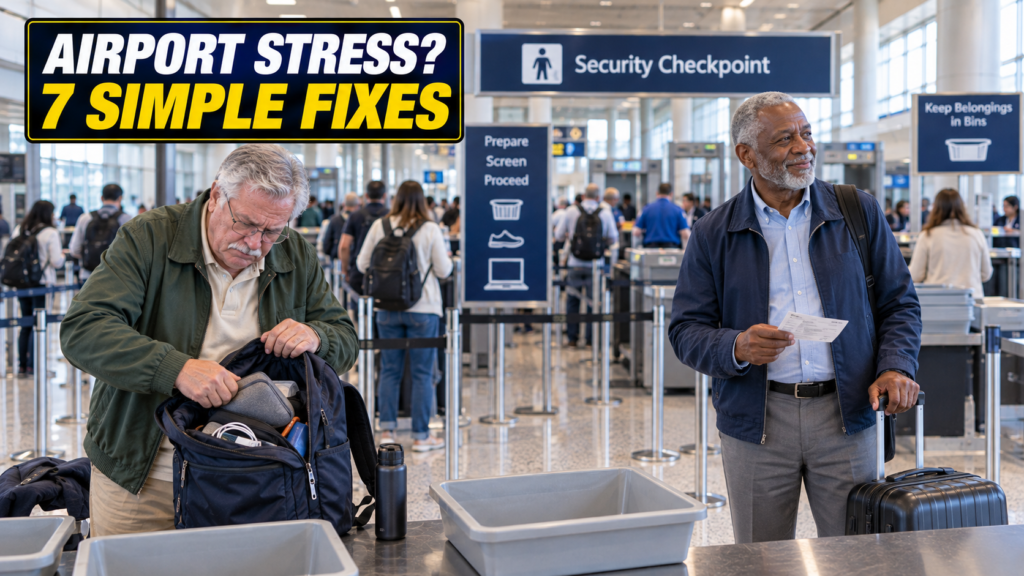
Imagine reaching the front of the security line and suddenly realizing you don’t remember where you put your identification.
You check your jacket.
Nothing.
You open your carry-on and search one pocket, then another.
Your ID eventually appears, but by then you’re frustrated and distracted.
There is a much easier approach: before entering the security process, decide where your most important airport items will live.
Choose one secure, easy-to-reach pocket or compartment in your carry-on for the essentials you expect to need during the airport portion of your trip.
The key is consistency.
If you move your identification from your wallet to your jacket, then to an outside suitcase pocket, and later into your backpack, you create more opportunities to forget where you placed it.
Instead, create a simple routine.
Use the same secure compartment throughout the airport whenever practical, and return important items there after using them.
Before screening, also pay attention to loose objects in your clothing pockets. TSA’s traveler checklist advises passengers to empty their pockets before screening and place those items in their carry-on bag.
That can reduce the number of individual belongings you have to manage at the checkpoint.
This habit is especially useful if you travel with glasses, medication, a phone, travel documents, or other small essentials that are easy to misplace when you are under pressure.
The objective isn’t speed for its own sake.
It’s reducing the number of things competing for your attention.
2. Don’t Automatically Copy What the Passenger Ahead of You Does
Airport security can become confusing when travelers assume everyone is following exactly the same screening procedure.
You may see one passenger leave certain belongings packed while another passenger is instructed to handle them differently.
That doesn’t necessarily mean someone is receiving special treatment.
Screening procedures can vary according to the lane, screening program, technology being used, and instructions given at the checkpoint.
One obvious example is TSA PreCheck.
Eligible travelers using TSA PreCheck lanes generally receive expedited screening procedures that allow them to leave on shoes, belts, and light jackets and keep compliant liquids and laptops in their bags. That does not mean a traveler in another lane should automatically do the same thing.
The safest habit is simple:
Follow the instructions for the lane you are actually using.
Don’t begin removing or unpacking everything merely because you watched another traveler do it.
Likewise, don’t assume you can leave something packed simply because the person in front of you did.
Look at the signs, listen to the officers, and prepare according to the instructions at your checkpoint.
This prevents unnecessary unpacking and repacking and can make the process considerably less stressful.
3. Keep Your Most Important Items Out of Your Checked Bag
A checked suitcase should not become the only place where you keep something you absolutely need immediately after landing.
Checked baggage can be delayed, misdirected, or otherwise unavailable when you expect it.
The U.S. Department of Transportation recommends keeping valuables and items you may need during the first 24 hours in your carry-on rather than checked baggage.
That principle can be turned into a simple packing rule:
Ask yourself what would cause a serious problem if your checked suitcase did not arrive with you.
Your answer will vary depending on the trip.
Important travel documents, keys, essential personal items, valuables, and things you expect to need soon after arrival deserve special consideration.
Medication requires even more deliberate planning. Keep necessary medication accessible and make sure you understand any destination-specific requirements when traveling internationally.
The point isn’t to move your entire suitcase into your carry-on.
It’s to create a small backup layer.
Imagine landing in another city while your checked suitcase is temporarily somewhere else. Could you comfortably get through the first night?
If the answer is no, reconsider what you are checking.
A few carefully chosen items in your carry-on can turn a baggage delay from a major travel crisis into an inconvenience you can manage.
4. Compare the Real Trip Price, Not Just the Fare on the Screen
One of the easiest ways to spend more than expected happens before you even arrive at the airport.
You see two flights:
Flight A appears cheaper.
Flight B costs slightly more.
Naturally, Flight A looks like the bargain.
But the advertised fare isn’t always the number that matters most to your individual trip.
Ask what you will actually need.
Will you check a bag?
Do you want a particular seat?
Are there restrictions attached to the fare?
Are other optional services important to you?
The Department of Transportation advises consumers to compare fares, restrictions, and optional services when shopping for air travel.
This is where a simple comparison can save money.
Suppose the cheaper fare requires you to pay separately for services you know you will use. Once those costs are added, the initially more expensive option could potentially become competitive—or even less expensive for your particular itinerary.
That doesn’t mean upgrades or bundled fares are automatically better deals.
Sometimes the cheapest basic fare really is the best option.
The hack is simply to calculate before deciding.
Instead of asking:
“Which ticket has the lowest advertised price?”
Ask:
“What will this trip cost after I add the things I actually need?”
That small change in thinking can prevent an unpleasant surprise later.
5. Understand the 24-Hour Airline Booking Rule Before You Need It
This is one of the most useful U.S. air-travel protections to understand—and also one of the easiest to oversimplify.
Under U.S. Department of Transportation requirements, when a qualifying airline reservation is made at least seven days before the flight’s scheduled departure, the airline must provide a 24-hour protection.
But there is an important detail.
An airline can satisfy the requirement by allowing passengers to hold the reservation at the quoted fare for 24 hours without payment, or by allowing passengers to cancel the reservation within 24 hours and receive a full refund without penalty.
The airline is not required to offer both options.
There is another important limitation: the federal 24-hour reservation requirement applies to airlines, while tickets purchased through third-party travel agencies may be subject to different rules.
So don’t turn “24-hour cancellation” into a universal assumption.
Before purchasing, check the terms for the company actually selling you the ticket.
Used correctly, the rule can be valuable if you notice an eligible booking mistake soon after purchasing directly from an airline—for example, a wrong date or other reservation detail.
Used incorrectly, assuming every ticket from every seller can always be canceled for free within 24 hours can create a costly surprise.
The real hack is knowing the protection before you need to use it.
6. Prepare Before You Reach the Front of the Security Process
One of the simplest airport habits is also one of the most overlooked:
Don’t wait until the last possible moment to get organized.
TSA’s traveler checklist recommends having your acceptable identification and boarding pass ready before reaching the checkpoint.
That sounds obvious, yet consider how often travelers begin searching only when someone is waiting for them.
A better routine starts earlier.
As you approach security, make sure you know where your required travel items are.
If you are using your phone, have what you need accessible rather than buried under unrelated apps and notifications.
If you have loose pocket items that need to be secured, organize them before you reach the screening point when possible.
And pay attention to checkpoint-specific instructions instead of relying entirely on what happened during your previous trip.
The objective is not to rush.
In fact, rushing often creates the problem.
Preparation gives you time to notice mistakes while they are still easy to fix.
For older travelers who prefer not to feel pressured by a line forming behind them, this can make a noticeable difference.
You arrive at the front already knowing where everything is.
7. Never Walk Away From Security Without Checking Your Bin and Belongings
You made it through security.
Your shoes are on. Your carry-on is back in your hand. Your phone is with you.
Time to leave?
Not quite.
Give yourself a final few seconds.
Look at the bin you used.
Look around the immediate area where you collected your belongings.
Then mentally check your highest-priority items before walking away.
TSA’s traveler checklist specifically reminds passengers to check their bins and collect all belongings after screening.
Small objects are particularly easy to overlook when several items have been separated during the screening process.
A phone, wallet, glasses case, document, watch, or other small item may not immediately catch your attention.
The easiest defense is a repeatable final check.
You can even use the same short mental list every time:
Phone. Wallet. ID. Carry-on.
Customize it to your own travel needs.
This isn’t about standing in the recomposure area for several minutes and blocking other passengers.
It is a brief, deliberate check before moving on.
Those few seconds can be much cheaper and less stressful than realizing at your gate that something important never left the checkpoint with you.
The Best Airport Hack Is Having a Routine
Notice what most of these tips have in common.
They aren’t secret loopholes.
They don’t require expensive travel gadgets.
And they don’t depend on being an expert traveler.
They reduce the number of decisions you have to make while you’re already navigating a busy environment.
Your ID has a home.
Your important belongings stay accessible.
You know which screening instructions apply to you.
You understand the real cost of your ticket.
You know what is too important to put entirely in checked baggage.
And before leaving security, you perform one final belongings check.
That is what makes these habits useful.
Airports contain plenty of things you cannot control: lines, delays, gate changes, baggage systems, weather, and other travelers.
Your preparation is one part you can control.
Before your next flight, take a few minutes to organize the parts of the airport experience that routinely create stress.
You may not eliminate every delay or expense.
But you can eliminate a surprising amount of unnecessary scrambling—and begin your trip feeling much more in control.
