
CRUISE TIP
Silly Cruise Traditions Explained: Why Cruisers Cheer, Hide Ducks & Wear Pineapples
Sep
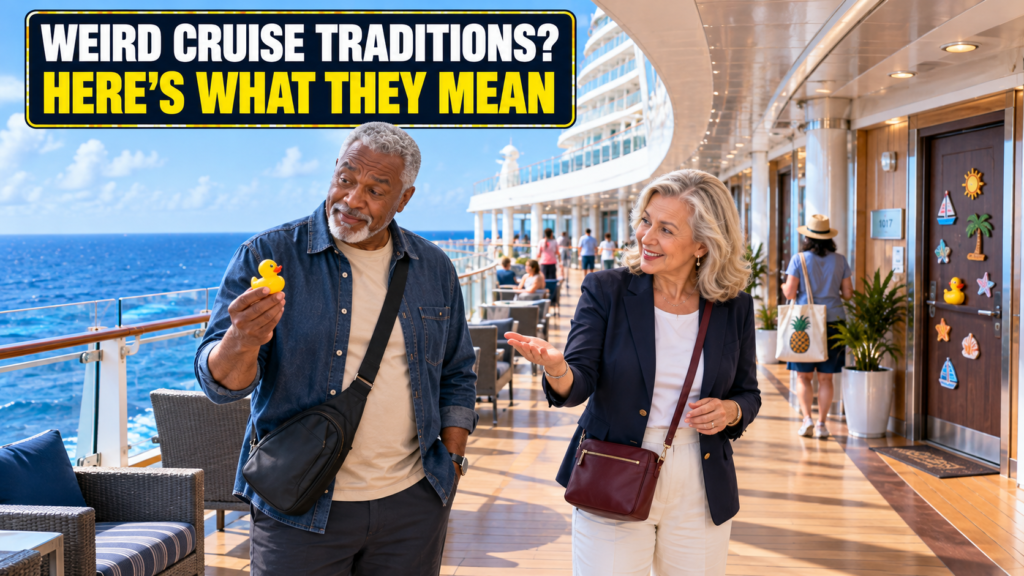
You’re walking along a cruise-ship promenade when you notice a tiny rubber duck tucked into an unexpected spot.
Did a child lose it?
Then another passenger tells you it may have been hidden there intentionally.
Later, you walk down your cabin corridor and see doors covered with magnets and birthday decorations. At sailaway, passengers gather outside, wave toward shore and celebrate as the ship pulls away. A family walks past wearing matching cruise shirts. And eventually somebody mentions one of cruising’s most talked-about symbols:
the pineapple.
For a first-time cruiser, some of this can look completely bizarre.
But much of it comes from informal passenger culture rather than official cruise rules. Some traditions are simply about celebrating the start of vacation. Others help passengers meet people or personalize their trip. Some are internet-driven trends that became associated with cruising. And a few symbols can carry a meaning you probably wouldn’t guess just by looking at them.
There is also an important distinction:
Not every ship, cruise line or passenger participates in these traditions.
Door-decoration policies, for example, can differ substantially. Disney currently permits tasteful magnetic door signs while prohibiting tape and other adhesives and restricting decorations to the door rather than corridor walls or ceilings. Carnival also publishes specific safety requirements for stateroom decorations, including rules about materials and placement. (Disney Cruise)
So none of the following should be treated as something you have to do.
Think of them instead as seven pieces of cruise culture you may encounter—and finally understand when you see them.
1. HIDING LITTLE RUBBER DUCKS AROUND THE SHIP
One of the funniest discoveries for a first-time cruiser can be finding a small rubber duck somewhere onboard.
It may not be lost.
Some passengers participate in the informal practice commonly called cruise duck hiding: bringing small rubber ducks aboard, leaving them in appropriate public locations and allowing other passengers to discover them.
Why people do it
The appeal is extremely simple.
Finding something unexpected can turn an ordinary walk around the ship into a tiny scavenger hunt.
Some participants attach a small tag or message. Depending on the version of the game they’re following, a finder may keep the duck, move it to another appropriate location, or share the discovery with others.
What first-time cruisers should know
Do not assume every rubber duck you encounter belongs to the cruise line or is part of an official onboard activity.
And don’t assume the existence of the tradition means passengers can hide objects anywhere they please.
Safety and ship rules come first.
A sensible interpretation of the tradition is:
fun discovery, appropriate public location, no interference with ship operations.
Never place objects where they obstruct walkways, interfere with safety equipment, enter crew-only areas, contaminate food areas or risk going overboard.
Important limitation
Cruise-duck hiding is an informal passenger activity, not a universal cruise tradition that every passenger or cruise line participates in.
If you’re thinking of bringing ducks yourself, check the current policies applicable to your specific cruise.
2. CHEERING, WAVING AND MAKING A BIG DEAL OUT OF SAILAWAY
Your ship starts moving.
Suddenly people are outside taking pictures, waving, raising drinks, pointing at the shoreline and acting as though something enormous just happened.
Technically, the ship simply left port.
Emotionally, however, the vacation just started.
Why it matters
Sailaway creates a natural dividing line between everyday life and the cruise itself.
Passengers may gather on open decks or balconies to watch the terminal disappear, photograph the coastline and enjoy the first views from sea.
Sometimes people wave toward passengers on another ship or toward people watching from shore.
There doesn’t need to be an official ceremony for passengers to turn departure into one.
What to expect
The atmosphere depends heavily on the ship and itinerary.
One sailing may have a lively organized sailaway event. Another may feel relaxed and informal.
You don’t have to participate at all.
But if this is your first cruise, being somewhere with a good exterior view as the ship leaves port can be one of the simplest ways to understand why repeat cruisers make such a big deal about departure.
Important limitation
Don’t interpret cheering or waving as a formal maritime tradition practiced identically on every ship.
For many passengers, it’s simply celebration.
3. DECORATING THE CABIN DOOR
Walk down certain cruise corridors and you’ll see what looks like a long row of identical doors.
Then suddenly:
HAPPY 50TH ANNIVERSARY!
Another door might have family names, cruise-themed magnets or birthday decorations.
For some cruisers, the cabin door becomes part of the vacation.
Why people do it
Door decorations can:
- celebrate birthdays or anniversaries,
- identify a group,
- add personality,
- or simply make a cabin easier to recognize in a long corridor.
But this is one tradition where you absolutely should not copy what another passenger is doing without checking the rules.
What to check
Cruise lines can impose different restrictions.
Disney Cruise Line currently allows tasteful magnetic signs but says not to use tape or other adhesives; decorations are limited to the door rather than surrounding corridor walls or ceilings. Disney also notes that magnets won’t adhere to certain wooden Concierge stateroom doors. (Disney Cruise)
Carnival’s current published policy includes requirements such as fire-retardant decoration materials and restrictions on where decorations may be placed. (Carnival Cruise)
Important limitation
Never assume:
“I saw this on another cruise, so it’s allowed on mine.”
Check your own cruise line’s current policy before packing decorations.
4. WEARING MATCHING CRUISE SHIRTS
Then there are the families who arrive looking like they have their own uniform.
SMITH FAMILY CRUISE 2026.
GRANDMA’S 70TH BIRTHDAY CRUISE.
Or perhaps every person is simply wearing the same bright tropical shirt.
It can look ridiculous.
That’s often part of the fun.
Why people do it
Cruises are frequently used for group celebrations:
birthdays,
anniversaries,
family reunions,
friend trips,
retirement celebrations
and multigenerational vacations.
Matching clothing turns the group into a visible little team and creates an easy photo opportunity.
Should you do it?
Only if your group enjoys it.
There is no cruise advantage to wearing matching shirts and no special status attached to them.
For some families, the photo becomes one of their favorite memories.
For others, convincing Grandpa to wear the shirt may be the hardest negotiation of the entire vacation.
Important limitation
This is social behavior, not cruise etiquette.
Nobody needs matching clothing to participate in group activities onboard.
5. CELEBRATING CRUISE MILESTONES LIKE THEY’RE MAJOR LIFE EVENTS
Repeat cruisers sometimes talk about their sailing history in ways that confuse newcomers.
Their first cruise.
Their tenth cruise.
A birthday cruise.
An anniversary cruise.
A retirement cruise.
A first solo cruise.
Or a return to a favorite ship or destination.
Why people do it
Cruising lends itself naturally to milestones because the vacation itself has clear beginnings and endings.
People may mark those moments with:
door decorations,
matching shirts,
photos,
special meals
or personal rituals.
For frequent cruisers, the ship may become part of the memory attached to the event.
What first-time cruisers should know
Don’t worry if other passengers seem to know traditions, terminology or routines that you don’t.
You aren’t missing a required part of cruising.
Many of these rituals exist precisely because passengers invented their own ways of making trips memorable.
Important limitation
Official recognition of milestones, loyalty benefits and celebration services varies.
A personal tradition should not be confused with a benefit the cruise line automatically provides.
6. HAVING YOUR OWN FIRST-DAY OR LAST-DAY RITUAL
Ask ten repeat cruisers what they do immediately after boarding and you may get ten different answers.
One wants lunch.
Another heads outside.
Someone else checks the cabin.
Another finds a favorite bar or observation area.
And one person may insist that the cruise hasn’t officially begun until they stand at the railing and take the exact same photograph they take on every sailing.
Why people repeat these rituals
Familiarity is part of the pleasure.
Once someone has taken several cruises, a small repeated action can become their personal signal:
We’re back. Vacation has started.
The same thing happens on the final evening.
Some passengers have a favorite last dinner, final walk around the promenade or quiet moment looking at the ocean.
Should you copy them?
Not necessarily.
A better idea is to let your own traditions develop.
Your favorite cruise ritual may turn out to be something nobody else cares about.
That’s what makes it yours.
Important limitation
Again, personal ritual and cruise-line procedure are completely different things.
Always complete required safety procedures and follow current ship instructions regardless of your usual first-day routine.
7. THE PINEAPPLE — AND WHY YOU SHOULDN’T ASSUME TOO MUCH
Now we get to the one that creates the most jokes.
The pineapple.
Pineapples are everywhere in vacation imagery: tropical shirts, drinks, bags, jewelry and decorations.
So if somebody wears a shirt covered in pineapples on a Caribbean cruise, what does it mean?
Quite possibly:
they like pineapples.
The important distinction is the upside-down pineapple.
It has become widely associated with the swinger lifestyle and can be used as a discreet signal by some people interested in meeting others with similar interests. Cruise-focused publications continue to describe that association. (The Points Guy)
Why cruisers talk about it
The contrast is what made the symbol famous online.
A cheerful tropical fruit suddenly has an adult secondary meaning when deliberately presented in a particular orientation and context.
That naturally produces jokes, stories and warnings among cruisers.
But don’t make this mistake
Do not assume every pineapple means the same thing.
A normal pineapple pattern on a shirt, swimsuit, bag or decoration can simply be tropical imagery.
Even an unusual display should not be treated as definitive proof of someone’s private life. The Points Guy specifically cautions that pineapples can simply reflect hospitality or design preference and advises using discretion rather than making assumptions. (The Points Guy)
What about cruise-line rules?
This is another reason to check current policies rather than relying on cruise folklore.
Rules governing door decorations can differ by cruise line, and they can change. For example, Disney and Carnival currently publish detailed decoration requirements covering placement and materials. (Disney Cruise)
So don’t assume a particular symbol or decoration is permitted simply because you’ve seen pictures of it online.
Important limitation
The upside-down pineapple association is informal social symbolism, not an official cruise-ship code.
Cruise lines do not assign passengers pineapple status.
And wearing ordinary pineapple clothing does not give strangers permission to make assumptions about you.
So Why Do Cruise Passengers Do All This?
Because a cruise isn’t only transportation between ports.
For repeat passengers, the ship itself becomes part of the vacation culture.
That’s how you end up with tiny ducks hidden in unexpected places, decorated cabin doors, matching family shirts, enthusiastic sailaway celebrations and personal rituals that make absolutely no sense until somebody explains them.
Some traditions spread passenger to passenger.
Some spread online.
Some are personal.
And some—like the upside-down pineapple—have developed a secondary social meaning far beyond ordinary cruise activities.
The important thing for a first-time cruiser is knowing the difference between fun passenger culture and an actual ship rule.
You do not have to hide a duck.
You do not have to decorate your door.
You do not need matching shirts.
You don’t have to cheer at sailaway.
And you definitely don’t need to panic because somebody walked past wearing pineapples.
The Bottom Line
Cruise traditions are fun precisely because most of them aren’t requirements.
Participate in the ones you enjoy, ignore the ones you don’t, and check your cruise line’s current rules before bringing decorations or placing objects around the ship.
And if you find a tiny yellow duck tucked somewhere appropriate onboard?
Now, at least, you won’t immediately assume somebody lost their bath toy.
