
Uncategorized
A PILOT WAS HIRED TO FLY “SPECIAL PASSENGERS” FROM NIGERIA TO THE USA — THEN HE FOUND OUT WHY
Sep
The pilot thought he had accepted an unusual charter flight.
He had no idea what was waiting for him behind the cockpit door.
The assignment sounded straightforward: fly a group of “special passengers” from Nigeria toward the United States.
No one gave him much of an explanation for that description.
They weren’t celebrities.
They weren’t government officials.
And as far as he knew, there wasn’t anything extraordinary about the aircraft itself.
Still, the words “special passengers” stayed in his mind as he prepared for departure.
The 48-year-old American captain had spent years around airplanes. He was accustomed to nervous travelers, excited families, first-time flyers and passengers who asked strange questions.
But shortly after takeoff, he realized this flight was going to be different.
Very different.
The Cabin Erupted the Moment They Were Airborne
As the aircraft climbed away, the atmosphere behind the cockpit changed almost instantly.
At first, the pilot heard scattered voices.
Then laughter.
Then singing.
Within moments, the cabin sounded more like a celebration than an ordinary flight.
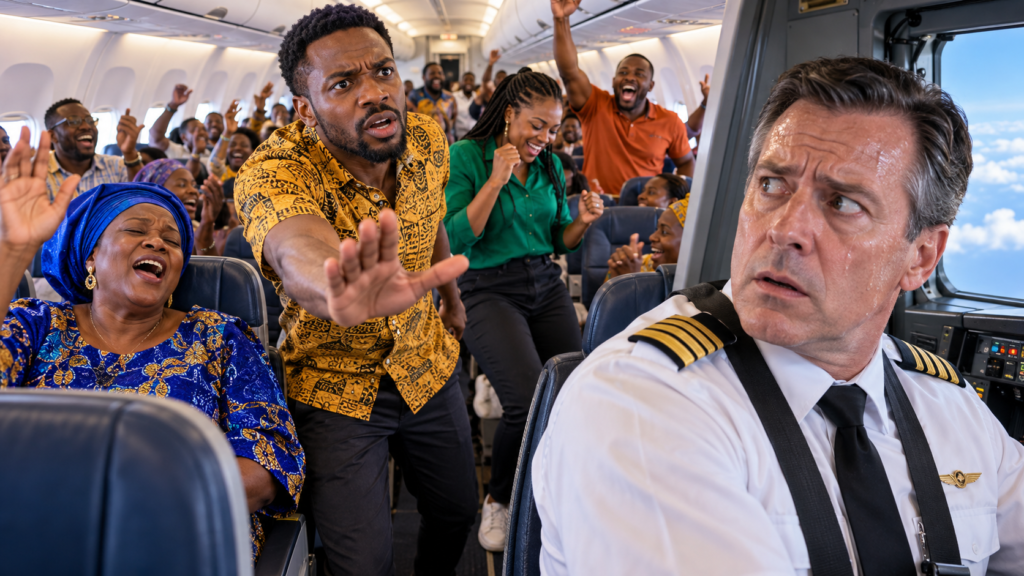
A woman wearing a bright royal-blue headwrap began singing gospel music enthusiastically from her seat.
Another passenger joined in.
Then another.
A young woman in an emerald-green blouse became so excited that she started dancing and celebrating in the aisle during a safe moment in this dramatized story.
Passengers laughed.
People clapped.
Then a man from farther back raised an arm and shouted:
“WE’RE GOING TO AMERICA!”
The cabin erupted again.
Inside the cockpit, the captain stared ahead.
He had expected excitement.
He hadn’t expected this.
And they had only just started the journey.
Then Someone Told the Pilot to “Slow Down”
Among the passengers was a particularly expressive 38-year-old Nigerian man wearing a mustard-yellow patterned shirt.
He had been watching everything around him with enormous curiosity.
Eventually, he apparently became concerned about the speed of the aircraft.
From his seat, he called toward the front:
“Pilot! Slow down! You’re going WAY too fast!”
The captain froze for a moment.
Too fast?
They were flying an airplane.
He couldn’t simply treat the aircraft like a car passing a speed-limit sign.
But the passenger sounded completely serious.
The pilot looked toward the cockpit instruments and then exchanged the kind of expression that said:
Is this really happening?
Behind him, the celebration continued.
Singing.
Talking.
Laughter.
Excited voices.
The captain tried to remain professional.
But this was becoming one of the strangest flights he could remember.
The Stranger Had an Even Bigger Question
A little while later, things became quieter near the front.
Then the captain noticed someone approaching the forward area.
It was the same man.
The passenger stopped at the appropriate boundary near the front of the cabin in this fictional retelling. He did not touch any cockpit controls or interfere with the operation of the aircraft.
Instead, he looked toward the captain with an intensely curious expression.
For a second, the pilot wondered what complaint was coming next.
The man leaned forward.
“Sir… could you teach me how to fly this plane?”
The pilot stared at him.
First he wanted the plane to slow down.
Now he wanted a flying lesson.
The captain could still hear the noise from the cabin.
Then he had an idea.
“Of Course. I’ll Teach You…”
The pilot kept a straight face.
“Of course. I’ll teach you…”
The man’s eyes widened.
But the captain wasn’t finished.
“…but first, go tell your friends to stop making all that noise.”
The passenger’s face lit up.
“Okay!”
He immediately turned around.
The captain watched him disappear back into the cabin.
Finally, the pilot exhaled.
Perhaps he had solved the problem.
Maybe the man would ask everyone to settle down.
Maybe the cabin would become manageable again.
Five minutes passed.
Then the captain noticed something.
No singing.
No dancing.
No shouting.
No laughter.
Nothing.
The entire airplane had gone completely silent.
The Silence Was Somehow More Concerning Than the Noise
A few minutes earlier, the captain had desperately wanted some peace.
Now he had it.
And suddenly he wasn’t sure he wanted it anymore.
The change was too dramatic.
He listened carefully.
Still nothing.
The captain looked toward the cabin.
What did that man tell them?
He had only asked him to quiet everyone down.
He hadn’t expected absolute silence.
Eventually, the man in the mustard-yellow shirt returned toward the front.
He looked extremely pleased with himself.
The pilot couldn’t resist asking.
“What did you tell them?”
The passenger smiled.
“I told them you said anyone who keeps making noise has to get off the plane.”
The captain’s eyes widened.
“You told them WHAT?”
The man nodded proudly.
“It worked.”
For a moment, the pilot didn’t know whether to laugh or correct him immediately.
Then a nervous voice came from somewhere in the cabin.
“Sir… we’re not getting off up here, right?”
The captain closed his eyes for half a second.
Now he understood the silence.
One Joke Had Been Taken Completely Seriously
The captain had made a simple request:
Tell your friends to stop making noise.
The passenger had apparently decided that wasn’t persuasive enough.
So he invented consequences.
And because everyone was already overwhelmed by the experience of the flight, the message worked almost too well.
The joyful cabin had transformed into something resembling a library.
Passengers sat upright.
Some barely spoke.
The gospel singing stopped.
The dancing stopped.
Even the man who had celebrated by shouting about America was suddenly keeping his voice down.
The captain quickly made sure the misunderstanding was corrected.
Nobody was being thrown out of an aircraft in midair.
Obviously.
The passenger in the yellow shirt seemed almost disappointed that his solution needed clarification.
But the captain couldn’t deny one thing.
The cabin was finally quiet.
Then the Pilot Began to Understand the “Special Passengers”
The strangest part wasn’t simply that the passengers were loud.
It was how intensely they reacted to everything.
The sound of the engines.
The view through the windows.
The feeling of acceleration.
The altitude.
The announcements.
Even ordinary parts of the flight seemed fascinating to several people aboard.
Slowly, the captain began looking at the cabin differently.
What had initially seemed chaotic began to look more like overwhelming excitement.
Some of these passengers, in this fictional story, were experiencing international air travel with a level of enthusiasm the pilot rarely encountered.
For him, flying had become routine.
For them, the journey represented something enormous.
That difference changed the way he saw the flight.
What Is Routine to a Pilot Can Be Extraordinary to a Passenger
Professional pilots spend thousands of hours around aircraft.
They hear engines constantly.
They see airports from above.
They watch cities disappear beneath the wings.
Eventually, experiences that once seemed extraordinary can become part of an ordinary workday.
Passengers don’t necessarily experience flying that way.
For someone traveling internationally for the first time, the entire process can be overwhelming.
The airport.
The boarding bridge.
The aircraft cabin.
Takeoff.
Looking down at clouds.
Watching the ground disappear.
Seeing the flight map cross an ocean.
What feels routine to an aviation professional can become a lifelong memory for somebody else.
That was the realization beginning to hit the captain.
The Man Still Wanted His Flying Lesson
Once the cabin settled down, the man returned to the subject he hadn’t forgotten.
“So… when do you teach me?”
The captain almost laughed.
The passenger had apparently interpreted the earlier promise literally.
The pilot now had another misunderstanding to resolve.
He wasn’t going to let a passenger operate a commercial aircraft.
There would be no spontaneous flying lesson.
There would be no passenger touching flight controls.
There would be no invitation into an operating cockpit merely because someone had successfully quieted the cabin.
The captain explained that flying an aircraft requires extensive training, licensing and professional qualification.
The man’s expression changed.
“So you can’t teach me today?”
Not today.
Not during this flight.
But the pilot could tell him something about aviation later, when appropriate and without interfering with flight operations.
That seemed good enough.
At least temporarily.
Real Cockpit Access Is Not Like the Movies
This part of the fictional story requires an important real-world distinction.
Modern airline cockpit security is serious.
Passengers cannot simply wander into the flight deck during a U.S. commercial airline flight and ask the pilots for lessons.
Federal regulations impose restrictions on flight-deck access, and airlines operate under strict security procedures.
A passenger also cannot manipulate aircraft controls merely because a pilot agrees to “show them how it works.”
So the conversation in this dramatization should be understood as comedy—not an example of normal or acceptable airline procedure.
The man approaches the forward area and asks his question.
He does not take control of the aircraft.
The pilot remains responsible for the flight at all times.
Cabin Safety Still Comes Before Celebration
The passengers’ excitement also raises another real aviation point.
Celebrating is one thing.
Ignoring crew instructions is another.
Passengers need to follow illuminated signs and crewmember directions.
If the seat-belt sign is illuminated, passengers should remain seated and restrained as directed.
If flight attendants tell passengers to clear the aisle, they should clear it.
If turbulence develops, the cabin needs to be secured.
A joyful atmosphere doesn’t override safety procedures.
In the dramatized version of this story, the dancing occurs only during a safe moment when permitted.
In a real cabin, instructions from the crew take priority over the celebration.
Why Turbulence Makes Standing in the Aisle Risky
One of the easiest dangers to underestimate aboard an aircraft is unexpected turbulence.
The cabin may look perfectly calm.
Passengers may be walking around.
Then the aircraft can suddenly encounter rough air.
That is why aviation authorities consistently emphasize seat-belt use.
A passenger who is standing can be thrown off balance during unexpected movement.
That doesn’t mean passengers must remain frozen in their seats for an entire long-haul flight.
But it does mean they should pay attention to conditions and crew instructions.
The same applies to anyone singing, celebrating or socializing in the cabin.
Fun ends where safety begins.
The Pilot’s Job Wasn’t to Control the Party
The captain had another realization.
His responsibility wasn’t to make everyone behave exactly like passengers on a silent business flight.
His responsibility was to operate the aircraft safely and ensure cabin issues were handled appropriately through the crew.
Different groups of passengers behave differently.
Some flights are almost silent.
Others are filled with families.
Some carry sports teams.
Some have vacation groups.
Some passengers applaud after landing.
Others immediately reach for their phones.
An experienced crew adapts to the people aboard while maintaining safety standards.
The goal isn’t to eliminate personality from air travel.
It’s to prevent that personality from interfering with safe operation.
Why the Flight Felt So Different
By the middle of the journey, the captain no longer interpreted every sound as a problem.
The gospel singing had been joyful.
The dancing came from excitement.
The shout about America wasn’t a threat.
And even the bizarre demand to “slow down” came from someone whose understanding of flying was very different from the captain’s.
The pilot had initially thought:
Who are these people?
Eventually, the better question became:
What does this journey mean to them?
That distinction changed the emotional tone of the flight.
Somewhere Over the Atlantic, Everyone Settled Down
Hours passed.
The cabin eventually found its rhythm.
Some passengers slept.
Others talked quietly.
A few stared through the windows.
The woman who had been singing gospel music earlier finally rested.
The dancing passenger returned to her seat.
The man in the burnt-orange polo no longer shouted about America every few minutes.
And the curious passenger in the yellow shirt occasionally looked toward the front as though he still hoped the captain might change his mind about the flying lesson.
The pilot began to relax.
What had started as chaos was turning into one of the most memorable flights of his career.
Then the Destination Became Real
As the aircraft moved closer to the United States, the atmosphere changed again.
Passengers began checking windows.
People adjusted their clothing.
Conversations became more animated.
The anticipation returned.
The captain heard excited voices from behind the cockpit.
But this time, he didn’t immediately tense up.
He understood it better.
For the passengers, this wasn’t simply another arrival.
The journey itself had become part of the story they would tell afterward.
And for the pilot, the people behind him were no longer just the mysterious “special passengers” mentioned in the assignment.
They were individuals experiencing a major moment in their lives.
The Man Had One Final Question
As the flight prepared for arrival, passengers followed instructions and returned to their seats.
Seat belts clicked into place.
The cabin was secured.
The captain prepared for descent.
Then the curious man had one final question for a flight attendant to relay.
“Can you ask the pilot if we’re still going too fast?”
The captain laughed when he heard it.
After everything that had happened, he couldn’t help himself.
The man had started the flight worried about speed.
Then he wanted to become a pilot.
Then he accidentally terrified the entire cabin into silence.
And now, as they approached the end of the journey, he was still thinking about how fast airplanes fly.
Some passengers are simply unforgettable.
What This Story Is Really About
On the surface, this is a comedy about an overwhelmed pilot and an unusually enthusiastic group of passengers.
But underneath the jokes is something more relatable.
People experience travel differently.
For aviation professionals, a flight can become routine.
For passengers, it can represent a beginning, a reunion, a dream, an opportunity or simply the first time they have ever seen the world from 35,000 feet.
That difference can produce misunderstandings.
Sometimes funny ones.
Sometimes stressful ones.
And sometimes moments that remind aviation professionals why flying still feels extraordinary to people who don’t do it every day.
The Important Real-World Safety Line
There is one part of this story that should never be misunderstood.
Passengers must not interfere with pilots, attempt to access aircraft controls or disregard crewmember instructions.
The cockpit isn’t a tourist attraction during an operating commercial flight.
Likewise, cabin behavior must remain within safety requirements.
Passengers can laugh.
They can talk.
They can celebrate when appropriate.
But aisles need to remain usable, instructions need to be followed and flight crews must be allowed to perform their duties without interference.
The humor in this story works precisely because the passenger’s questions are absurd.
They are not instructions for how anyone should behave aboard a real aircraft.
A Flight the Captain Would Never Forget
By the time the aircraft reached its destination, the captain had experienced almost every emotion possible.
Confusion.
Stress.
Disbelief.
Amusement.
Concern.
And eventually, understanding.
The “special passengers” weren’t special because they were secretly powerful.
There was no hidden government operation.
No celebrity reveal.
No classified mission.
No sinister secret waiting behind the curtain.
In this dramatized story, what made them memorable was far simpler.
They turned an ordinary flight into an experience the captain would probably talk about for years.
The singing.
The dancing.
The passenger yelling at an airplane to slow down.
The request for a flying lesson.
And, above all, those five unforgettable minutes when a cabin that had been impossibly loud suddenly became completely silent.
All because one passenger had found the most ridiculous possible interpretation of the pilot’s request.
The Bottom Line
The captain had been hired expecting a straightforward international flight.
Instead, he found himself transporting a group whose excitement transformed the cabin almost immediately.
At first, he couldn’t understand them.
Then he became frustrated.
Then one passenger walked toward the front and asked the question the captain never expected:
“Could you teach me how to fly this plane?”
The captain thought he had found a clever way to restore peace.
“Of course. But first, tell your friends to stop making all that noise.”
Five minutes later, the airplane was silent.
Too silent.
Only then did the captain discover what the man had told everyone:
Keep making noise…
and the pilot would make you get off the plane.
At cruising altitude.
The captain had asked for quiet.
He got it.
Just not remotely in the way he expected.
And from that point forward, he knew one thing for certain:
This was never going to be just another flight.
