
AIRPORT TIPS
8 DUMBEST THINGS PASSENGERS DO ON AIRPLANES THAT CAN CAUSE SERIOUS TROUBLE
Sep
Most passengers don’t board a plane intending to cause a problem. Yet every flight brings together hundreds of people in a tightly controlled environment where one careless decision can quickly create trouble.
Sometimes it’s impatience. Sometimes it’s overconfidence. And sometimes a traveler simply assumes that a rule doesn’t matter because nothing bad happened the last time they ignored it.
For travelers over 60, experience can actually create another trap: “I’ve been flying for decades. I know how this works.”
But aircraft, airport procedures, battery-powered devices, and airline operations have changed considerably over the years. Even experienced travelers can make surprisingly poor decisions.
Here are eight mistakes passengers should avoid—and what to do instead.
1. Wandering Toward an Aircraft Because You Want a Better Picture
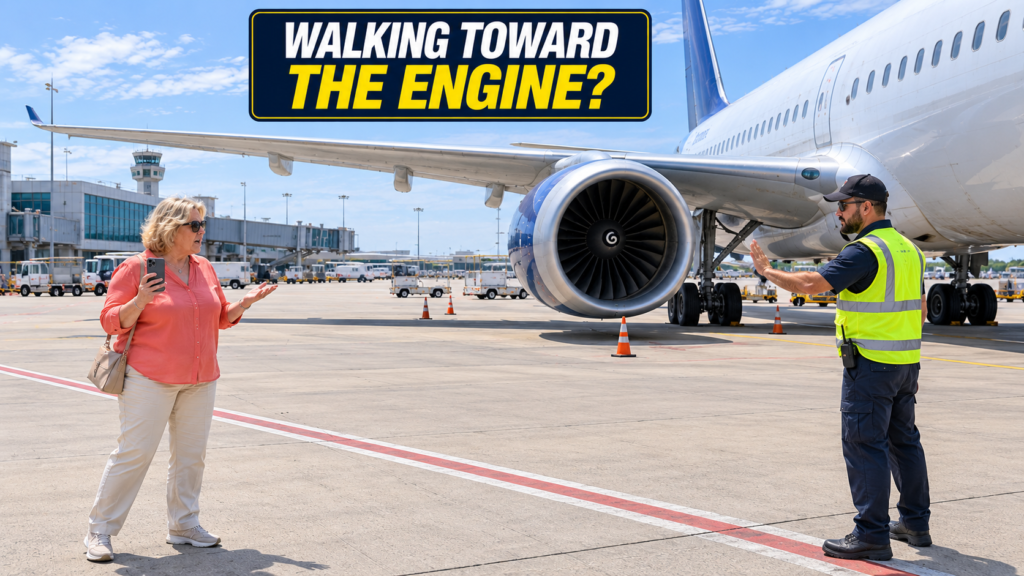
Imagine boarding from an outdoor ramp and seeing a huge jet engine only a short distance away.
It makes an incredible photograph.
So a passenger leaves the designated walking route, raises a phone, and starts moving toward the aircraft.
That is exactly the kind of spontaneous decision that can create a serious safety problem.
An airport apron isn’t a sightseeing area. It is an active operational environment where aircraft, ground equipment, baggage vehicles and airport personnel may all be moving.
Passengers using outdoor boarding areas should stay on the designated route and follow instructions from airline and ground personnel.
The important distinction is that the danger isn’t simply “being near an airplane.”
The problem is wandering into an operational area where passengers aren’t supposed to be.
Aircraft engines also deserve enormous respect. Depending on the operational situation, engines can create hazards around both the intake and exhaust areas. Ground crews are trained to work around aircraft; ordinary passengers are not.
So if you spot an incredible photo opportunity while walking across a ramp, don’t improvise your own route.
Take photographs only where permitted and keep moving along the passenger path.
If an employee tells you to stop or change direction, do it immediately.
A photograph is never worth wandering into an aircraft operating area.

2. Standing Up Because the Air “Feels Smooth”
The seatbelt sign comes on.
You look around the cabin.
Nothing appears to be happening.
The aircraft isn’t shaking. The flight attendants don’t look alarmed. Your drink isn’t moving.
So you decide this is probably a good time to get something from the overhead bin.
That’s poor reasoning.
Turbulence isn’t always something passengers can predict by looking out the window or judging how smooth the previous few minutes felt.
FAA passenger guidance recommends keeping your seatbelt fastened whenever you’re seated, even when the seatbelt sign isn’t illuminated.
That is an easy habit, especially for older travelers.
You don’t need to tighten the belt uncomfortably. Simply keeping it properly fastened while seated can help protect you if unexpected movement occurs.
And when the crew tells passengers to remain seated, don’t try to personally evaluate whether the instruction is necessary.
They have information you don’t.
The smarter approach is simple:
Sit down, buckle up, and wait.
Your bag can stay in the overhead compartment a little longer.
3. Moving Into an Empty Premium Seat Without Permission
You paid for economy.
After boarding, however, you notice something interesting.
A premium seat nearby appears to be empty.
Nobody is sitting there.
The door closes.
Still empty.
A passenger might think, “Nobody bought it, so why shouldn’t I use it?”
Because an empty seat isn’t automatically a free upgrade.
Airlines sell different seating products, and cabin crews need passengers to follow seating instructions. There may also be operational reasons why passengers shouldn’t simply relocate themselves.
If you’d like to move, ask.
Don’t grab your bag, settle into a premium seat and force a flight attendant to come explain why you need to return to your assigned location.
The same principle applies when you want to swap ordinary seats.
Ask first when appropriate, and don’t assume another passenger or the crew must accommodate your preference.
This becomes especially important when the desired seat involves an exit row.
Exit seating comes with specific eligibility and safety considerations. It isn’t simply extra legroom available to whoever gets there first.
A vacant seat can look tempting.
But “empty” and “available to me” aren’t necessarily the same thing.

4. Packing a Power Bank Where It Doesn’t Belong
This mistake has become increasingly important because travelers carry more rechargeable electronics than ever.
Phones, tablets, cameras, hearing-device accessories and other travel electronics can make batteries an essential part of a trip.
But don’t treat a power bank like an ordinary piece of clothing.
FAA guidance states that spare lithium batteries and power banks must be carried in carry-on baggage rather than checked baggage.
That creates an important situation at the gate.
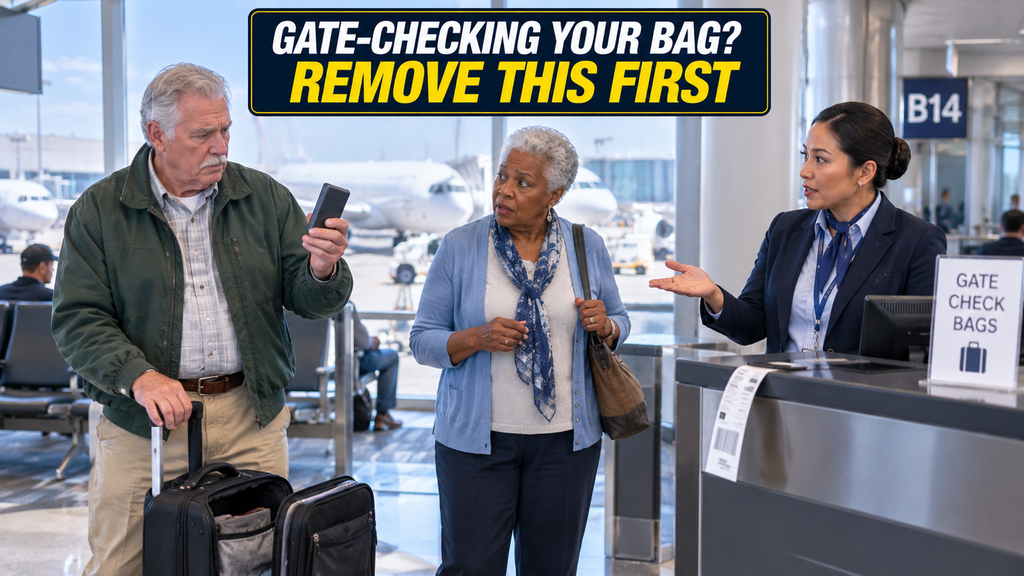
Suppose the overhead bins fill up and the airline asks you to gate-check your carry-on.
Before handing over the bag, think about what’s inside.
Did you pack a power bank?
Loose spare batteries?
An electronic smoking device?
Items that aren’t permitted in checked baggage need to be removed before the bag goes into the cargo hold.
For older travelers, a simple preflight organization system helps enormously.
Keep critical electronics and permitted battery items in an easily accessible section of your carry-on instead of burying them beneath clothing.
That way, if your bag unexpectedly needs to be checked, you aren’t kneeling beside the boarding door digging through everything you packed.
Before every trip, check the current battery guidance for your specific device and battery size.
Lithium battery restrictions can depend on factors such as battery type and capacity.
“It’s just a battery” isn’t a useful packing rule.
5. Ignoring the Safety Briefing Because You’ve Heard It Before
You’ve flown 50 times.
Maybe 100.
You already know about seatbelts.
You know oxygen masks drop from above.
You know there are emergency exits.
So when the safety demonstration begins, you put on your headphones and continue scrolling through your phone.
Experienced traveler?
Perhaps.
Smart decision?
Not necessarily.
The basic safety information may sound familiar, but the aircraft and your seating position can change.
One of the simplest things you can do is identify the exits around you.
Don’t merely glance at the closest one.
Notice where another exit is located as well.
FAA passenger guidance specifically encourages travelers to pay attention to the preflight safety briefing and read the safety information card.
That doesn’t require anxiety.
It requires a few minutes of attention.
This is particularly useful when you’re flying an unfamiliar aircraft type or sitting in a cabin location you don’t normally choose.
A frequent flyer can become so comfortable with flying that routine information becomes background noise.
That’s exactly when complacency appears.
You don’t need to memorize the airplane.
Just give the briefing your attention.
6. Turning a Simple Crew Instruction Into an Argument
A flight attendant asks a passenger to do something.
Maybe it’s fastening a seatbelt.
Maybe it’s returning to an assigned seat.
Maybe it’s putting an item away for a particular phase of flight.
The passenger disagrees.
Instead of complying and discussing the issue calmly when appropriate, the passenger decides that the middle of the aircraft cabin is the perfect place for a debate.
This can turn a manageable situation into an unnecessary confrontation.
There is an important distinction here.
Not every disagreement with a flight attendant is automatically a federal crime, and travelers shouldn’t be frightened by exaggerated claims suggesting otherwise.
But serious interference with crewmember duties is another matter. Federal aviation law prohibits assaulting, threatening, intimidating or interfering with crewmembers while they are performing their duties.
FAA enforcement against unruly passengers is real.
The practical lesson isn’t “never ask a question.”
Passengers can ask for clarification.
If something seems wrong, politely explain the problem.
But shouting, threatening, physically confronting a crewmember or deliberately obstructing their safety duties can push the situation into far more serious territory.
When an immediate safety instruction is given, the cabin aisle isn’t the place to prove that you’re right.
Stay calm.
Follow legitimate crew instructions.
Resolve ordinary service complaints through the appropriate channel afterward.
7. Thinking a Vape Is Fine Because You Aren’t “Smoking”
Some travelers mentally separate vaping from smoking.
That distinction can create a costly misunderstanding onboard an aircraft.
Electronic cigarettes and vaping devices have specific aviation restrictions.
FAA guidance says these devices must be carried in the aircraft cabin—in carry-on baggage or on your person—not in checked baggage. Passengers must also take measures to prevent accidental activation.
But carrying the device in the cabin doesn’t mean you can use it.
FAA guidance states that electronic smoking devices may not be used or charged aboard the aircraft.
That second part is easy to overlook.
A passenger may understand that vaping is prohibited but think plugging the device in for a quick charge is harmless.
Don’t make that assumption.
There is another important moment to remember: gate checking.
If your carry-on contains an electronic cigarette or vaping device and the airline requires the bag to be checked, remove the device first.
The safest approach is to organize these items before reaching the gate and review both federal requirements and your airline’s instructions.
Don’t wait until a flight attendant is explaining the rule at 30,000 feet.
8. Treating Airplane Mode Like an Optional Suggestion
The cabin door closes.
The flight attendant tells passengers to switch portable electronic devices into airplane mode.
Someone nearby thinks:
“My phone worked normally on my last flight. It doesn’t matter.”
That’s another example of personal experience being mistaken for permission.
FAA passenger guidance says cellphones and other portable electronic devices should be used in airplane mode or with the cellular connection disabled during flight.
If the aircraft has an installed Wi-Fi system and the airline allows passengers to use it, Wi-Fi may be used under the airline’s procedures.
That’s different from simply leaving your cellular connection operating because you personally don’t think it matters.
This mistake is especially easy to make because modern aircraft cabins are full of electronics.
Passengers watch movies on tablets.
They use Bluetooth accessories.
They connect to onboard Wi-Fi.
They send messages through internet-based services.
From the passenger’s perspective, it can seem contradictory.
But the correct response isn’t to invent your own rule.
Follow the instructions provided for your flight.
If you’re uncertain about a particular device, ask the crew rather than assuming.
The Common Thread Behind These Mistakes
These eight situations look very different.
One passenger wanders toward an aircraft for a photograph.
Another ignores the seatbelt sign.
Someone else decides an empty premium seat is theirs.
Another traveler packs a power bank incorrectly.
But most of these mistakes share the same underlying problem:
The passenger substitutes personal judgment for the procedure being used around them.
“I’ll only be near the engine for a second.”
“The flight feels smooth.”
“Nobody is using that seat.”
“I’ve always packed batteries this way.”
“I’ve heard the safety briefing before.”
“I’m just arguing with the flight attendant.”
“I’m not technically smoking.”
“My phone won’t cause a problem.”
Those explanations may sound reasonable to the person saying them.
That doesn’t make them good decisions.
What Travelers Over 60 Should Do Differently
Flying experience is valuable.
An experienced traveler usually knows how to pack efficiently, move through an airport calmly and recognize the rhythm of boarding.
But experience works best when it is combined with current information.
Before your next trip, check current restrictions for unusual items you’re carrying, particularly batteries and electronic devices.
Once onboard, listen to the safety briefing even if you’ve heard similar instructions dozens of times.
Keep your seatbelt fastened while seated.
Stay on designated passenger routes when boarding or deplaning outdoors.
And if an employee gives you a safety-related instruction, don’t turn the situation into a contest.
Ask reasonable questions when necessary, but remember that the airport ramp and aircraft cabin are controlled operational environments—not ordinary public spaces where every traveler chooses their own procedure.
A Few Seconds of Judgment Can Save a Lot of Trouble
The smartest passengers aren’t necessarily the people who have flown the most.
They’re the travelers who recognize when their own assumptions might be wrong.
You don’t need to be nervous about flying.
You don’t need to memorize hundreds of regulations.
And you certainly don’t need to treat every minor mistake as a catastrophe.
Instead, develop a few reliable habits:
Stay where passengers are supposed to be.
Keep your seatbelt fastened while seated.
Ask before changing seats.
Know where your batteries belong.
Listen to the safety briefing.
Treat cabin crew professionally.
Follow the rules for electronic smoking devices.
Use your phone according to the instructions for your flight.
Those small decisions make travel easier for you, the crew and everyone sitting around you.
And if you’re ever standing on an airport ramp thinking, “That jet engine would make an incredible close-up photo,” remember the simplest rule of all:
Stay on the passenger route and let the zoom on your camera do the walking.
