
AIRPORT TIPS
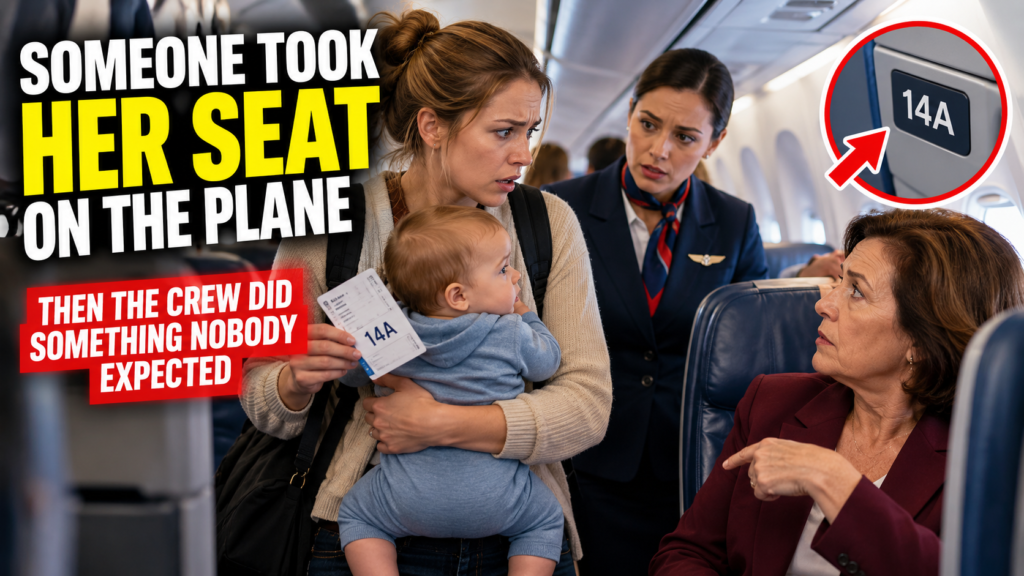
Someone Took Her Seat on the Plane — Then the Crew Did Something Nobody Expected
Sep
Few moments during boarding are more frustrating than walking down a crowded airplane aisle, carrying everything you need for a flight, finding your row—and discovering somebody already sitting in the seat printed on your boarding pass.
For one mother traveling with her 10-month-old baby, that was exactly what appeared to happen.
She had already managed the hardest part of boarding with an infant. Her baby was balanced securely against her body. Her handbag was hanging from her shoulder. Passengers were still squeezing bags into overhead bins around her.
Then she reached Row 14.
She looked at her boarding pass.
14A.
She looked at the window seat.
Someone was already sitting there.
At first, it seemed like one of the most familiar airplane conflicts imaginable: someone took her seat on the plane.
But within minutes, the confrontation became something entirely different.
The woman sitting in 14A insisted she had the same seat assignment. The mother insisted hers also said 14A. Neither woman understood how both could apparently be right.
Then a flight attendant stepped in.
What the crew discovered changed the entire situation—and the mother certainly wasn’t expecting where she would be sitting when the aircraft finally departed.
Part 1: The Mother Reaches Row 14 and Finds Her Seat Occupied
Boarding With a Baby Was Already Complicated Enough Someone Took Her Seat on the Plane
The aircraft was still parked at the gate as boarding approached its final stages.
It was a typical narrow-body cabin: three seats on either side of a single aisle, passengers standing between rows, overhead bins still open, and the constant shuffle of people trying to get settled without blocking everyone behind them.
The mother was 33 and traveling with her 10-month-old son.
She held him close with one arm as she made her way down the aisle. The baby, dressed in a light-blue knitted romper, seemed more interested in the unfamiliar faces and sounds around him than in the logistical challenge his mother was facing.
For her, however, every movement required planning.
She needed one hand to support him. She needed to keep track of her handbag. She needed to make sure nothing was dropped in the aisle. And, like every passenger boarding a busy aircraft, she needed to locate her assigned row without holding up the people behind her.
Her boarding documentation showed 14A.
A window seat.
She reached Row 14 and stopped.
There was already a woman sitting beside the window.
For a moment, the mother simply looked at the row and then back at her boarding pass.
Maybe she had misread the number.
She checked again.
14A.
She looked at the row marker.
Row 14.
Then she looked at the woman in the window seat.
There was no obvious explanation.
“Excuse Me, You’re Sitting in My Seat.”Someone Took Her Seat on the Plane
The seated passenger was a woman in her mid-50s wearing a burgundy blazer. She appeared completely settled. Her handbag was nearby, and nothing about her behavior suggested that she thought she was sitting somewhere she shouldn’t be.
The mother hesitated.
With passengers still behind her in the aisle, she couldn’t simply stand there indefinitely.
Finally, she addressed the woman.
“Excuse me, you’re sitting in my seat.”
The woman looked up.
Instead of immediately apologizing and moving, she answered:
“No, I’m not. My boarding pass says 14A.”
That was not the response the mother expected.
She looked at her own boarding pass again.
“What? Mine says 14A too!”
Now the problem had changed.
This was no longer an obvious case of a passenger casually moving into an empty window seat and hoping nobody would notice.
Both women appeared convinced that they belonged there.
The seated woman remained where she was.
“Then you need to talk to the crew. I’m not moving.”
The mother’s confusion became visible.
“How can we both have the same seat?!”
Nearby passengers began noticing.
Not enough to create a spectacle, but enough for several heads to turn.
A seat disagreement during boarding can attract attention quickly because it creates an immediate question everyone understands: Who is supposed to sit there?
But the most important thing neither passenger knew yet was that the answer might not be found simply by comparing what they remembered selecting when they booked their tickets.
An Airplane Seat Dispute Isn’t Always What It Looks Like Someone Took Her Seat on the Plane
From the aisle, the situation looked simple.
One seat.
Two passengers.
Two claims.
But airline seating can be more complicated than that.
A passenger may select a seat when booking. A seat may be assigned later. An airline may change an assignment for operational reasons. Aircraft changes, seating configurations, accessibility needs, safety considerations, or other operational circumstances can also affect seating.
That is why it would have been premature to accuse either woman of deliberately taking someone else’s seat.
The mother had documentation showing 14A.
The seated woman also believed her documentation supported 14A.
The useful next step wasn’t a louder argument.
It was verification.
And that was exactly what happened.
The Flight Attendant Steps Into the Row 14 Dispute
A flight attendant a couple of rows behind them noticed the aisle had stopped moving normally.
She approached.
The mother still held her baby securely against her. The seated woman remained at the window. Neither had physically confronted the other, but their disagreement had reached the point where they could not resolve it themselves.
The flight attendant spoke calmly.
“Ladies, please let me check both boarding passes.”
That sentence immediately changed the dynamic.
The mother presented hers.
“See? Mine clearly says 14A.”
From her perspective, that should have settled it.
She wasn’t trying to steal a better seat. She wasn’t asking another passenger to switch simply because she preferred the window.
She had arrived at the seat indicated on the documentation she was holding.
Yet the flight attendant didn’t immediately order the other woman to move.
Instead, she checked the information.
Then she checked the current seat assignment.
That distinction mattered.
Why the Crew Didn’t Immediately Remove the Woman From 14A Someone Took Her Seat on the Plane
For a viral airplane video, the dramatic version might have been much simpler.
Passenger A produces boarding pass.
Crew points at Passenger B.
Passenger B is declared wrong.
Everyone applauds.
Real airline operations don’t need to work like a social-media morality play.
Airlines can have policies allowing seat assignments to change. For example, American Airlines currently tells passengers that it tries to ensure customers get their selected seats but that seat assignments are not guaranteed and can change for operational, safety, or security reasons. American also states that a passenger sitting somewhere other than the assigned seat may be asked to move.
Delta likewise explains in its current U.S. Contract of Carriage that it cannot guarantee a particular assigned seat and may change seat assignments.
Those are airline-specific examples rather than a universal promise about what every U.S. carrier will do in every situation.
But they illustrate why the flight attendant in this story needed to verify the current assignment instead of deciding the dispute solely on appearances.
Neither woman’s age mattered.
The mother’s baby didn’t determine who owned 14A.
And the fact that the mother was standing while the other passenger was already seated didn’t automatically resolve the issue either.
The crew needed the current information.
Then the flight attendant found it.
Part 2: The Crew Discovers What Really Happened to Seat 14A
“You’re Right. It Originally Did.”
The flight attendant looked back at the mother.
“You’re right. It originally did, but your seat assignment was changed.”
For a second, the mother seemed even more confused than before.
The words originally did explained why she had been so certain.
She hadn’t imagined seeing 14A.
She hadn’t walked to the wrong row.
And the woman sitting by the window did not necessarily have to be lying either.
The situation had changed.
The mother tightened her hold on her baby slightly.
“Changed? Then where am I supposed to sit?”
It was a reasonable question.
Finding out that your expected seat has changed can be frustrating under ordinary circumstances. Finding that out while standing in a boarding aisle with a baby in your arms can feel considerably more stressful.
But the flight attendant wasn’t preparing to send her toward the back of the aircraft.
Instead, she gestured toward the front.
“Actually, your new seat is up front. Come with me.”
The mother’s expression changed immediately.
“Wait… I’m moving up front?”
“Yes, ma’am. I’ll show you to your new seat.”
And just like that, the conflict at 14A was over.
The Passenger in 14A Wasn’t the Villain After All Someone Took Her Seat on the Plane
One of the most important turns in the story is easy to miss.
The woman sitting in 14A did not have to be exposed as a “seat thief” for the story to have a satisfying ending.
She had been defensive, certainly.
“I’m not moving” sounded confrontational when the mother first heard it.
But from the seated woman’s perspective, she also believed she was occupying her assigned seat.
Once the crew verified the current information, there was no reason for the dispute to become personal.
That is an important lesson for passengers who encounter similar confusion during boarding.
Someone sitting in the seat you expected may be:
- in the wrong row;
- confused about the seat letters;
- occupying a seat temporarily;
- hoping to arrange a voluntary switch;
- looking at outdated or misunderstood information;
- or dealing with an assignment situation that requires crew verification.
The safest assumption is not automatically that the person is deliberately stealing from you.
Start with the seat number.
Then involve the crew if the discrepancy cannot be resolved quickly.
The Mother Follows the Flight Attendant Forward
The mother adjusted her baby in her arms and followed the flight attendant.
Behind her, the woman in 14A stayed in the window seat.
There was no shouting.
No security team came down the aisle.
Nobody was dragged off the aircraft.
There was no announcement about a federal offense.
The disagreement ended because the crew had information the two passengers did not.
As the mother walked forward, the surrounding cabin gradually returned to the ordinary rhythm of boarding.
Passengers returned to their phones.
Bags disappeared into bins.
Seat belts clicked.
The brief drama at Row 14 had seemed, for a moment, as though it might turn into a serious confrontation.
Instead, it had been resolved through verification.
And there was still one surprise left.
Was the Mother Really Being Upgraded? Someone Took Her Seat on the Plane
The phrase “up front” can mean different things depending on the aircraft and carrier.
In this dramatized story, the mother’s reassigned seat was a better seat farther forward, creating the unexpected payoff promised by the title.
But that point requires an important distinction.
A passenger does not gain a general right to a free premium-cabin upgrade merely because someone appears to be sitting in the passenger’s expected seat.
Airline seat assignments, upgrades, cabin inventory and operational decisions are carrier-specific and situation-specific.
In other words, don’t turn this story into a travel “hack”:
Find someone in your seat → complain → get upgraded.
That is not what the factual airline guidance supports.
The surprise works as a story because the mother’s new assignment had already changed and the crew was directing her according to the resolution in this particular scenario.
Her baby wasn’t a magic upgrade ticket.
The dispute wasn’t a secret way to get into first class.
And the flight attendant wasn’t rewarding her for winning an argument.
Why This Distinction Matters
Air-travel stories often become misleading when a single unusual resolution is presented as a rule.
For example:
“Airlines must upgrade you if your seat is taken.”
That is far stronger than what the relevant carrier policies support.
Or:
“Your boarding pass gives you an absolute legal right to that exact seat.”
Again, airline policies can permit seat reassignment.
Or:
“Sitting in somebody else’s seat is automatically a federal crime.”
A simple seat disagreement should not be described that way.
Federal aviation enforcement does address serious unruly behavior and interference with crew duties, but a basic seating misunderstanding is not the same thing as threatening, assaulting, intimidating or interfering with crewmembers.
The FAA’s unruly-passenger materials focus on serious disruptive conduct and interference with crew responsibilities—not on turning every mistaken seat assignment into a federal enforcement case.
The distinction keeps an entertaining story entertaining without manufacturing a fake aviation law.
What Should You Do If Someone Is Sitting in Your Airplane Seat?
The mother in this story did one important thing correctly: she started by speaking to the passenger rather than immediately creating a confrontation.
If you reach your row and someone is sitting in the seat you expected, the first step can be remarkably simple.
Check everything again.
Check the Row and Seat Letter First
Airplane cabins are confusing when boarding is busy.
A passenger looking for 14A can accidentally stop at 13A or 15A.
Another passenger may confuse an aisle seat with a window seat.
Boarding passes can be viewed quickly while juggling bags, phones, children and coats.
Before assuming somebody took your seat, confirm:
- flight;
- row number;
- seat letter;
- and the current boarding information available to you.
If the other passenger immediately realizes the mistake, the issue may be finished in seconds.
Ask Politely Before Assuming Bad Intent
Something as simple as:
“Excuse me, I believe this is my assigned seat.”
is usually better than:
“You stole my seat.”
The first statement identifies the problem.
The second assigns motive before you know what happened.
That difference can determine whether the next 30 seconds are routine or hostile.
If the other passenger produces documentation that appears to show the same seat—or simply refuses to resolve the matter—don’t turn the aisle into a courtroom.
Ask the crew for help.
Let the Crew Verify the Current Assignment
This is the critical step.
The crew or appropriate airline staff may have access to current operational information that passengers don’t have from memory or an earlier screenshot.
If a seat has been reassigned, the most useful question is not:
“Who selected it first?”
It is:
“What is the current seat assignment, and where should each passenger sit now?”
That is essentially what resolved the Row 14 dispute in this story.
Part 3: Why Airplane Seat Assignments Can Change
A Selected Seat Is Important—but It May Not Be an Absolute Guarantee
Passengers understandably become attached to seat selections.
That is especially true when they paid for a particular seat, chose a window for sleep, selected an aisle for mobility, or arranged seats so family members could sit together.
But the details depend on the airline’s contract and policies.
American Airlines states on its seating information that it makes efforts to accommodate seat selections but does not guarantee assignments and may change them for operational, safety or security reasons.
Delta’s U.S. Contract of Carriage likewise states that it cannot guarantee a specific seat assignment and reserves the ability to change assignments.
That does not mean passengers should simply accept any unexplained problem without asking questions.
It means the correct response to a discrepancy is to establish what the airline’s current assignment actually is.
Aircraft Changes Can Affect Seating
One practical reason seating can become complicated is an aircraft change.
A carrier may need to substitute a different aircraft type or configuration.
Even aircraft that look similar from the outside can have different seating layouts.
A row that has a certain cabin designation or seat arrangement on one configuration may not map perfectly to another.
Airline systems and staff then have to accommodate passengers within the available seating.
Operational changes are one reason passengers should continue checking their trip information as departure approaches rather than assuming a seat selected months earlier can never change.
Safety and Operational Needs Can Also Matter Someone Took Her Seat on the Plane
Airlines may need flexibility in seating for legitimate operational or safety reasons.
The exact policies vary by carrier.
That is why a useful passenger habit is to distinguish between:
“This is the seat I selected or previously saw assigned to me”
and
“This is the seat the airline currently has me assigned to on this flight.”
Often they are identical.
Occasionally they are not.
The mother at Row 14 discovered that difference in the most awkward possible place: while standing next to the seat with her baby in her arms.
Traveling With a Baby Makes a Seat Problem Feel Bigger
The Mother’s Frustration Was Understandable
A seating disagreement is inconvenient for anyone.
For a parent holding an infant, it adds several layers of difficulty.
The mother couldn’t simply drop her belongings and start sorting through documents with both hands.
She had to maintain a secure hold on her baby.
She had to remain aware of people trying to pass.
She also needed to keep her own frustration from frightening the child.
That does not give a parent greater ownership of an airplane seat than another passenger.
But it does explain why efficient crew intervention can matter so much.
The faster the actual assignment is verified, the faster everyone can settle safely.
Parents Should Keep Essential Information Accessible
One practical takeaway from the story is especially useful for anyone traveling with a baby on a plane.
Keep the documents and items you may need during boarding somewhere you can reach with one hand.
That may include your phone, boarding pass and identification.
Do not bury the information you need beneath everything else in a carry-on while holding a child.
The goal is not to prepare for a seat confrontation.
It is simply to make boarding easier when something unexpected happens.
Parents already have enough to manage.
A Baby Should Never Become a Weapon in the Argument Someone Took Her Seat on the Plane
Another point matters.
The mother in this story did not argue that she deserved 14A because she had a baby.
Her claim was straightforward:
Her boarding documentation showed 14A.
That’s the relevant issue.
Likewise, the other passenger should not be portrayed as morally obligated to surrender a properly assigned seat merely because another traveler has a child.
Passengers can voluntarily switch seats when they want to, but a voluntary favor is different from a universal obligation.
That distinction keeps seat disputes from becoming personal attacks.
What the Seated Passenger Could Have Done Differently
The woman in 14A ultimately wasn’t portrayed as deliberately stealing the seat.
Still, there was a better response available than:
“I’m not moving.”
That phrase escalates tension before anyone knows what the airline’s current records show.
A more constructive response would be:
“My boarding pass also shows 14A. Let’s ask the flight attendant to check.”
Same position.
Same evidence.
Much less hostility.
This is one of the most useful lessons from the entire story.
You can firmly protect your own interests without accusing the other passenger of lying.
What the Mother Could Have Done Differently
The mother handled the opening reasonably, but even her first sentence could be softened slightly in a real-world situation.
Instead of:
“You’re sitting in my seat.”
try:
“Excuse me, my boarding pass shows 14A. Does yours show the same seat?”
That phrasing leaves room for the possibility of an airline or passenger error.
It also immediately focuses the discussion on information rather than blame.
If the other person refuses to cooperate, involve the crew.
There is rarely a benefit to arguing in the aisle while boarding is still underway.
Why the Flight Attendant’s Response Worked
The crew member did not begin by deciding who was more sympathetic.
She didn’t side with the mother because she was holding a baby.
She didn’t side with the seated passenger because that woman had arrived first.
She requested both boarding passes.
Then she checked the assignment.
That is exactly why the resolution felt unexpected.
The audience is initially encouraged to think the story is about a rude passenger taking a mother’s window seat.
It turns out to be a story about incomplete information.
Verification Came Before Judgment
This principle extends far beyond airplane seats.
Two people can each possess information that appears correct while still reaching conflicting conclusions.
The solution is to find the authoritative current information.
In an airline seat dispute, that may require airline staff.
The mother could stare at “14A” all day.
The seated woman could do the same.
Neither could independently explain why the conflict existed.
The crew could.
The Flight Attendant Also De-Escalated the Cabin
By approaching calmly, checking documentation and giving a direct resolution, the flight attendant prevented a minor disagreement from becoming a major boarding disruption.
That’s important because serious onboard disruption is a different category from an ordinary customer-service disagreement.
The FAA maintains a zero-tolerance approach toward unruly passenger behavior and can pursue enforcement in qualifying cases involving serious misconduct.
But the best outcome is often that a routine disagreement never approaches that level.
This one didn’t.
The passengers did not become physically aggressive.
No one threatened the crew.
No one needed to be removed.
The situation stayed a seat-assignment problem.
And then it was solved.
Could a Passenger Be Asked to Move From a Seat?
Yes, depending on the circumstances and the airline’s applicable rules.
For example, American Airlines currently states that passengers sitting in a seat other than the one assigned may be asked to move. It also makes clear that seat assignments themselves can change.
Those two ideas need to be understood together.
If the current assignment says a passenger belongs elsewhere, staff may direct that passenger accordingly.
But passengers should not attempt to enforce that by physically moving someone, touching another person’s belongings or creating a confrontation.
Get the crew.
Let them verify.
Follow their instructions.
What If You Paid for a Specific Seat and It Changes?
This is where the story and real-world passenger questions diverge.
The dramatized mother received a surprisingly favorable new seat.
A real passenger whose paid seat selection changes should check the specific airline’s terms and contact the carrier about any applicable refund or remedy for the purchased seating product.
Do not assume every carrier has identical policies.
Do not assume a better seat is guaranteed.
And don’t assume that the person occupying the expected seat is responsible for the financial issue.
The airline is the party that can explain the current assignment and any applicable seating-product policy.
Why “Someone Took My Airplane Seat” Stories Go Viral
Airplane seating disputes are unusually compelling because almost everyone understands the stakes immediately.
A boarding pass has a number.
A seat has a number.
If two people claim the same one, the audience instinctively wants an answer.
Who is right?
Who is wrong?
Who has to move?
This story adds another emotional layer because the passenger standing in the aisle is holding a baby.
At first glance, the image practically writes its own conclusion.
A tired mother has arrived.
Another woman is sitting in her seat.
Surely the seated passenger is the villain.
Except she isn’t.
That’s the twist.
The Real Surprise Wasn’t Just the Better Seat
The better seat provides the satisfying final reveal.
But the deeper surprise is that the apparent conflict was built on a false assumption.
The woman in 14A did not necessarily “take” the mother’s seat in the ordinary sense.
The mother had information indicating 14A.
The seated passenger also believed she belonged there.
The current assignment resolved the discrepancy.
That makes the ending more interesting than simply watching one passenger defeat another.
Nobody needed to lose for the mother to get a good outcome.
Airplane Etiquette: Don’t Turn Seat Confusion Into a Showdown
Most passengers want the same thing during boarding: to sit down and get underway.
If a seat conflict happens, keeping it small is usually the fastest way to solve it.
A practical sequence is:
- Recheck your row and seat.
- Politely show or state the seat assignment.
- Ask the other passenger to check theirs.
- If there is disagreement, contact the crew.
- Let airline staff verify the current assignment.
- Follow the crew’s instructions.
- Address any separate payment/refund issue with the airline through the appropriate channel.
What you should avoid is equally important.
Don’t touch the other passenger.
Don’t grab their belongings.
Don’t involve their child.
Don’t recruit nearby passengers into taking sides.
Don’t make legal threats based on something you saw on social media.
And don’t assume that a screenshot or earlier seat selection tells the entire operational story.
FAQ: Someone Took Her Seat on the Plane
What should I do if someone is sitting in my assigned airplane seat?
First, confirm your row and seat letter. Politely tell the passenger what your current boarding information shows. If they dispute it, ask a flight attendant or appropriate airline employee to verify the assignments rather than escalating the argument yourself.
Can an airline change my seat assignment?
Yes, depending on the carrier and circumstances. Major U.S. airlines including American and Delta explicitly state in current policies that seat assignments may not be guaranteed and can be changed under certain circumstances. Check the policy of the airline operating your specific flight.
If my boarding pass says 14A, is 14A legally guaranteed to me?
You should not assume that. Airline contracts and seating policies can allow assignments to change. The appropriate airline staff can verify your current seat if there is a discrepancy.
Is taking another passenger’s airplane seat a federal crime?
A routine seat mistake or disagreement should not automatically be described as a federal crime. Serious unruly conduct, threats, assault, intimidation or interference with crew duties can raise very different legal and enforcement issues.
Can a flight attendant make someone change seats?
Airline staff can direct passengers regarding seating consistent with applicable safety requirements and carrier policies. For example, American states that a passenger sitting somewhere other than the assigned seat may be asked to move.
Does traveling with a baby guarantee a better seat?
No. Having an infant does not create a general entitlement to a free premium upgrade because of an ordinary seat dispute. Family seating, infant travel, paid seating products and cabin upgrades can involve separate carrier policies and applicable requirements.
Was the woman sitting in 14A deliberately stealing the mother’s seat?
Not in this story. The reveal is that the situation required crew verification. She believed she had a valid basis for sitting in 14A, while the mother’s information also showed that seat before the assignment issue was clarified.
Why did the mother get moved forward?
That is the story-specific resolution. It should not be interpreted as a rule requiring airlines to upgrade passengers whenever a seating conflict occurs.
The Bigger Lesson From the Row 14 Mix-Up
The mother entered Row 14 convinced she knew exactly what had happened.
Someone had taken her seat.
The woman at the window was equally convinced of the opposite.
“No, I’m not. My boarding pass says 14A.”
For a few tense moments, both passengers had enough information to believe the other person was wrong.
Then the crew checked.
The mother’s documentation really had shown 14A.
But her assignment had changed.
Instead of being ordered to squeeze into some unwanted seat after an argument, she heard the words she never expected:
“Actually, your new seat is up front. Come with me.”
She looked at the flight attendant.
Then at her baby.
“Wait… I’m moving up front?”
“Yes, ma’am. I’ll show you to your new seat.”
The confrontation was finished.
The woman in 14A stayed where the current resolution placed her. The mother followed the crew toward the front. The baby remained safely in his mother’s arms.
And the cabin returned to normal.
Final Takeaway: When Someone Appears to Take Your Airplane Seat, Verify Before You Fight
The most useful lesson from Someone Took Her Seat on the Plane — Then the Crew Did Something Nobody Expected isn’t that complaining about a seat will get you upgraded.
It won’t necessarily.
It isn’t that the first boarding pass someone produces automatically ends every disagreement.
And it certainly isn’t that every passenger sitting in the wrong place has committed some dramatic federal offense.
The lesson is simpler:
Verify first.
If someone is sitting in the seat you expected, check your information, speak politely and get the crew involved when the assignments conflict.
Airline seating can change.
Passengers can make mistakes.
Documents can create confusion when operational circumstances change.
And sometimes the person who looks like the villain during the first five seconds of a confrontation isn’t a villain at all.
For this mother, that realization came with an unexpected bonus.
She approached Row 14 expecting a window seat.
She found another passenger sitting there.
She expected an argument.
Instead, after the crew checked the current assignment, she found herself walking toward the front of the aircraft with her baby in her arms.
The seat dispute that looked like it might ruin the beginning of her flight ended in a way nobody around Row 14 saw coming.
And that is precisely why, when a seating conflict happens on a plane, the smartest question isn’t:
“Who should I fight with?”
It’s:
“Can the crew check the current seat assignment?”
