
AIRPORT TIPS
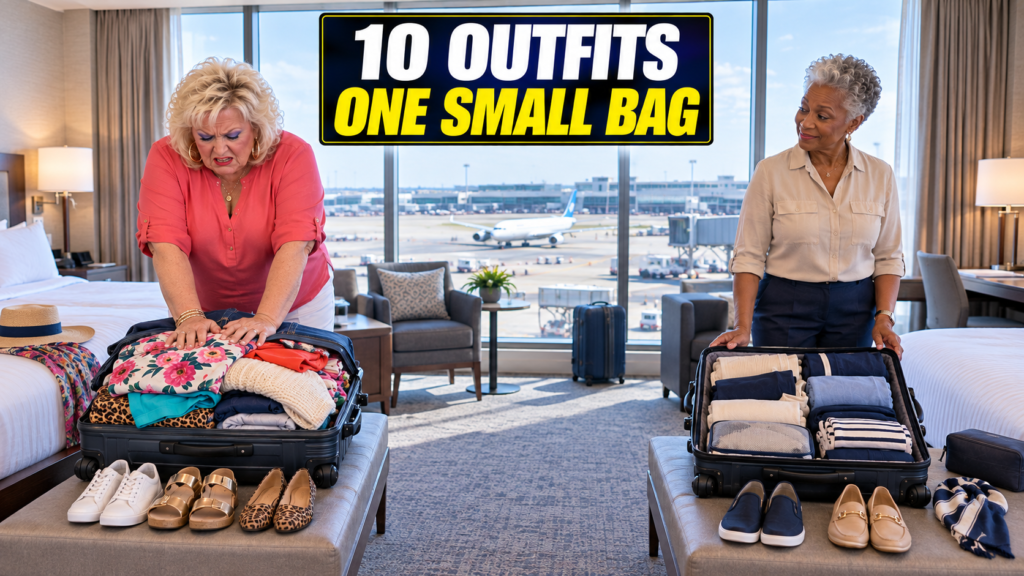
Over 60? Pack 10 Outfits in One Bag With This Simple Strategy
Sep
Packing for a trip can become surprisingly complicated.
You start with a few shirts. Then you add another pair of pants “just in case.” A nicer outfit goes in for dinner. Then a sweater. Another sweater because the first one might be too warm. Walking shoes, nicer shoes, backup shoes—and suddenly your carry-on looks like it needs someone to sit on it before the zipper will close.
If you’re trying to travel with one bag, there’s a much easier way to think about your clothes.
Don’t pack 10 complete outfits. Pack a small group of pieces that can create 10 outfits.
That is the basic idea behind a travel capsule wardrobe.
It isn’t about wearing identical clothes every day or reducing your wardrobe to an unrealistic handful of items. It’s about making sure most of what goes into your suitcase works with several other things you packed.
For travelers over 60, that can be particularly useful when the goal is comfort, easier luggage handling, and fewer decisions during the trip.
Here’s how I would build one.
1. Start With the Trip, Not the Clothes
One of the easiest packing mistakes is opening the closet before thinking about what you’ll actually be doing.
First, picture the trip.
Will you spend most days sightseeing? Will there be long walks? Restaurants? Museums? A cruise before or after the flight? A nicer dinner? Rain? Cool mornings followed by warm afternoons?
Your capsule needs to fit those activities.
A seven-day city trip with lots of walking needs a different wardrobe from a resort vacation or a cold-weather trip.
Before selecting individual pieces, I make a short list of the situations I expect:
- travel day
- casual sightseeing
- longer walking days
- nicer lunch or dinner
- cool morning or evening
- possible rain
- relaxed hotel time
Now every item has to earn its place.
If I can’t identify when I would realistically wear something, it probably doesn’t belong in the bag.
2. Choose a Small Color Palette
This is where capsule packing starts becoming much easier.
If every shirt only works with one particular pair of pants, you are essentially packing separate outfits.
Instead, choose a few colors that cooperate.
For example, a simple travel palette might include:
navy + cream + light blue + beige
You don’t have to use those colors. Black, gray, olive, white, brown, denim and other combinations can work just as well.
The important part is compatibility.
Ideally, most tops should work with most bottoms.
That means when one pair of trousers is unavailable, you don’t suddenly lose three outfits.
It also makes getting dressed easier. Instead of standing in a hotel room trying to remember which shirt was supposed to go with which pants, you have several combinations that already work.
3. Build Around Three Versatile Tops
For a compact capsule, I like starting with approximately three everyday tops.
The exact number should change according to trip length, climate, laundry access and personal needs, but the principle remains the same.
Each top should work with more than one bottom.
For example:
Top A: light blue
Top B: cream
Top C: subtle print containing colors already in the capsule
Avoid choosing three pieces that all require completely different accessories or layers.
Comfort matters too.
If you’re going to spend hours walking through an airport and then sightseeing, a shirt that looks wonderful but constantly needs adjusting may not deserve valuable carry-on space.
Think about breathable fabrics, easy movement and pieces you genuinely enjoy wearing.
4. Two Bottoms Can Do More Work Than You Think
Now add two bottoms.
This is where the math starts working in your favor.
If all three tops work with both bottoms, you already have:
3 tops × 2 bottoms = 6 basic combinations.
That’s six outfits before adding a layer or changing the overall look with shoes and accessories.
For example:
- Light-blue top + navy trousers
- Cream top + navy trousers
- Printed top + navy trousers
- Light-blue top + beige trousers
- Cream top + beige trousers
- Printed top + beige trousers
None of this requires packing six complete outfits.
You’re reusing the same five core pieces intelligently.
For the bottoms, I would prioritize comfort and versatility over novelty.
A pair of trousers that looks good but becomes uncomfortable after an hour of sitting is not a great travel piece.
Likewise, if one bottom only matches one shirt, it weakens the capsule.
5. Add One Lightweight Layer
A lightweight cardigan, overshirt or similar layer can dramatically increase the usefulness of your capsule.
It can help with cool airplane cabins, air-conditioned restaurants and temperature changes during the day.
More importantly for outfit planning, a layer can change the appearance of combinations you have already worn.
Take:
cream top + navy trousers
Now add your coordinating cardigan.
Visually, it becomes a different combination without requiring another complete outfit in the suitcase.
The important word here is lightweight.
A bulky layer can consume a large percentage of a carry-on. If your destination genuinely requires a heavy coat, that is a different packing problem. But for moderate conditions, a versatile lighter layer generally gives you more flexibility for the space it occupies.
6. Include One Slightly Dressier Option
A capsule wardrobe becomes less useful if everything you packed feels extremely casual.
You may want something appropriate for a nicer restaurant, evening event or other occasion where your daytime sightseeing clothes don’t feel quite right.
That does not necessarily mean packing an entire formal outfit.
Look for one piece that can elevate items already in the capsule.
Depending on your style, that could be:
- a polished lightweight layer
- a wrinkle-resistant blouse
- a simple dress
- a smarter shirt
- a scarf or other compact accessory
The goal is not formalwear for an event you’re unlikely to attend.
The goal is having enough flexibility that one nicer evening doesn’t require another pile of clothing.
7. Here’s How the Capsule Reaches 10 Looks
This is the part that often sounds impossible until you lay everything out.
Suppose the core wardrobe includes:
- 3 tops
- 2 bottoms
- 1 lightweight cardigan
- 1 dressier layer or piece
Your first six looks come from pairing each top with each bottom.
Then use the layers strategically.
For example:
Look 1: Light-blue top + navy trousers
Look 2: Cream top + navy trousers
Look 3: Printed top + navy trousers
Look 4: Light-blue top + beige trousers
Look 5: Cream top + beige trousers
Look 6: Printed top + beige trousers
Look 7: Light-blue top + navy trousers + cardigan
Look 8: Cream top + beige trousers + cardigan
Look 9: Printed top + navy trousers + dressier layer
Look 10: Cream top + navy trousers + dressier layer
That’s the basic concept.
Are Looks 1 and 7 made from some of the same clothes?
Of course.
That’s the point.
A capsule wardrobe creates different combinations from repeated pieces. It is not a promise that every look uses completely unique garments.
You can also vary the combinations with a scarf, jewelry or another compact accessory without adding much luggage volume.
8. Be Ruthless About Shoes
Clothes are only part of the problem.
Shoes can destroy an otherwise efficient carry-on strategy because they are bulky, relatively heavy and difficult to compress.
A common pattern looks like this:
walking shoes
dress shoes
sandals
backup walking shoes
“maybe” shoes
Suddenly a large section of the suitcase is gone.
For many trips, I would start by asking whether two carefully selected pairs can cover the expected activities.
For example:
Pair 1: comfortable walking/travel shoes
Pair 2: lighter or slightly dressier shoes
Your exact needs may differ. Hiking, formal events, beaches, winter weather and medical or orthopedic needs can all change the equation.
The important rule is not “everyone gets exactly two pairs.”
It’s this:
Every pair needs a real job.
And if possible, wear the bulkier pair while traveling rather than using valuable suitcase space for it.
9. Don’t Pack for Imaginary Emergencies
This is where many suitcases quietly become overloaded.
“What if it gets cold?”
“What if we go somewhere fancy?”
“What if these shoes hurt?”
“What if I spill something?”
“What if I suddenly need another sweater?”
Some contingency planning is sensible.
But packing for every imaginable scenario defeats the entire purpose of traveling light.
Instead, plan for probable situations and give yourself a reasonable backup strategy.
A lightweight layer can handle temperature changes.
A coordinated dressier piece can handle many dinners.
Laundry can reset frequently worn basics on longer trips.
A small stain-removal product may be more useful than packing several extra shirts solely because something might spill.
There is a difference between being prepared and carrying an entire second wardrobe for events that probably won’t happen.
10. Plan Laundry Before You Leave
A capsule wardrobe becomes much easier on longer trips when you know whether and how you can wash clothing.
Check your accommodation before departure.
Does your hotel have guest laundry?
Is laundry service available?
Will you have access to a washer halfway through the trip?
Would you be comfortable hand-washing a lightweight item if necessary?
You don’t necessarily need to wash clothes every day. But knowing you have an opportunity to refresh a few core pieces can dramatically reduce the urge to pack duplicates.
For a longer trip, one planned laundry session can be more valuable than several extra outfits.
11. Lay Everything Out Before It Goes Into the Bag
This is one of my favorite parts of the process.
Don’t immediately put each item into the suitcase as you choose it.
Lay the capsule out where you can see everything.
Put the tops in one row.
Put the bottoms beneath them.
Place the layer nearby.
Then start mentally creating combinations.
Ask:
Does Top 1 work with both bottoms?
Does Top 2?
Can the cardigan work with most of them?
Can my shoes work with several combinations?
This is where weak pieces reveal themselves.
Maybe you packed a beautiful shirt but it only works with one bottom.
Maybe one pair of shoes clashes with almost everything.
Maybe two sweaters perform exactly the same job.
Remove the pieces that aren’t contributing enough.
Your suitcase should be the final step—not the planning surface.
12. Pack for Comfort, Not Just Photographs
A capsule wardrobe still fails if you hate wearing it.
This matters especially on travel days.
You may spend hours sitting on an airplane, walking through terminals, waiting at baggage claim, getting into taxis and checking into hotels.
Choose clothes that allow comfortable movement.
Consider:
- waistbands that remain comfortable while sitting
- layers that are easy to remove
- shoes you can genuinely walk in
- fabrics appropriate for the climate
- garments that don’t require constant adjustment
For travelers with specific mobility, circulation, temperature or footwear needs, those requirements should take priority over any capsule formula.
Travel light—but not at the expense of your actual comfort.
13. Your Travel-Day Outfit Is Part of the Capsule
One of the easiest ways to save suitcase space is to stop treating the clothes you wear to the airport as separate from your vacation wardrobe.
Your travel-day outfit should ideally work again later.
For example, you might wear:
- one capsule top
- one capsule bottom
- your bulkiest practical shoes
- your main lightweight layer
Those pieces are now traveling on you instead of inside the bag.
Once you reach your destination, they can return to the normal mix-and-match rotation.
This is much more efficient than wearing a completely separate “airport outfit” that has no purpose for the rest of the trip.
14. Give Yourself a Final “Would I Actually Wear This?” Test
Before closing the suitcase, examine every questionable item.
Not the obvious essentials.
The maybes.
That extra blouse.
The third pair of shoes.
The bulky sweater.
The outfit for a hypothetical fancy dinner.
Ask one question:
Would I realistically choose this over the other clothes I already packed?
If the answer is no, remove it.
This is surprisingly effective because many people pack items they technically could wear rather than things they are actually likely to choose.
A good capsule is not the smallest wardrobe mathematically possible.
It is a collection of clothes you will genuinely use.
A Simple 10-Look Capsule Checklist
Here is the basic strategy in one place.
Core clothing
- 3 versatile tops
- 2 coordinating bottoms
- 1 lightweight layer
- 1 dressier layer or option
Footwear
- 1 primary comfortable walking/travel pair
- 1 second practical or slightly dressier pair, when appropriate
Optional small extras
- scarf
- compact jewelry
- belt
- other low-volume accessories
Then make sure your pieces coordinate well enough to produce at least 10 combinations you would actually be happy wearing.
Remember: this is a framework, not a universal packing rule.
A cold-weather trip may require more layers. A beach trip may require less. A formal event may require dedicated clothing. A traveler with specific footwear or health needs may need completely different choices.
Adjust the capsule to the trip rather than forcing the trip to fit the capsule.
The Real Goal Isn’t 10 Outfits
The number 10 makes this strategy easy to visualize, but the bigger lesson is more useful.
Stop measuring a travel wardrobe by how many individual garments you packed.
Start measuring it by how many useful combinations those garments create.
That one change can turn an overflowing suitcase into a much more manageable packing system.
Instead of ten shirts for ten days, perhaps three shirts work with two bottoms and multiple layers.
Instead of four pairs of shoes “just in case,” perhaps two pairs cover nearly everything you actually plan to do.
And instead of arriving with a suitcase full of clothes you never touch, you arrive with pieces that were selected because they work together.
Before your next trip, lay everything out before packing.
Then ask:
Am I packing outfits—or am I packing possibilities?
That’s the capsule wardrobe difference.
