
CRUISE NEW
EVERYONE CRAMMED INTO THE ELEVATOR — BUT NO ONE WOULD GET OUT
Sep
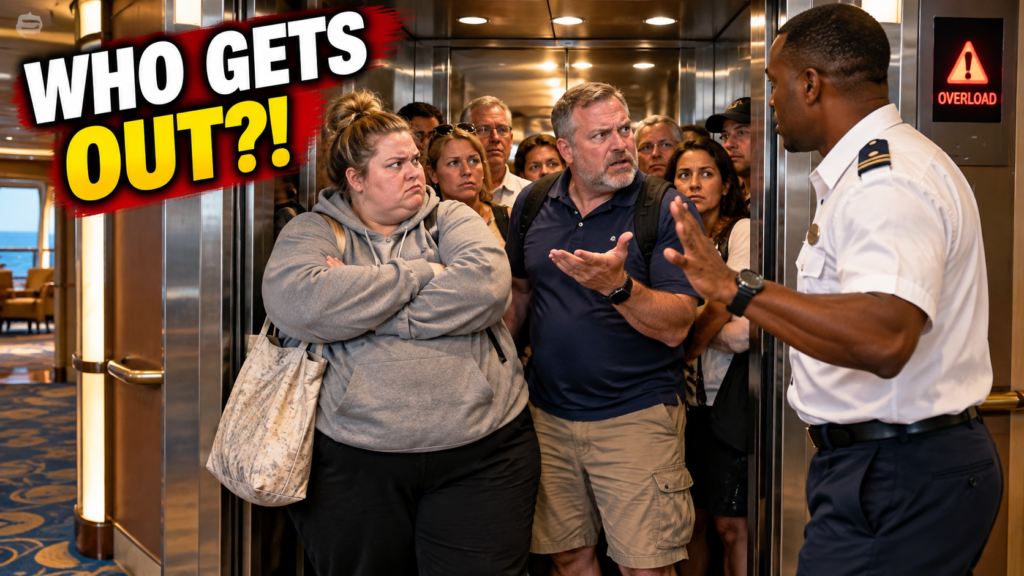
The elevator doors opened after a packed evening show, and everyone had exactly the same idea.
Get in.
Within seconds, the cruise ship elevator was shoulder-to-shoulder with passengers. People were carrying drinks, shopping bags and purses. Someone was trying to squeeze into the back. Another passenger was holding the door.
Then two more people pushed inside.
The elevator didn’t go anywhere.
A crew member approached and delivered the obvious solution:
“Folks, this elevator is overloaded. I need a few people to step out.”
Silence.
Everyone looked at everyone else.
Nobody moved.
One man finally protested:
“Why me? I was here first!”
A woman immediately responded:
“I’m not getting out either. I’ve already waited ten minutes!”
And suddenly, one of the most ordinary parts of a cruise vacation had turned into a ridiculous standoff.
If you’ve taken enough cruises, you probably recognize the larger problem. Cruise ship elevators can become extremely busy at predictable times, particularly after shows, dinner, port arrivals and other major events.
But what should passengers actually do when an elevator is already packed? What happens when it reaches its capacity? And what about passengers who depend on elevators because stairs aren’t a practical option?
The answers reveal why a little cruise elevator etiquette can make life much easier for everyone onboard.
WHY CRUISE SHIP ELEVATORS GET SO CROWDED- EVERYONE CRAMMED INTO THE ELEVATOR
A modern cruise ship can carry thousands of people.
And those thousands of people frequently move at the same time.
A theater show ends.
Hundreds of guests stand up.
Dinner finishes.
Passengers head toward entertainment venues.
The ship arrives in port.
Everyone wants to reach the gangway.
A deck party finishes.
Everyone heads back toward their cabins.
The elevators suddenly become one of the biggest bottlenecks on the ship.
It isn’t necessarily because the ship has too few elevators.
The problem is concentrated demand.
Imagine a theater emptying hundreds of passengers into nearby corridors within several minutes. Many of those passengers are trying to reach the same elevator banks at approximately the same time.
That is how you get the familiar cruise scene:
DING.
Doors open.
The elevator is already almost full.
And five more people try to squeeze inside anyway.
AN ELEVATOR DOESN’T HAVE UNLIMITED CAPACITY
This sounds obvious, but crowded elevators sometimes make people forget it.
Passenger elevators are designed around capacity and load limits.
That applies on land, and elevators installed aboard passenger vessels are also subject to technical and safety standards.
The U.S. Access Board’s guidance for passenger vessels, for example, discusses elevator accessibility and references recognized elevator safety standards including ASME A17.1.
The practical lesson for passengers is simple:
A cruise ship elevator is not an unlimited box.
The fact that another human being can physically squeeze through the doorway does not mean everyone should keep squeezing in.
If an elevator indicates that its load limit has been reached or crew members tell passengers that people need to step out, arguing does not solve the problem.
Reducing the load does.
WHO SHOULD GET OUT FIRST? EVERYONE CRAMMED INTO THE ELEVATOR
Now we reach the awkward part.
Suppose 12 people are inside an elevator.
The elevator indicates an overload condition.
Someone needs to leave.
Who should it be?
There is no universal cruise rule saying:
“The youngest passenger must leave first.”
There is no universal rule saying:
“The heaviest passenger must leave.”
And turning the situation into an argument about another passenger’s body size is both unnecessary and unlikely to solve anything.
The simplest solution is usually voluntary cooperation.
If you’re physically able to step out and wait for the next elevator—or use the stairs when appropriate—you can solve the problem in seconds.
Someone has to make the first move.
Once one person volunteers, another often follows.
The elevator leaves.
The next one arrives.
Everyone moves on with their vacation.
Instead, passengers sometimes turn a 30-second inconvenience into a five-minute confrontation because nobody wants to lose their place.
“BUT I WAS HERE FIRST!”
This is probably the most predictable argument.
You waited.
You got into the elevator.
Then someone else squeezed inside.
Now the elevator cannot proceed normally.
Why should you have to leave?
Emotionally, the argument makes sense.
Operationally, it doesn’t help.
If everyone inside says:
“I’m not moving because someone else should move first,”
the result is an elevator full of people going nowhere.
This is where basic courtesy beats winning the argument.
You may technically have been waiting longer.
You may have entered first.
You may believe another passenger caused the problem.
But if you’re capable of stepping out without significant difficulty, volunteering can end the entire standoff.
Sometimes being right is less useful than getting everyone moving again.
DON’T TURN BODY SIZE INTO THE ARGUMENT
An overcrowded elevator can quickly become personal.
Someone looks around and decides another passenger is taking up too much space.
Then comes the comment nobody needed:
“You take up enough room for two people.”
Now the problem isn’t the elevator.
It’s an argument.
Capacity should be handled according to the elevator’s actual operating conditions and crew instructions—not passenger guesses about another person’s body.
Passengers should not appoint themselves human scales.
If the elevator is overloaded, let the system and crew handle the issue.
The goal is to reduce the load safely.
Humiliating another passenger contributes nothing.
WHY CREW INSTRUCTIONS MATTER
A crew member who asks passengers to step out is not trying to ruin someone’s evening.
They are trying to resolve an operational and safety issue.
Cruise lines maintain guest-conduct policies requiring passengers to follow safety-related instructions from ship personnel.
That matters throughout the ship—not just inside elevators.
If a crew member says an elevator cannot proceed with its current load, the useful response is cooperation.
Not:
“Make somebody else get out.”
Not:
“I paid thousands for this cruise.”
And definitely not:
“I’m staying here until you make it move.”
Crew members cannot make the elevator’s safe operating limits disappear because someone purchased an expensive cabin.
THE PASSENGERS WHO REALLY NEED THE ELEVATOR
There is another part of cruise elevator etiquette that deserves more attention.
Not every passenger has the same mobility.
Some guests use wheelchairs.
Some use mobility scooters.
Some use walkers.
Some have medical or mobility limitations that are not immediately visible.
Others may simply be unable to climb several flights of stairs safely.
For these passengers, an elevator isn’t merely a convenience.
It can be essential transportation around the ship.
Major cruise lines specifically design accessible routes around this reality.
Carnival’s accessibility information, for example, describes elevator features including tactile controls and audible signals intended to assist guests with disabilities.
Royal Caribbean likewise identifies elevators and ramps as part of its accessibility infrastructure.
So when a packed elevator opens and a wheelchair user is waiting outside, it is worth remembering that some people cannot simply say:
“I’ll take the stairs.”
You might be able to.
They might not.
That doesn’t require inventing a universal rule that wheelchair users legally “own” the elevator.
It simply requires courtesy and awareness.
MOBILITY SCOOTERS CREATE A DIFFERENT SPACE REQUIREMENT
Mobility scooters can take up substantial elevator floor space.
That sometimes frustrates other passengers during busy periods.
But again, perspective matters.
The person using that scooter may rely on it to move around the ship.
For them, taking six flights of stairs isn’t a realistic alternative.
If you’re an able-bodied passenger traveling one or two decks and the elevator bank is overwhelmed, consider using the stairs.
You aren’t legally required to turn every elevator into an accessibility-only space.
But cruise vacations work better when passengers recognize that their own convenience isn’t always the highest priority in the room.
KEEP THE ELEVATOR LOBBY CLEAR
The etiquette problem doesn’t end inside the elevator.
The lobby matters too.
Royal Caribbean’s current accessibility guidance says mobility scooters and other assistive devices should be stored in guest staterooms and notes that corridors, fire doors and elevator lobbies need to remain clear for emergency evacuation.
That’s an important reminder for everyone.
Don’t leave scooters parked in elevator lobbies.
Don’t abandon luggage directly in front of the doors.
Don’t form a giant semicircle that prevents passengers from exiting.
Don’t block the path while deciding which deck you’re going to.
An elevator lobby is a circulation space.
People need to move through it.
LET PEOPLE OUT BEFORE YOU GET IN
This may be the single most violated elevator rule on cruise ships.
The doors open.
Passengers waiting outside immediately move forward.
Meanwhile, the people inside are trying to leave.
Everyone collides in the doorway.
There is an incredibly easy solution:
Stand aside and let passengers exit first.
Once people get out, there is more room inside.
You can see how crowded the elevator actually is.
And boarding becomes much faster.
Trying to force your way inside before passengers exit accomplishes the opposite.
It creates congestion exactly where congestion is least useful.
STOP HOLDING THE DOOR FOR EVERYONE YOU KNOW
Another familiar scene:
A passenger enters the elevator.
Their spouse is still walking down the hallway.
Their children are coming around the corner.
Their friends are 50 feet away.
So they hold the elevator.
Everyone inside waits.
Then another friend appears.
The door gets held again.
Courtesy toward your group can become discourtesy toward everyone already inside.
If your entire party isn’t ready, sometimes the better choice is to let the elevator leave and take the next one together.
Your fellow passengers did not sign up to become hostages to your family reunion.
DON’T RUSH A CLOSING DOOR
You see the doors closing.
Your instinct says:
RUN!
Maybe you stick out an arm.
Maybe you throw a shopping bag between the doors.
Maybe you shout for someone inside to hold them.
Occasionally another passenger will help.
But if the doors are already closing and the elevator is packed, letting it leave is often the better option.
Another elevator is coming.
There is no reason to create chaos because this particular elevator happened to arrive first.
Cruise vacations are supposed to slow life down a little.
The elevator is a good place to practice.
THE STAIRS CAN SOMETIMES BE FASTER
Here’s one of the simplest cruise hacks:
If you’re physically able and only traveling one or two decks, take the stairs during peak periods.
You may arrive faster.
Cruise ship elevators can make numerous stops.
A ride from Deck 5 to Deck 7 can take longer than walking when everyone is moving after a show.
Stairs also free elevator capacity for passengers traveling many decks or those who genuinely need elevator access.
Obviously, this advice does not apply to everyone.
Mobility limitations, medical conditions, age and other factors matter.
But if stairs are easy for you, they can be the fastest solution to elevator congestion.
KNOW THE WORST TIMES
Cruise elevator traffic isn’t random.
Certain moments predictably create congestion.
Immediately after major theater shows
Hundreds of people leave simultaneously.
Around popular dinner times
Passengers move between cabins, restaurants, bars and entertainment venues.
When arriving in port
Large numbers of guests head toward gangways.
When passengers return from port
Everyone comes back carrying bags, towels and purchases.
Embarkation day
Passengers are learning the ship while sometimes managing carry-ons.
Around major deck events
When an activity ends, traffic can shift suddenly.
If you’re not in a hurry, waiting five or ten minutes can completely change the experience.
DON’T PACK INTO AN OBVIOUSLY FULL ELEVATOR
Sometimes you don’t need a warning indicator.
The doors open.
People are already shoulder-to-shoulder.
Someone is pressed against the control panel.
Another passenger is holding shopping bags against their chest because there is nowhere to put them.
And still somebody says:
“We can fit!”
Can you?
Maybe.
Should you?
Probably not.
Let it go.
The next elevator may arrive nearly empty.
Forcing yourself into a visibly packed elevator saves very little time and makes everyone uncomfortable.
WHAT IF THE ELEVATOR INDICATES OVERLOAD?
Don’t panic.
An overload indication does not mean the elevator is about to plunge through the ship.
It means the situation needs to be corrected according to the equipment’s operation.
The practical response is simple:
Reduce the load and follow crew instructions.
Passengers should not invent dramatic explanations about cables snapping or elevators falling.
Modern passenger elevators incorporate safety systems and are operated within defined specifications.
The solution to too many people inside is not an argument.
It is fewer people inside.
WHAT IF NOBODY VOLUNTEERS?
Then you’ve reached the absurd situation from our opening scene.
The crew member says:
“I need a few people to step out.”
Nobody moves.
One passenger says:
“I was first.”
Another says:
“I’ve waited ten minutes.”
Someone points at somebody else.
Nobody volunteers.
And the elevator remains where it started.
At that point, the problem isn’t really technology.
It’s human behavior.
A functioning elevator full of adults has been defeated by the fact that nobody wants to wait another minute.
Eventually, passengers need to follow the crew’s directions so the situation can be resolved safely.
The faster people cooperate, the faster everyone—including the people who step out—gets where they’re going.
CRUISE ELEVATOR ETIQUETTE IN 8 SIMPLE RULES
You don’t need an entire rulebook.
Remember these:
1. Let people exit before entering.
2. Don’t force yourself into an obviously full elevator.
3. Follow posted capacity information and crew instructions.
4. If you’re able to use stairs for one or two decks during peak periods, consider doing it.
5. Be considerate of guests who rely on wheelchairs, scooters, walkers or accessible routes.
6. Don’t block elevator lobbies with luggage, scooters or groups of people.
7. Don’t insult another passenger’s weight or body size during an overload situation.
8. If someone needs to step out and you can easily volunteer, sometimes just be that person.
Rule eight may be the most important.
WHAT CRUISE PASSENGERS SHOULD NOT CLAIM
Social media has a habit of turning ordinary cruise situations into fake “rules.”
Be skeptical of claims like:
“Cruise elevators are legally limited to exactly ten passengers.”
Capacity varies by elevator.
Or:
“The youngest passenger has to leave first.”
There is no universal rule like that.
Or:
“Wheelchair passengers legally have priority on every elevator on every cruise line.”
Accessibility is important, but don’t invent a universal legal rule that isn’t supported.
Or:
“If you overload a cruise elevator, the captain can fine you $500.”
There is no universal cruise fine like that.
And definitely avoid:
“An overloaded elevator could fall into the ocean.”
That is sensationalism, not useful cruise advice.
Good cruise content doesn’t need fake rules.
The real human behavior is entertaining enough.
FAQ: CRUISE SHIP ELEVATOR ETIQUETTE
Do cruise ship elevators have weight limits?
Passenger elevators operate within designed capacity and load limits. Passengers should follow posted information, elevator indications and crew instructions.
How many people can fit in a cruise ship elevator?
There is no single number that applies to every cruise elevator. Ships and elevator models differ. Check the information for the specific elevator rather than relying on a universal number from social media.
Who should leave if a cruise elevator is overloaded?
There isn’t a universal rule assigning one particular passenger. Cooperation and crew instructions should resolve the situation. If you can easily step out and take the next elevator, volunteering is often the fastest solution.
Should wheelchair users get elevator priority?
Passengers should be considerate of guests who rely on accessible routes and may not be able to use stairs. However, avoid claiming a universal legal priority rule unless the cruise line or applicable regulation specifically establishes one.
Can mobility scooters use cruise ship elevators?
Cruise ships accommodate guests with mobility disabilities, including guests who use mobility devices, subject to the cruise line’s accessibility and equipment requirements.
Can scooters be left in the elevator lobby?
Don’t assume so. Royal Caribbean, for example, says scooters and assistive devices must be stored in staterooms and that elevator lobbies and corridors must remain clear for emergency evacuation.
Should I take the stairs instead?
If you are physically able and only traveling a small number of decks, stairs can be quicker during busy periods. Guests with mobility or medical limitations should use whichever accessible route is appropriate for them.
What should I do when elevator doors open?
Stand aside first.
Let everyone who needs to exit leave.
Then board if there is sufficient room.
It’s astonishing how many elevator problems disappear when people follow this one simple habit.
THE REAL PROBLEM ISN’T THE ELEVATOR
Cruise ships put thousands of strangers together in a relatively limited space.
That is part of what makes cruising interesting.
It is also why basic courtesy matters.
You share hallways.
You share restaurants.
You share pool decks.
You share theaters.
And, yes, you share elevators.
Most elevator conflicts don’t require security.
They don’t require a new rule.
They don’t require somebody screaming about what they paid for their vacation.
They require patience.
If the elevator is full, wait.
If people are getting out, move aside.
If you can take the stairs, consider doing it.
If another passenger genuinely depends on accessible transportation, show some awareness.
And if the elevator is overloaded and a crew member says a few passengers need to leave, staring at everyone else while refusing to move accomplishes exactly one thing:
Nobody goes anywhere.
Sometimes the easiest way to improve your cruise vacation is also the simplest.
Wait for the next elevator.
