
CRUISE TIP
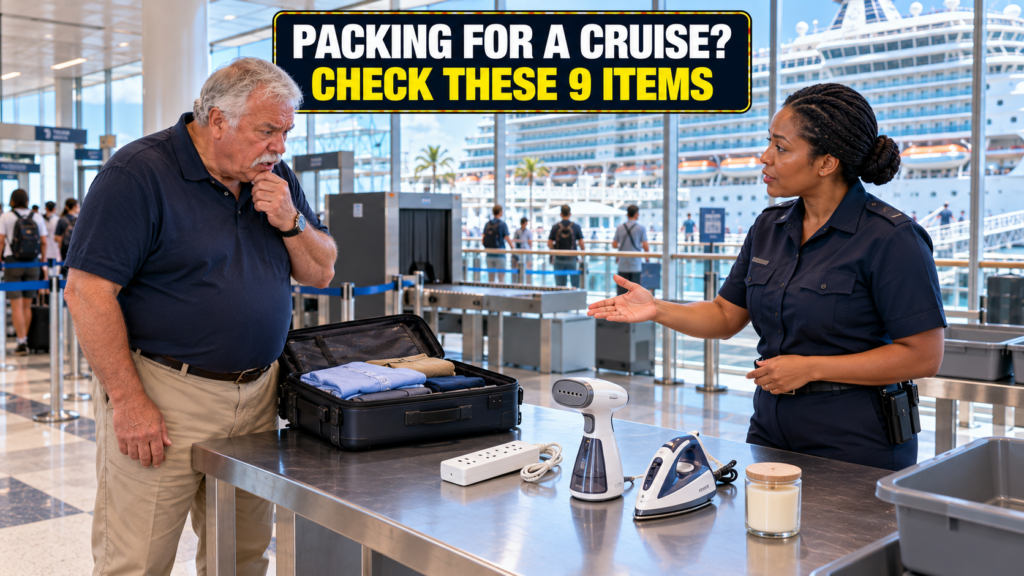
Packing for a Cruise? 9 Cruise Items to Check Before You Pack
Sep
Most cruise passengers know the basic packing routine: bring your passport or other required travel documents, medications, comfortable shoes, chargers, sunscreen and enough clothes for the itinerary. Experienced cruisers may even keep a permanent packing checklist so they can zip the suitcase without thinking twice.
But there is another checklist that deserves just as much attention: what your particular cruise line does not want you to bring onboard.
That can be surprisingly easy to overlook. A power strip may seem like the perfect solution for a cabin with limited outlets. A garment steamer seems useful for dinner clothes. A small coffee maker can feel like a harmless convenience. Candles, an extension cord, a heating pad or even a familiar electronic device may already be part of your normal travel routine.
The problem is that cruise ships have safety, electrical and security rules that are different from those at a hotel—and the rules are not identical across cruise lines. Current prohibited-item policies from major operators include restrictions involving extension cords, power strips, irons, steamers, heating appliances, candles and incense, cannabis products, certain recreational devices and even some less-obvious household or electronic items.
That does not mean every item below is prohibited by every cruise line. Policies can vary by company, ship, itinerary, departure country, device type and the reason you need the item. Some equipment may also require advance review rather than simply being packed.
Timing matters, too. Discovering a restriction at home gives you time to find an alternative. Discovering it during embarkation screening can mean surrendering an item, additional inspection or delayed luggage.
Before you close your suitcase, here are 9 categories worth checking, why each one matters, who needs to pay particular attention, when to check, and exactly what to confirm with your cruise line.
1. Power Strips and Multi-Plug Outlets
Cruise cabins can quickly turn into charging stations. A couple may have two phones, watches, a tablet, headphones and other rechargeable devices competing for available outlets.
That makes a household power strip or multi-plug adapter seem like an obvious thing to pack.
But electrical-distribution devices are one area where assumptions can cause trouble. Royal Caribbean’s current prohibited-items policy includes power strips and multi-plug outlets among electrical equipment that is prohibited, while other cruise lines can apply different standards or exceptions. Disney Cruise Line also lists power strips, multi-plugs and surge protectors among prohibited electrical items.
Why it matters
This is especially relevant to travelers who carry several rechargeable devices or who have become accustomed to using the same power strip in hotels.
Something sold online as suitable for travel is not automatically approved by your cruise line. Likewise, successfully taking a device on a previous cruise does not prove that the same device is permitted on your next sailing.
What to ask
- Are power strips or multi-plug adapters permitted on my specific cruise line?
- Does the presence of surge protection change the rule?
- What type of USB charging hub or outlet adapter, if any, is permitted?
Important limitation
There is no single rule that should be assumed across the entire cruise industry. Check the current official prohibited-items page for the cruise line you are actually sailing before buying or packing an outlet-expansion device.
2. Extension Cords
An extension cord may seem like an ordinary travel accessory, but it can become much more important for a passenger who needs electrical equipment positioned near the bed or another particular part of the cabin.
Major cruise lines can prohibit guests from bringing ordinary personal extension cords. Royal Caribbean currently includes extension cords in its prohibited electrical-equipment category, and Disney Cruise Line lists them among prohibited electrical items as well.
Why it matters
For most passengers, leaving an extension cord at home is an inconvenience. For someone who relies on electrical medical or accessibility equipment, simply removing it from the packing list without making another arrangement may create a much bigger problem.
That is why the correct solution is not to hide or quietly pack the cord. It is to contact the cruise line in advance.
What to ask
- May I bring my own extension cord?
- If not, can the ship provide an approved solution for my equipment?
- Does my medical or accessibility equipment require advance review?
- How far in advance should I contact the accessibility team?
Important limitation
Do not assume that a general prohibition means legitimate accessibility needs cannot be accommodated. At the same time, a medical need does not automatically make a personally supplied electrical device acceptable. Contact the cruise line before sailing and explain what equipment you actually need to power.
3. Clothing Irons
A compact travel iron looks useful when dress shirts, blouses or formal-night clothing emerge from a suitcase covered in wrinkles.
On a cruise ship, however, the concern is not how small the iron is. It is the heat it produces.
Royal Caribbean explicitly lists clothing irons as prohibited, Disney Cruise Line prohibits electric irons, and Norwegian Cruise Line’s current prohibited-items information restricts devices containing heating elements, including clothing irons.
Why it matters
Passengers sometimes assume that “travel size” means “travel permitted.” Those are two different things.
A compact appliance can still fall under a ship’s fire-safety restrictions.
What to ask
- Are personal clothing irons permitted onboard?
- Does my ship offer laundry or pressing services?
- Are passenger-accessible ironing facilities available on this particular ship?
- What wrinkle-removal alternatives does the cruise line recommend?
Important limitation
Do not assume that every ship provides the same alternative. For example, Disney says its ships provide self-service laundry facilities with irons and ironing boards, but facilities and services differ across cruise lines and ships.
Check your actual vessel before deciding what you will use instead.
4. Garment Steamers
A garment steamer can feel like the clever workaround to the iron problem.
Unfortunately, that assumption can fail too.
Royal Caribbean currently identifies garment steamers as prohibited. Disney Cruise Line also prohibits electric steamers.
Why it matters
This item is easy to pack without thinking because many travelers view a steamer as a grooming or clothing-care accessory rather than a potentially restricted heating appliance.
For passengers planning specialty dining, formal evenings, celebrations or photographs, discovering the restriction at embarkation is too late to rethink how they will handle wrinkled clothing.
What to ask
- Does my cruise line permit garment steamers?
- What pressing or laundry services are available onboard?
- How much do those services cost?
- Is there a self-service option on my ship?
Important limitation
Hair-styling appliances and garment-care appliances may be treated differently. Do not conclude that because a cruise line permits a curling iron or hair straightener, it must also permit a garment steamer.
Check the exact appliance category.
5. Coffee Makers, Kettles and Other Heating Appliances
For many travelers, especially those who wake early, a personal coffee maker or kettle is part of the normal morning routine.
A cruise cabin is not a hotel kitchenette, however.
Current cruise-line rules commonly restrict appliances containing heating elements. Disney Cruise Line specifically lists coffee makers and several other heating appliances as prohibited. Norwegian Cruise Line lists equipment containing heating elements, including coffee machines with heating or hot plates. Royal Caribbean’s safety policy also prohibits various heat-producing appliances.
Why it matters
The inconvenience is avoidable if you check before sailing.
Instead of packing a personal appliance, you can investigate where coffee, tea or hot water is available onboard and whether room service or another venue meets your needs.
What to ask
- Is my specific appliance permitted?
- Where can I get coffee or hot water early in the morning?
- Is room service available for hot water or beverages?
- Are there any cabin-category benefits that change my available options?
Important limitation
Do not generalize from one appliance to another. Cruise-line policies can distinguish among coffee makers, kettles, hair dryers, curling irons and other electrical devices.
Verify the exact device you intend to bring.
6. Candles, Incense and Other Open-Flame Items
A scented candle may make a cabin feel more like home. Incense may be part of someone’s normal relaxation routine.
On a ship, an open flame creates an obvious safety concern.
Royal Caribbean prohibits items that produce open flames, including candles and incense. Norwegian Cruise Line prohibits candles and incense burners, and Disney Cruise Line also lists candles and incense among prohibited household items.
Why it matters
This is one of the easier categories to avoid because there is usually no reason to wait until embarkation to find out.
If you want a particular cabin atmosphere, choose a non-flame alternative that complies with the cruise line’s rules.
What to ask
- Are candles or incense permitted?
- Are battery-operated decorative lights permitted?
- Are diffusers or other fragrance devices restricted?
- Does the cruise line restrict decorative electrical devices as well?
Important limitation
“Flameless” does not automatically mean “permitted.” Disney, for example, also restricts certain electrical and household devices. Check the specific alternative rather than assuming anything without a flame is acceptable.
7. Marijuana, Cannabis and CBD Products
This is one category where relying on the law at home can create a serious travel mistake.
A cannabis or CBD product being legal where you live does not automatically make it acceptable on a cruise.
Royal Caribbean’s current policy prohibits marijuana regardless of medical authorization or local legality. Carnival’s current prohibited-items information lists marijuana, cannabis and cannabis-derived products, including CBD, as prohibited. Cruise itineraries can also cross multiple jurisdictions with their own drug laws.
Why it matters
The consequences can extend beyond losing an item.
Cruise passengers travel through terminals, ships and foreign ports where different laws and enforcement rules may apply. A prescription, medical authorization or legal purchase at home should never be treated as automatic permission to travel internationally with a cannabis-related product.
What to ask
- Does my cruise line prohibit the exact cannabis or CBD product I use?
- What are the laws at my embarkation port and ports of call?
- If I use a product for medical reasons, what legal alternative should I discuss with my healthcare professional before travel?
Important limitation
Do not rely on advice from another passenger, an online forum or the rules of your home state. This category involves both cruise-line policy and potentially local or national law.
Verify before traveling.
8. Hoverboards, Scooters and Certain Recreational Devices
Not everything on a prohibited-items list looks like a traditional dangerous object.
Norwegian Cruise Line’s current list, for example, includes self-balancing hoverboards, air wheels, scooters and Segways. Royal Caribbean also restricts certain recreational vehicles and devices.
Why it matters
The important distinction for older passengers is between recreational equipment and equipment genuinely required for mobility or accessibility.
Someone traveling with a mobility device should not look at a restriction involving recreational scooters and assume that their necessary mobility equipment is automatically treated the same way.
What to ask
- Is my particular device considered recreational equipment or mobility equipment?
- Are there size, battery or storage requirements?
- Does the cruise line need advance notice?
- Are there cabin or doorway dimensions I need to confirm?
Important limitation
Accessibility equipment has its own requirements and procedures. If you rely on a scooter, wheelchair or another mobility device, contact the cruise line’s accessibility department with the exact model and specifications rather than relying on a generic prohibited-items list.
9. The Surprising Items That Vary by Cruise Line
This final category is the reason you should read the actual policy instead of relying on a generic “what not to pack” article—including this one.
Cruise-line lists contain company-specific items that many passengers would never think to search for.
Disney Cruise Line’s current prohibited-items information, for example, includes over-the-door hanging organizers and hooks, certain streaming devices and various electrical or household items. Norwegian Cruise Line’s current list includes items such as walkie-talkies and portable modems, along with several other categories.
Why it matters
Experience can actually make a traveler overconfident.
If you have taken 10 cruises, you may be more likely to think, “I always bring this.”
But changing cruise lines—or even changing the type of device you pack—can change the answer.
What to ask
- What is on my cruise line’s current official prohibited-items list?
- Has the policy changed since my previous sailing?
- Are there separate rules for electrical devices, batteries or household items?
- Does my itinerary or departure country add additional restrictions?
Important limitation
Never turn another cruise line’s prohibited list into a universal rule.
A restriction published by Disney, Royal Caribbean, Norwegian or Carnival proves what that company currently says about the relevant item; it does not automatically prove that every other cruise line follows the same rule.
The 5-Minute Check Before You Zip Your Suitcase
You do not need to memorize every cruise restriction.
You need to know where to check.
First, go directly to the official website of the cruise line operating your sailing and find its current prohibited or restricted items page. Pay particular attention to electrical appliances, batteries, heating devices, medical or accessibility equipment and anything unusual you plan to carry.
Second, check the exact item, not merely the general category. “Electrical device” is too broad when a cruise line may permit one grooming appliance while prohibiting another heating appliance.
Third, if you rely on medical, mobility or accessibility equipment, contact the cruise line before departure. Ask what information it needs, what equipment you may bring and whether an approved alternative can be provided.
Fourth, consider the itinerary. Your ship is only one part of the journey. Embarkation ports and destinations can have laws or restrictions that matter too.
Finally, do the check before the suitcase is closed—not while standing at security.
The simplest rule to remember is this:
“I brought it on my last cruise” does not mean “I can bring it on this cruise.”
Cruise lines maintain their own policies, and those policies can change. Five minutes spent checking the current official rules before leaving home can prevent a surprisingly frustrating start to your vacation.
