
CRUISE NEW
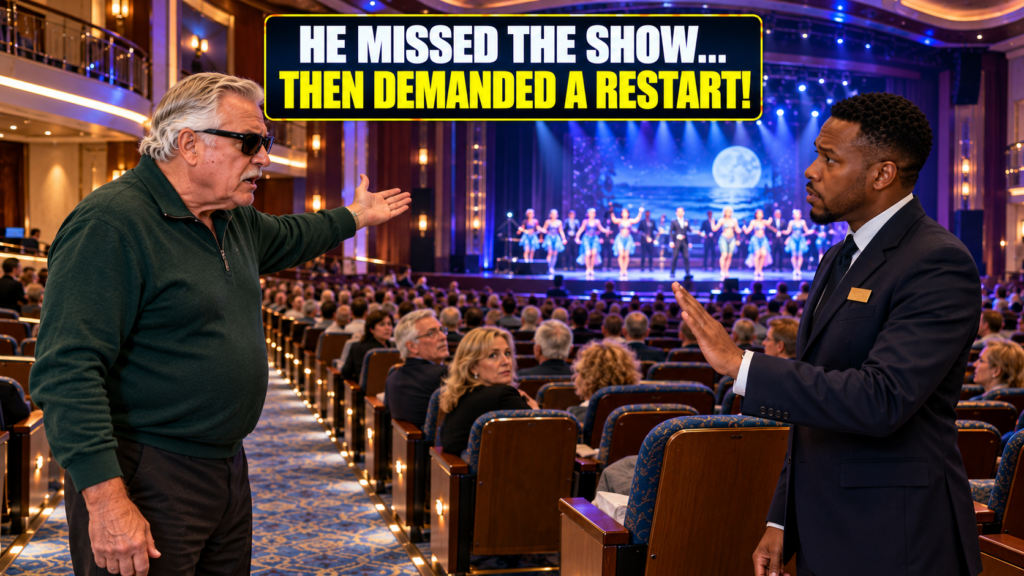
He Missed Part of a Cruise Show Then Demanded They Stop It, Perform It Again, or Give Him a Refund
Sep
Part 1 — “Stop the Show.”
The theater was nearly full when Robert Mercer decided he couldn’t wait any longer.
At seventy, Robert was still a big, imposing man, the kind of passenger who could fill an aisle simply by standing in it. He had spent most of the evening watching the ship’s headline production from a good seat several rows back from the stage.
Then, halfway through one of the biggest musical numbers, he needed the restroom.
Robert slipped out through the side aisle.
The performance continued.
The singers kept singing. The dancers moved into the next sequence. The audience applauded, and within several minutes the production had already moved on.
When Robert returned, he stopped at the entrance instead of heading back to his seat.
He stared toward the stage.
Then he turned to the usher stationed beside the aisle.
“Wait. What happened to the number they were doing before?”
The usher leaned closer so he wouldn’t have to raise his voice over the performance.
“It finished a few minutes ago, sir.”
Robert frowned.
“I didn’t see the end.”
“I’m sorry, sir.”
Robert looked back toward the stage as though waiting for something to happen.
Nothing did.
The next scene continued.
“So when are they going to do it again?”
The usher hesitated.
“If you mean another performance, Guest Services can help you check whether this production has another scheduled showing during the voyage.”
Robert shook his head.
“No. I mean tonight.”
The usher stared at him.
Robert pointed toward the stage.
“Start that part over.”
For a moment, the usher seemed unsure whether Robert was joking.
He wasn’t.
“Sir, this is a live performance.”
“I know that.”
Robert’s voice rose just enough for several nearby passengers to turn around.
“I missed that whole part. Stop the show and do it again.”
A woman seated near the aisle glanced over her shoulder. Her husband looked at Robert, then quickly back at the stage.
The usher kept his voice low.
“Sir, we can’t restart a live show for one guest.”
Robert’s expression hardened.
“But I paid for the whole show.”
“Yes, sir, but the performance continued while you were outside.”
“That’s exactly the problem.”
The usher blinked.
Robert gestured toward the stage again.
“I wasn’t here.”
A few more heads turned.
The usher lowered his voice even further.
“I understand that, sir.”
“Then fix it.”
“We cannot stop the performance and ask the cast to repeat a section.”
Robert stared at him as if the answer were completely unacceptable.
He had apparently expected resistance.
He had not expected a flat refusal.
“All right,” he said.
The usher probably thought the argument was finished.
Instead, Robert folded his arms.
“If you won’t replay what I missed, then there’s another way you can fix it.”
The usher waited.
Robert pointed toward the theater exit.
“Give me my money back.”
Part 2 — “Then Give Me My Money Back.”
The usher took a second before answering.
“Sir, what refund are you requesting?”
“The show.”
Robert said it as if the answer should have been obvious.
“I paid for this cruise. Entertainment is part of what I paid for. I left for a few minutes, and you people kept going.”
The usher glanced toward the stage.
“Yes, sir. Because it’s a scheduled live performance.”
Robert leaned forward slightly.
“Then stop it.”
Several passengers turned again.
This time one of them whispered, “Come on.”
Robert heard it.
He looked toward the seats.
“I’m talking to the employee.”
The passenger immediately turned back toward the stage.
The usher remained composed.
“Sir, people are trying to watch the performance.”
“So am I!”
That response earned Robert several incredulous looks.
The usher motioned toward the open lobby behind them.
“If you’d like to discuss this, I can speak with you outside so we don’t disturb the other guests.”
“No. I want to see the show.”
“Then you’re welcome to return to your seat.”
“But I missed part of it!”
They had arrived back at exactly the same argument.
Robert pointed toward the stage once more.
“I’m giving you two options. Have them redo what I missed, or give me my money back.”
“I’m not able to do either of those things.”
“Then get someone who can.”
“Sir—”
“Manager.”
Robert’s voice was now louder than the dialogue coming from the nearest section of the stage.
“Get your manager.”
The usher finally nodded.
“Please remain here.”
“I’m not going anywhere.”
That turned out to be true.
Robert stayed in the aisle while the performance continued behind him.
Ironically, he barely watched it.
He was too busy shaking his head, checking the lobby, and occasionally looking toward the usher as if wondering why the manager had not materialized instantly.
A few minutes later, a theater manager approached.
She introduced herself quietly and asked Robert to explain the problem.
Robert did.
At length.
He explained that he had been enjoying the production. He explained that he had needed the restroom. He explained that when he returned, the performers had moved on without him.
Then he reached his conclusion.
“So I asked them to replay that section. He says they won’t.”
The manager nodded.
“That’s correct.”
“Then I want a refund.”
“For the cruise?”
“For what I missed!”
The manager maintained a remarkably neutral expression.
“Sir, was there a technical problem with the performance?”
“No.”
“Was the show interrupted?”
“No.”
“Did the performers stop while you were away?”
Robert frowned.
“No. That’s the problem. They kept going.”
The manager paused.
Then she asked the question that changed the entire conversation.
“Sir, did the performance stop while you were away?”
“No.”
“And did the cruise line ask you to leave the theater?”
Robert’s jaw tightened.
“No.”
“So you chose to step out during the performance?”
“I had to use the restroom.”
“I understand.”
Robert nodded, apparently expecting that statement to help his case.
It didn’t.
The manager continued.
“But the performance itself was provided as scheduled.”
Robert stared at her.
Behind him, the show continued.
And while Robert argued about the minutes he had already missed, he was missing even more.
Part 3 — The Show Wasn’t the Part That Stopped
Robert wasn’t ready to surrender.
“So that’s it?”
The manager kept her voice low.
“If a guest leaves during a live performance, we can’t stop the production until that guest returns.”
“I never said everybody had to wait.”
The usher looked at the manager.
The manager looked at Robert.
Robert seemed to realize what he had just said.
“Well, obviously they’d have to wait,” he added. “But only for a few minutes.”
There it was.
A theater full of passengers should have waited because Robert needed the restroom.
The cast should have paused.
The musicians should have stopped.
And hundreds of passengers should have sat quietly until Robert returned.
Robert still seemed to consider this perfectly reasonable.
“Look,” he said, lowering his voice slightly. “Forget stopping it now. When the show ends, have them do that number again.”
“The cast will not repeat part of the production for one passenger after the performance.”
“Why not?”
“Because that isn’t how a scheduled production works.”
Robert exhaled sharply.
“Then refund me.”
“There is no separate admission charge being refunded here, sir, and the performance was not canceled or interrupted.”
“So I just lose the part I missed?”
The manager gave him the simplest answer possible.
“You left during that part, sir.”
Robert opened his mouth.
Then closed it.
For the first time all evening, he had no immediate response.
The manager gestured gently toward the theater.
“You can still watch the remainder of the show.”
Robert looked toward his seat.
He could have returned.
Instead, he stayed.
“But I still think—”
Suddenly, the theater erupted in applause.
Robert stopped speaking.
All three of them looked toward the stage.
The performers were lined up beneath the lights.
They bowed.
The audience applauded again.
Robert stared.
The curtain call had begun.
While he had spent all that time demanding compensation for the section he missed during his restroom break, he had stood in the aisle arguing through almost everything that remained.
The final bows finished.
The lights began to rise.
Passengers stood and started collecting their belongings.
Robert remained beside the usher.
People began filing toward the exits.
One older passenger who had been sitting near the aisle walked past him.
He recognized Robert immediately.
“You missed the ending, too.”
Then he kept walking.
The usher looked down.
The manager maintained her professional expression.
Robert slowly turned toward the now-bright stage.
The performers were already leaving.
This time, Robert didn’t demand that they come back.
He didn’t ask anyone to stop the audience.
And he didn’t mention the refund again.
He simply stood there while the theater emptied around him.
He had originally missed only a few minutes because he needed the restroom.
That was ordinary.
Nobody in the theater would have cared.
But Robert had turned those few missing minutes into a personal dispute, convinced that an entire live production should somehow adjust itself around his absence.
In the process, he missed far more of the show than the restroom break had ever cost him.
The performance had never stopped.
The cruise hadn’t ruined his evening.
The usher hadn’t taken anything from him.
Robert had spent the ending arguing about the middle.
And no matter how many times he demanded otherwise, there was one thing the crew couldn’t give him:
the time he had chosen to waste.
