
CRUISE TIP
WHO SHOULD BOARD FIRST — LOYAL CRUISERS OR FAMILIES WITH KIDS?
Sep
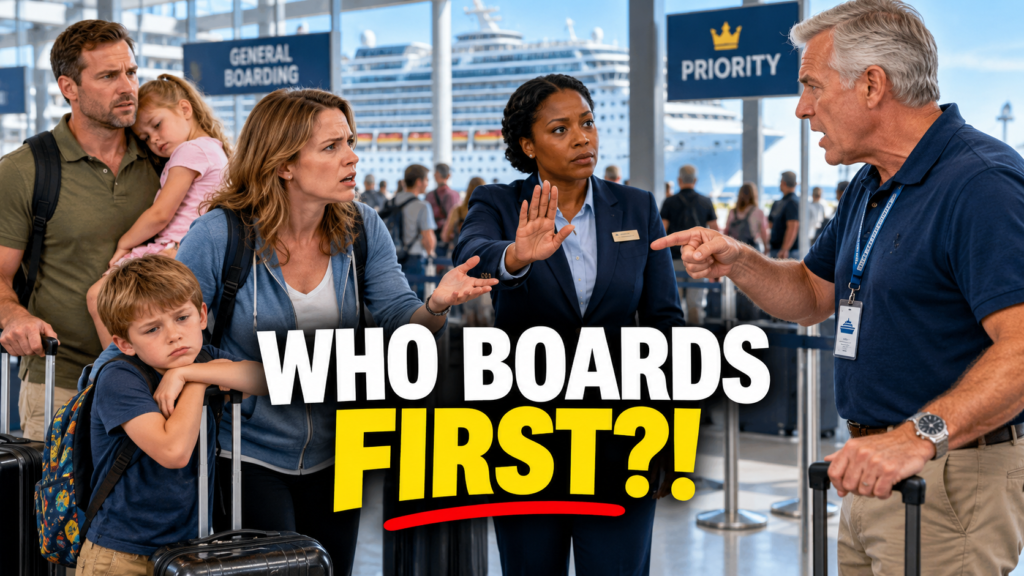
The cruise terminal was already crowded when the argument started.
A family of four had been waiting with two exhausted children. Their seven-year-old was leaning against his mother. Their four-year-old could barely keep her eyes open. The parents had carry-on bags, backpacks, and the unmistakable expression of people who had already answered “Are we getting on the ship yet?” at least twenty times.
Then their boarding group began moving.
That was when a longtime cruiser in the priority area stepped forward.
“Excuse me! I have PRIORITY boarding. Why are they going ahead of me?”
The mother turned around.
“Because we have two exhausted kids! We’ve been waiting forever!”
His response came immediately.
“I earned this status after YEARS of cruising!”
And there it was: one of those cruise debates where both sides can make an emotional argument.
The family sees two tired children and thinks five extra minutes shouldn’t matter to an adult.
The loyal cruiser sees a benefit he earned—or possibly paid for—and wonders why “priority” apparently stops meaning priority when another passenger has children.
So who actually should board first?
The answer is less dramatic than the argument:
There is no universal cruise-industry rule that families with children automatically board ahead of loyal cruisers.
But there also isn’t a universal rule saying every repeat cruiser gets to board ahead of every family.
Real cruise boarding order can depend on the cruise line, loyalty tier, suite or purchased priority benefits, accessibility or assistance needs, arrival appointment, embarkation port, and the procedures for that particular sailing.
That distinction matters.
Because “I have kids” and “I’ve cruised before” don’t automatically answer the question.
WHY THIS CRUISE BOARDING DEBATE GETS SO HEATED
Embarkation day is supposed to be exciting.
In reality, it can also be exhausting.
Families may arrive after an early flight, hotel checkout, airport transfer, or long drive. Parents are carrying documents, phones, medications, backpacks, and whatever entertainment they brought to keep their children occupied.
Then the waiting begins.
A four-year-old doesn’t care that check-in systems are processing thousands of passengers.
She knows she is tired.
A seven-year-old doesn’t understand why a giant cruise ship is visible through the terminal windows but he still isn’t allowed to walk onto it.
Parents naturally want to get their children settled.
Now consider the other side.
A frequent cruiser may have spent years—and substantial money—building loyalty status with a cruise line.
Priority benefits may be one reason that passenger stayed loyal.
Other travelers may have booked a suite or purchased a package specifically because priority access was advertised as a benefit.
When they arrive and see someone apparently moving ahead, their reaction is predictable:
“Then what exactly was my priority for?”
That’s why this debate can’t be settled simply by deciding which passenger deserves more sympathy.
Cruise lines use actual boarding procedures.
DOES HAVING CHILDREN AUTOMATICALLY GIVE A FAMILY PRIORITY BOARDING?
Generally, you should not assume that it does.
Being a family with young children is not, by itself, a universal cruise-industry boarding category that automatically places you ahead of loyalty guests.
A parent may reasonably believe allowing an exhausted toddler to board sooner is the courteous thing to do.
Another passenger may even voluntarily let that family go ahead.
That’s kindness.
It is not the same thing as a universal boarding rule.
If your family is traveling with children, check the instructions issued for your actual reservation rather than arriving at the terminal expecting automatic family priority.
Your boarding documents, arrival appointment, cabin category, purchased benefits, loyalty status, and approved assistance arrangements can all matter.
LOYALTY STATUS CAN PROVIDE REAL PRIORITY BENEFITS
This is where the loyal cruiser in our argument has a legitimate point.
Priority isn’t always just a sign hanging over a terminal lane.
On some cruise lines and for qualifying guests, it is a published benefit.
Carnival currently provides one of the clearest examples.
Its Faster to the Fun information states that when boarding begins at the pier, Carnival Rewards Diamond guests board first, followed by Platinum guests, then guests traveling in suites, followed by Faster to the Fun guests.
Carnival also says Faster to the Fun guests use the Priority line for check-in and that availability for the package is capacity-controlled based partly on the number of Diamond and Platinum members booked on the sailing.
So imagine a Carnival Diamond guest standing in the terminal.
That passenger isn’t necessarily being entitled simply because he says:
“I have priority boarding.”
He may actually have a published boarding benefit associated with his status.
That doesn’t give him permission to insult other passengers.
But it does mean the word “priority” has a real operational meaning.
PRIORITY DOESN’T MEAN “IGNORE YOUR ARRIVAL TIME”
There is another detail cruisers sometimes miss.
Priority benefits do not necessarily mean:
“Show up whenever you want and walk directly onto the ship.”
Carnival currently says all guests, including Faster to the Fun guests, must select an Arrival Appointment during online check-in.
Carnival specifically notes that Faster to the Fun guests who arrive before their selected appointment window cannot simply be accommodated early because they have the package. Guests arriving after their selected window can be accommodated in the priority line.
That’s an important lesson beyond Carnival:
Priority and arrival scheduling are not always the same thing.
Follow the instructions issued for your specific reservation.
Don’t assume a loyalty card overrides every other embarkation procedure.
NORWEGIAN ALSO RECOGNIZES PRIORITY EMBARKATION
Norwegian Cruise Line provides another useful example of why the phrase “loyal cruiser” needs context.
NCL’s current Latitudes Rewards benefits chart includes Priority Check-In / Embarkation among its tier benefits.
The important word here is tier.
Simply having sailed with a cruise line before doesn’t mean every repeat guest receives every premium loyalty benefit.
Cruise loyalty programs typically differentiate between membership levels.
That means this argument would be misleading:
“I cruised with this company once before, so I board before your family.”
That is not how you should interpret loyalty priority.
A much more accurate statement is:
“My qualifying loyalty status includes an embarkation priority benefit.”
That is something terminal staff can verify.
PAID PRIORITY CAN MATTER TOO
Loyalty isn’t the only way passengers may receive expedited terminal access.
Royal Caribbean’s current The Key program is a good example.
The Key includes priority access during a designated arrival time communicated to the guest.
But even this benefit has important limitations.
Royal Caribbean says priority access through The Key is not offered in Vancouver, Singapore, or ports in Australia. The company also notes that The Key may not be available on every sailing and that benefits can vary by ship and destination.
That destroys another common cruise misconception:
A priority benefit doesn’t necessarily work identically at every port in the world.
Port matters.
Ship matters.
Sailing matters.
Program terms matter.
That is why the employee standing at the terminal knows more about today’s boarding process than the passenger who remembers how things worked on a cruise three years ago.
WHAT ABOUT SUITE GUESTS?
Cabin category can also influence embarkation benefits.
Carnival’s current Faster to the Fun information places suite guests in its published embarkation sequence ahead of Faster to the Fun guests.
Other cruise lines may provide their own suite-related embarkation benefits.
So the terminal isn’t necessarily divided into just two groups:
LOYAL CRUISERS
versus
EVERYONE ELSE.
There may be multiple categories operating simultaneously.
Depending on the cruise and line, those could include loyalty guests, suite guests, guests with purchased priority programs, passengers receiving approved assistance, and general boarding groups.
This is why passengers should resist trying to run the terminal themselves.
You may see another family move ahead without knowing why.
A FAMILY MAY HAVE A REASON YOU CAN’T SEE
This is perhaps the most important nuance in the entire debate.
Suppose you’re a loyalty guest.
You’re waiting for your group.
A family with children is escorted ahead.
You immediately think:
“They’re letting them go first just because they have kids!”
Maybe.
But you don’t actually know that.
A family could have an accessibility or assistance arrangement that isn’t visible to you.
Royal Caribbean, for example, currently offers an autism-friendly initiative for families living with autism, Down syndrome, and other developmental disabilities. Among the services listed by Royal Caribbean are priority check-in, boarding, and departure.
That’s a major distinction.
The family isn’t receiving priority simply because children are present.
They may be receiving an accessibility-related service.
And a disability or developmental condition is not always something another passenger can identify by looking at someone for five seconds.
So before confronting another guest, remember:
You probably don’t know their reservation or accommodation details.
Let terminal staff manage the boarding process.
“MY KIDS ARE EXHAUSTED” IS UNDERSTANDABLE — BUT IS IT ENOUGH?
Every parent knows how quickly a family trip can deteriorate when young children become exhausted.
The four-year-old starts crying.
The seven-year-old wants to sit on the floor.
Everyone is hungry.
The parents are frustrated.
The ship is sitting right there.
Emotionally, asking to board early can seem completely reasonable.
But if tired children automatically overrode established priority groups, priority boarding would become nearly impossible to administer consistently.
How young must the children be?
Does a family with a two-year-old go ahead of a Diamond loyalty guest?
What about a six-year-old?
A ten-year-old?
What if another family has three children?
What if a passenger is 80 years old?
What if another traveler has an invisible disability?
Once passengers start creating their own hierarchy, the process falls apart.
That’s why established procedures matter.
COURTESY AND ENTITLEMENT ARE NOT THE SAME THING
Here is where the argument becomes more interesting.
A passenger can have the right boarding benefit and still behave badly.
Likewise, a family can lack formal priority and still deserve compassion.
Imagine the loyal cruiser looks at the exhausted four-year-old and says:
“Go ahead. I’ve got nowhere to be.”
That’s a generous gesture.
But it is voluntary.
Now imagine the mother responds:
“My children are tired, so you HAVE to let us go first.”
That’s different.
Courtesy works best when it is offered rather than demanded.
The same applies to loyalty passengers.
Having priority doesn’t give you permission to humiliate families in the terminal.
There is a huge difference between saying:
“Excuse me, I believe my boarding group has priority. Could you please check?”
and screaming:
“I PAID FOR PRIORITY! GET THEM OUT OF MY WAY!”
You can be correct about your boarding benefit and still be wrong about how you treat people.
DON’T CONFUSE CHECK-IN WITH BOARDING
Cruise terminology can make this debate even more confusing.
Check-in and boarding are related, but they aren’t always identical stages.
A guest may have access to a priority check-in line.
Another benefit may provide priority access into the terminal.
A cruise line may then organize actual boarding according to separate groups or procedures.
Carnival’s published Faster to the Fun information, for example, discusses both priority check-in and a specific order once boarding begins.
So when someone says:
“I have priority,”
the useful question is:
Priority for what?
Check-in?
Security?
Terminal access?
Actual ship boarding?
Tender operations later in the cruise?
Debarkation?
Don’t assume every “priority” benefit means the passenger is literally the first human being allowed onto the ship.
Read the actual benefit.
WHAT SHOULD THE CRUISE EMPLOYEE DO?
In our fictional terminal argument, the loyal cruiser demands:
“I have PRIORITY boarding. Why are they going ahead of me?”
The mother fires back:
“We have two exhausted kids!”
Then both passengers start trying to determine boarding policy themselves.
That’s exactly when staff should take control.
A fact-safe response would be:
“Having children does not automatically determine who boards first. We follow the priority and assistance procedures for this sailing. Please wait until your group is called.”
Notice what that response does not say.
It doesn’t declare:
“Loyalty guests always win.”
It doesn’t say:
“Families always win.”
It doesn’t disclose another passenger’s private circumstances.
And it doesn’t invent a universal law.
It simply returns authority to the actual boarding procedure.
FIVE THINGS FAMILIES CAN DO TO MAKE EMBARKATION EASIER
Traveling with children doesn’t have to turn embarkation into an endurance test.
1. Follow your assigned arrival instructions
Don’t arrive extremely early simply because you want to be first.
If your cruise line uses arrival appointments, follow yours.
2. Keep essentials in your carry-on
Medication, travel documents, diapers, wipes, snacks where permitted, chargers, and anything your child will need before checked luggage arrives should remain accessible.
3. Give children something to do
A tablet, book, small toy, headphones, or simple game can transform terminal waiting time.
4. Prepare children for waiting
Don’t promise:
“We’ll get there and walk straight onto the ship.”
Embarkation can involve lines and processing.
5. Arrange necessary assistance before travel
If a member of your family has accessibility needs, contact the cruise line and follow its procedures rather than waiting until an argument develops at the terminal.
FIVE THINGS LOYAL CRUISERS SHOULD REMEMBER
Frequent cruisers have responsibilities too.
1. Know your actual benefits
Don’t rely on what somebody posted in a Facebook group three years ago.
Programs change.
2. Loyalty status isn’t permission to police other guests
If someone is moving ahead of you, ask staff—not the passenger.
3. You may not know why someone has assistance
Not every disability or accommodation is visible.
4. Follow your own arrival instructions
Priority does not necessarily erase scheduled arrival procedures.
5. Protect the benefit without becoming the problem
A calm question to staff usually accomplishes more than shouting at another passenger.
THE BIGGEST BOARDING MISTAKE: ASSUMING YOU KNOW WHY SOMEONE WENT FIRST
This happens constantly in travel.
Someone sees another passenger receive different treatment.
Immediately:
“Why did THEY get to go?”
Maybe they have loyalty status.
Maybe they’re in a qualifying suite.
Maybe they purchased an eligible program.
Maybe they have an approved accommodation.
Maybe they’re following a boarding group you didn’t hear announced.
Or maybe staff made a mistake.
You don’t know.
Ask politely.
Don’t turn another passenger into your enemy before you have the facts.
SO, WHO SHOULD BOARD FIRST?
Now we can finally answer the title.
Neither “loyal cruisers” nor “families with kids” automatically wins in every situation.
A qualifying loyal cruiser may have a real published priority benefit.
A family merely having young children does not create a universal cruise-industry right to board ahead of that passenger.
But a family may separately qualify for priority or expedited boarding because of an accessibility program, suite category, purchased benefit, loyalty status of its own, or another applicable procedure.
And individual cruise lines, ports and sailings can handle priority differently.
Therefore, the best rule is remarkably simple:
Follow the boarding instructions for your specific sailing and let terminal staff determine the order.
Not the loudest passenger.
Not the most exhausted parent.
Not the person waving a loyalty card.
The actual procedure.
FAQ: CRUISE PRIORITY BOARDING
Do families with young children automatically board cruise ships first?
Do not assume so. There is no universal cruise-industry rule giving every family automatic priority solely because children are traveling with them. Check the procedures for your cruise line and sailing.
Do loyal cruise passengers get priority boarding?
Some qualifying loyalty tiers do provide priority check-in or embarkation benefits. Carnival and Norwegian both currently publish relevant priority benefits for qualifying loyalty guests, but eligibility depends on the specific program and tier.
Who boards first on Carnival?
Carnival’s current Faster to the Fun information says that when boarding begins at the pier, Carnival Rewards Diamond guests board first, followed by Platinum guests, suite guests, and then Faster to the Fun guests. Guests should still follow the current instructions for their own sailing.
Does Carnival Faster to the Fun include priority?
Yes. Carnival currently advertises priority check-in among Faster to the Fun benefits and places FTTF guests in its priority boarding sequence after Diamond, Platinum and suite guests. The program is capacity-controlled and not available on every itinerary.
Does Norwegian offer loyalty priority boarding?
Norwegian’s current Latitudes Rewards chart lists Priority Check-In / Embarkation as a benefit at qualifying levels. Always verify the benefit associated with your actual tier.
Does Royal Caribbean’s The Key include priority access?
Royal Caribbean currently says The Key includes priority access during the designated arrival time communicated to the guest. The benefit is subject to availability and location-specific exceptions; Royal Caribbean currently excludes this priority access in Vancouver, Singapore and Australian ports.
Can families with accessibility needs receive priority boarding?
They may qualify for specific assistance depending on the cruise line and circumstances. Royal Caribbean’s autism-friendly program, for example, currently lists priority check-in, boarding and departure for families living with autism, Down syndrome and other developmental disabilities.
Can I demand to know why another family boarded before me?
Ask staff about your own boarding position. Don’t demand private details about another passenger’s disability or accommodation.
Does priority boarding mean I can arrive whenever I want?
Not necessarily. Carnival, for example, requires Faster to the Fun guests to select an Arrival Appointment and says guests arriving before that window cannot simply be accommodated early because of FTTF.
What should I do if I think my priority benefit isn’t being honored?
Speak calmly with terminal staff and show the relevant boarding documentation or reservation information. Let employees resolve it instead of confronting another passenger.
THE BOTTOM LINE
The mother looks at her exhausted children and thinks:
“Surely they should let us go first.”
The longtime cruiser looks at his loyalty status and thinks:
“I earned this benefit. Why should I give it up?”
Both reactions are understandable.
But only the cruise line knows all the factors governing that particular embarkation.
The family beside you may have an accommodation you cannot see.
The passenger behind you may have a legitimate priority benefit you didn’t know existed.
The procedure may even change depending on the port.
That’s why the smartest cruise passenger doesn’t try to become the terminal’s unofficial boarding officer.
Know your benefits.
Follow your arrival instructions.
Be considerate toward families.
Respect accessibility needs.
Ask staff when something seems wrong.
And remember that boarding five minutes later is rarely worth starting your vacation with a screaming match.
Because the real question isn’t:
“Who deserves the cruise more?”
It’s:
“Whose boarding group is being called?”
When that answer comes from the cruise line instead of the crowd, everybody gets onboard with a lot less drama.
