
CRUISE TIP
Is It Rude to Bring Luggage in a Cruise Elevator? 8 Etiquette Rules You Should Know
Sep
Most cruise passengers know the basics of elevator courtesy: wait for the doors to open, press your deck, make room when possible and avoid deliberately holding up a crowded elevator. And yes, passengers sometimes need to bring luggage into an elevator. On embarkation day, after a port stay, during a cabin change or while preparing to leave the ship, carrying or rolling bags between decks can be completely normal.
But the overlooked problem isn’t usually the luggage itself. It’s what happens when luggage meets a crowded elevator.
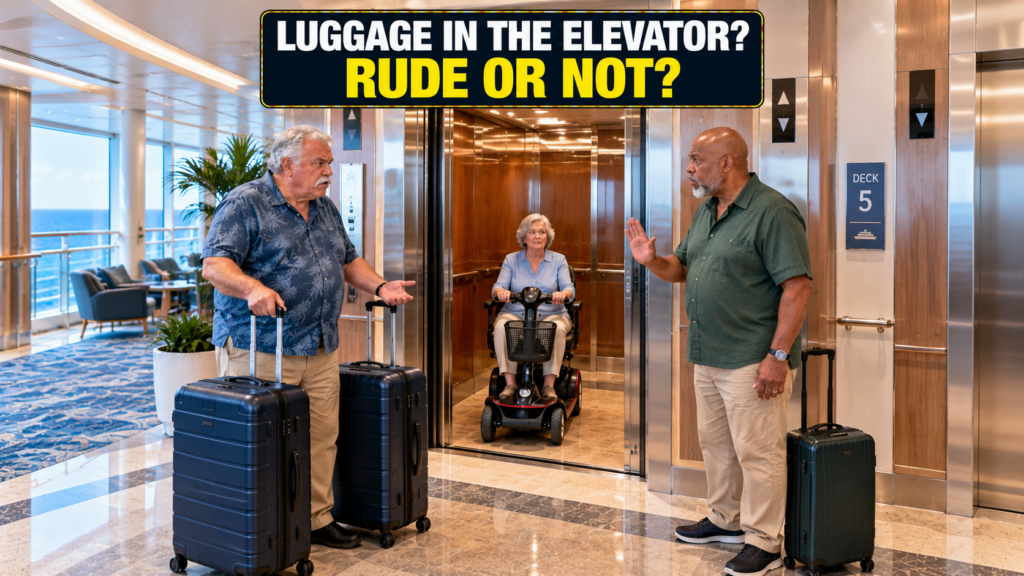
Two large suitcases can block the doorway. Someone rushing in can prevent passengers from getting out first. A bag left sideways can reduce maneuvering space for a wheelchair or mobility scooter. Holding the doors while the rest of a group is still walking down the corridor can frustrate an elevator full of waiting passengers. And during peak periods, repeatedly squeezing into an already packed car can make a busy situation even worse.
There is an important distinction here: these are primarily etiquette and practical crowd-flow guidelines, not eight universal cruise-line rules that automatically result in a penalty. Ships vary in layout, elevator size, accessibility features and operating procedures. Passenger needs vary too. Someone who can comfortably use the stairs is in a different situation from a passenger with limited mobility, balance concerns or heavy luggage.
Timing also matters. Embarkation, the return from popular port calls, dinner periods and debarkation can create very different elevator conditions from a quiet afternoon at sea.
So, is it rude to bring luggage into a cruise elevator? No—not by itself. What matters is how you handle it.
Here are eight cruise elevator etiquette rules that can make the ride easier for you and everyone around you.
1. Bringing Luggage Into the Elevator Isn’t Automatically Rude
Passengers sometimes need elevators precisely because they are carrying something difficult to take up or down stairs.
A rolling suitcase, carry-on or shopping bag does not automatically make someone inconsiderate. The problem begins when a passenger treats the elevator as though their luggage gives them priority over everyone else.
Why it matters
This distinction is particularly important during embarkation and debarkation, when many passengers are moving with bags at the same time.
Older travelers may also prefer an elevator because carrying luggage on stairs can be uncomfortable or unsafe. Nobody should feel pressured to use stairs simply to prove they are being polite.
Courtesy means using the elevator responsibly—not avoiding it when you genuinely need it.
What to ask
- Is there enough room for me and my luggage without crowding other passengers?
- Can everyone already inside still reach the door comfortably?
- Would waiting for the next elevator make this easier?
- Am I keeping my bags under control rather than spreading them across the floor?
Important limitation
This is etiquette, not a universal prohibition on luggage in cruise elevators.
If an elevator is crowded, wait when practical. If you need the elevator because of mobility, balance or physical limitations, use it without feeling that you should take the stairs instead.
2. Let People Exit Before You Enter
This may be the simplest elevator rule—and one of the easiest to forget when you are concentrating on your luggage.
When the doors open, pause.
Give passengers inside enough time and space to leave before you begin pulling your bags into the elevator.
Why it matters
Trying to enter while someone else is exiting creates two-way traffic through a narrow doorway.
Add two rolling suitcases, a wheelchair or a mobility scooter and the situation becomes much harder to navigate.
Waiting a few seconds usually clears the doorway faster than trying to squeeze past everyone.
What to ask
- Is someone inside moving toward the door?
- Have I left a clear path through the doorway?
- Are my suitcases positioned where exiting passengers can get around them?
Important limitation
Don’t rely only on whether someone immediately steps forward. A passenger using a mobility device or walking slowly may need additional time to begin exiting.
Pause long enough to understand what is happening before moving in.
3. Don’t Leave Your Bags Blocking the Doorway
Once you enter, bring your luggage fully under your control.
Don’t leave one suitcase halfway through the doorway while you reposition another. Don’t park bags directly in the exit path if there is room to move them elsewhere.
Why it matters
Elevator doors are shared transition space.
A bag placed carelessly near the entrance can make every stop awkward because passengers must step around it to enter or exit.
It can be particularly inconvenient for someone using a cane, walker, wheelchair or mobility scooter.
What to ask
- Can passengers reach the door without stepping over or around my luggage?
- Can I position my suitcase vertically beside me?
- Do I have more luggage than I can reasonably control in one trip?
Important limitation
Elevator dimensions vary considerably by ship. A luggage arrangement that works comfortably in one elevator may be impractical in another.
If your bags cannot fit without obstructing the doorway, waiting for a less crowded elevator may be the better choice.
4. Give Wheelchairs and Mobility Scooters Room to Maneuver
A mobility scooter or wheelchair needs more than the exact physical footprint of the device.
The passenger may need space to enter, position the device, turn, back out or travel straight through the doorway.
Why it matters
A standing passenger can often step sideways around a suitcase.
Someone operating a mobility device may not have that option.
Leaving maneuvering room makes elevator use safer and less stressful without requiring anyone to turn the situation into a confrontation.
What to ask
- Is my luggage reducing the passenger’s exit path?
- Have I left enough room for the device to maneuver?
- Would moving myself or my suitcase to another part of the elevator help?
- Should I wait for another elevator instead of squeezing into the remaining space?
Important limitation
Do not assume every person using a wheelchair or scooter needs the same amount of help—or wants unsolicited physical assistance.
Create space first. If assistance appears necessary, ask rather than grabbing someone’s mobility device.
5. Don’t Hold a Busy Elevator for People Who Aren’t Ready
You’ve reached the elevator. Your spouse is still coming down the corridor. Another family member went back to the cabin. Someone says, “Hold it!”
During a quiet period, a brief courtesy hold may cause no problem.
During a crowded period, holding the doors for people who are nowhere near the elevator can delay everyone already inside.
Why it matters
A small delay becomes more frustrating when elevators are already operating near capacity.
It can also prevent the elevator from continuing to other decks where more passengers are waiting.
What to ask
- Is the person I’m waiting for actually a few steps away?
- Is the elevator already crowded?
- Would it be easier for our group to take the next elevator together?
Important limitation
Use judgment.
This is not about slamming the door on someone approaching the elevator. It is about avoiding unnecessary delays while an entire group slowly gathers from different parts of the corridor.
6. Don’t Use Luggage to Reserve Elevator Space
A suitcase is not a placeholder.
Avoid rolling a bag into the doorway to keep the elevator from leaving while other members of your party catch up.
Likewise, don’t spread several bags across available floor space simply to preserve room for people who have not arrived yet.
Why it matters
Other passengers cannot easily tell what you are doing, and luggage in or near the doorway can create unnecessary congestion.
The simplest solution is usually for the group to be ready before boarding.
What to ask
- Is my entire party ready to enter?
- Am I occupying space for someone who isn’t here?
- Would taking the next elevator together be easier?
Important limitation
Groups can become separated, particularly on large ships. That happens.
There is usually no need to turn a temporary separation into a problem for everyone else. Meet on the destination deck or wait together for another elevator when practical.
7. Expect Embarkation and Debarkation to Be Different
An elevator that feels empty at 2 p.m. on a sea day may be packed when passengers first board or when everyone is preparing to leave.
Luggage makes those peak periods even busier.
Why it matters
Knowing when congestion is likely helps you plan instead of becoming frustrated.
If you have flexibility, moving at a less congested time can sometimes be more comfortable than fighting the busiest flow.
For travelers over 60, that can also mean less standing, less rushing and less pressure to squeeze into a crowded elevator.
What to ask
- Is this a peak movement period?
- Can I allow additional time instead of rushing?
- Do I actually need to move all of my luggage myself?
- What luggage-handling instructions has my cruise line provided for embarkation or debarkation?
Important limitation
Do not assume stairs are the answer for everyone.
Passengers with heavy bags, limited mobility, balance concerns or other accessibility needs may reasonably depend on elevators even when they are busy.
Plan extra time rather than pressuring someone to use the stairs.
8. Sometimes the Polite Choice Is Simply to Wait for the Next Elevator
The doors open.
Technically, there might be enough room for one more person.
But you have two large suitcases, several passengers are already inside and someone near the back will need to get out soon.
You don’t have to prove that you can fit.
Why it matters
Waiting for another elevator can turn an uncomfortable squeeze into an easy trip.
This is especially useful when traveling with multiple bags or when the available space would leave luggage directly in the doorway.
A few extra minutes may be worth avoiding a stressful interaction.
What to ask
- Can I enter without forcing other passengers to rearrange themselves?
- Will my luggage block anyone?
- Is someone with a mobility device already inside?
- Do I have enough time to wait for another elevator?
Important limitation
“Wait for the next one” should not become a rule that repeatedly pushes passengers with mobility needs aside.
Courtesy works both ways. Passengers who depend on elevators should have reasonable access too.
So, Is Luggage in a Cruise Elevator Rude?
No.
Bringing luggage into a cruise elevator is not inherently rude.
What can become inconsiderate is blocking the doorway, entering before other passengers have exited, forcing multiple bags into an already crowded elevator, preventing mobility devices from maneuvering or unnecessarily delaying everyone while waiting for your group.
The easiest rule is also the most useful:
Look at the space before you look at the button.
Let people exit. Keep your luggage close. Leave maneuvering room. During busy periods, allow extra time. And when an elevator is clearly too crowded for you and your bags, sometimes the easiest cruise etiquette decision is simply waiting for the next one.
A little patience can make a surprisingly big difference on a ship where thousands of passengers are sharing the same elevators.
