
AIRPORT TIPS
BUYING EXTRA BAGGAGE WEIGHT? HERE’S WHAT YOU NEED TO KNOW
Sep
You arrive at the airport feeling prepared.
Your suitcase is packed. Your flight is confirmed. And because you knew you were bringing more than usual, you already paid extra for baggage before leaving home.
Then the airline agent puts your suitcase on the scale.
She looks at the number.
Then she looks at you.
“Sir, this suitcase is over the weight limit for your itinerary.”
You immediately point out the obvious:
“What?! I already PAID for extra baggage!”
And that is where one of the most confusing baggage problems begins.
Paying for extra baggage does not necessarily mean you can put all that additional allowance into one enormous suitcase.
Depending on the airline, ticket, route, destination, and type of baggage purchase, there can be an important difference between adding another checked bag, paying an overweight-bag charge, receiving a larger baggage allowance, and exceeding the maximum weight the airline will accept for one individual bag.
The Federal Aviation Administration makes the broader rule clear: airlines may restrict baggage by number of pieces or by weight, depending on the airline, type of travel, origin, and destination. If baggage exceeds an airline’s restrictions, the carrier may treat it as excess baggage and charge for it.
So before you pay for “extra baggage,” here is what you need to understand.
EXTRA BAGGAGE AND AN OVERWEIGHT BAG ARE NOT ALWAYS THE SAME THING
This is the distinction that causes many airport-counter arguments.
Imagine your ticket includes one checked suitcase.
You purchase an additional baggage option.
You might think:
“Great. Now I can make my original suitcase heavier.”
Not necessarily.
Depending on the carrier and fare structure, you may have purchased an additional piece of checked baggage rather than additional weight for the suitcase you already have.
Even when an airline permits overweight baggage for a fee, that doesn’t mean the airline accepts unlimited weight.
There can still be a maximum weight for an individual piece.
That is why the most important question isn’t simply:
“How much baggage did I buy?”
It is also:
“How much can each individual bag weigh?”
The answer must come from the operating carrier’s rules for your itinerary.
THERE IS NO UNIVERSAL 50-POUND FEDERAL RULE FOR EVERY SUITCASE
You’ve probably heard travelers say:
“Your suitcase can’t be over 50 pounds.”
That statement is too broad.
The FAA does not establish 50 pounds as one universal maximum checked-bag weight for every passenger on every airline.
Instead, the FAA tells passengers that airlines may limit the number or weight of checked bags depending on the airline, type of travel, and origin or destination, and advises travelers to check directly with their carrier.
Fifty pounds—or about 23 kilograms—is certainly an important threshold in many airline baggage policies.
But a threshold where an additional charge begins is not necessarily the same thing as an absolute maximum weight.
American Airlines provides a useful real-world example.
For most regions, American currently lists its standard checked-bag allowance at 50 pounds/23 kilograms and 62 linear inches/158 centimeters. But confirmed First or Business passengers can have different weight allowances for qualifying free bags.
The lesson is simple:
Don’t turn one airline’s standard allowance into a universal aviation law.
PAYING AN OVERWEIGHT FEE STILL DOESN’T MEAN UNLIMITED WEIGHT
Now imagine your suitcase exceeds your normal allowance.
You tell the agent:
“Fine. Charge me the overweight fee.”
That might solve the problem—if the bag falls within the airline’s accepted overweight range for that itinerary.
But there is another line travelers need to know about:
The maximum accepted weight.
American Airlines currently states that it does not accept checked bags over 100 pounds/45 kilograms on American-operated flights.
But even that number isn’t universal across all of American’s routes.
American currently says bags over 70 pounds/32 kilograms are not accepted for several travel regions, including Europe, Israel, and Qatar. Its current policy also says bags over 70 pounds/32 kilograms are not accepted to or from Australia.
That’s exactly why saying:
“I’ll pay whatever the fee is!”
doesn’t always fix the problem.
At some point, depending on the airline and itinerary, the issue may stop being the price.
The bag may simply fall outside what the carrier will accept as checked baggage.
“I PAID FOR 20 MORE KILOGRAMS” CAN BE A DANGEROUS ASSUMPTION
Suppose your original baggage allowance and your purchased baggage are described by weight rather than pieces.
It is still important to read exactly how that allowance may be distributed.
Don’t automatically assume that purchasing more total baggage weight means one individual suitcase can absorb the entire increase.
The operating carrier may have a per-piece maximum.
There may also be restrictions based on destination, aircraft, fare, or the type of baggage product purchased.
Before adding another ten shirts, three pairs of shoes, a stack of books, and half your bathroom to one giant suitcase, check two separate things:
Your total baggage allowance and the maximum permitted weight for each individual piece.
Those are not automatically the same number.
WHY AIRLINES CARE ABOUT INDIVIDUAL BAG WEIGHT
Passengers often see this entirely as a pricing issue.
“If I’m willing to pay, why does the airline care?”
Airline baggage isn’t handled only by the passenger and the check-in agent.
It has to move through a larger baggage-handling and aircraft-loading system.
The FAA’s weight-and-balance guidance also requires operators to account for heavy bags in aircraft weight calculations.
More broadly, airline baggage restrictions exist within operational and safety systems that go well beyond the few seconds you spend standing at the counter.
So when an agent says an individual bag cannot be accepted above a certain limit, arguing:
“But I can afford the fee!”
misses the point.
Some limits aren’t simply another price tier.
YOUR DESTINATION CAN CHANGE THE ANSWER
One of the biggest mistakes travelers make is checking an airline’s baggage policy without checking the route-specific exceptions.
American Airlines’ current overweight policy demonstrates why this matters.
The airline accepts certain overweight ranges on some routes while refusing the same weight range on others. Fees also vary by region.
American additionally publishes seasonal and year-round baggage limitations for certain destinations. For select destinations with baggage limitations, the airline says overweight items above 70 pounds/32 kilograms, oversized items above 62 linear inches/158 centimeters, and excess bags beyond the applicable limit may not be accepted.
That means:
“They accepted this suitcase on my last flight”
isn’t enough information.
Was it the same airline?
Same operating carrier?
Same route?
Same destination?
Same season?
Same fare?
Same baggage product?
If any of those changed, the result may change too.
OVERWEIGHT AND OVERSIZED ARE TWO DIFFERENT PROBLEMS
Weight isn’t the only measurement that matters.
Your suitcase can be within the acceptable weight and still be too large.
Or it can be within the normal dimensions and be too heavy.
Or it can exceed both.
American currently calculates checked-bag dimensions by adding length, width, and height. Its standard dimensions are 62 linear inches/158 centimeters for the checked-bag allowance described on its baggage page.
For larger items, American currently says checked bags above 115 linear inches/292 centimeters are not accepted.
And if one item exceeds the standard thresholds for both weight and size, American says the higher of the applicable oversize or overweight charges applies, in addition to the checked-bag fee.
This is another reason travelers should avoid treating every baggage problem as “extra weight.”
Your problem might actually be size.
AN EXTRA BAG MAY BE CHEAPER—OR SIMPLY NECESSARY
Suppose your suitcase is too heavy but your belongings themselves are permitted.
One possible solution may be redistributing items between bags.
For example, instead of one extremely heavy suitcase, you might be able to divide your belongings between two checked bags.
But this is not universal advice.
Whether that works depends on your airline, route, ticket, number-of-bag restrictions, fees, and the contents of the baggage.
Some destinations may have limits on excess bags.
Some items cannot be placed in checked baggage at all.
And purchasing another bag may cost more—or less—than paying an overweight charge depending on the itinerary.
The smartest approach is to compare those options before arriving at the airport.
CHECK THE PRICE BEFORE YOU PACK
The U.S. Department of Transportation specifically advises consumers to check carrier baggage policies before buying a ticket.
DOT says airlines must provide baggage-fee information through a clear link from the airline’s homepage and through a link associated with the first screen displaying a fare quotation for a specific itinerary.
DOT also warns that airlines may have additional charges and restrictions for overweight and oversized baggage.
So don’t plan your luggage around a fee you vaguely remember from your previous vacation.
Check the current policy.
And check it for the actual flight you’re taking.
DON’T FORGET THE OPERATING CARRIER
This becomes especially important when your itinerary involves multiple airlines.
You may buy a ticket displaying one airline’s name while one or more segments are operated by another carrier.
Baggage rules and benefits can become more complicated on codeshare and partner itineraries.
American, for example, specifically notes that complimentary baggage benefits may not apply to codeshare flights on partner airlines and directs travelers to the operating carrier’s website for details.
If you’re connecting between carriers, don’t assume the baggage rule you saw for one segment automatically controls every segment.
Check the itinerary carefully.
DON’T WAIT UNTIL THE CHECK-IN COUNTER TO WEIGH YOUR BAG
This is one of the easiest airport problems to prevent.
Buy or borrow a small luggage scale.
Pack your suitcase.
Weigh it.
Then leave yourself some margin.
Why margin?
Because home scales and airport scales may not display exactly the same result, and travelers have a remarkable ability to add “just one more thing” after weighing their luggage.
If you’re sitting right at the threshold, moving a few items before leaving home is far less stressful than opening your suitcase on the airport floor while hundreds of people walk past you.
IF YOU DO HAVE TO REPACK, THINK BEFORE MOVING ITEMS
Imagine the agent says:
“You may need to redistribute some items into another bag.”
Your instinct might be to start throwing everything into your carry-on.
Be careful.
Checked-baggage rules and carry-on rules are not identical.
The FAA’s PackSafe guidance notes that many dangerous goods are prohibited or restricted in passenger baggage, with different rules applying to particular items.
Lithium batteries are an especially important example.
Current FAA guidance says spare lithium batteries, including power banks and portable chargers, must be carried in the cabin and cannot be placed in checked baggage. Rechargeable lithium battery-powered devices have additional conditions when checked.
So solving a weight problem should never mean blindly moving items from one bag to another.
Check where those items are legally and safely allowed to travel.
TSA DOESN’T SET YOUR AIRLINE’S OVERWEIGHT BAG FEE
This distinction matters in U.S. airport content.
The person telling you your suitcase is overweight at the airline counter is generally dealing with an airline baggage policy, not imposing a TSA overweight-baggage rule.
The FAA itself directs travelers to check their airline for checked-baggage restrictions.
TSA has a different role involving security screening and prohibited items.
So if your suitcase weighs too much for your airline’s allowance, don’t frame the story as:
“TSA fined me because my suitcase was overweight.”
That’s misleading.
The more accurate framing is:
“My airline said my checked bag exceeded its baggage allowance or acceptance limit.”
CAN YOU JUST PAY FOR EXTRA BAGGAGE AT THE AIRPORT?
Sometimes you can purchase or pay for baggage at the airport.
But don’t build your travel plan around the assumption that money will solve every baggage problem at check-in.
The airline could have a maximum per-piece weight.
Your destination could have an excess-baggage restriction.
Your bag could be oversized as well as overweight.
Your itinerary could involve another operating carrier.
Or the bag could contain an item subject to separate restrictions.
That’s why buying baggage in advance—when available—should be accompanied by reading the actual conditions of the baggage product.
The words “extra baggage” alone aren’t enough.
FIVE QUESTIONS TO ASK BEFORE BUYING EXTRA BAGGAGE
Before clicking “Add baggage,” find the answers to these five questions:
- Am I buying another piece or additional weight? Know exactly what the purchase adds to your reservation.
- What is the maximum weight of one checked bag? This may be different from your total baggage allowance.
- What happens if one bag exceeds my standard allowance? Check the current overweight charges and acceptance limits.
- Are there route or destination restrictions? Seasonal and permanent limitations can matter.
- Which airline actually operates my flight? Partner and codeshare flights can complicate baggage benefits.
If you can’t answer those questions, don’t finish packing yet.
WHAT TO DO IF YOUR BAG IS OVERWEIGHT AT THE AIRPORT
First, stay calm.
The airline employee didn’t pack your suitcase.
Arguing about the existence of the scale won’t make the bag lighter.
Ask the agent what options are actually available for your itinerary.
Depending on the carrier’s rules and your situation, possibilities could include paying an applicable overweight charge, checking another permitted bag, redistributing allowable items, or removing items entirely.
But don’t assume every option will be available.
If the bag exceeds an absolute acceptance limit for your itinerary, paying another fee may not solve it.
And don’t hold up the counter by beginning a major repacking operation without asking where the airline wants you to do it.
THE AIRPORT ARGUMENT THAT DOESN’T NEED TO HAPPEN
Return to our passenger.
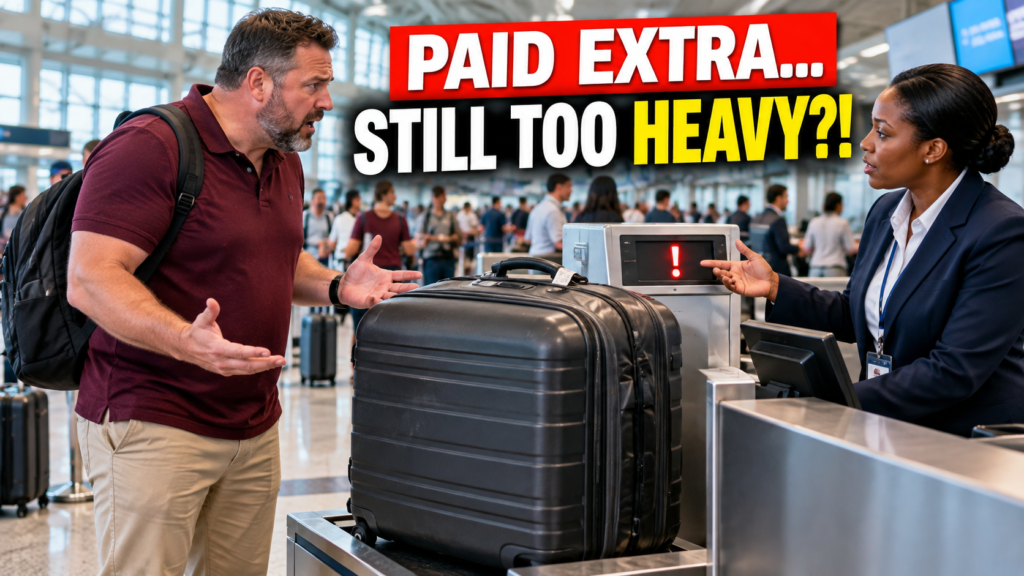
His enormous charcoal suitcase hits the scale.
The agent looks at the reading.
“Sir, this suitcase is over the weight limit for your itinerary.”
He immediately objects:
“What?! I already PAID for extra baggage!”
The agent explains that he purchased additional baggage allowance, but the individual suitcase is still overweight.
He gets frustrated.
“Then charge me the overweight fee! What’s the problem?”
And there is the entire issue in one sentence.
The passenger thinks baggage is purely a financial transaction:
More money = more weight.
But airline baggage policies can have multiple layers:
standard allowance → extra baggage → overweight charges → maximum acceptance limits → route-specific restrictions.
Those aren’t interchangeable.
Understanding that before you leave home can save you money, time, and one very public suitcase explosion at the check-in counter.
FAQ: BUYING EXTRA BAGGAGE WEIGHT
Does buying extra baggage mean my suitcase can be heavier?
Not necessarily. You may be purchasing another checked piece rather than increasing the weight permitted in your existing suitcase. Even when extra weight is permitted, the airline may still impose a maximum weight for each individual bag.
Is 50 pounds the legal maximum for checked baggage in the United States?
No. There is no universal FAA rule making 50 pounds the absolute maximum for every checked suitcase. Airlines establish baggage restrictions based on their policies, travel type, routes, and destinations.
Can I pay an overweight fee if my suitcase is too heavy?
Sometimes, provided your bag remains within the airline’s accepted overweight range for your itinerary. A bag exceeding the airline’s maximum may not be accepted even if you’re willing to pay.
What is American Airlines’ maximum checked-bag weight?
American currently says it does not accept checked bags over 100 pounds/45 kilograms on American-operated flights, but lower acceptance limits apply on certain routes. For example, bags above 70 pounds/32 kilograms are not accepted on several specified international itineraries.
Are overweight and oversized baggage the same?
No. Overweight refers to weight; oversized refers to dimensions. A suitcase can exceed one or both thresholds, and the applicable treatment and fees depend on the airline.
Does TSA charge overweight baggage fees?
Airline baggage allowance and overweight charges are carrier matters. TSA’s role centers on security screening and prohibited items, while FAA guidance tells passengers to check baggage restrictions directly with their airline.
Can baggage rules change depending on destination?
Yes. Airline restrictions and charges can vary by destination and may include seasonal or year-round limitations. American currently publishes such restrictions for selected destinations.
Should I buy extra baggage online or wait until the airport?
Check your airline’s current options and pricing before traveling. More importantly, verify exactly what you’re buying and the maximum size and weight permitted for each piece.
What if my bag is too heavy to be accepted?
Ask the airline what options are available for your specific itinerary. Depending on the circumstances, you may be able to redistribute permitted items or use another eligible bag, but there is no universal guarantee that repacking or paying another fee will solve the problem.
THE BOTTOM LINE
Buying extra baggage can be useful.
But “I paid extra” does not mean “this suitcase can weigh anything I want.”
Your total allowance, number of permitted bags, standard per-bag allowance, overweight charges, maximum accepted weight, dimensions, route restrictions, and operating carrier can all affect what happens when your suitcase reaches the airport scale.
The FAA’s advice is straightforward: baggage restrictions can vary by airline, type of travel, origin, and destination, so travelers should check directly with their carrier.
And the U.S. Department of Transportation specifically reminds passengers that airlines may impose additional charges and restrictions on overweight and oversized baggage.
So before you zip up that giant suitcase, ask yourself two questions:
How much baggage did I buy?
And, just as importantly:
How much is this ONE bag actually allowed to weigh?
Knowing the difference could save you from discovering the answer with your suitcase wide open on the airport floor.
