
AIRPORT TIPS
A SUDDEN STORM HIT THE FLIGHT — THEN EVERYTHING WENT WRONG
Sep
The flight had been completely ordinary.
Passengers were watching movies. Some were sleeping. Others were quietly talking as the aircraft cruised above the clouds.
Then the seat-belt sign came on.
DING.
Most people barely reacted.
A few passengers looked up.
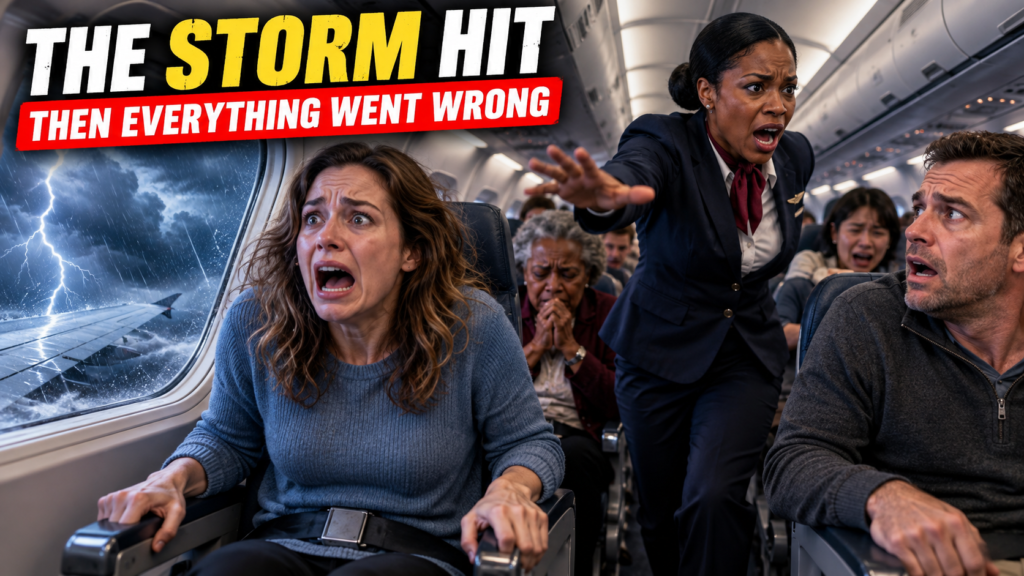
The 33-year-old woman sitting beside the window glanced outside and noticed that the bright sky had disappeared. Thick gray clouds surrounded the aircraft, and rain began streaking across the window.
Then the captain’s voice came through the speakers.
“Ladies and gentlemen, we’ve encountered severe weather. Fasten your seat belts immediately.”
His voice was calm.
But the word “immediately” got everyone’s attention.
The woman reached down and tightened her seat belt.
Across the aisle, a man stopped what he was doing and looked toward the front of the cabin.
A flight attendant began moving toward her jumpseat.
Then the airplane jolted.
Hard.
A cup jumped from a tray.
Several passengers screamed.
And within seconds, an ordinary flight had become something nobody in the cabin would forget.
The First Jolt Changed the Entire Cabin
The aircraft shook again.
This time, there was no mistaking what was happening.
“Oh my God! What was THAT?!” the woman beside the window screamed.
The man across the aisle grabbed both armrests.
“Are we going down?!”
The flight attendant immediately raised her voice above the noise.
“EVERYBODY SIT DOWN! Seat belts ON! NOW!”
Passengers who had been talking seconds earlier were suddenly silent.
Some gripped their armrests.
Others looked through the windows.
A few began to pray.
The flight attendant knew that standing in the aisle was no longer where she needed to be.
After making sure nearby passengers were seated, she moved quickly toward her jumpseat and secured herself.
Then another jolt hit.
“Please, God… Please Protect Us”
A 67-year-old woman sitting several rows back had both hands clasped tightly against her chest.
Her eyes filled with tears.
“Please, God… please protect us.”
Nearby, another passenger bowed his head.
“Lord, please… bring us down safely.”
A young woman in a gray hoodie began crying.
“I can’t do this! I CAN’T DO THIS!”
The aircraft shook again.
The sound of rain against the windows became louder.
Some passengers could see flashes in the dark clouds outside.
Every unfamiliar sound suddenly seemed threatening.
The vibration of an overhead bin.
The movement of a cup.
The creaking of a seat.
The change in engine noise.
Fear had transformed ordinary sounds into warning signs.
But inside the cockpit, the situation looked very different.
The Captain Had a Job to Do
The 52-year-old captain wasn’t screaming.
He wasn’t looking back at the passengers.
He wasn’t making dramatic announcements about the airplane “going down.”
He was flying.
That distinction matters.
In a serious weather encounter, passengers may experience intense fear while pilots remain focused on aircraft control, weather information, routing and communication.
The captain and crew were working to move away from the worst weather.
The passengers didn’t see that work.
All they could feel was the airplane shaking.
Then the PA system activated again.
“Everyone remain seated. Keep your seat belts securely fastened. The crew is seated as well.”
That last sentence made several passengers exchange nervous looks.
If even the flight attendants were sitting down, they knew the turbulence was being taken seriously.
Why Thunderstorms Demand Respect From Pilots
Thunderstorms are not simply clouds with rain.
They are convective systems capable of producing powerful vertical air movement, heavy precipitation, lightning, wind shear and severe turbulence.
That is why professional aviation treats thunderstorm avoidance seriously.
A flight crew does not need to prove that an aircraft can “handle” a storm by intentionally driving straight through the strongest part of it.
The better strategy is avoidance whenever practical.
Pilots may use onboard weather information, forecasts, reports from other aircraft and coordination with air traffic control to find a safer path.
Sometimes that means deviating left or right.
Sometimes it means changing altitude when appropriate.
And in more difficult circumstances, it can mean diverting.
The objective is not to preserve the original route at any cost.
The objective is to operate safely.
Weather Radar Doesn’t Show Everything Passengers Think It Does
There is another common misunderstanding about thunderstorms.
People sometimes imagine aircraft weather radar as a magical screen that displays every invisible bump in the atmosphere.
That isn’t how it works.
Weather radar is particularly useful for identifying precipitation intensity and helping crews evaluate convective weather.
But turbulence itself is not simply represented as a perfect map of every future jolt.
That matters because severe atmospheric motion can exist around convective weather, not only inside the most visually dramatic part of a cloud.
A thunderstorm can also be much larger as a hazardous system than the portion passengers can see through a window.
This is one reason aviation guidance emphasizes keeping appropriate distance from severe convective activity rather than trying to thread unnecessarily close to it.
Then the Airplane Dropped Again
Back in the cabin, another hard movement sent a wave of screams through the aircraft.
“OH MY GOD!”
The woman at the window pressed herself against her seat.
The man across the aisle stared toward the flight attendant.
“How long is this going to last?!”
Nobody could give him a precise answer.
The older woman continued praying.
The young passenger in the hoodie was crying.
The flight attendant, now secured in her jumpseat, called out firmly:
“HEADS BACK! STAY BUCKLED!”
Another rumble of thunder seemed to roll outside.
Then the captain returned to the PA.
His voice was still controlled.
But now it sounded more serious.
“Ladies and gentlemen, I need everyone to remain calm and follow the crew’s instructions.”
The cabin quieted enough to listen.
Then came the sentence everyone had been waiting for.
“We are changing course to get away from this weather.”
Changing Course Is Not a Sign the Pilots Have Lost Control
To a frightened passenger, hearing that an aircraft is changing course can sound dramatic.
In reality, a weather deviation can be exactly what passengers should want pilots to consider when convective weather affects the planned route.
Air traffic control can provide weather information and assist with deviations, while pilots can request alternative routing around hazardous weather.
A deviation does not automatically mean an emergency.
It does not automatically mean the original route was unsafe.
And it certainly does not mean the pilots are “lost.”
It can simply mean the crew is responding to changing conditions.
In this fictional flight, that was exactly what the captain was doing.
The route on the flight plan was no longer the most desirable path.
So they were moving away from the weather.
The Most Important Safety Device Was Already Around Their Waists
As frightening as turbulence can feel, one of the most important protections for passengers is remarkably simple:
The seat belt.
Unexpected turbulence can happen with little warning.
An unrestrained passenger can be thrown from a seat when the aircraft moves suddenly.
That is why keeping the belt fastened even when the sign is off is such a useful habit.
It doesn’t need to be painfully tight.
It simply needs to be properly secured.
On this flight, the passengers who had already buckled up before the strongest jolt were in a much better position than someone who might have been standing in the aisle.
The flight attendant’s urgent command wasn’t about creating drama.
It was about preventing injuries.
Why Flight Attendants May Sit Down Before Passengers Expect Them To
Passengers sometimes assume flight attendants should remain standing during turbulence to help everyone else.
That can become dangerous.
Cabin crew members are exposed when they are moving through the aisle.
If turbulence becomes strong enough, securing themselves may be the safest and most responsible action.
The FAA’s turbulence injury data illustrates why this matters.
In U.S. Part 121 operations, the FAA recorded 23 serious turbulence injuries in 2024: three passengers and 20 crew members.
That does not mean turbulence commonly causes serious injury.
It shows why cabin crew take sudden turbulence seriously.
When a flight attendant says:
“Sit down now.”
That instruction deserves immediate attention.
What Passengers Should Do When Turbulence Suddenly Gets Worse
The best response is usually much less dramatic than what people instinctively want to do.
Don’t stand up to see what is happening.
Don’t rush toward a flight attendant.
Don’t unbuckle to retrieve something that fell.
Don’t crowd the aisle.
Stay seated.
Keep the seat belt secured.
Listen.
If the crew gives instructions, follow them.
If a drink spills or something lightweight falls onto the floor, it can usually wait until conditions improve.
Your phone, purse or cup is not worth unbuckling during significant turbulence.
The Cabin Slowly Became Quieter
Minutes passed.
To frightened passengers, they felt much longer.
The violent jolts became less frequent.
The shaking gradually eased.
The woman at the window looked outside again.
Dark clouds were still visible, but the aircraft no longer seemed surrounded by the worst of them.
The man across the aisle finally loosened his grip on the armrests.
The older woman kept her hands together.
“Thank you,” she whispered.
Nobody celebrated yet.
Nobody wanted to tempt fate.
The cabin remained unusually quiet.
Then the captain spoke again.
The Announcement Everyone Wanted to Hear
“Ladies and gentlemen, we are now moving away from the strongest weather.”
A collective breath seemed to leave the cabin.
The captain continued.
“Please remain seated with your seat belts fastened until we advise you otherwise.”
That second sentence was important.
The worst-looking cloud might be behind them, but turbulence can persist around convective weather.
The seat-belt sign remained illuminated.
The flight attendants remained secured.
Passengers stayed seated.
This time, nobody complained.
Why a Storm Can Look Different From the Cockpit
Passengers experience weather through a small window.
Pilots have a broader set of information.
That difference can create very different perceptions of the same situation.
A passenger may see one enormous black cloud and think the aircraft is heading directly toward disaster.
Another passenger may see lightning far away and assume the aircraft has been struck.
Pilots, meanwhile, are considering routing, precipitation returns, forecasts, reports, air traffic control information and other operational factors.
That does not mean pilots can predict every bump.
Weather is dynamic.
But it does mean the view from seat 18A is not the entire picture.
Could Lightning Bring Down the Airplane?
Lightning is visually terrifying.
A bright flash near an aircraft can instantly convince passengers that something catastrophic has happened.
But a lightning flash near a storm does not automatically mean the aircraft has suffered a critical failure.
The more relevant issue in this story is the convective environment itself: turbulence, powerful updrafts and downdrafts, precipitation and rapidly changing atmospheric conditions.
That is why the story should not rely on an unrealistic sequence where one lightning bolt instantly destroys both engines.
The storm is dramatic enough without inventing a Hollywood failure.
“Are We Going to Divert?”
Once the cabin had stabilized, passengers began whispering.
One question spread quickly:
Would they still land at the original destination?
A diversion is always possible when weather or operational conditions make it appropriate.
But a weather deviation and a diversion are not the same thing.
A deviation may simply move the aircraft around a storm before it returns toward the planned route.
A diversion means landing somewhere other than originally planned.
The captain and airline’s operational team would evaluate the situation using the information available to them.
Passengers might find a diversion inconvenient.
Safety comes first.
The Flight Attendant Finally Stood Up
Only after conditions improved and it was appropriate did the flight attendant release her restraint.
She paused.
She watched the cabin.
Then she carefully stood.
The confident authority from earlier remained, but her expression had softened.
She began checking passengers.
“Everybody okay?”
Several people nodded.
The young woman in the gray hoodie wiped tears from her face.
The frightened man exhaled.
The older woman smiled faintly.
The woman beside the window looked at the flight attendant and asked:
“Was that as bad as it felt?”
The flight attendant gave the kind of answer experienced cabin crew often need to give.
“It was rough. But you did exactly what we needed you to do—you stayed buckled.”
For the first time since the storm began, the passenger smiled.
What “Everything Went Wrong” Really Means
The title sounds catastrophic.
But the most realistic version of this story isn’t about an airplane falling apart.
It’s about how quickly a normal cabin can feel out of control when weather changes.
A cup flies from a tray.
Passengers scream.
Someone begins praying.
Another passenger thinks the airplane is falling.
A flight attendant has to stop what she is doing and secure herself.
The captain changes course.
From the cabin, those events can feel like everything has gone wrong at once.
From an aviation-safety perspective, however, something very different is happening:
The safety system is working.
The seat-belt sign comes on.
The captain communicates.
Passengers secure themselves.
Cabin crew stop service.
Flight attendants take their seats.
The pilots work around the weather.
The aircraft continues safely.
That is the part dramatic aviation stories often overlook.
Turbulence Is Frightening — But Panic Doesn’t Help
Fear during severe or unexpected turbulence is understandable.
The human body interprets sudden vertical movement as danger.
You cannot see the air.
You don’t know when the next jolt is coming.
And you aren’t controlling the aircraft.
That loss of control can make turbulence especially frightening.
But passengers still have control over a few important things.
They can keep their seat belts fastened.
They can listen to the crew.
They can keep the aisle clear.
They can avoid spreading unverified claims like:
“The engines stopped!”
or:
“The plane is crashing!”
when they have no evidence that either is true.
In a tense cabin, panic can spread faster than accurate information.
The Storm Finally Fell Behind Them
Eventually, the dark clouds began breaking apart.
The rain weakened.
Light returned through the windows.
The seat-belt sign remained on for a while longer.
Nobody seemed eager to challenge it.
The man who had asked whether they were going down looked through the window and shook his head.
“I thought that was it.”
The woman beside him answered quietly:
“So did I.”
Several rows behind them, the older woman was no longer crying.
The young woman in the hoodie had stopped shaking.
And at the front of the cabin, the flight attendant checked that everything was secure before normal service gradually resumed.
The aircraft continued.
The passengers had experienced several terrifying minutes.
But the story wasn’t ending with flashing emergency vehicles or a destroyed airplane.
It was ending with something much less cinematic—and much more important.
They were still flying.
The Real Lesson From a Frightening Flight
Weather can change.
Turbulence can occur unexpectedly.
And even a routine flight can suddenly become uncomfortable or frightening.
Passengers cannot control the atmosphere.
They cannot choose the aircraft’s heading.
They cannot see everything the pilots see.
But they can do one simple thing that significantly improves their protection from unexpected turbulence:
Stay buckled whenever seated.
That is not fearmongering.
It is practical aviation safety.
The captain’s calm announcement at the beginning of this fictional story contained the most important instruction of the entire flight:
“Fasten your seat belts immediately.”
Everything after that—the screams, prayers, rattling cabin and frightening view outside—made the instruction feel more dramatic.
But the instruction itself was simple.
Sit down.
Buckle up.
Listen to the crew.
And let the people trained to operate the aircraft do their jobs.
The Bottom Line
The flight began normally.
Then the sky disappeared behind dark clouds.
The seat-belt sign illuminated.
The captain’s voice came over the speakers.
“Ladies and gentlemen, we’ve encountered severe weather. Fasten your seat belts immediately.”
Seconds later, the first major jolt hit.
A woman screamed.
A man asked if they were going down.
A passenger began praying.
The flight attendant shouted:
“EVERYBODY SIT DOWN! Seat belts ON! NOW!”
Then another violent movement shook the cabin.
For the passengers, it felt as though everything had gone wrong.
But behind the fear, the crew was doing exactly what aviation safety demands:
Communicating.
Securing the cabin.
Staying restrained when necessary.
Monitoring the weather.
And changing course to get away from the hazardous conditions.
The passengers would remember the screams.
They would remember the storm outside their windows.
They would remember the moment they wondered whether the aircraft was going down.
But the most important part of the story was much simpler.
When the weather suddenly changed, the crew reacted.
And when the captain told everyone to buckle up, those few words became the most important announcement of the entire flight.
